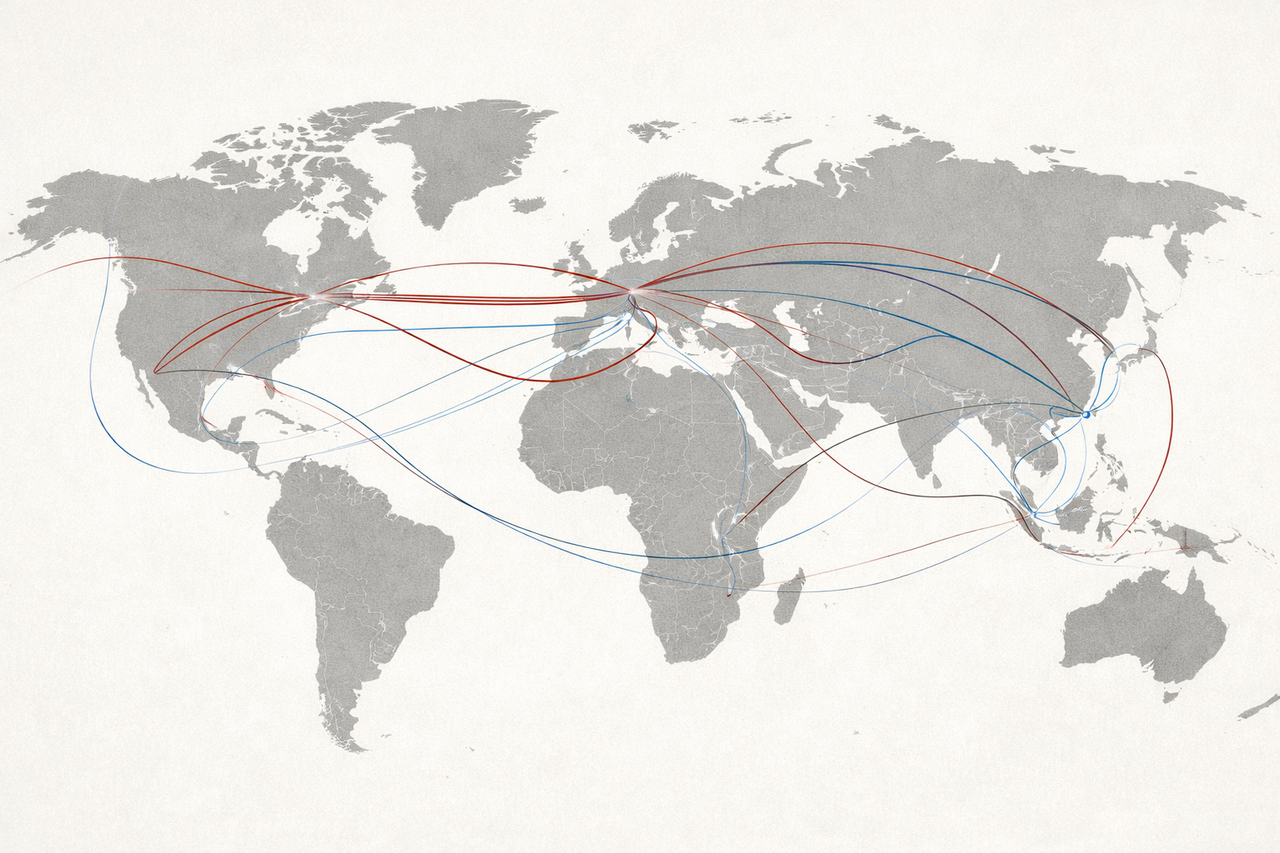
Trade Network
The conventional framing of the arms trade as a marketplace, in which buyers and sellers transact at arm's length on the basis of capability and price, is analytically inadequate to the reality of how weapons actually move across borders and what those movements accomplish politically. Arms transfers are instruments of statecraft as much as they are commercial transactions. The states that dominate the supply side of the global arms trade, the United States, Russia, France, the United Kingdom and a rising tier of second-order exporters including South Korea, Germany, Israel and Turkey, do not make export decisions on commercial criteria alone. They make them on a complex calculation that weighs strategic relationship building, industrial base sustainability, geopolitical influence projection and diplomatic signalling simultaneously. The client states that receive advanced military systems acquire not merely hardware but a sustained relationship with the supplier state that shapes their procurement choices, their military doctrine, their alliance orientation and their foreign policy behaviour for decades. Understanding this is the beginning of understanding the arms trade as a system rather than a market.
Demand for arms is widespread but geographically concentrated in ways that reflect the distribution of security threats, strategic competition and available financing rather than population size or economic development. The Middle East has consistently been the largest importing region in the contemporary period, accounting for approximately 27 per cent of global arms imports in the 2019-2023 interval, driven primarily by the Gulf states' sustained procurement programmes and by Israel's continuous modernisation cycle. The combination of high hydrocarbon revenues, acute threat perceptions regarding Iran, the requirements of the Yemen conflict and competitive procurement dynamics within the Gulf Cooperation Council has sustained Middle Eastern arms import volumes at levels that would be extraordinary by any historical comparison. Saudi Arabia alone was the world's largest arms importer in the 2019-2023 period, accounting for approximately 9 per cent of total global imports.
South and East Asia together represent the second major demand cluster, accounting for approximately 33 per cent of global imports, driven by India's sustained modernisation programme, the competitive dynamic between India and Pakistan, China's defence industrial development reducing but not eliminating its import requirements, and the accelerating procurement programmes of states across the Indo-Pacific responding to China's expanded military footprint. India has been the world's largest arms importer for much of the past two decades, a position reflecting both its large force structure and the relative underdevelopment of its domestic defence industrial base, though the government's Make in India defence policy has progressively increased the share of domestic procurement. Europe's share of global arms imports has risen sharply since 2022, driven by NATO allies responding to the Ukraine conflict with the largest military procurement surge in the post-Cold War period.
East
The dependency relationships created by arms transfers are among the most durable in international relations, outlasting governments, surviving diplomatic crises and persisting through changes in strategic alignment that would sever most other bilateral relationships. When a state purchases a major weapons platform, it purchases not merely the hardware but the entire ecosystem required to sustain it: training programmes for operators and maintainers, spare parts supply chains, technical support contracts, software upgrade access, ammunition resupply arrangements and the institutional relationships between the client state's military and the supplier's defence industrial base and armed forces that develop through years of sustained engagement. These dependencies are structural features of advanced military systems, not incidental complications. They are, from the supplier's perspective, valuable features, because they create ongoing revenue streams, sustained bilateral engagement and leverage that can be applied across the broader bilateral relationship.
The clearest contemporary example of this dependency dynamic playing out in real time is the situation of states that procured Russian military systems before 2022 and have since found themselves unable to maintain, upgrade or sustain those systems due to the combination of Western sanctions on Russia, Russian export capacity constraints and the reputational consequences of operating equipment whose battlefield limitations were comprehensively exposed in Ukraine. Egypt, Algeria, India, Vietnam and several other significant Russian equipment operators face varying degrees of this constraint. Their responses, ranging from India's accelerated diversification toward US, French and Israeli systems to Egypt's quiet enquiries about alternative sources for its large fleet of Russian aircraft, are reshaping the global arms trade network in ways whose full consequences will take a decade to fully register in SIPRI's transfer data.
When a state purchases a major weapons platform, it purchases not merely the hardware but the entire ecosystem required to sustain it. These dependencies are not incidental complications. From the supplier's perspective, they are the most valuable feature of the transaction.
The Meridian Intelligence Desk · April 2026Arms transfers cluster into recognisable regional network patterns, each shaped by specific security architectures, supplier competition dynamics and the procurement preferences of dominant regional powers whose choices influence the options available to smaller neighbours and partners.
Access to advanced military systems depends not only on political eligibility and technical capability but on financing. The cost of modern major weapons systems is substantial: a single F-35A fighter costs approximately $80 million at current production rates; a Eurofighter Typhoon costs broadly similar amounts; a modern diesel-electric submarine costs between $500 million and $1.5 billion depending on the specification. For the majority of states that purchase these systems, the acquisition cost is a significant fiscal commitment that requires either dedicated defence budget allocation over multiple years or external financing support. This financing dimension of the arms trade is as strategically significant as the technology transfer dimension, because it determines which states can participate in the top tier of the global arms market and shapes the bilateral relationships through which procurement is structured.
The United States Foreign Military Financing programme, which provides grants and concessional loans to eligible foreign governments to purchase US defence equipment and services, distributed approximately $6.1 billion in fiscal year 2024, with the largest recipients concentrated in Israel, Egypt, Jordan and a range of Indo-Pacific and Eastern European allies. FMF grants are not philanthropy. They are strategic investments in the procurement relationships that keep client states within the US defence industrial and alliance ecosystem, ensuring that the next generation of procurement decisions follows the same supplier relationships as the current generation. China's defence financing model, offering arms packages bundled with infrastructure financing, resource extraction agreements and diplomatic alignment signals, represents a competing framework whose terms are often more accessible to states with lower credit ratings and fewer alternative financing options but whose conditionality is less transparent and potentially more politically consequential than the US model.
Turkey's emergence as a significant arms exporter, concentrated primarily in its Bayraktar drone family, represents one of the most strategically interesting developments in the global arms trade network of the past five years. The Bayraktar TB2's combat performance in Ukraine, Libya, Nagorno-Karabakh and Ethiopia generated a wave of export demand that Baykar, the privately held Turkish company that manufactures it, has struggled to fully satisfy. More than 30 countries have procured or expressed serious interest in TB2 systems, including states across Africa, the Middle East, Central Asia and Europe. The drone's combination of relatively low unit cost (approximately $5 million per aircraft), proven combat effectiveness and Turkish willingness to sell without the human rights conditionality that constrains European and US export decisions has created a new competitive segment in the medium-altitude long-endurance drone market. Turkey has used these sales to expand its diplomatic footprint in regions where it had previously had limited strategic presence, demonstrating how a single successful weapons system can reshape the geometry of a state's influence network within a very short period.
The formal arms trade documented by SIPRI and national export licensing systems represents only a portion of total global weapons flows. Secondary markets, in which equipment is resold or transferred between states after its original acquisition, diversion networks in which weapons procured by one actor end up in the hands of another, and informal supply chains operating through grey and black market channels all contribute to the actual distribution of military capability in ways that are significantly harder to track and that frequently undermine the strategic and humanitarian objectives of formal export control regimes.
The Ukraine conflict generated the most visible recent example of deliberate secondary market management at scale, as Western governments transferred large quantities of equipment from their own inventories and from third countries' stocks to Ukraine, accelerating the depletion of legacy Cold War-era systems from multiple European militaries while simultaneously creating demand for modern replacement systems. The diversion problem operates in the opposite direction in many other contexts: weapons supplied to nominally reliable partners end up in the hands of third parties through capture, resale or deliberate diversion. The MANPADS proliferation problem, in which man-portable air defence systems originally supplied to Afghan, Libyan or Syrian opposition groups have subsequently appeared in the inventories of jihadist organisations across multiple regions, illustrates the systemic nature of diversion risk in supply chains that pass through conflict environments or through states with limited inventory management capacity. No export control system currently operating addresses this risk adequately, because the political relationships that enable the original supply are the same relationships that constrain the accountability mechanisms that might prevent diversion.
The arms trade functions as a network because changes in one part of the system propagate through interconnections to affect other parts in ways that are not always predictable and that frequently produce consequences whose strategic significance exceeds the immediate transaction that triggered them. Russia's reputational collapse as an arms exporter following the Ukraine invasion is reshaping procurement decisions in Africa, South Asia and the Middle East simultaneously, creating commercial opportunities for French, South Korean, Turkish and Israeli exporters that will translate into new bilateral relationships, new dependency structures and new vectors of geopolitical influence over the next decade. The Abraham Accords' normalisation of Israel-Gulf relations has opened procurement corridors that did not previously exist, with UAE interest in Israeli air defence systems and intelligence technology creating a new node in the Middle Eastern arms network that reshapes the region's security architecture in ways that extend well beyond the weapons themselves.
The acceleration of European rearmament is creating demand that the European defence industrial base cannot fully satisfy on its own timescales, drawing in South Korean, US and Israeli suppliers in ways that will diversify the supply side of the European arms network and reduce the relative weight of France and Germany as intra-European suppliers. Each of these dynamics affects the others: South Korea's expanded European presence strengthens its negotiating position in Asian markets; France's Rafale export success in the Middle East and Asia funds industrial capacity that makes it more competitive in European procurement competitions; the US's consolidation of F-35 as the dominant NATO air platform creates interoperability pressures on non-F-35 operators that gradually constrain their procurement alternatives. The network effect is that the arms trade continuously reorganises itself in response to security events, industrial developments and diplomatic realignments, but does so in ways that preserve and reinforce the fundamental structural feature that defines it: the concentration of supply in a small number of powerful states whose weapons create enduring dependencies in the states that buy them.
The arms trade continuously reorganises itself in response to security events and diplomatic realignments. But it does so in ways that preserve its fundamental structural feature: the concentration of supply in a small number of states whose weapons create enduring dependencies in the states that buy them.
The Meridian · April 2026The global arms trade is not a collection of transactions. It is an interconnected system whose structure shapes both conflict and cooperation across every region of the world. Exporters, client states, financing mechanisms, regional alliance architectures and informal secondary markets interact to produce a continuously evolving network of military dependencies and influence relationships that outlast the governments that created them and persist through the political changes that might be expected to disrupt them.
The flow of weapons is also a flow of influence. And influence, once established through the structural dependencies that advanced military systems create, tends to persist long after the weapons themselves have become obsolete. That is the essential insight that distinguishes understanding the arms trade as a network from understanding it as a marketplace. Everything else is noise.
April 2026 · War Economy Edition