The Budget Deficit State: An Autopsy of Mauritius Since 1968
The framing essay of the series. It argues that Mauritius diversified into several externally constrained pillars, leaving the State budget to absorb the unresolved strain.
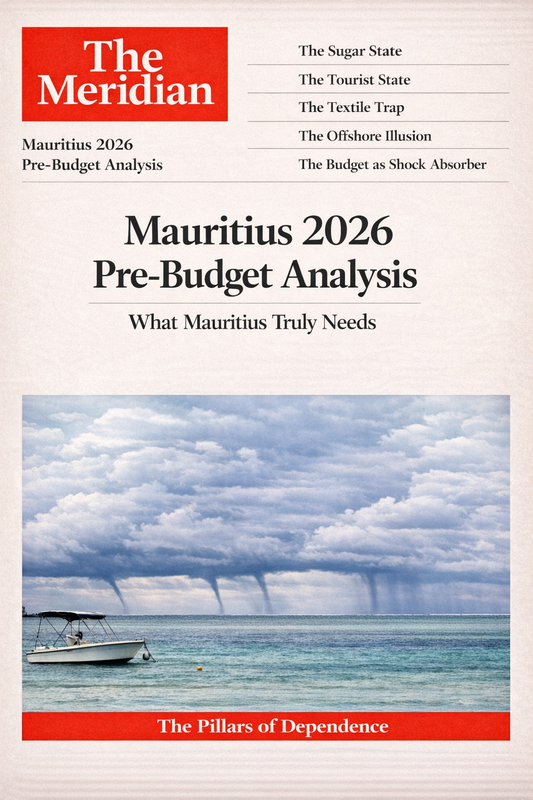
What Mauritius Truly Needs.
A reference document on economy, power, people and the state.
What Mauritius Truly Needs.
This special report examines Mauritius as a post-independence economy that diversified without fully securing command over its own terms of accumulation. The series investigates sugar, tourism, textiles, offshore finance, the ocean economy, household stress, productive depth, budget dependence and political preservation, asking not only how the model was built, but why it remained so difficult to change.
The framing essay of the series. It argues that Mauritius diversified into several externally constrained pillars, leaving the State budget to absorb the unresolved strain.
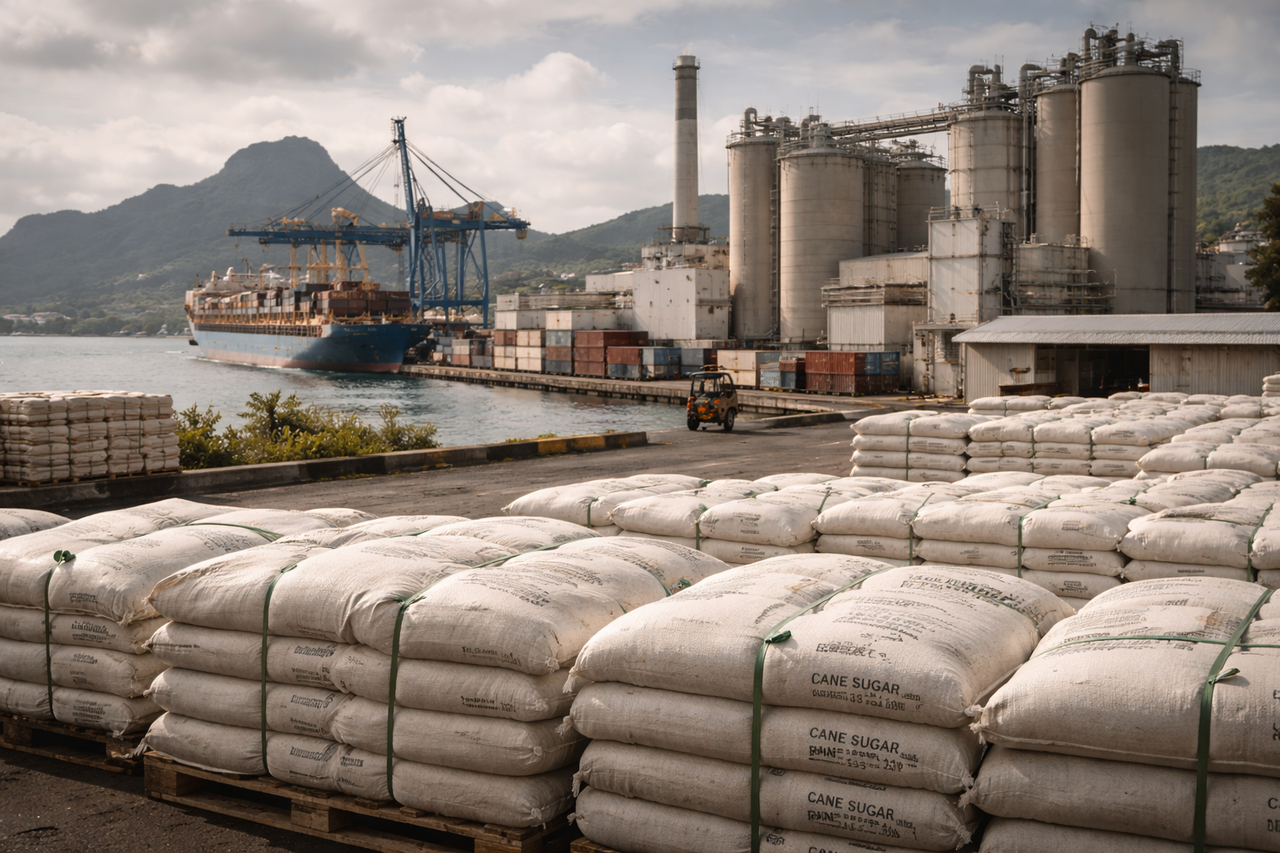
How Mauritius preserved a high-cost, price-taking sugar sector through protection, policy cushioning and political continuity long after its strongest commercial logic weakened.
An inquiry into how Mauritius built foreign exchange through tourism while remaining dependent on foreign demand, aviation economics, imported inputs and external calm.
A study of export manufacturing under external discipline: imported inputs, foreign buyers, wage pressure and industrial depth that never fully matured into sovereignty.
How financial prestige expanded under rule systems Mauritius benefited from but did not control, raising questions about depth, sovereignty and resilience.
How Mauritius turned to the sea as a new frontier of growth, building a maritime position that remains commercially real but structurally dependent on foreign fleets, imported fuel and external trade routes.
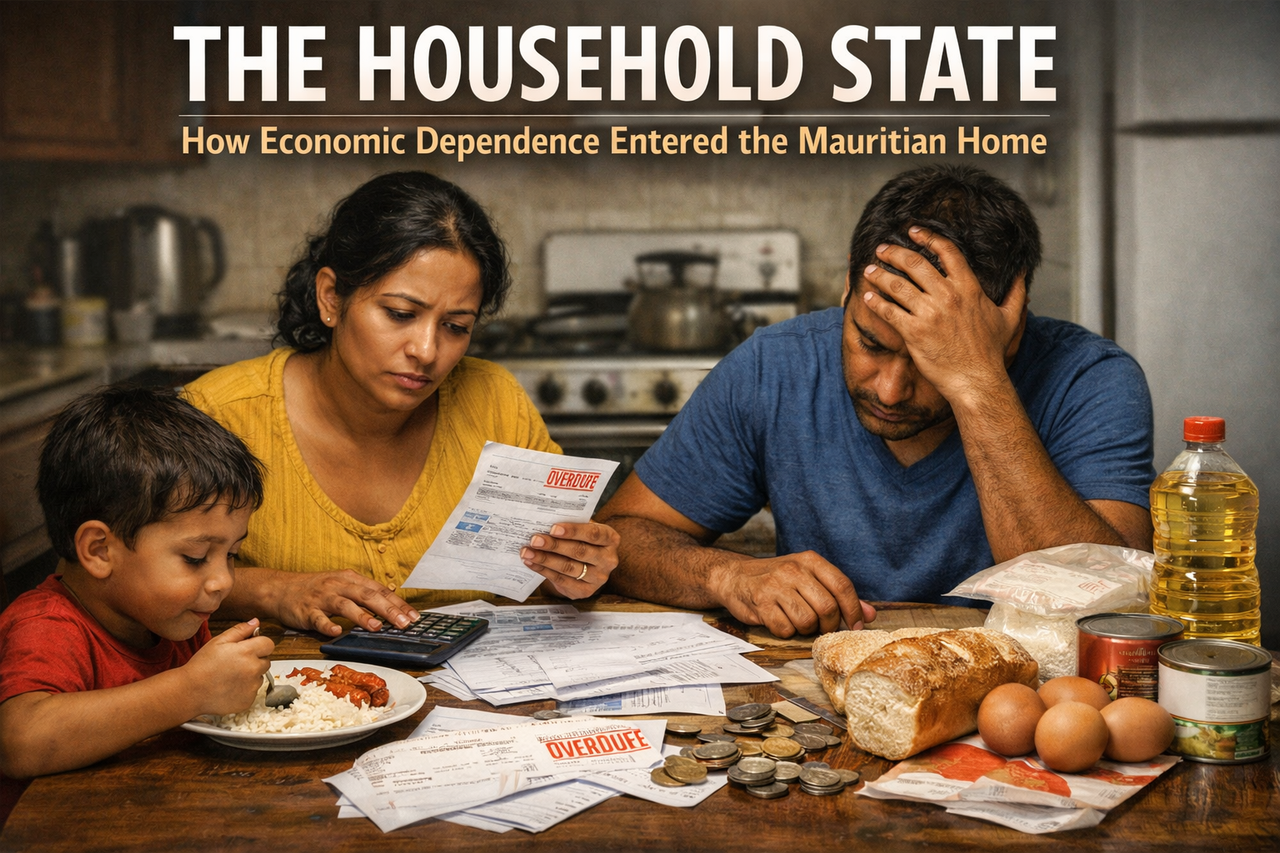
The cost of dependence as it enters the home: prices, wages, fuel, rent, food, housing pressure and the shrinking space between income and survival.
Why Mauritius still imports what it could produce, and why better planning, deeper industry and broader local supply were repeatedly deferred or avoided.
A closer reading of how subsidies, public spending, transfers and state employment absorbed the contradictions the growth model could not resolve on its own.
Why governments preserved the structure more often than they transformed it, and how political continuity, protection and reform avoidance became part of the model.
The closing argument of the report: how dependence, political preservation, procurement opacity, institutional bloat and delayed reform reproduce the same cycle.
A reference document on economy, power, people and the state.
Mauritius Real Outlook 2024-2029 delivers systematic, empirically grounded analysis of the Mauritian state across the governing mandate inaugurated by the November 2024 general election. The report is designed as institutional architecture for investors, institutions, researchers and citizens demanding accountability. Its sections below examine the state, rule of law, labour, production, external dependence and strategic choice across the full policy cycle.
This section establishes the analytical foundations of the Mauritius Real Outlook. It defines the governing mandate, methodological discipline, macro-fiscal architecture, and political-economic structures shaping all subsequent outcomes.
A consolidated diagnosis of structural stagnation, institutional inertia, and policy limits shaping Mauritius through the current electoral mandate.
Defines evidence tiers, data discipline, and analytical boundaries governing the Outlook.
Establishes the political time horizon and governing legitimacy underlying the analysis.
Reads stated policy intent against fiscal capacity, structural limits, and execution risk.
Explains the arithmetic of debt, growth, inflation, and state sustainability.
Maps shock transmission channels and contingent liabilities facing the Mauritian state.
Examines how ministries, audits, and systems function beyond formal budget announcements.
Links electoral incentives, political finance, and governance outcomes.
Dissects how value is created, captured, and distributed across the economy.
Examines how firm formation, scaling, and competition are constrained by rents and structural bias.
Identifies which firms and ownership structures genuinely employ the country, and how corporate concentration shapes wages, precarity, and labour outcomes.
Interprets the findings in terms of national choices, risks, and institutional responsibility.
This section examines the institutional foundations of the Mauritian state: policing, justice, parliamentary oversight, electoral integrity, media power, and democratic legitimacy.
An examination of investigative capacity, prosecutorial independence, and the structural limits of accountability in high-profile corruption and governance cases.
A structural analysis of legislative effectiveness, oversight quality, and the gap between parliamentary form and governing substance.
How Mauritius' hybrid French-English legal system shapes rights, enforcement, reform inertia, and institutional complexity.
Court capacity, judicial workload, systemic delay, and the structural limits that constrain justice delivery beyond formal constitutional guarantees.
A detailed inquiry into police power, custodial accountability, complaint mechanisms, and systemic stress within the justice chain.
How repeated institutional failures, selective enforcement, and opacity weaken public trust in the justice system over time.
Electoral administration, political norms, contestation dynamics, and the boundaries between democratic choice and structural advantage.
How Mauritius scores across global democracy indices and what those scores conceal about lived democratic experience.
Survey-based trust, participation, legitimacy, and the widening gap between institutional stability and public confidence.
Ownership structures, editorial incentives, political pressure, and the invisible boundaries of public discourse.
An institutional map of appointments, remuneration, diffusion of responsibility, and the hidden governance costs of the board economy.
This section examines how Mauritian society functions beneath macroeconomic aggregates: labour conditions, wage formation, household stress, demographic change, and human capital erosion.
Examines formal labour protections, leave structures, enforcement gaps, and how social protection operates in practice.
A ground-level assessment of hours, precarity, enforcement failures, and the divergence between legal standards and lived experience.
Analyses how economic value is split between capital and labour, and why wage growth remains structurally constrained.
Identifies which firms genuinely employ the country, revealing concentration, dependency, and employment fragility.
Tracks inflation transmission, household budgets, coping mechanisms, and rising economic pressure across income groups.
Examines household debt, credit costs, interest sensitivity, and systemic exposure within the banking sector.
Evaluates labour adjustment mechanisms, severance systems, and the limits of shock absorption.
Assesses education outcomes, skills mismatch, productivity drag, and long-term competitiveness risks.
Dissects wage growth, allowances, overtime practices, and reform inertia within the public sector.
Explores staffing shortages, service gaps, cost structures, and the structural penalties of distance.
Analyses ageing trends, labour force contraction, dependency ratios, and fiscal-social implications.
Tracks confidence in institutions, social mood, perceived fairness, and the erosion of civic trust.
This section analyses how Mauritius produces value, allocates capital, trades with the world, and absorbs external shocks in a small, open island economy.
An examination of how value is produced, captured, and distributed across sectors, firms, and income groups.
Why firm creation and scaling are structurally constrained by rent concentration and capital bias.
A reality check on Mauritius' service exports beyond branding, rankings, and policy narratives.
Explores why export growth has not translated into sustained productivity or wage gains.
Dissects the gap between international rankings and lived regulatory complexity for firms.
Assesses exposure to external supply shocks and the limits of import substitution strategies.
Maps structural trade imbalances and their implications for long-term economic sovereignty.
Explains how FX management shapes inflation, imports, reserves, and policy space.
Tracks how goods, capital, labour, and profits circulate through Mauritius' open economy.
Analyses fuel dependence, energy costs, and the feasibility of self-sufficiency pathways.
Separates blue economy potential from fiscal, ecological, and governance realities.
Quantifies physical climate vulnerabilities and their economic transmission channels.
This section closes the Mauritius Real Outlook. It translates analysis into responsibility, documents the evidentiary foundations of the work, and maps the strategic choices available to policymakers, institutions, firms, and citizens.
Interprets the findings of the Outlook in terms of national responsibility, institutional decision-making, and long-run risk management across state, business, and society.
Documents the datasets, methodologies, validation standards, and transparency principles underpinning the Outlook's analysis and conclusions.
Maps plausible strategic trajectories for Mauritius, identifying trade-offs, risk thresholds, and decision points shaping the country's medium-term future.
This final section provides the methodological backbone of the Mauritius Real Outlook. It documents data sources, tracks version history, and defines technical terms.
Explains composite indices, methodological assumptions, and construction logic.
Tracks revisions, updates, and evolution, reinforcing auditability and living-document discipline.
Formal definitions ensuring precision, consistency, and interpretive clarity across the Outlook.