A Note from the Editor
An introduction to the February 2026 issue — what we are tracking, where risks cluster, and the institutional logic behind this month’s analysis of power, capture and state capacity.
Read the letter →

An introduction to the February 2026 issue — what we are tracking, where risks cluster, and the institutional logic behind this month’s analysis of power, capture and state capacity.
Read the letter →

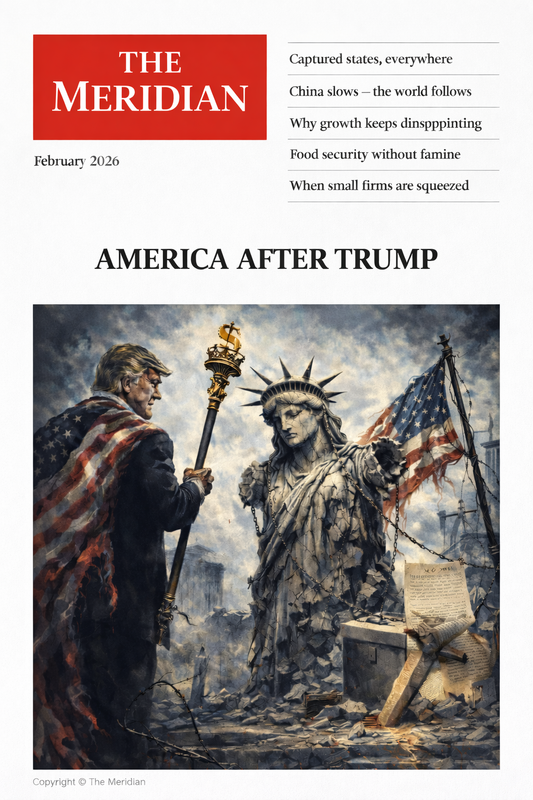
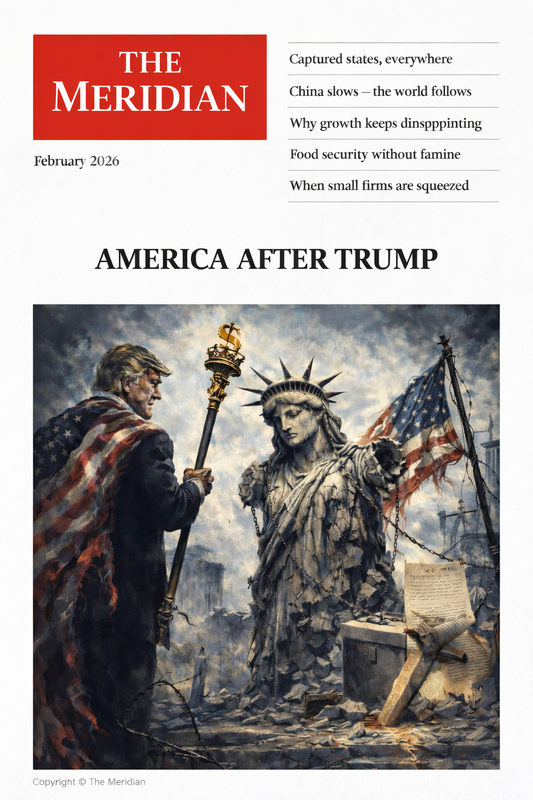
Private power, public capacity and the erosion of institutional balance in the United States — a study of democratic precedent in transition.

Economic positioning, political transitions and the inner workings of state capture in a small but strategically exposed island economy.

Elections, governance risk and five flashpoints where institutional stress and geopolitical competition intersect most sharply.

Sovereignty, military presence and the strategic logic beneath the Chagos question.

Empire management, proxy logic and the operating grammar of great-power rivalry in 2026.

Market access, regulation and geopolitical positioning inside a consequential trade negotiation.

A map of fiscal pressure, institutional erosion and the signals that states are losing policy coherence.

Networks, patronage and administrative control as the quiet machinery of capture.

Why escaping a rentier state is difficult even when reformers know what must change.

Oil, patronage and the inherited structures of a deeply captured state.

Elite bargaining, resource rents and continuity beneath surface-level political change.

Why electoral victories no longer guarantee effective governance in systems shaped by incentives and institutional asymmetry.

Two growth models, one decade of divergence and sharply different execution capacities.

High potential and persistent underperformance in one of the world’s most consequential regions.

Structural constraints, weak productivity and the reasons expansion is slowing almost everywhere.

Economic interdependence, deterrence and the logic of managed rivalry.

Trade, technology and quiet cooperation beneath the rhetoric of competition.

Liquidity, network effects and why reserve dominance persists despite the rhetoric of dedollarisation.

Gas, renewables and the infrastructure gap between resource potential and real access.

Tariffs, subsidy politics and the deep economics of electricity pricing in emerging markets.

How states restore trust after macroeconomic failure, default and institutional breakdown.

Data localisation, digital sovereignty and the fragmentation of the once-universal internet.

Strategic autonomy, hedging and the return of flexible positioning in Global South diplomacy.

A look at why total war is not only catastrophic militarily, but economically near-impossible in an interdependent world.

The erosion of norms, multilateral restraint and the widening space for selective legality.

Diet, diabetes and the nutrition transition inside a small island economy under modern food pressures.

The quiet crisis of chronic malnutrition, unstable supply chains and hidden vulnerability beneath headline hunger data.

The credit trap, regulatory drag and financing gaps holding back the middle of the economy.
Economic realism beyond textbooks. A sharper framework for understanding how markets, power and institutions actually work in the world as it is, not as it is described.
How incentive systems shape behaviour predictably, why well-meaning actors reproduce capture, and why reform so often collapses into disappointment.
Why markets have never been free, why states quietly structure every major market, and how the myth distorts policy from finance to industrial strategy.
An introduction to the Meridian framework: how institutional design determines who wins, who loses, and how economies are shaped by power before prices.