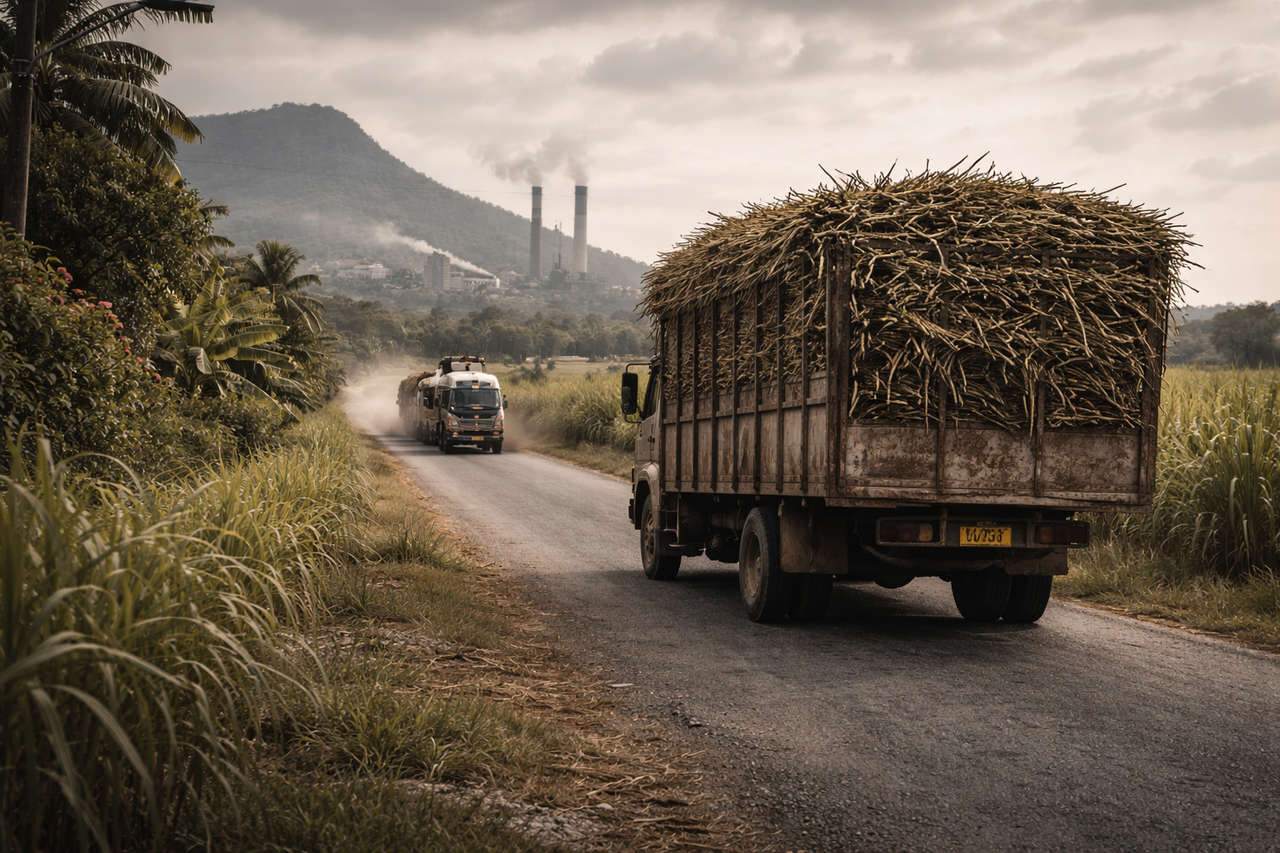
The sugar harvest does not begin in a spreadsheet. It begins in a field, with a cane cutter, a loading truck and a road to the mill. It is a physical operation and its costs are physical costs. What the cane farmer and the transport operator pay for diesel, electricity and equipment maintenance determines whether the harvest is financially viable at the farmgate before the first ton of sugar is weighed, exported or sold at a price set by a market that is not in Mauritius and does not consult it. That is the basic arithmetic of the Mauritian sugar sector. This year, that arithmetic has been complicated by an energy shock that struck the island's cost base at exactly the wrong point in the agricultural calendar.
The numbers documenting this pressure are not hypothetical. Diesel rose from Rs 58.95 to Rs 64.80 per litre following the March price adjustment, a jump of approximately 10 percent in a single revision. The Central Electricity Board, which generates and distributes most of the island's electricity and relies heavily on imported heavy fuel oil, was already operating under documented supply pressure before the Strait of Hormuz crisis intensified in March 2026. The government's own emergency committee acknowledged that successive fuel procurement rounds had cost the state approximately Rs 500 million more than budgeted per shipment, with two such shipments falling due within a fifteen-day window. That is roughly Rs 1 billion in unplanned fuel expenditure over a fortnight, against a backdrop of a fiscal deficit already exceeding 9.3 percent of GDP and a gross public sector debt ratio of 86.5 percent, both figures that exceed the statutory ceilings Mauritius has set for itself by law.
Sugar is discussed in Mauritius primarily in terms of land use, labour, trade policy and EU market access. These are the right conversations in a normal year. This is not a normal year. In 2026, the primary constraint on the viability of the cane harvest is energy cost, because energy cost is the variable that has moved most sharply and most unpredictably in the weeks immediately before harvest begins.
The mechanics are straightforward and rarely explained with sufficient clarity in public debate. Mechanical cane cutting, which has largely replaced manual cutting across most of the island's planted area, requires diesel-powered machinery. Cane transport to mills uses diesel trucks operating over sometimes difficult terrain. The mills themselves are among the most energy-intensive industrial operations on the island, requiring sustained heat and electricity for crushing, evaporation and crystallisation. The electricity the mills draw from the grid comes partly from heavy fuel oil generation through the CEB and partly from bagasse, the fibrous residue of crushed cane that is burned as fuel. Bagasse provides a degree of energy self-sufficiency during the harvest period, but it does not eliminate external energy dependence. It reduces it. The residual dependence on diesel and grid electricity means that every significant upward movement in fuel prices directly raises the operational cost of running a harvest that, on the revenue side, sells its output at a price set by global commodity markets that have no interest in the cost structure of a small island mill in the Indian Ocean.
Sugar revenue is set globally. Sugar costs are set locally. When energy prices move, only one side of that equation responds. The margin is what absorbs the difference. And right now, the margin is under serious pressure.
Vayu Putra · The Meridian · April 2026This cost-revenue mismatch is the structural problem that every Mauritian sugar harvest carries as a baseline. What makes 2026 different is not the existence of the mismatch but its severity. Diesel has risen by approximately 10 percent in a single adjustment. Electricity generating costs have risen with heavy fuel oil prices. The CEB, which was already under supply pressure before the Hormuz disruption, is now navigating an environment where each new procurement round is more expensive than the last. The operational cost environment for the 2026 harvest is materially worse than it was twelve months ago, and it is worsening on a timeline that does not accommodate the agricultural calendar's own requirements.
The government's fiscal position going into this period is not a minor background detail. It is the central constraint on every option available for managing the harvest cost problem. A government with significant fiscal reserves and low debt can absorb an energy shock by subsidising affected sectors while it waits for global prices to stabilise. Mauritius is not in that position. Its gross public sector debt has already exceeded the 60 percent of GDP ceiling that its own Public Finance Management Act establishes as a maximum. Its fiscal deficit for the most recent completed fiscal year reached 9.3 percent of GDP, against a statutory objective of fiscal consolidation. Its pension deficit stands at Rs 238.9 billion in accumulated unfunded liability. These are not speculative risk factors. They are documented figures from the government's own reporting and from the National Audit Office's published assessments.
Against that background, the arrival of approximately Rs 1 billion in unplanned heavy fuel oil expenditure within fifteen days is not a manageable inconvenience. It is a fiscal signal. It tells the government, the Central Electricity Board and any sector planning for harvest logistics that the environment in which they are operating is materially tighter than the one assumed in the budget, and that additional pressures from harvest season will arrive on top of a fuel cost structure that has already moved significantly beyond its planned parameters.
The dangerous interaction in 2026 is not simply that harvest is expensive or that fuel is expensive. It is that harvest is fuel-intensive, fuel is more expensive than budgeted, the budget is already in deficit beyond its statutory ceiling, the state is already absorbing unplanned fuel costs, and no mechanism exists to raise the sugar price to compensate. All five of these conditions are simultaneously true. Each one individually would be manageable. Together, they represent a structural pressure point that the Mauritian agricultural and energy economy has not faced in this combination before.
When domestic costs rise and external revenue is fixed, the adjustment must happen somewhere. In the Mauritian sugar economy, there are three places it can land, and none of them is comfortable.
The first is producers and transporters. If the state does not intervene, growers and transport operators absorb the higher fuel cost from within their own margins. For well-capitalised operations with diversified income streams, this is painful but survivable. For smallholder growers who depend on cane income as a primary revenue source and operate on thin margins at normal fuel prices, a 10 percent diesel increase without compensating revenue adjustment is not a margin compression. It is a solvency risk. The political economy of the Mauritian cane sector, which involves a large number of small planters with significant collective political weight, makes this option extremely difficult to sustain without social and political consequences.
The second is the state. The government can intervene through direct payments, administered cost relief, fuel price caps or some form of agricultural support. This is the historically familiar response in Mauritius when the cane sector faces acute stress. But the state intervening in 2026 is a state that is already beyond its statutory debt ceiling, already managing an unplanned fuel cost increase of approximately Rs 1 billion, and already carrying the accumulated weight of a pension deficit and a pattern of fiscal expansion that the most recent National Audit Office reports document in considerable and uncomfortable detail. Intervention is not impossible. But each additional intervention deepens a structural fiscal problem that has no easy exit path.
The third is structural change: accelerating the transition away from fuel-intensive harvest practices, investing in energy storage and renewable generation to reduce electricity cost exposure, diversifying the revenue base so that sugar is a smaller share of the agricultural economy and its energy cost is a smaller share of the national fiscal risk. This is the right answer. It is also not an answer that arrives in time for the 2026 harvest. Structure cannot be changed between the moment of an energy shock and the beginning of cane cutting season.
When domestic costs rise and external revenue is fixed, the adjustment must happen somewhere. The state, the grower and the taxpayer are the only candidates. All three are already under pressure. That is why this harvest season is different from every recent one that preceded it.
Vayu Putra · The Meridian · April 2026The harvest pressure matters beyond agriculture because it reveals the full structure of Mauritian economic vulnerability in one concrete and temporally specific event. Sugar season crystallises in a single agricultural operation everything that The Meridian has documented about the island's relationship with imported energy, external pricing, fiscal constraint and the limits of state cushioning. It is the point at which the abstract structural arguments about dependency become specific operational problems with real costs in real rupees paid by real people.
Mauritius is not unique in facing this problem. Small island developing states across the Indian Ocean, the Caribbean and the Pacific face the same structural exposure: externally priced commodity exports, fully imported energy, thin fiscal margins and a political economy that demands state cushioning of price shocks that the state cannot sustainably afford to cushion indefinitely. What makes Mauritius particularly instructive is that it has the institutional infrastructure, the analytical capacity and the political stability to think carefully about these problems and to make genuinely strategic choices about them. The question is whether the 2026 harvest season becomes a catalyst for those choices or whether it becomes another round of emergency management that defers them again.
- Oil shock raises fuel prices externally.
- Diesel reprices upward at the pump.
- Every stage of harvest becomes more expensive.
- Sugar revenue does not rise to compensate.
- The state is asked to intervene with a depleted budget.
- Structural reform is the answer that arrives too late for this season.
The Mauritius Trap established the structural dependence: sugar, tuna, subsidies and energy all locked into externally priced systems that domestic policy cannot easily escape. The Energy Crisis mapped the global shock arriving from the Strait of Hormuz.
This article shows where those two forces meet: at the cane field, the mill gate and the State Trading Corporation's fuel invoice. Abstract structural analysis becomes concrete operational pressure. The series will continue with the labour dimension and the wider question of what genuine structural reform would require.
Mauritius is entering its 2026 cane harvest season at a moment when every dimension of the cost environment has moved against it simultaneously. Diesel is more expensive. Electricity is more expensive to generate. The CEB was already supply-constrained before the Hormuz shock intensified the pressure. The government has already spent approximately Rs 1 billion more than planned on fuel procurement in a single fortnight. The fiscal deficit and public debt both exceed the country's own statutory ceilings. And the global sugar price, which is the only variable that could rescue the margin arithmetic from the revenue side, remains entirely outside Mauritius' control.
This is not a crisis in the conventional sense. Mauritius is not collapsing. Its institutions are functioning. Its harvest will proceed. But the conditions under which it proceeds in 2026 reveal, with unusual clarity, the depth of the structural vulnerability that has been built into the Mauritian economic model over decades of managed dependency. Energy is imported. Costs are domestic. Revenue is external. The state stands between them. And the state, right now, is running out of the fiscal room that role requires.
Sugar season is no longer just an agricultural event. It is the 2026 version of an old and unresolved question: who pays, in the end, for an economy built on a cost structure it does not control and a revenue structure it cannot influence?
April 2026 · Mauritius Dispatch · Political Economy