America After Trump: Power, Precedent and the End of Democratic Illusions
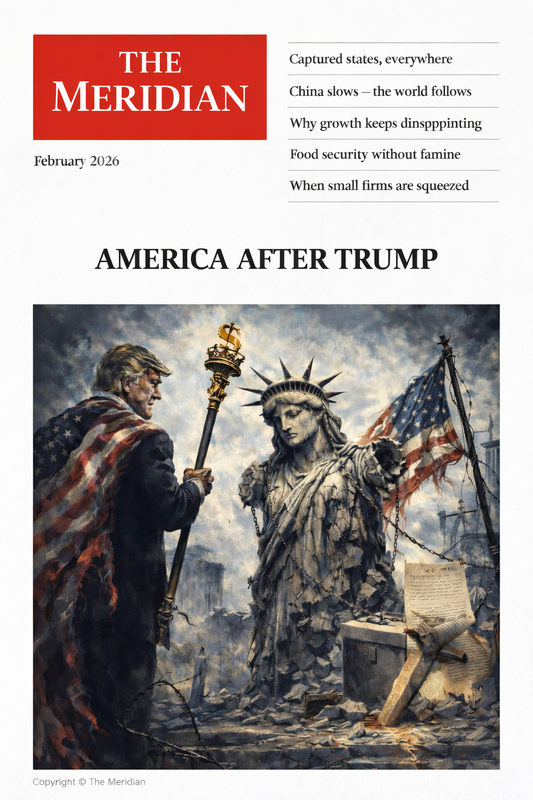
Trump as symptom, not origin
It is tempting to treat Trump as the cause of America's troubles. This is psychologically comforting. It suggests that once he leaves the stage, the system will right itself. But this interpretation mistakes a catalyst for a cause. Long before Trump, the United States had entered an era of extreme inequality. The share of national income flowing to the top decile rose sharply from the early 1980s onwards. Wealth concentration accelerated. Market power consolidated across technology, finance, pharmaceuticals, agribusiness and defence. Political campaigns became increasingly dependent on large donors. Regulatory agencies were steadily weakened, captured or defunded.
These shifts hollowed out the social contract. For large sections of the population, wages stagnated whilst costs rose. Communities deindustrialised. Public services thinned. The promise that effort would be rewarded became less credible. In this environment, trust in institutions eroded, not because citizens suddenly rejected democracy, but because democracy increasingly failed to deliver. Trump's appeal lay in his ability to channel this resentment whilst redirecting it away from its structural origins. He offered spectacle instead of reform, grievance instead of redistribution, identity instead of institutional repair. Yet the anger he mobilised was real. It had been accumulating for decades in a political economy that privileged capital over labour and private influence over public accountability.
The erosion of democratic capacity
Democracy depends not only on elections, but on state capacity: the ability of public institutions to design, implement and enforce policy in the public interest. In the United States, that capacity has quietly weakened. Congress has ceded authority to the executive whilst simultaneously paralysing itself through polarisation. Regulatory agencies face constant legal challenge, political interference and resource constraints. Courts are increasingly drawn into political conflict, undermining their perceived neutrality. The civil service has been politicised and hollowed out, making long-term governance harder.
Trump did not create these trends, but he tested their limits. His willingness to ignore conventions, pressure institutions and personalise power revealed how fragile many constraints had become. That some of his efforts were resisted, by courts, by officials, by markets, should not obscure the fact that many norms bent rather than held. The danger lies in precedent. Once a line is crossed without consequence, it becomes easier for others to cross it again. Power ratchets outward; restraint becomes optional. This is how democratic erosion occurs in advanced systems: not through abrupt collapse, but through cumulative weakening.
Law as instrument, not boundary
One of the most damaging legacies of the Trump era has been the transformation of law from a shared framework into a contested weapon. Legal processes have increasingly been used not to resolve disputes, but to signal loyalty, intimidate opponents or delay accountability. This erosion matters because law is not merely procedural; it is foundational. In stable democracies, law functions as a boundary on power, not a tool of it. When legal norms are selectively applied, or openly disparaged, trust collapses, not only in specific rulings, but in the system as a whole.
Trump's repeated attacks on judges, prosecutors and regulators were not simply rhetorical excess. They normalised the idea that legal constraint is illegitimate when it conflicts with political objectives. Even where courts ruled against him, the damage was done: a significant portion of the electorate came to see legal outcomes as partisan rather than principled. America after Trump must confront a sobering reality: restoring respect for law will require more than replacing leaders. It will require rebuilding confidence that rules apply evenly, that institutions act independently, and that power is accountable regardless of who wields it.
Rise of private power: Large corporations now command resources, data, influence and mobility that rival states. Financial markets discipline governments more swiftly than voters. Technology platforms shape information flows, public discourse, political mobilisation. Transformation since 1980s.
Democratic implications: When governments depend on private actors for investment, employment, innovation, capacity to regulate diminishes. Political campaigns rely on large donors, agendas narrow. Public services outsourced, accountability blurs.
Trump's paradox: Promised to restore popular control whilst deepening structural conditions that undermine it. Rhetoric attacked corporate elites; policy favoured them (tax cuts, deregulation, weakened enforcement). Result: further entrenchment of private influence. Contradiction remains unresolved.
Inequality and democratic fragility
Economic inequality is not merely a social problem; it is a political one. Highly unequal societies struggle to sustain democratic legitimacy because outcomes diverge too sharply from expectations. In the United States, inequality has reached levels that strain democratic consent. When large segments of the population perceive that the system consistently favours a small elite, trust erodes. Participation becomes cynical. Politics turns negative, focused more on blocking opponents than advancing shared goals.
Trump thrived in this environment, but he did not create it. Nor did his opponents meaningfully reverse it. The deeper challenge for America after Trump is whether it can address inequality without descending into polarisation or paralysis. This will require confronting entrenched interests, reforming taxation, strengthening labour power, and investing in public goods. None of these are easy. All are politically costly. Yet without them, democratic decline will continue, regardless of who occupies the White House.
America and the world: credibility under strain
Trump's impact has not been confined to domestic politics. Internationally, his approach has altered how America is perceived and how its power is exercised. For decades, US leadership rested not only on military and economic strength, but on predictability and commitment to rules. Allies trusted American guarantees because they believed they reflected enduring interests rather than transient impulses. That assumption no longer holds. Trump's transactional approach to alliances, his threats over trade and security, and his open disdain for multilateral institutions have prompted allies to hedge.
Europe has accelerated efforts towards strategic autonomy. Partners in Asia reassess their exposure. Even long-standing relationships are now treated as conditional. The issue is not whether America remains powerful—it does—but whether it is reliable. Power without predictability invites resistance, not cooperation. America after Trump will inherit a world that no longer assumes US leadership is benign or stable. This recalibration is unlikely to reverse quickly. Trust, once lost, is slow to rebuild.
The illusion of restoration
There is a persistent belief in Washington that America can simply "return to normal" after Trump. This belief is mistaken. Norms that depend on voluntary restraint cannot be restored by decree. Institutions weakened by years of neglect do not recover overnight. Social trust, once fractured, does not spontaneously regenerate. Moreover, many of the conditions that enabled Trump's rise remain in place: inequality, concentration of power, media fragmentation, and institutional gridlock. Removing the figure does not remove the forces.
America after Trump will therefore not resemble America before him. The challenge is not restoration, but adaptation: rebuilding democratic capacity under less forgiving conditions. The opposite temptation is fatalism: the belief that American democracy is beyond repair. This too is mistaken. The United States retains significant strengths. Its federal structure disperses power. Its courts, though strained, remain independent. Its states and cities often innovate where national politics stall. Its civil society remains vibrant. Its economy, despite distortions, continues to generate opportunity. Elections still matter. The danger lies not in recognising democratic fragility, but in surrendering to it.
Rebuilding democratic capacity
If America is to emerge stronger after Trump, the focus must shift from personalities to structures. That means confronting private power through antitrust enforcement, regulatory reform and campaign-finance overhaul. It means reducing inequality through progressive taxation, social investment and labour protection. It means restoring the capacity of public institutions to plan, regulate and deliver over the long term. It also means recalibrating expectations. Democracy cannot promise perfect outcomes or permanent consensus. It can promise accountability, correction and inclusion, if its institutions are strong enough to deliver them.
This agenda is neither radical nor nostalgic. It is pragmatic. It recognises that democratic legitimacy depends on performance as much as procedure. America after Trump will be more constrained, more sceptical and more contested than before. Its democracy will be harder to govern and easier to disrupt. But it will not be empty. The country's future depends less on defeating a single figure than on addressing the conditions that made him possible. That task is slow, unglamorous and politically risky. It will not be completed in one election cycle.
Survival is not the same as recovery. Trump did not invent America's dysfunction. He accelerated it, exposed it, and exploited it. The roots lie in structural transformation: the massive rise of private power and inequality since the 1980s. America after Trump will not return to some imagined equilibrium. The age of illusion is over.
The age of illusion is over. What comes next will depend on whether the United States can relearn how to govern itself. That process requires neither nostalgia for what was, nor fatalism about what must be, but clear-eyed pragmatism about what is possible. The task has only just begun.