Mauritius and the Economics of the Sea: The Untapped Power of an Ocean State
Key Takeaways
- Ocean territory at scale: Mauritius controls approximately 2.3 million square kilometres (1.9 million km² EEZ plus 396,000 km² Joint Management Area with Seychelles), generating $609 per km² annually from ocean economy activities totalling $1.4 billion.
- Current ocean economy contribution: 10 to 12% of GDP (approximately $1.4 billion in 2023), growing 3 to 4% annually, with $530 million fisheries exports and 560,000 TEU port throughput.
- Untapped potential quantified: Sustainable ocean value estimated at $2.2 to $2.6 billion annually ($956 to $1,130 per km²), of which current $1.4 billion represents 54% to 64% capture rate, leaving $800 million to $1.2 billion in unrealized potential.
- Port performance leadership: Port Louis ranks second most efficient port in Africa (World Bank 2023), with 18 to 24 hour customs clearance post-digitalization, but dwell time of 2.7 to 3.5 days still lags Singapore's 0.5 to 1.0 days.
- Governance determines outcomes: Illegal fishing costs Western Indian Ocean $60 to $80 million annually. Mauritius achieves 95% VMS compliance, demonstrating enforcement capacity when invested.
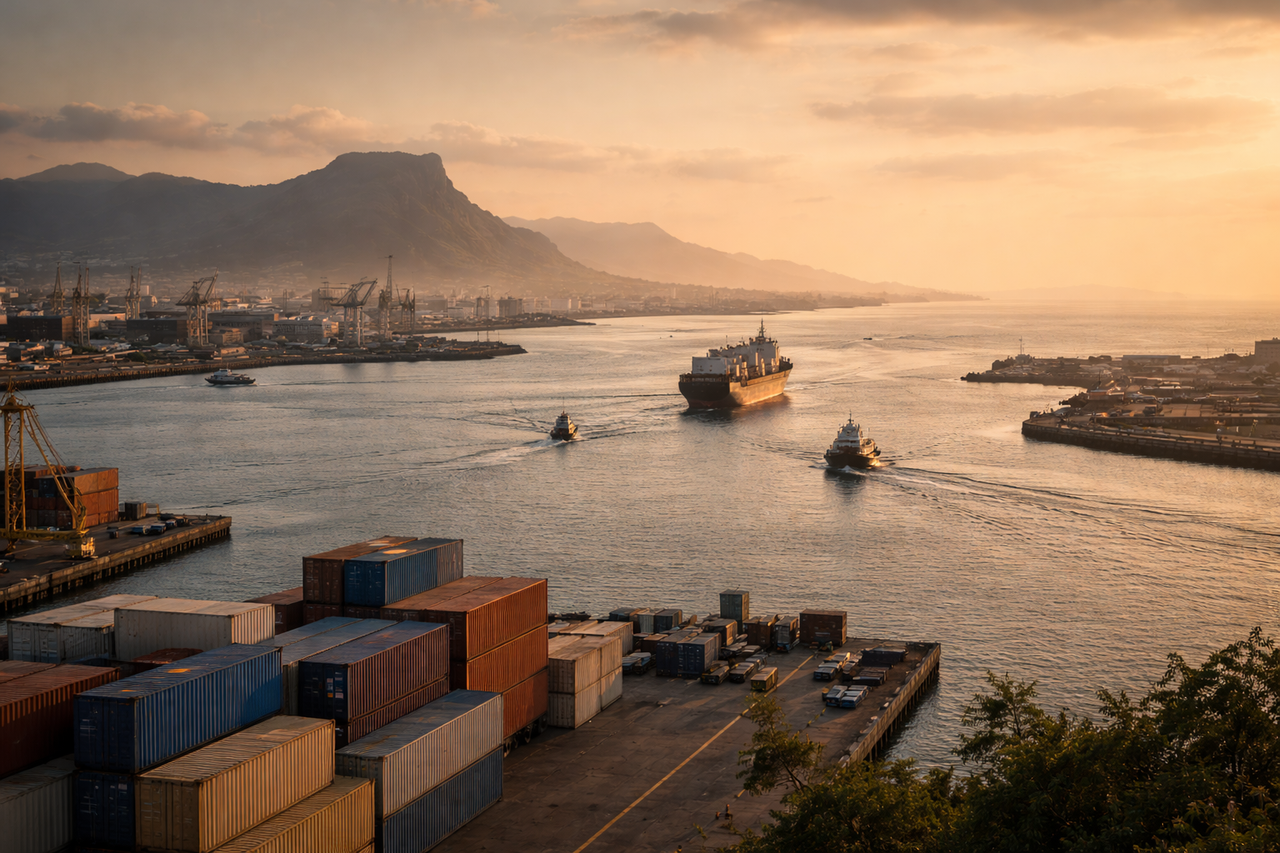
When the Mauritius Ports Authority releases its annual throughput data, a transformation becomes measurable. Container traffic grew from 375,000 TEUs in 2015 to 560,000 TEUs in 2023, representing 49% growth over eight years. Customs clearance time dropped from 48 to 72 hours pre-digitalization to 18 to 24 hours post-2022 reforms. Dwell time, whilst still 2.7 to 3.5 days, positions Mauritius as second most efficient port in Africa according to World Bank 2023 rankings.
These operational metrics matter because they quantify whether ocean territory translates to economic capacity. Mauritius controls approximately 2.3 million square kilometres of ocean jurisdiction (1.9 million km² Exclusive Economic Zone plus 396,000 km² Joint Management Area with Seychelles on Mascarene Plateau). This ocean space currently generates approximately $850 per square kilometre annually, primarily through fisheries ($530 million exports), port services, ship registry and bunkering ($80 to $100 million), and maritime-enabled digital services ($600 million).
The gap between current productivity ($609 per km²) and estimated sustainable potential ($956 to $1,130 per km²) represents the governance challenge. Ocean states do not earn returns from water alone. They earn from competence in fisheries monitoring, port efficiency, maritime security, cable resilience, and regulatory credibility. The question is whether Mauritius can scale the operational discipline demonstrated in port performance across all ocean corridors.
Ocean Territory in Economic Terms
Mauritius ocean economy currently contributes 10 to 12% of GDP, approximately $1.4 billion in 2023, growing at 3 to 4% annually since 2016. This positions the ocean sector as material but not dominant component of economic output. The composition reveals concentration in specific corridors: fisheries exports ($530 million), port logistics (560,000 TEU throughput), maritime services ($80 to $100 million ship registry and bunkering), and cable-enabled digital services ($600 million in fintech, data hosting, and business process outsourcing).
Employment data shows 19,000 direct jobs in ocean-related sectors, representing approximately 5% of total employment, concentrated in ports, seafood processing, and marine tourism. This understates indirect employment in logistics, trade finance, customs brokerage, and support services dependent on maritime activity.
Sources: OECD ocean economy reports, FAO fisheries data, Mauritius Ports Authority, World Bank ocean economy assessment, Indian Ocean Tuna Commission statistics.
The productivity gap is measurable. At $609 per km² annually, Mauritius ocean territory generates approximately 54% to 64% of estimated sustainable potential ($956 to $1,130 per km²). The uncaptured value of $800 million to $1.2 billion sits in marine biotechnology (currently negligible), expanded seafood processing margins (18 to 25% value-add on $530 million base could reach 30%), deep sea mineral exploration (unexplored), expanded aquaculture (current 2,500 tons versus 15,000 ton potential), and maritime services scaling (ship finance, maritime legal services, marine insurance).
Where Mauritius Stands Against Regional Competitors
Port efficiency determines whether island economies function as trade facilitators or trade bottlenecks. The comparative data positions Mauritius between high-performing Asian hubs and underperforming island ports.
| Port | TEU Throughput | Dwell Time (Days) | Customs Clearance (Hours) | Efficiency Rank |
|---|---|---|---|---|
| Singapore | 37 million | 0.5 to 1.0 | Under 6 | #1 globally |
| Colombo | 7.2 million | 1.5 to 2.0 | 12 to 18 | #3 globally |
| Port Louis (Mauritius) | 560,000 | 2.7 to 3.5 | 18 to 24 | #2 in Africa |
| Seychelles | 130,000 | 3.5 to 4.0 | 24 to 36 | Not ranked |
| Maldives | 120,000 | 3.8 to 4.2 | 24 to 30 | Not ranked |
Sources: World Bank Port Performance Index 2023, UNCTAD maritime statistics, Mauritius Ports Authority annual reports.
The comparative positioning reveals Mauritius performance pattern. Customs clearance at 18 to 24 hours significantly outperforms Seychelles and Maldives (24 to 36 hours), positioning Mauritius as credible trade facilitator among Indian Ocean island states. The 2022 digitalization reforms demonstrably improved clearance speed from previous 48 to 72 hour baseline.
However, dwell time of 2.7 to 3.5 days lags both Singapore (0.5 to 1.0 days) and Colombo (1.5 to 2.0 days). Dwell time measures total elapsed time from vessel arrival to cargo release, encompassing not just customs processing but port handling efficiency, storage capacity, trucking availability, and documentation completeness. The gap indicates infrastructure or operational constraints beyond customs reform alone.
TEU throughput growth from 375,000 (2015) to 560,000 (2023) represents 49% increase over eight years, averaging 5.1% annual growth. This outpaces Mauritius GDP growth (3 to 4% annually), suggesting port sector captures increasing share of economic activity. The trajectory indicates port infrastructure capacity remains adequate for current volumes, though future growth may require expansion investment.
From Raw Catch to Value Capture
Mauritius fisheries sector demonstrates transition from extraction to processing. Annual catch volumes of 35,000 to 40,000 tons generate $530 million in export value through seafood processing capacity of 120,000 tons annually. This positions Mauritius as major tuna processing hub in Indian Ocean, not merely fishing operation.
The value capture mechanism is processing margin. Tuna species (skipjack, yellowfin, bigeye) account for 75% of export volume. Processing adds 18 to 25% margin through tuna loins, canned tuna, and chilled fish products meeting EU sanitary standards. Primary export markets are European Union (70% of exports), Japan (10%), and South Africa (5%). This market concentration creates trade policy dependency: EU market access determines sector viability.
Sustainable yield estimates for Mauritius EEZ range from 45,000 to 50,000 tons annually across pelagic species according to FAO fisheries reviews. Current catch of 35,000 to 40,000 tons sits within sustainable limits, suggesting scope for 12 to 25% volume expansion without ecological overshoot. However, this assumes enforcement prevents illegal, unreported, and unregulated (IUU) fishing that currently costs Western Indian Ocean $60 to $80 million annually (approximately 15% of potential catch value).
Vessel Monitoring System (VMS) compliance: 95% Mauritius employs mandatory VMS for licensed fishing vessels, achieving 95% compliance through cooperative surveillance with Indian Ocean Tuna Commission (IOTC). This compares favorably to regional average of 70 to 80% compliance.
Monitoring cost versus revenue. Maritime surveillance costs approximately $20 million annually to cover 2.3 million km² EEZ. Against fisheries export revenue of $530 million, this represents 3.8% of sector value, demonstrating enforcement as economically justified investment rather than cost burden.
IUU fishing prevention. Regional IUU losses estimated at $60 to $80 million annually across Western Indian Ocean. Mauritius high VMS compliance suggests effective deterrence, protecting domestic catch value and sustainable yield capacity.
Regional cooperation framework. Mauritius participates in Indian Ocean Commission (IOC) and Indian Ocean Rim Association (IORA) maritime domain awareness networks, sharing surveillance data and coordinating enforcement. This reduces per-country enforcement costs whilst improving coverage.
Aquaculture expansion potential. Current production of 2,500 tons annually could expand to 15,000 tons according to FAO assessments, adding diversification to wild capture fisheries. Infrastructure requirements include hatcheries, feed supply chains, and sanitary certification for export markets.
The economic return per km² of EEZ from fisheries alone is approximately $230 ($530 million export value divided by 2.3 million km²). This accounts for 38% of total ocean productivity of $609 per km². The remaining 62% derives from port services, ship registry, cable-enabled digital services, and marine tourism. Fisheries represent largest single sector but less than half of per-km² productivity, indicating successful diversification beyond extraction activities.
The Invisible Ocean Economy
Mauritius hosts five active submarine cables (SAFE, LION, LION2, IOX, METISS) with combined design capacity exceeding 60 terabits per second. Three physically separate landing points provide 99.9% uptime resilience, creating redundancy that enterprise clients require for data hosting, financial services, and business process outsourcing.
This infrastructure underpins approximately $600 million in annual digital services exports, including fintech, data centre operations, and BPO activities. The economic multiplier is significant: cable infrastructure investment (capital intensive, one time) enables recurring high-margin services exports that scale without proportional employment growth.
Landing station regulation by Information and Communication Technologies Authority (ICTA) aligns with ITU and IORA cybersecurity standards, providing governance credibility that multinational corporations assess when selecting data hosting locations. The regulatory framework matters as much as physical infrastructure because data residency, privacy compliance, and continuity planning determine enterprise adoption.
Cable resilience demonstrates ocean economy principle: infrastructure reliability creates economic value beyond direct connectivity sales. The $600 million digital services exports enabled by cables represents 43% of total ocean economy contribution ($1.4 billion), making submarine cable infrastructure the highest-value ocean corridor per dollar invested. This contrasts with fisheries (capital intensive, ecologically constrained, price-taker in global markets) and ports (infrastructure intensive, dependent on regional trade volumes).
What Works in Other Island States
Ocean economy strategies vary across small island developing states based on resource endowments, geographic position, and governance capacity. The comparative evidence provides policy lessons.
| Country | Primary Model | Ocean GDP Share | Key Strengths | Constraints |
|---|---|---|---|---|
| Singapore | Maritime services hub | Approximately 7% | Port efficiency (#1 globally), ship finance, maritime legal services, bunkering | No fisheries resource, dependent on transshipment volumes |
| Iceland | Quota-based sustainable fisheries | Approximately 10% | ITQ system prevents overfishing, value-added processing, strong enforcement | Single-sector concentration, climate vulnerability |
| Seychelles | Tourism plus fisheries, marine spatial planning | Approximately 25% | EEZ management, blue bonds innovation, conservation financing | Small domestic market, tourism volatility |
| Maldives | Tourism-ocean integration | Approximately 30% | Eco-tourism premium pricing, reef conservation, resort model | Climate vulnerability, limited diversification |
| Mauritius | Diversified: port, fisheries, digital, tourism | 10 to 12% | Regional port efficiency leader, processing hub, cable infrastructure | Scale constraints, import dependency, EEZ enforcement costs |
Sources: OECD ocean economy reviews, World Bank sectoral assessments, national statistics offices, FAO fisheries data.
Singapore demonstrates that ocean economy does not require natural resources. The maritime services hub model captures value through port efficiency, ship financing, maritime insurance, legal services, and bunkering. With 37 million TEU throughput and 0.5 to 1.0 day dwell times, Singapore processes 66 times Mauritius container volume at three times the speed. The infrastructure investment and operational discipline required for this performance level represents multi-decade institutional commitment.
Iceland provides fisheries governance model. Individual Transferable Quota (ITQ) system assigns property rights to catch shares, preventing tragedy of commons whilst maintaining sustainable yields. Iceland captures processing margins through strict sanitary standards and premium market positioning. The model requires rigorous enforcement and long-term political commitment to quota discipline despite short-term pressure to increase catches.
Seychelles innovated blue bonds financing, issuing $15 million sovereign blue bond in 2018 (first globally) to fund marine conservation and sustainable fisheries. The model demonstrates how ocean governance can access capital markets through credible environmental commitments. Seychelles EEZ (1.4 million km²) generates approximately 25% of GDP from ocean activities, higher than Mauritius 10 to 12%, indicating greater ocean sector development or alternatively higher dependency concentration.
Maldives ocean economy contributes approximately 30% of GDP, highest among comparators, almost entirely from tourism rather than fisheries or ports. This concentration creates climate vulnerability (reef degradation, sea level rise) and economic volatility (global tourism demand shocks). The model works whilst environmental assets remain pristine and tourism demand sustains, but lacks diversification buffer.
Mauritius positioning sits between specialized models (Singapore ports, Iceland fisheries, Maldives tourism) with diversified ocean economy combining ports, fisheries processing, cable infrastructure, and marine tourism. This reduces single-sector risk but may prevent achieving excellence in any specific corridor. The strategic choice is whether to deepen specialization or maintain diversification.
How Ocean Economies Underperform
Blue economy failures follow predictable patterns. The most common is overcapitalization without market demand. Solomon Islands invested in tuna processing capacity exceeding sustainable catch volumes and export demand, creating stranded assets and fiscal burdens. The error was building processing infrastructure before securing fishing rights, vessel capacity, and confirmed export contracts.
The second failure mode is enforcement collapse. When monitoring systems fail, IUU fishing eliminates economic returns whilst degrading fish stocks. The Western Indian Ocean loses $60 to $80 million annually to IUU fishing (15% of potential catch value), demonstrating the cost of weak enforcement. Countries with inadequate VMS systems, limited patrol capacity, or corrupt licensing processes see ocean resources captured by foreign vessels with domestic economy receiving minimal benefit.
The third failure is infrastructure without complementary systems. Building ports without customs reform creates bottlenecks that negate infrastructure investment. Expanding fisheries without cold chain logistics wastes catch value. Developing tourism without marine conservation degrades the environmental asset being monetized. Ocean economy requires system integration, not isolated projects.
The fourth failure is skills gaps. Maritime logistics, seafood processing quality control, maritime legal services, and marine biotechnology all require specialized training. Countries that invest in infrastructure without workforce development face operational inefficiency and dependence on foreign technical staff. Mauritius fisheries processing employs 19,000 directly but relies on imported expertise for quality systems and export compliance.
The constraint binding Mauritius specifically is scale. At 2.3 million km² ocean territory and 560,000 TEU port throughput, Mauritius operates at regional level but not global scale. Singapore achieves maritime services hub status through 37 million TEU throughput that justifies specialized service providers. Mauritius must choose niches where regional scale suffices (Indian Ocean tuna processing, cable landing redundancy, boutique ship registry) rather than competing on global commodity services.
Converting Ocean Space into Economic Returns
Ocean economy development requires sequential investment where each stage enables the next. The evidence from successful island states (Singapore, Iceland, Seychelles) and failures (overcapitalized processing, enforcement collapse) indicates specific ordering.
Stage one: Measurement and transparency. Publish port performance metrics (dwell time, clearance speed, throughput), fisheries catch data by species and zone, VMS compliance rates, IUU fishing incidents, cable uptime statistics, and maritime security costs. Mauritius already publishes some metrics (TEU throughput, customs clearance improvements) but comprehensive ocean dashboard would enable accountability. Published data disciplines procurement, exposes corruption, and allows private sector to price risk accurately.
Stage two: Enforcement as foundation. Ocean resources without enforcement become open access commons. Mauritius $20 million annual surveillance spending across 2.3 million km² (approximately $8.70 per km²) represents cost-effective investment given $530 million fisheries export value protected. Expanding VMS from current 95% compliance to mandatory 100% with automatic sanctions for non-compliance would close remaining gaps. Regional cooperation through IOC and IORA reduces per-country costs whilst improving coverage. Enforcement investment should precede resource expansion because poorly monitored fisheries or ports attract illicit activity that degrades sector reputation.
Stage three: Processing before extraction. Mauritius already demonstrates this principle: 120,000 ton annual processing capacity against 35,000 to 40,000 ton catch, meaning infrastructure can handle 43% expansion in raw material before capacity constraint. Adding processing capacity ahead of catch expansion ensures value capture infrastructure exists when resources available. The 18 to 25% processing margin on $530 million base ($95 to $132 million margin) represents returns to processing investment. Expanding into higher-margin products (smoked fish, specialty cuts, prepared meals) requires sanitary certification, cold chain logistics, and market development but leverages existing capacity.
Stage four: Infrastructure resilience and redundancy. Mauritius five submarine cables with three landing points provide 99.9% uptime, demonstrating redundancy investment. Ports require similar resilience: backup power systems, alternative trucking routes, digital systems with offline fallback, and disaster recovery protocols. Single points of failure (one port, one cable route, one fish processing plant) create systemic vulnerability. Redundancy costs more initially but prevents catastrophic shutdowns that destroy sector credibility.
Stage five: Skills and certification. Ocean economy increasingly competes on standards compliance rather than cost. EU sanitary requirements for seafood, IMO maritime safety standards, cybersecurity certifications for data hosting, and environmental certifications for sustainable tourism all require trained workforce. Mauritius should develop technical training in maritime logistics, seafood quality control, marine biotechnology, and maritime law. These skills enable higher-margin ocean activities than raw extraction or commodity transshipment.
Stage six: Regulatory credibility and rule stability. Ocean sector investment horizons span 10 to 30 years (port infrastructure, processing plants, cable systems, fisheries quota allocations). Policy instability destroys investment because capital cannot be recovered if rules change. Mauritius should codify ocean governance frameworks with sunset provisions preventing retroactive changes, transparent licensing procedures, and published criteria for permits. Regulatory credibility attracts long-term capital that commodity-dependent economies struggle to access.
This sequence differs from typical blue economy narratives that begin with resource extraction or infrastructure announcements. The evidence-based sequence starts with enforcement and measurement, adds processing capacity before expanding extraction, invests in resilience before scaling, develops skills before automation, and stabilizes regulation before seeking investment. Each stage creates conditions for the next rather than hoping investment alone solves governance gaps.
Sovereignty Disputes and Ocean Economics
Mauritius maintains sovereignty claim over Chagos Archipelago, currently administered by United Kingdom as British Indian Ocean Territory. The dispute has ocean economy implications: Chagos EEZ encompasses approximately 640,000 km² of ocean territory, representing 28% addition to Mauritius current 2.3 million km² jurisdiction.
The economic significance depends on resource potential and enforcement capacity. Adding 640,000 km² would expand Mauritius ocean territory from 2.3 million to 2.94 million km² (28% increase). At current productivity of $609 per km², this would add $390 million in potential ocean economy value annually. However, this assumes enforcement capacity scales linearly, which is unlikely. Mauritius currently spends $20 million annually for 2.3 million km² surveillance ($8.70 per km²). Extending enforcement to additional 640,000 km² would require proportional $5.6 million increase, plus infrastructure for distant operations.
The Chagos waters contain tuna stocks and potential deep sea mineral resources, but exploitation requires capital investment in patrol vessels, processing facilities if fish landed in Mauritius, and diplomatic negotiations regarding existing fishing licenses. The net economic benefit depends on whether sovereignty transfer includes existing arrangements (UK-US base lease, fishing licenses to third countries) or enables Mauritius to renegotiate terms.
UN maritime law reviews (2019 to 2024) support Mauritius sovereignty position, but economic realization requires governance capacity to manage expanded territory effectively. The case demonstrates ocean economy principle: legal rights to ocean space create economic potential only when backed by enforcement capacity and investment in value capture infrastructure.
Where $1.4 Billion Ocean Revenue Actually Goes
Mauritius generates $1.4 billion annually from ocean economy activities across 2.3 million square kilometres of ocean territory. This represents measurable economic scale. The critical question is not whether ocean wealth exists, but who captures it and whether public finances benefit proportionally.
The evidence reveals systematic fiscal leakage. Government captures an estimated $100 to $180 million annually from the $1.4 billion ocean economy, representing 7% to 13% of total ocean revenue. The remaining 87% to 93% flows to private sector profits, foreign shareholders, and concentrated corporate structures. This creates the paradox where ocean GDP contribution measures 10% to 12% whilst fiscal contribution to government coffers represents only 2% to 6% of budget.
Fisheries sector ($530 million export value):
Private seafood processing companies (Rogers Group, Princes Tuna, concentrated ownership structures) operate the 120,000 ton annual processing capacity. Processing margins of 18% to 25% generate $95 million to $132 million in profits. Government captures approximately $30 million to $40 million through fishing license fees ($10 to $20 million annually, representing only 2% to 4% of export value) plus corporate tax on processing profits ($14 to $20 million at 15% rate). Private sector retains $490 million to $500 million (92% to 94% of sector value).
Port services ($170 to $190 million):
Cargo Handling Corporation Ltd operates as partially state-owned entity but functions commercially. Private logistics firms, warehousing operators, and shipping lines (predominantly foreign) capture majority of revenue. Government receives estimated $15 million to $25 million in dividends from state ownership stake. Private sector retains $165 million to $175 million (87% to 92%).
Digital services ($600 million cable-enabled):
Private fintech companies, business process outsourcing operators (many foreign-owned), data hosting firms, and telecommunications duopoly (Mauritius Telecom, Emtel controlling over 90% market share) generate this revenue. Government captures $50 million to $80 million in corporate tax, though many technology firms operate under special tax status, freeport exemptions, or offshore structures that reduce effective taxation. Private sector retains $520 million to $550 million (87% to 92%).
Maritime services ($80 to $100 million):
Ship registry generates $20 million to $30 million in government fees. Bunkering operations (fuel supply for vessels) operate through private concentrated suppliers. Ship repair facilities are privately owned. Government captures $20 million to $40 million total. Private sector retains $60 million to $80 million (60% to 75%).
Total fiscal capture: $115 million to $185 million from $1.4 billion ocean economy (8% to 13%).
Private sector retention: $1.215 billion to $1.285 billion (87% to 92%).
This fiscal capture rate reveals structural problem. Compare to other resource sectors: oil-producing countries typically capture 60% to 80% of resource value through royalties, production sharing agreements, and state equity participation. Norway's petroleum fund captures 78% of oil revenue for public benefit. Mauritius captures 8% to 13% of ocean resource value, allowing 87% to 92% private retention.
The leakage mechanisms are identifiable. First, fishing license fees charge $10 million to $20 million annually for access to fisheries generating $530 million in export value, representing 2% to 4% of sector value. Pacific island states charge 15% to 20% of catch value for equivalent fishing rights, suggesting Mauritius underprices ocean access by $60 million to $80 million annually.
Second, processing sector concentration allows margin capture by private conglomerates without corresponding public benefit. When top three seafood processors control majority of 120,000 ton capacity, processing margins of $95 million to $132 million flow to concentrated ownership rather than distributed through competitive market or shared through equity participation.
Third, port operations generate $170 million to $190 million in revenue but government dividend capture of $15 million to $25 million represents only 13% to 15% of sector value despite partial state ownership. This suggests either highly diluted government equity stake or commercial operation structure that prioritizes private returns over public dividend.
Fourth, digital services sector operates under tax incentive regimes (freeport status, special economic zones, offshore structures) that reduce effective corporate taxation below nominal 15% rate. When $600 million in digital exports generates only $50 million to $80 million in tax revenue, effective rate falls to 8% to 13%, well below rates applied to domestic service sectors.
The political economy implication is direct. Ocean territory of 2.3 million square kilometres generates $1.4 billion in economic activity annually. Employment creates 19,000 direct jobs (approximately 5% of total employment). But fiscal benefit to government of $100 million to $180 million represents only 4% to 7% of estimated $2.5 billion annual government budget. Citizens observe ocean wealth statistics whilst experiencing government fiscal constraints because ocean revenue flows to private balance sheets rather than public finances.
The concentration pattern compounds the capture problem. If the same conglomerate groups that control banking (top 5 banks at 80% to 85% of assets), telecommunications (over 90% duopoly), and import corridors also control seafood processing, port logistics, and maritime services, then ocean economy functions as integrated rent extraction system. Vertical integration across ocean value chains (fishing licenses to processing to export logistics to trade finance) allows concentrated groups to capture margins at each stage whilst government receives only license fees and modest corporate tax.
This structure explains the disconnect between ocean economy contribution to GDP (10% to 12%) and ocean economy contribution to government fiscal capacity (2% to 6% of budget). GDP measures total economic activity. Fiscal capacity measures public resource availability. When private sector retains 87% to 92% of ocean revenue, high GDP contribution does not translate to proportional government capacity to fund infrastructure, enforcement, education, or social services.
The enforcement cost asymmetry reveals the subsidy direction. Government spends $20 million annually on maritime surveillance protecting 2.3 million square kilometres of ocean territory. This enforcement protects fisheries generating $530 million in private export revenue (government captures $30 million to $40 million). The state invests $20 million in surveillance to enable private sector capture of $490 million to $500 million. Enforcement costs are socialized whilst profits are privatized.
The employment argument often justifies private sector ocean economy on grounds of job creation. The 19,000 direct ocean sector jobs represent valuable employment. However, at $1.4 billion revenue divided by 19,000 jobs, revenue per employee is $73,684. If average ocean sector wage is $15,000 to $20,000 annually (processing, port labour, maritime services), then labour captures $285 million to $380 million (20% to 27% of ocean revenue). Capital captures the remaining $1.02 billion to $1.115 billion (73% to 80%). The distribution favours capital over labour by 3:1 to 4:1 ratio.
International comparisons clarify the capture gap. Iceland captures approximately 40% of fisheries value through quota auction system and processing sector taxation. Norway captures 78% of petroleum value through state equity in Equinor and petroleum tax regime. Botswana captures 50% of diamond value through joint venture ownership with De Beers. Mauritius captures 8% to 13% of ocean value, suggesting governance choices that prioritize private accumulation over public benefit.
The policy implication is not nationalization or expropriation. It is rebalancing capture mechanisms to align with international norms for resource sectors. Fishing license fees could increase from 2% to 4% of export value to 15% to 20%, generating additional $60 million to $80 million annually. Government equity stakes in processing facilities would capture dividends proportional to capital contribution. Export levies of 3% to 5% on seafood would generate $16 million to $26 million whilst remaining below levels that destroy competitiveness. Elimination of special tax status for digital services not demonstrating technology transfer or skills development would increase effective taxation from 8% to 13% toward nominal 15% rate, adding $12 million to $30 million revenue.
These mechanisms would increase government fiscal capture from current $100 million to $180 million toward $250 million to $350 million (18% to 25% of ocean economy value), still well below resource sector norms of 50% to 80% but representing substantial improvement. The additional $70 million to $200 million annual revenue could fund expanded maritime surveillance, fisheries research, port infrastructure maintenance, marine protected areas, and skills development in maritime sectors. This creates positive cycle: improved governance attracts higher-value ocean activities, increased public capture funds better services, enhanced enforcement protects resources for sustainable long-term productivity.
The current structure represents choice, not inevitability. Ocean resources are public assets under sovereign jurisdiction. The state grants access through licenses, permits, and regulatory frameworks. When private sector captures 87% to 92% of value from public ocean resources whilst government bears enforcement costs and infrastructure investment, the arrangement constitutes systematic wealth transfer from public to private. This is extractive economics masquerading as development.
The fiscal reality contradicts ocean economy narratives. Mauritius does not lack ocean wealth. It lacks public capture mechanisms. The 2.3 million square kilometres generate measurable value. That value flows disproportionately to concentrated private interests rather than public benefit. Correcting this requires not romantic appeals to blue economy potential, but hard-nosed resource governance comparable to petroleum, minerals, or telecommunications sectors where public ownership of scarce resources justifies public share of economic returns.
From Ocean Territory to Ocean Returns
Mauritius controls 2.3 million square kilometres of ocean territory, generating $1.4 billion annually (10 to 12% of GDP) at productivity of $609 per km². Estimated sustainable potential of $2.2 to $2.6 billion annually ($956 to $1,130 per km²) indicates 57% to 86% upside from current levels. However, the productivity gap is secondary to the capture gap. Government currently receives only $100 million to $180 million (8% to 13%) of the $1.4 billion ocean economy, whilst private sector retains $1.2 billion to $1.3 billion. This represents systematic wealth transfer from public ocean resources to concentrated private interests.
Port Louis demonstrates what operational discipline achieves: 560,000 TEU throughput with 18 to 24 hour customs clearance, ranking second most efficient port in Africa. Fisheries sector shows value capture through processing: 120,000 ton annual capacity against 35,000 to 40,000 ton catch, generating $530 million exports through 18% to 25% processing margins. Submarine cable infrastructure enables $600 million digital services exports through 99.9% uptime resilience from five cables at three landing points. VMS compliance at 95% demonstrates enforcement capacity when invested. Yet these operational successes flow primarily to private balance sheets rather than public benefit.
The governance challenge is dual. First, expanding ocean productivity from $609 per km² current to $956 to $1,130 per km² potential through improved fisheries management, port efficiency, maritime services, and marine biotechnology. Second, and more urgent, increasing public fiscal capture from current 8% to 13% toward international resource sector norms of 40% to 60%. Iceland captures 40% of fisheries value. Norway captures 78% of petroleum value. Mauritius captures 8% to 13% of ocean value, representing governance failure in resource extraction comparable to colonial-era plantation economies where land generated wealth for external owners whilst domestic population received wages alone.
For Mauritius, the policy choice is whether ocean territory functions as public asset generating public benefit or private concession generating private accumulation. The $1.4 billion ocean economy exists. The 2.3 million km² jurisdiction is real. The question is whether that wealth serves 1.3 million citizens or concentrated shareholders. Fishing license fees at 2% to 4% of export value could increase to 15% to 20% ($60 million to $80 million additional revenue). Government equity in processing would capture dividends. Removing special tax status for digital services would increase effective taxation. These mechanisms would shift fiscal capture from $100 million to $180 million toward $250 million to $350 million annually, still modest by resource sector standards but representing movement from extraction to development.
Ocean states earn returns through governance, not geography. Mauritius possesses ocean territory at scale. The 2.3 million km² jurisdiction exceeds land area by orders of magnitude. The question is whether institutional capacity expands to match ocean opportunity, converting sea space into measurable public returns through enforcement, processing, infrastructure resilience, regulatory credibility, and critically, fiscal capture mechanisms that align private incentives with public benefit. The gap between $609 per km² current and $956 to $1,130 per km² potential ($347 to $521 per km² unrealized) is not resource availability. It is governance execution. The gap between 8% to 13% public capture and 40% to 60% international norms is not technical constraint. It is political economy choice about who benefits from public resources.