The South as a System
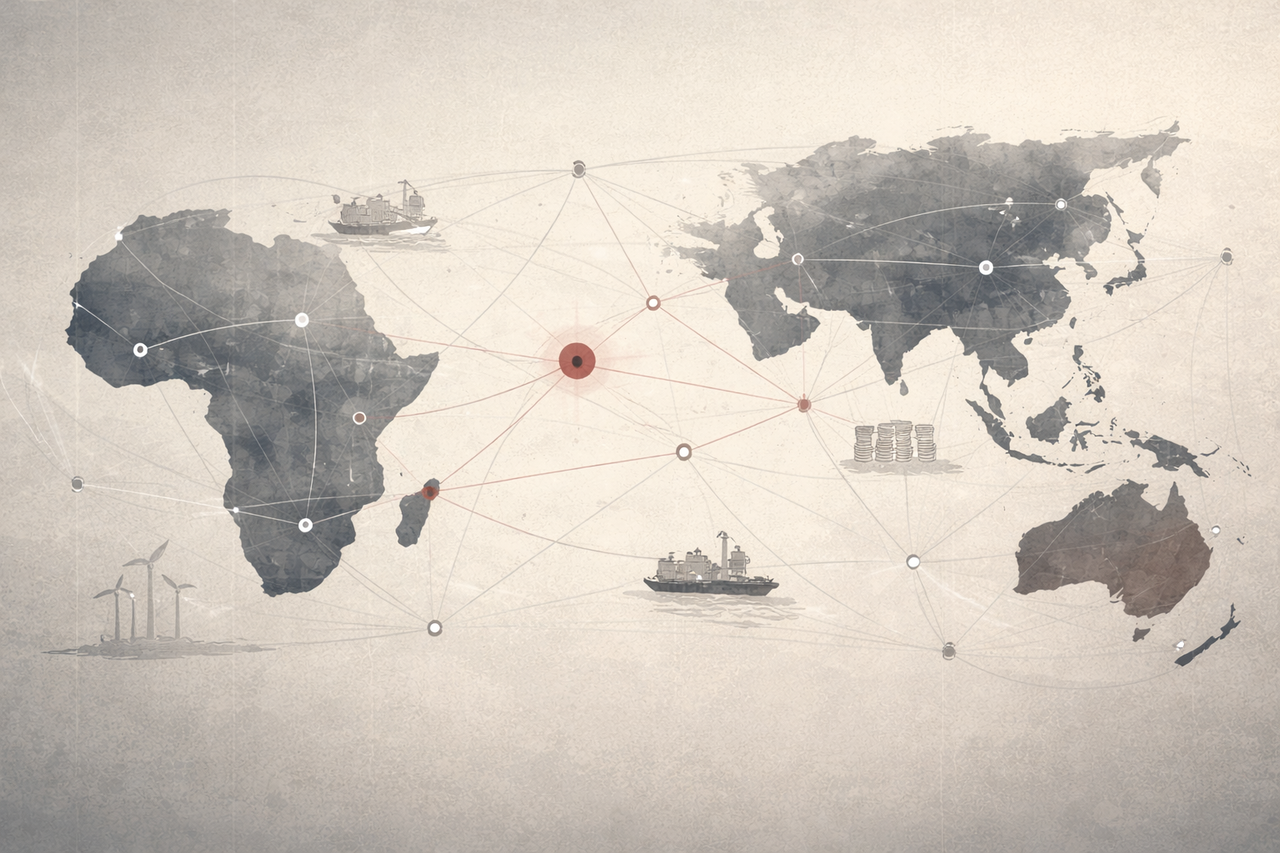
The Global South is often analysed as collection of discrete problems. Debt crises here, labour shortages there, inflation elsewhere, governance failures everywhere. Each debated in isolation with its own policy prescriptions and timelines. Yet persistent feature of past decade is not recurrence of individual shocks, but consistency with which partial solutions fail to produce transformation.
This failure is not ideological. It is architectural. Economies of Global South operate as tightly coupled systems where components interact continuously. When one element is stressed, load shifts elsewhere. When one lever is pulled, resistance appears in another domain. Growth without institutions becomes inflation. Debt relief without productivity becomes currency weakness. Labour mobility without domestic opportunity becomes remittance dependence. Energy constraints without reliable supply become invisible tax on every transaction. System absorbs pressure, but it does not transform.
Global South system indicators reveal interdependencies: remittances stabilize households whilst signaling labour market failure, energy deficits constrain growth despite rising GDP, and firms self-generate power at massive cost rather than collapse. Each adaptation extends survival without addressing root causes.
Interdependence, Not Sequencing, Defines Outcomes
Policy debates often assume linear causality: fix growth first, then distribute; stabilise inflation, then invest; reform governance, then trust returns. In practice, order rarely holds because system components interact simultaneously rather than sequentially. Growth that arrives without energy reliability raises costs through generator dependence and production losses. Fiscal consolidation without labour absorption depresses demand and narrows tax base. Anti-inflation tightening without export capacity strengthens currencies temporarily whilst weakening them structurally through competitiveness erosion.
Sub-Saharan Africa demonstrates paradox clearly. Since 2004, electricity generation per capita has trended downward whilst GDP per capita has trended upward. This should not be possible in developing economy requiring energy intensity expansion according to Kuznets curve pattern. Result is growth constrained by undersupply manifesting through load-shedding, private generator dependence, and productivity losses.
Economic cost quantified: Power outages cost Sub-Saharan African firms 6% of turnover on average for formal enterprises with backup generation, and 16% for informal enterprises unable to afford generators. In Nigeria, Angola, and Ghana, over 25% of businesses lose double-digit sales due to power outages, with some firms averaging 31% losses. Hardest-hit firms average over 200 hours without power monthly.
System response: Firms that can afford it invest in private generation (raising costs 15-20%), firms that cannot absorb losses or exit market. GDP may rise through sectors less energy-intensive (services, extractives) whilst manufacturing stagnates. Growth appears but productive transformation fails. Energy deficit becomes structural barrier disguised by aggregate statistics.
The system reacts predictably. Capital flows adjust to avoid unreliable power environments. Labour exits toward economies with functioning infrastructure. Informality expands as firms avoid regulatory costs when state cannot deliver basic services like electricity. Remittances substitute for wages since domestic employment cannot pay enough to offset cost of living in dysfunctional systems. Informal credit replaces formal finance when institutions fail. Each adaptation stabilises households in short term whilst weakening institutions in long term. Economy survives, but it does not converge toward higher productivity.
This is why electricity access in Sub-Saharan Africa rose from 30% of population (2012) to 50% (2024) whilst average household consumption fell by approximately 25% during same period. Access expanded but quality, reliability, and affordability deteriorated. Rising tariffs outpaced household income growth, forcing consumption reduction even among newly connected households. System delivers access statistic whilst failing delivery outcome, creating appearance of progress masking capability decline.
What Actually Holds an Economy Together
Across countries and regions, five elements repeatedly determine whether pressure leads to reform or drift. These are not aspirational goals but mechanical requirements. When any component fails, others compensate through adaptation that preserves stability whilst undermining transformation.
1. Institutions: Not their rhetoric, but their maintenance. Tax systems that actually collect, regulators that enforce predictably, courts that resolve disputes rather than delay them indefinitely. When institutions weaken, every other policy becomes more expensive because credibility deficit requires higher risk premiums, longer verification times, and defensive contracting. India's contract enforcement requiring 1,445 days (nearly four years) at 31% of claim cost demonstrates judicial inefficiency creating systematic barrier to formalization and scaling. Small businesses absorb losses rather than pursue remedies. Large corporations navigate through legal departments and political access. Productivity gap widens between formal corporate sector and informal small business majority.
2. Labour: Demographics alone do not create growth. Labour must be absorbed productively, trained adequately, and paid credibly in purchasing-power terms. When domestic labour markets fail, migration becomes macro policy by default. India at 32.8% female labour force participation excludes approximately 200 to 250 million potential workers, representing GDP loss of potentially $500 billion to $800 billion annually. This is not demographic constraint but institutional failure creating gender barriers through safety concerns, childcare infrastructure absence, transportation inadequacy, and discriminatory employment practices. Labour market failure produces remittance dependence as rational household response.
3. Energy: No system scales without reliable power. Energy insecurity behaves like invisible tax, compounding inflation through generator costs, deterring investment through unreliability risk, and shrinking real wages through higher input costs. Per capita electricity consumption in Sub-Saharan Africa (excluding South Africa) averages only 124 kilowatt-hours annually, barely 1% of high-income country levels. If entirely allocated to household lighting, this would hardly power one light bulb per person for six hours daily. Yet 730 million people globally lack access entirely (2024), with 600 million in Africa alone representing 85% of global deficit.
4. Currency credibility: Exchange rates reflect trust in entire system, not just monetary policy. When currencies weaken persistently, households self-insure through dollar holdings, asset accumulation, or exit. Iran's rial depreciation 97.6% (2015-2025) and Lebanon's pound collapse 98% demonstrate currency failure as system failure indicator. Dual exchange rates create arbitrage opportunities worth billions for politically connected whilst destroying purchasing power for wage earners. India receives $129 billion remittances annually (#1 globally), Mexico $68 billion, Philippines $40 billion, Pakistan $33 billion. These flows exceed FDI and ODA combined, indicating household strategies built around domestic currency and labour market inadequacies.
5. Time: Most overlooked variable. When systems waste time through queues, outages, delays, and uncertainty, productivity collapses regardless of headline growth. Time lost to power outages (200+ hours monthly for hardest-hit firms), contract enforcement delays (1,445 days in India), regulatory approvals, infrastructure inadequacy accumulates into systematic drag. Ecuador's April 2024 rotating blackouts cost estimated $12 million per hour nationally ($5 million commerce, $2.4 million industry, $2.1 million exports). Time is not political inconvenience. It is economic constraint with quantifiable cost.
Household Resilience, Institutional Failure
Remittances are often celebrated as success stories. They are stable, counter-cyclical to domestic shocks, and large absolutely. In 2024, remittance flows to low- and middle-income countries reached $685 billion, larger than foreign direct investment ($544 billion) and official development assistance combined. Remittances have outpaced FDI significantly, with gap widening: during past decade, remittances increased 57% whilst FDI declined 41%. For receiving countries, this appears as external financing windfall requiring no sovereign borrowing.
But at system level, remittances are diagnostic rather than therapeutic. They indicate households have built parallel survival strategies outside domestic economy because domestic systems cannot provide adequate employment, wages, or opportunity. When remittances finance consumption, health, education, and housing, they substitute for wages, public services, and credit markets. System does not collapse. But it stops reforming because external shock absorber prevents pressure from forcing institutional change. Exit becomes stabiliser. Dependency hardens.
Remittance dependency measured as percentage of GDP reveals where domestic labour markets have failed most severely. Tajikistan (45%), Tonga (38%), Nicaragua (27%), Lebanon (27%), Samoa (26%) top global rankings. These are not success stories. They are measurements of economic systems unable to employ and pay their populations adequately, forcing migration as survival strategy.
This is why remittances grow fastest where labour markets are weakest, currencies most fragile, and public goods thinnest. El Salvador, Honduras, Nepal, and Lebanon all receive remittances exceeding 20% of GDP whilst FDI accounts for less than 4% in same countries. Comparison reveals stark reality: external financing comes not from productive investment but from workers who had to leave because domestic system failed them. Those workers support families left behind, reducing poverty statistics whilst perpetuating institutional weakness that caused migration initially.
Philippines example: Received $40 billion remittances (2024), roughly 10% of GDP. Overseas Filipino Workers (OFWs) send money supporting families' basic needs, education, healthcare. This reduces measured poverty and stabilizes current account. But it also indicates domestic labour market cannot provide comparable wages or opportunities. Brain drain continues: educated workers leave, remittances flow back, domestic institutions avoid reform pressure because households have external buffer.
System consequence: Remittances function as informal unemployment insurance and wage subsidy, masking domestic labour market failures whilst draining human capital. Pakistan received $33 billion (2024), primarily from Gulf countries. Bangladesh $26.6 billion, Egypt $22.7 billion. Each flow represents workers earning abroad what domestic economies cannot pay. This is rational household response to structural constraint, not development strategy.
Policy trap: Governments come to rely on remittance inflows for current account stability and poverty reduction, creating incentive to facilitate migration rather than fix domestic labour markets. Migration becomes export commodity. Remittances stabilize macroeconomic indicators whilst perpetuating micro-level failures forcing emigration.
Remittances are projected to reach $690 billion by 2025, growing 2.8% annually. Widening income disparities between developed and developing nations, demographic pressures from regional conflicts, and climate change impacts are expected to drive increased migration. This means remittance dependency will likely deepen rather than diminish, further embedding parallel household survival systems that bypass domestic institutions. They are not development strategy. They are systems response to constraint, revealing where labour markets, wage levels, and opportunity structures have failed most severely.
Why GDP Can Rise Whilst Capacity Erodes
Several countries now exhibit rising GDP alongside declining institutional capacity. This is not paradox. It is result of growth driven by narrow sectors (extractives, services), commodity cycles, demographic momentum, or financial expansion without corresponding investment in systems that make growth sustainable. When GDP rises but education quality falls, health access deteriorates, infrastructure reliability decreases, and governance credibility weakens, economy inflates expectations without raising resilience. System looks larger statistically but behaves smaller under stress.
India demonstrates precisely. Generated $1.81 trillion additional GDP from 2015 to 2024, ranking fifth globally. Yet 89% of workers remain informal (890 million without pensions, benefits, protections), 48% of healthcare costs fall on households with 17% facing catastrophic expenditure annually, only 44% of fifth-graders can read at grade level, female labour force participation at 32.8% excludes 200 to 250 million potential workers, and tax revenue at 11.7% of GDP constrains public investment. These are not separate policy failures. They are systematic misalignment between aggregate scale and distributed capacity.
The energy-GDP decoupling in Sub-Saharan Africa provides another case. GDP per capita rose whilst electricity generation per capita fell since 2004. This should violate development economics logic requiring energy intensity expansion during industrialization phase. Resolution: growth concentrated in sectors requiring less energy (services, extractives) whilst manufacturing stagnates. Economy grows statistically whilst productive transformation required for sustainable employment fails. Energy constraint becomes binding barrier disguised by aggregate output statistics measuring extractive rents and service sector activity rather than productive capacity building.
Statistical achievement: Nigeria is Africa's largest economy by GDP ($477 billion, 2024 est.), major oil exporter, growing services sector, expanding telecommunications. GDP growth appears positive in most years.
System reality: Power generation collapses periodically with nationwide grid failures. Over 25% of businesses lose double-digit sales due to power outages. Firms invest heavily in private generators, raising costs. Tax revenue collection weak relative to GDP. Infrastructure deteriorated. Governance indices show corruption and inefficiency. Currency stressed with parallel market rates. Fuel subsidy removal (2023) caused inflation spike despite being fiscal necessity.
Outcome: GDP grows through oil rents and service sector expansion whilst manufacturing struggles, formal employment stagnates, and households face rising costs without corresponding wage growth. Economic scale increases but system capacity to deliver services, infrastructure, and opportunity does not match. Growth without transformation. Scale without systems.
This pattern repeats across contexts. Egypt's GDP grows whilst currency repeatedly devalues and remittance inflows reach $24 billion (2024) indicating labour market exodus. South Africa achieves middle-income status whilst experiencing persistent load-shedding costing economy $54.54 billion for single-day national blackout. Pakistan receives $33 billion remittances annually whilst debt burdens constrain public investment. Each demonstrates GDP rise can coexist with capacity erosion when growth concentrates in narrow sectors or relies on external buffers (remittances, commodity rents) rather than broad-based productivity improvements requiring institutional investment.
From Optimization to Coherence
Systemic reform does not mean doing more interventions. It means doing fewer things in alignment so components reinforce rather than contradict. Energy policy must support industry through reliability not just balance sheets through tariff adjustment. Labour policy must absorb youth productively before policing migration flows. Fiscal policy must stabilize currencies through credible revenue collection not just deficit targeting through spending cuts. Institutions must reduce uncertainty through predictable enforcement not redistribute discretion through political allocation.
Most importantly, reform must be timed appropriately. Systems fail when governments promise transformation faster than institutions can deliver capacity, or demand adjustment faster than households can absorb shocks without collapse. Time is not political inconvenience to be overcome through will. It is economic constraint with real costs when violated. Ecuador's April 2024 blackouts cost $12 million per hour nationally because businesses and households lacked time to adapt systems dependent on continuous power.
Correct sequence (reinforcing): Invest in reliable electricity → manufacturing becomes viable → formal employment expands → tax base grows → institutions funded adequately → enforcement improves → business confidence rises → investment increases. Each step enables next.
Incorrect sequence (conflicting): Demand fiscal consolidation → cut infrastructure investment → power reliability falls → manufacturing struggles → informal employment expands → tax revenue stagnates → institutions underfunded → enforcement weakens → business confidence falls → investment exits. Each step undermines system.
Current reality (adaptation): Power unreliable → firms self-generate at high cost → production costs rise → exports uncompetitive → formal employment limited → workers emigrate → remittances flow back → current account stabilized → reform pressure reduced → energy investment delayed. System adapts to dysfunction rather than fixing root cause because adaptation (remittances, generators) masks failure sufficiently to reduce urgency.
Sub-Saharan Africa requires connecting 90 million people annually to electricity by 2030 (threefold increase from current rate) to reach universal access. This demands not just generation capacity but grid reliability, affordable tariffs, and productive use opportunities making electricity economically valuable to consumers. Mission 300 initiative targets connecting 300 million Africans to electricity by 2030, requiring $90 billion financing. But financing alone insufficient. Requires regulatory reforms enabling private capital, tariff structures balancing affordability with cost recovery, grid infrastructure preventing overcapacity in some areas whilst millions lack access elsewhere, and coordination between generation investment and transmission/distribution capacity.
This is systemic challenge. Building generation without transmission creates overcapacity paradox where installed capacity exceeds demand in some locations whilst vast populations lack access elsewhere. Observed in Ghana, South Africa, Ethiopia where surplus power generation coexists with access deficits because grid infrastructure inadequate to deliver power where needed. Connecting households without enabling productive uses keeps consumption low, making electricity economically unsustainable for utilities and households alike. Average household consumption in Sub-Saharan Africa fell 25% (2012-2024) even as access expanded because affordability constraints and productive use limitations prevented consumption growth necessary to sustain utility operations.
Reform therefore requires coherence across energy pricing (tariffs reflecting costs whilst remaining affordable), labour policy (enabling productive uses creating employment and electricity demand), institutional capacity (regulatory frameworks supporting private investment), and temporal realism (scaling at pace institutions can manage rather than political timeline demands). Optimizing any single variable whilst others remain constrained produces adaptation (generators, remittances, informality) rather than transformation.
Why The Meridian Reads the System, Not the Slogan
Every article in this edition examines different entry point into same structure: currencies revealing institutional credibility, labour markets showing whether growth creates opportunity, energy systems determining if production can scale, firms navigating between formality costs and informality constraints, debt exposing fiscal capacity limits, institutions either reducing or redistributing uncertainty. None stands alone. Together, they describe system under continuous load where components interact simultaneously.
Purpose is not pessimism. It is precision. Systems can be redesigned. But only once seen clearly through actual interactions rather than isolated variables, measured honestly through outcomes not intentions, and governed patiently at pace institutions can sustain rather than political cycles demand. The evidence is unambiguous: remittances reach $685 billion annually because labour markets fail 20-25 million Indian workers seeking opportunity abroad; 600 million Africans lack electricity because energy systems cannot deliver despite generation capacity in some areas; firms lose 31% sales to power outages because adaptation (generators) proves cheaper than system reform; households reduce electricity consumption 25% despite new connections because tariffs rise faster than incomes.
Each statistic reveals system interaction. Remittances stabilize current accounts whilst signaling labour market failure. Electricity access expands whilst consumption falls indicating tariff-affordability mismatch. GDP rises whilst energy intensity falls showing growth-productivity decoupling. Firms survive through adaptation (generators, informality, exit) whilst system capacity stagnates. These are not separate problems with separate solutions. They are single system pulling against itself.
The Global South is not behind schedule on linear development path. It is constrained by coherence deficits where energy policy contradicts labour goals, fiscal consolidation undermines infrastructure investment, and institutional weakness forces private adaptation substituting for public goods. These are not abstract gaps. They are solvable technical challenges with quantified costs and demonstrated solutions. But only at system level where reforms reinforce rather than contradict, where timing matches institutional capacity rather than political urgency, and where measurement tracks actual outcomes (household consumption, firm productivity, wage adequacy) rather than access statistics masking delivery failures.
The Global South faces constraint by coherence, by credibility, and by time. Those are not metaphysical deficits. They are mechanical ones amenable to engineering solutions once understood systemically. This edition provides system map showing load-bearing elements, interaction points, and failure modes. The objective is not comprehensive catalog of problems but precise diagnosis enabling targeted intervention where system design rather than component optimization determines outcomes.