The 2024 General Election and Mandate Reset
Electoral outcome and parliamentary configuration
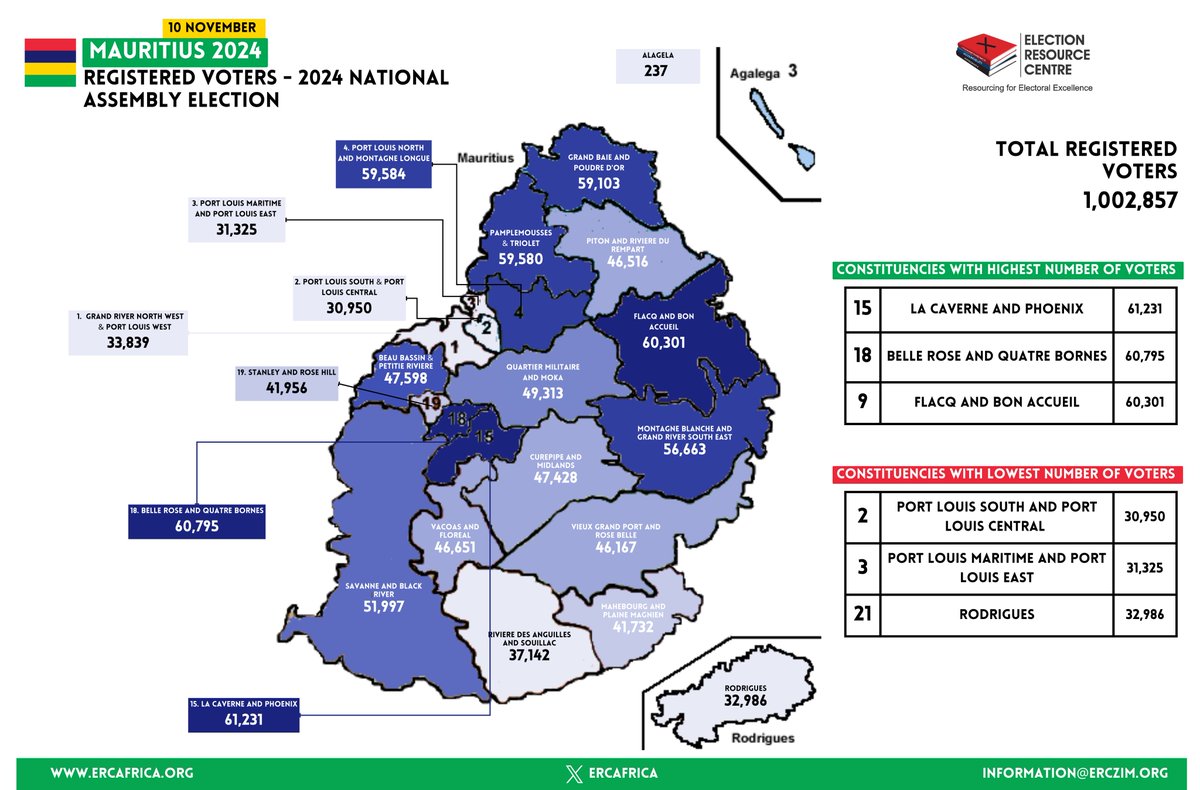
The general elections held on 10 November 2024 produced a decisive electoral verdict that fundamentally reordered Mauritian political geography. The Alliance du Changement, led by Navin Ramgoolam and comprising the Parti Travailliste (Labour Party), Mouvement Militant Mauricain (MMM), and Nouveaux Démocrates (ND), secured all sixty constituency seats in a parliamentary sweep unprecedented in modern Mauritian electoral history. The governing Lepep Alliance, which had held power since 2014 under Prime Minister Pravind Jugnauth, was completely eliminated from parliamentary representation through the constituency-based electoral system.
This outcome represents more than routine alternation of power. The total absence of opposition representation through constituency seats creates a parliamentary configuration wherein the governing coalition faces no organised legislative counterweight beyond the eight best-loser seats allocated through constitutional provisions designed to ensure minority representation. While these best-loser seats provide some parliamentary presence for defeated parties, they generate neither the institutional capacity nor political legitimacy to mount effective opposition.
The electoral arithmetic reveals both the magnitude of the swing and the mechanical effects of the first-past-the-post system operating across twenty three-member constituencies. Alliance du Changement secured approximately sixty percent of the popular vote, a substantial majority but one that translates into complete constituency dominance through the winner-take-all mechanism. Lepep Alliance retained approximately thirty-five percent of votes nationally, sufficient to have secured significant parliamentary representation under proportional systems but yielding zero constituency seats under the existing electoral architecture.
The parliamentary configuration matters profoundly for governance dynamics across the 2024-2029 mandate. Super-majority control enables constitutional amendments, legislative acceleration, and policy implementation unconstrained by negotiation with parliamentary opposition. This legislative dominance creates capacity for decisive action on structural reforms that previous governments found politically intractable. Pension parametric reform, public sector restructuring, fiscal consolidation measures, and energy sector liberalisation all become technically feasible absent parliamentary veto points.
However, the same configuration that enables decisive governance also concentrates political risk. Without institutional opposition functioning as early warning system for policy misjudgements, legislative overreach, or executive dysfunction, the governing coalition must generate internal discipline and self-correction mechanisms that ordinarily emerge through adversarial politics. The absence of parliamentary opposition shifts accountability pressure toward civil society, media scrutiny, and public opinion as primary checks on governmental power. Whether these extra-parliamentary mechanisms possess sufficient institutional capacity and political independence to fulfil oversight functions typically performed by legislative opposition constitutes a critical variable for governance quality across the mandate period.
The electoral swing: magnitude and distribution
The electoral swing from Lepep Alliance to Alliance du Changement exceeded twenty percentage points nationally, representing one of the largest vote shifts in post-independence Mauritian electoral history. This magnitude of change indicates not merely preference adjustment but fundamental reassessment of governing performance. The uniformity of swing across constituencies suggests systemic factors driving voter behaviour rather than localised candidate effects or constituency-specific issues.
Geographic distribution of the swing reveals instructive patterns. Urban constituencies including Port Louis, Beau Bassin-Petite Rivière, Curepipe, and Quatre Bornes recorded among the largest swings, indicating particular dissatisfaction among middle-class urban voters facing cost-of-living pressures, employment precarity, and deteriorating public service quality. Rural constituencies in Flacq, Grand Port, and Savanne demonstrated comparable swing magnitudes, suggesting economic grievances transcended urban-rural divides.
Turnout patterns provide additional analytical dimension. Overall turnout reached approximately seventy-nine percent of registered voters, marginally lower than the 2019 general election but consistent with long-term participation trends. The modest turnout decline likely reflects voter demobilisation among traditional Lepep Alliance supporters facing choice between abstention and voting against party allegiance rather than enthusiasm gap favouring Alliance du Changement. This interpretation finds support in constituency-level analysis showing largest turnout declines in areas of traditional Lepep strength.
Mauritius employs a modified first-past-the-post system across twenty three-member constituencies (sixty seats total) supplemented by eight best-loser seats allocated to maintain ethnic and political balance. This system creates substantial mechanical advantage for leading coalitions. A party securing fifty-five percent of national vote share can theoretically sweep all sixty constituency seats if its vote distribution proves geographically uniform.
The 2024 outcome demonstrates this mechanical effect. Alliance du Changement's sixty percent vote share translated into complete constituency dominance through consistent performance across all twenty constituencies. Even constituencies where Lepep Alliance performed relatively strongly yielded zero seats due to the winner-take-all mechanism operating at constituency level.
Drivers of electoral change
Multiple factors combined to produce the electoral outcome, each contributing distinct weight to the aggregate result. Economic grievances dominated campaign discourse and appear to have exercised primary influence on voter choice. Household cost-of-living pressures accelerated substantially across 2023 and 2024 as global inflation transmitted through food and energy import channels while wage growth lagged price increases. Middle-class voters experienced erosion of purchasing power and consumption compression despite nominal GDP growth, creating disconnect between macroeconomic indicators and household economic reality.
Governance quality concerns reinforced economic discontent. A series of high-profile audit reports documenting procurement irregularities, infrastructure project cost overruns, and wasteful public expenditure generated perception that public funds were being mismanaged while households faced economic stress. The Auditor-General's reports on the Metro Express project, national broadband infrastructure, and COVID-19 procurement provided concrete documentation of dysfunction that opposition parties effectively weaponised during campaign period.
Corruption perceptions proved particularly damaging to Lepep Alliance electoral prospects. Transparency International's Corruption Perceptions Index recorded Mauritius declining from rank fifty-two globally in 2019 to rank fifty-seven in 2023, with corresponding score deterioration from fifty-four to fifty-one points. While these shifts appear marginal in absolute terms, they signalled directional movement counter to regional improvement trends and aligned with citizen perception that elite impunity had increased during the mandate period.
Specific policy failures compounded systemic grievances. The government's handling of the Wakashio oil spill in 2020, initially characterised by delayed response and inadequate containment, generated lasting environmental and political damage. The attempted telecommunications surveillance legislation in 2021, withdrawn following public outcry and international pressure, raised concerns about democratic backsliding and civil liberties. COVID-19 management, while initially praised for effective border controls and vaccination rollout, faced criticism for economic support programme implementation, procurement transparency, and differential treatment of connected businesses versus small enterprises.
Demographic factors provided structural context favouring change. First-time voters, those reaching electoral age since the 2019 elections, represented approximately twelve percent of the electorate. This cohort faced particularly adverse labour market conditions characterised by high youth unemployment, credential inflation requiring higher educational attainment for equivalent job security, and housing affordability crisis pricing home ownership beyond reach without family wealth transfer. Their political socialisation occurred during a period of economic stress rather than growth optimism, creating predisposition toward change regardless of specific policy platform.
Alliance du Changement: coalition structure and internal dynamics
The victorious Alliance du Changement constitutes a coalition uniting three historically significant but ideologically distinct political formations. The Parti Travailliste under Navin Ramgoolam provides the coalition's institutional core, drawing on the party's legacy as the vehicle of independence struggle and its traditional support base among Hindu voters and labour constituencies. The Mouvement Militant Mauricain (MMM) contributes urban middle-class support, Creole community representation, and intellectual credibility through its historical association with progressive politics and anti-corruption campaigns. Nouveaux Démocrates (ND), the coalition's smallest component, brings specific constituency strengths and serves bridging function between Labour and MMM factions.
This coalition structure creates both governing capacity and potential fragility. The seat distribution heavily favours Parti Travailliste, which holds approximately forty-two of the sixty constituency seats, granting Ramgoolam substantial latitude in cabinet formation and policy direction. However, MMM's contribution of approximately fifteen seats and its distinct urban support base grant it significant bargaining power within coalition dynamics. The party possesses credible exit threat: withdrawal from coalition would not immediately collapse the government given Labour's numerical dominance, but would generate political crisis and undermine governing legitimacy.
Cabinet composition reflects these internal power dynamics. Key economic portfolios (Finance, Economic Planning and Development) are held by Parti Travailliste ministers, ensuring Labour control over fiscal policy and development strategy. MMM secured significant ministerial positions including Foreign Affairs, Health, and Environment, providing policy influence in domains aligned with party priorities while avoiding potential conflict over core economic management. This portfolio allocation suggests negotiated equilibrium designed to maintain coalition stability while enabling distinct party identities to persist within governing framework.
The coalition agreement establishing Alliance du Changement reportedly includes provisions regarding prime ministerial succession, with speculation about potential mid-term leadership rotation between Ramgoolam and MMM leader Paul Bérenger. Whether such arrangements prove binding or evolve into sources of tension will significantly influence government stability across the mandate period. Historical precedent suggests coalition agreements face severe stress when theoretical leadership transition approaches practical implementation.
Cohesion enablers: Shared opposition to previous government. Electoral success creating collective stake in stability. Complementary support bases reducing internal competition. Cabinet positions distributing power adequately.
Fragmentation risks: Ideological differences on economic policy orientation. Personal rivalries between senior politicians. Constituency-level competition in future local elections. Policy failures generating blame attribution conflicts. Succession arrangements creating leadership uncertainty.
Mandate character and governing latitude
The 2024 electoral outcome grants Alliance du Changement extraordinary governing latitude matched by commensurately elevated accountability expectations. The mandate's character reflects both the magnitude of electoral victory and the nature of campaign commitments that generated voter support. This creates specific constraints and opportunities for governance across the 2024-2029 period.
The government possesses constitutional amendment capacity through its parliamentary supermajority, enabling fundamental institutional reforms that previous governments found politically intractable. Electoral system modification, strengthening of parliamentary oversight mechanisms, establishment of independent anti-corruption architecture, and constitutional provisions enhancing transparency all become technically feasible. Whether political will exists to pursue such reforms, particularly those constraining executive power or increasing accountability burdens, remains uncertain given historical patterns wherein governments prove reluctant to institutionalise checks on their own authority.
Economic policy latitude appears substantial. Campaign commitments included pension increases, public sector wage adjustments, cost-of-living relief measures, and infrastructure investment acceleration. The fiscal arithmetic required to deliver these commitments while maintaining debt sustainability necessitates either substantial revenue increases through tax reform, significant expenditure reprioritisation away from existing programmes, or acceptance of larger fiscal deficits than currently projected. The absence of parliamentary opposition enables legislative passage of unpopular measures such as tax increases or subsidy reductions, but does not eliminate political costs or public resistance.
Foreign policy recalibration constitutes another domain of governing latitude. The previous government's positioning in regional and international alignments, including relations with India, China, the European Union, and African partners, can be reassessed and adjusted based on Alliance du Changement's strategic preferences. Decisions regarding the Chagos Archipelago sovereignty negotiations with the United Kingdom, participation in BRICS expansion discussions, and positioning within Commonwealth and Francophonie frameworks all become subject to policy revision.
The mandate's character imposes accountability expectations that constrain governing latitude despite parliamentary dominance. Campaign promises regarding cost-of-living relief, employment creation, corruption elimination, and improved public service delivery created explicit benchmarks against which performance will be measured. The government cannot plausibly attribute failure to opposition obstruction given parliamentary configuration. This concentrates accountability directly on cabinet performance and implementation capacity.
Opposition dynamics and accountability mechanisms
The complete elimination of opposition parties from constituency-based parliamentary representation creates unprecedented governance dynamics. Lepep Alliance's relegation to best-loser seats (potentially five or six of the eight available slots based on vote distribution) provides minimal institutional platform for opposition functions. Best-loser MPs possess identical legislative rights to constituency representatives but lack political legitimacy deriving from direct constituency victory. This status diminishes their capacity to claim representative mandate or generate media attention for opposition critique.
The institutional weakness of parliamentary opposition shifts accountability burden toward extra-parliamentary mechanisms. Civil society organisations, media institutions, professional associations, labour unions, and business chambers must function as primary checks on governmental power absent effective legislative opposition. The capacity and independence of these institutions therefore becomes critical for governance quality.
Media landscape configuration particularly matters. Independent journalism capable of investigating governmental performance, exposing malfeasance, and providing platform for critical analysis serves accountability functions ordinarily performed by opposition parties. However, Mauritian media faces structural vulnerabilities including economic dependency on government advertising revenue, ownership concentration among politically connected business groups, and legal constraints through defamation provisions that chill investigative reporting. Whether media institutions prove capable of sustained critical scrutiny of a popular government with parliamentary supermajority remains uncertain.
Civil society organisations possess mixed capacity for accountability functions. Professional associations including Bar Council, medical associations, and engineering bodies can provide expert critique of government policy in their domains. Labour unions maintain capacity for industrial action and public mobilisation around economic grievances. However, many civil society organisations depend on government funding or regulatory approval, creating dependency that may compromise independence. The effectiveness of civil society accountability functions will depend substantially on whether organisations prioritise institutional independence over access to government resources.
Constitutional institutions including the Electoral Commission, Public Service Commission, Ombudsperson, and independent audit functions provide additional accountability mechanisms. The Auditor-General particularly serves critical function through systematic documentation of public financial management quality. However, these institutions face resource constraints, limited enforcement powers, and vulnerability to political pressure through appointment processes and budget allocation. Strengthening their independence and capacity represents governance priority, though governments historically prove reluctant to empower institutions capable of constraining executive discretion.
The next general elections scheduled for 2029 provide ultimate accountability mechanism, but five-year intervals between electoral accountability create substantial governance latitude for executive decisions that prove unpopular or damaging. The absence of intermediate accountability through local elections (Mauritius lacks elected local government) further extends periods between opportunities for voters to register dissatisfaction with government performance.