Police Accountability, Custodial Deaths & the Provisional Charge System
29A.0 The Judiciary-Police Asymmetry
Judicial capacity and rule of law cannot be assessed solely through courts and constitutional doctrine. In Mauritius between 2015 and 2025, police conduct, custodial deaths, and accountability mechanism effectiveness constitute a critical pressure point in the justice system. Whilst courts remain formally independent—ranking 47th globally on World Justice Project indices, adjudicating high-profile cases including electoral petitions and billion-dollar commercial disputes (Section 29)—repeated incidents involving police abuse, deaths in custody, allegations of evidence fabrication, and systematic opacity in disciplinary outcomes have significantly undermined public confidence in justice delivery.
This creates profound institutional asymmetry: courts demonstrate independence, but depend on police investigations and evidence. When policing integrity is questioned through custodial deaths, brutality allegations, or evidence planting claims, judicial independence exists structurally yet inputs into the justice process remain compromised. International rule-of-law rankings measure constitutional protections and court autonomy; they cannot capture whether enforcement operates with transparent accountability enabling citizens to trust that arrests, detentions, and prosecutions occur lawfully rather than arbitrarily.
Independent Police Complaints Commission: Complaints Without Consequences
The Independent Police Complaints Commission Act 2017 established the IPCC to investigate complaints against police conduct, including deaths in custody and brutality allegations. The IPCC replaced the former Police Complaints Division in 2018, representing institutional acknowledgment that external oversight of police was necessary. The IPCC possesses statutory mandate to summon witnesses, require documentary evidence, investigate custodial deaths, and advise on eliminating police misconduct.
Documented Complaint Volume: 4,229 Cases, 17 Prosecutions
According to secondary media reporting aggregating IPCC data through mid-2024, the commission registered 4,229 complaints since inception. Of these:
The 0.4% Prosecution Rate: Accountability Mathematics
Of 4,229 complaints registered, only 17 reached prosecution—a prosecution rate of 0.4 percent. This means 99.6% of police complaints do not result in criminal charges against officers, regardless of merits. Even among the 48 cases deemed serious enough for IPCC referral to the Director of Public Prosecutions (representing 1.1% of all complaints), only 35% (17 of 48) proceeded to prosecution. The largest single category outcome: 1,643 complaints (38.9%) suspended for insufficient evidence—nearly 40% of all complaints terminated without conclusive findings.
The IPCC does not publish consolidated annual public datasets covering 2015-2025 with:
- • Complete year-by-year complaint volumes and categories (excessive force, wrongful arrest, deaths in custody, discrimination, evidence fabrication)
- • Investigation outcomes by type (founded, unfounded, insufficient evidence, reconciled)
- • Disciplinary sanctions imposed on officers (dismissals, suspensions, reprimands, salary reductions)
- • Prosecution conviction rates and sentences imposed
- • Average investigation duration (time from complaint to conclusion)
- • Compensation or reparations granted to victims
- • Recurring patterns (repeat offenders, systemic issues by police unit or station)
Only partial aggregated data exists via secondary media reporting. No official IPCC annual reports with comprehensive statistics are publicly available online. Without systematic transparency, determining whether 0.4% prosecution rate reflects evidentiary challenges, systemic impunity, or IPCC capacity constraints becomes impossible.
UN Committee Against Torture Findings (2025)
In its most recent 2025 Concluding Observations on Mauritius, the UN Committee Against Torture expressed concern about "high number of allegations of torture, death in police custody, police violence and abuse received by the Independent Police Complaints Commission." The Committee specifically noted:
- Police officers interfere in investigations of their own misconduct
- Victims withdraw complaints for fear of reprisals
- Existing protective measures are ineffective
- Low rates of investigation and prosecution for torture or ill-treatment by police
Earlier in 2017, the UN Human Rights Committee had already flagged "lack of clear information about the overall number of complaints lodged, nature and authors of alleged acts, investigations carried out, convictions, sanctions imposed on those responsible, and reparation granted to victims." Eight years later in 2025, the Committee Against Torture reiterated essentially identical concerns—transparency deficits persist structurally, not accidentally.
Section 29A.2Custodial Treatment and Suspicious Deaths: Cases Without Accountability
Between 2015 and 2025, several cases involving police treatment of detainees and subsequent deaths have become embedded in Mauritian public consciousness, shaping perceptions of impunity and accountability deficits. The most documented case—David Gaïki (2018-2020)—exemplifies the pattern: viral photographic evidence, promised investigations, complete subsequent opacity, and suspicious death without published inquiry outcomes.
Historical Cases Establishing Distrust Pattern
Kaya (Joseph Réginald Topize) died in police custody in 1999 after arrest for cannabis possession. A judicial inquiry found evidence of police brutality. Though predating this review period, the case remains foundational reference point for Mauritian civil society regarding police impunity and inadequate accountability—particularly affecting Rastafarian and activist communities who view Kaya as symbol of police targeting based on cultural identity and political expression.
Iqbal Toofany died in police custody in 2000 following detention after routine traffic stop, according to US State Department human rights reporting. Circumstances triggered public concern regarding treatment of detainees. Like Kaya, this case remains emblematic of unresolved accountability despite occurring outside the formal review period.
Case Study: David Gaïki (2018-2020) — From Viral Evidence to Suspicious Death
The case of David Gaïki represents the most extensively documented example within the 2015-2025 review period of police treatment violations, public outcry, promised accountability, and subsequent opacity culminating in suspicious death.
January 26-29, 2018: Arrest and Viral Photograph
On Friday, January 26, 2018, David Gaïki, a resident of Pailles, was arrested by CID Curepipe in connection with investigation of robberies. He appeared before Curepipe court on Monday, January 29, 2018, charged with larceny and night breaking, and was returned to police custody.
His lawyer, Anoup Goodary, took the unprecedented step of posting on Facebook a photograph of his client naked, handcuffed, and chained to a chair in the premises of CID Curepipe. The photograph, subsequently published by Defimedia and other Mauritian news outlets, went viral and became immediate national controversy.
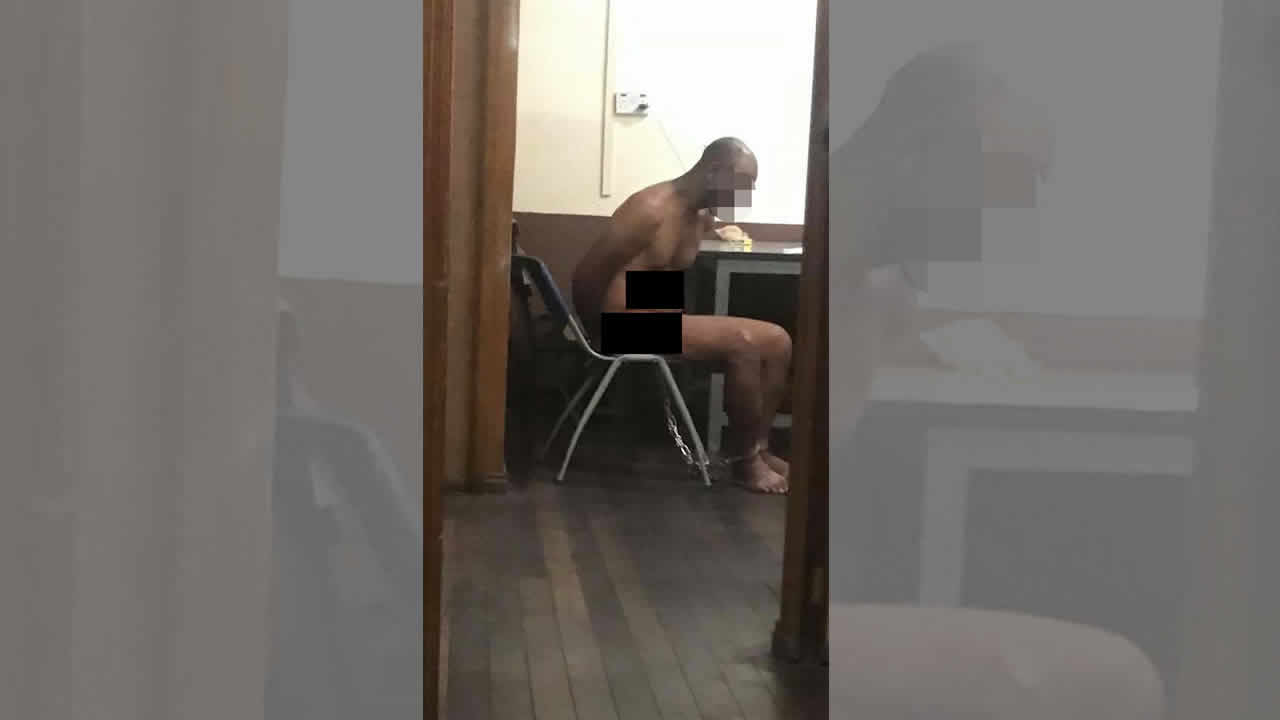
David Gaïki photographed naked, handcuffed, and chained to chair at CID Curepipe, January 2018. Image published by Defimedia Mauritius and posted by his lawyer Anoup Goodary on Facebook, sparking national controversy regarding police treatment of detainees.
Legal and Public Response
Lawyers and human rights advocates expressed immediate outrage. A panel of lawyers—Sanjeev Teeluckdharry, Deepak Rutnah, Erickson Mooneapillay, Jay Prakash Rutnah, Neeven Mooneesamy, and Neelkanth Dulloo—formed to represent Gaïki on pro bono basis, replacing Goodary who became witness to the treatment he documented.
At press conference on Monday, January 29, 2018, lawyer Shakeel Mohamed stated that Chapter 12 of the Standing Orders of the Police does not mention "strip search" or chaining a suspect to a chair. He noted that police officers involved remained in office despite photographic evidence of unauthorized procedures.
The panel of lawyers subsequently formed the Human Rights Association specifically in response to this case, with stated purpose: "Stop degrading and ill-treating human beings in Police custody and Uphold Human Rights standards." Barrister Neelkanth Dulloo stated the lawyers agreed "that if we do not take a stand to stop any further of this, it will continue."
Government and Police Response
Deputy Prime Minister Ivan Collendavelloo defended police handling when questioned at Thaipoosam Cavadee celebrations on Wednesday following the photograph's circulation. He stated that Police Commissioner Mario Nobin was "handling David Gaïki's case perfectly." When asked about the ongoing investigation, Collendavelloo said: "The CP said that an investigation was opened and that he would take appropriate action. I leave it to him."
Police Commissioner Mario Nobin stated during oath ceremony for new police officers that investigation had been initiated by CCID and Human Rights Commission. He emphasized: "We must not forget that these police officers are also humans. I know how to punish and reward when necessary. Since I am CP, 36 police officers have been suspended while more than 1,800 have been promoted. In addition, surveillance cameras will be installed in the police stations."
Psychiatric Hospitalization
On Tuesday, January 30, 2018, Gaïki was transferred to Brown-Sequard psychiatric hospital in Beau Bassin. His lawyer Deepak Rutnah stated it was Gaïki himself who requested transfer, claiming he was "living in fear." His wife corroborated: "When I went to see my husband in the hospital, his hands and feet were chained. The police did not allow me to talk to him. I was asked to wait outside. David never had a mental problem."
Investigation Outcome: Complete Opacity
Despite Police Commissioner's announcement that investigation had been initiated by CCID and National Human Rights Commission, no investigation report was published. Whether officers were disciplined, prosecuted, or faced any consequences: unknown. What happened to Gaïki between January 2018 psychiatric hospitalization and May 2020: no public record.
May 10, 2020: Suspicious Death
On May 10, 2020—more than two years after the viral photograph—David Gaïki died at Jeetoo Hospital.
His original lawyer, Anoup Goodary, posted on Facebook:
The promised reasons for fearing murder were never revealed publicly.
2020-2025: Continued Silence
No official explanation has been published regarding:
- Cause of David Gaïki's death
- Whether post-mortem examination or autopsy was conducted
- Whether judicial inquiry was convened into his death
- Outcome of the 2018 CCID and NHRC investigation into police treatment
- Whether any CID Curepipe officers faced disciplinary action or prosecution
- Why his lawyer feared murder and what reasons were never revealed
- What happened to Gaïki during the 28-month period between viral photograph and death
The David Gaïki case exemplifies systematic accountability failure across 2018-2025 period:
- • Undeniable visual evidence: Photograph published by major news outlets showing treatment unauthorized by Police Standing Orders
- • Government defended treatment: Deputy PM stated case "handled perfectly" despite photographic documentation
- • Investigation promised: Police Commissioner announced CCID and NHRC investigations initiated
- • Complete opacity: No investigation outcomes published, no officer accountability documented
- • Suspicious death: Subject died 28 months later with lawyer expressing fear of murder
- • Continued silence: Five years after death, no official explanation for any aspect of case
The pattern is consistent: Evidence → Outcry → Investigation promised → Opacity → Death → Continued opacity → Zero documented accountability. The silence itself constitutes the finding—what is not investigated, not published, not explained enables impunity to persist.
High-Profile Unresolved Cases: Kistnen and McAreavey
Beyond custodial treatment cases, two high-profile investigations between 2011 and 2025 have become emblematic of investigative capacity deficits, international criticism, and unresolved accountability: the 2020 murder of whistleblower Soopramanien Kistnen and the 2011 killing of Irish honeymooner Michaela McAreavey. Both cases involved intense public scrutiny, international attention, judicial findings of investigative failures, yet neither has resulted in successful prosecution as of January 2026.
The Soopramanien Kistnen Case (2020-2026): Political Murder Without Conviction
On October 18, 2020, the half-charred body of Soopramanien Kistnen was discovered in sugarcane fields near Moka. Kistnen was a construction contractor and former political agent for the Mouvement Socialiste Militant (MSM)—the ruling party—in Constituency No. 8 (Quartier-Militaire–Moka), where Prime Minister Pravind Jugnauth and two cabinet colleagues had been elected in 2019.
Police initially ruled the death suicide. Under civil society pressure, the determination was revised to murder. It subsequently emerged that Kistnen had been preparing to expose:
- Electoral fraud: Evidence showing government ministers allegedly exceeded campaign spending limits in 2019 elections, potentially invalidating election results
- COVID procurement corruption: Irregular government purchase of personal protective equipment during pandemic
The case thus presented characteristics of political assassination to silence whistleblower possessing evidence threatening to bring down government.
Judicial Inquiry Findings: "Unprecedented Level of Incompetence"
A judicial inquiry ordered by Moka magistrate was completed in November 2021. The inquiry report—submitted by Magistrate Vidya Mungroo-Jugurnath—condemned police handling in extraordinary terms, describing investigation as exhibiting "unprecedented level of incompetence" and documenting blatant attempts to manipulate facts.
Key findings included:
- Cause of death determination: Dr. Satish Boolell, former head of police forensic department and consultant in forensic medicine, concluded Kistnen's death was "homicide by asphyxiation"—strangled or suffocated, not suicide
- Crime scene manipulation: Body found in cane field was not primary murder location; Kistnen died elsewhere and was transported to Telfair to stage suicide
- Evidence failures: Missing Safe City camera footage at crucial times, disappearance of mobile phones, unavailable vital information
- Autopsy irregularities: Conflicting expert forensic evidence, questionable role of investigating officers in autopsy procedures
- Timeline evidence: Based on fly egg development on corpse, death occurred approximately October 16, 2020, not October 18 when body discovered
Political Implications and Ongoing Investigation
The case implicated high-level political figures. Former Commerce Minister Yogida Sawmynaden was prosecuted in connection with constituency clerk allegations. As of May 2024, the case was reported as "awaiting judgment." The broader investigation into Kistnen's actual murder continues without resolution.
In March 2025, new government under Prime Minister Navin Ramgoolam announced case reopening with strengthened CCID team. In June 2025, Scotland Yard experts arrived in Mauritius to work alongside local investigators, reviewing Kistnen case plus deaths of Nadine Dantier and Vanessa Lagesse. PM Ramgoolam stated 98 people had been interviewed, including Sawmynaden, but criticized previous police commissioner for ignoring DPP directives.
As of January 2026—more than five years after Kistnen's death—no one has been convicted of his murder. The case remains unresolved despite judicial inquiry findings, international assistance, and extensive witness interviews.
Systemic Gap: No Whistleblower Protection
Although Mauritius ratified UN Convention Against Transnational Organized Crime (UNTOC) in 2003 and UN Convention Against Corruption (UNCAC) in 2004, the country has no whistleblower protection legislation. Only reference exists in Section 49 of Prevention of Corruption Act 2002, providing immunity from civil/criminal liability but no physical protection, witness security, or employment safeguards.
The Kistnen case demonstrates consequences: whistleblowing happens at individuals' own risk. When information implicates prominent figures with wealth and influence to interfere with investigations or harm witnesses, absence of protection framework creates conditions enabling violence against those exposing corruption.
The Michaela McAreavey Case (2011-2026): Tourist Murder, Diplomatic Crisis, No Justice
Michaela McAreavey (née Harte), a 27-year-old Irish teacher and daughter of prominent Gaelic football manager Mickey Harte, was strangled in her hotel room at the Legends Hotel, Grand Gaube, on January 10, 2011—just 10 days after her wedding, whilst on honeymoon with husband John McAreavey.
She returned alone to room 1025 during lunch to retrieve biscuits and disturbed a burglary in progress. Her husband found her body near the bathroom. The case became Mauritius' first murder of a tourist, triggering intense international scrutiny and diplomatic pressure.
Arrests, Trial, and Acquittals
Within 24 hours, three Legends Hotel employees were arrested: Avinash Treebhoowoon (32), Sandip Moneea (43), and Raj Theekoy. Charges against Theekoy were dropped; he agreed to testify for prosecution, claiming he witnessed the two men leaving McAreavey's suite. Former security guard Dassen Narayanen was charged with conspiracy to commit larceny, confessing he gave Moneea a key card to access the room.
The trial lasted eight weeks (originally scheduled nine days). On July 12, 2012, after two hours of deliberation, the jury returned unanimous verdicts acquitting Treebhoowoon and Moneea.
Allegations of Police Brutality and Coerced Confessions
Defense argued confessions were obtained through torture and duress:
- Dassen Narayanen: Retracted confession claiming he was held at gunpoint and forced to implicate Moneea
- Avinash Treebhoowoon: Alleged severe police brutality including waterboarding causing him to vomit blood, beatings, threats that his wife would be deported to live with victim's husband unless he confessed, statement not read back before signing
Police denied all brutality allegations. However, the acquittals suggested jury found confession evidence unreliable.
Crime Scene Photo Publication: Diplomatic Incident
On July 15, 2012—three days after acquittals—Mauritian newspaper Sunday Times published "exclusive" photographs of crime scene including images of McAreavey's body and her injuries. The publication sparked international outrage:
- Irish Taoiseach (Prime Minister) Enda Kenny lodged formal complaint "in the strongest possible terms" with Mauritius government
- Family described publication as "insensitive to their grief" and "another low" in treatment
- Mauritian police raided newspaper offices; editor Imran Hosany arrested and charged, later released on bail
- Incident intensified calls for tourism boycott of Mauritius
Ongoing Investigation and Mysterious Deaths
Following acquittals, new investigation team established August 2012 conducted extensive work:
- 38 people interviewed
- 68 witnesses participated in reconstruction
- 350 DNA samples sent to France for analysis
- December 2012: Police report submitted to DPP naming suspect (identity not disclosed)
In October 2021, key witness Raj Theekoy was found dead in Mauritius under circumstances not publicly explained. In April 2022, Sandeep Moneea was re-arrested for questioning; he held press conference declaring innocence before arrest. Various re-investigations and re-arrests have occurred through 2025.
2025-2026: 15th Anniversary, No Conviction
As of November 2025—approaching the 15th anniversary—no one has been convicted of Michaela McAreavey's murder. Irish Tánaiste (Deputy Prime Minister) Simon Harris met with McAreavey and Harte families in November 2025, pledging renewed diplomatic efforts. Irish government requested that UK Foreign Secretary support PSNI (Police Service of Northern Ireland) assistance to Mauritian authorities.
John McAreavey stated: "When it comes to getting to the truth about Michaela's murder, nothing has been straightforward in Mauritius and neither the Hartes nor myself will be deterred from pursuing justice and truth. Not today, not tomorrow and not ever."
The family received approximately €1.6 million civil settlement from Legends Hotel in August 2015, but criminal justice remains unachieved.
Both Kistnen (2020-2026) and McAreavey (2011-2026) cases demonstrate consistent patterns:
- • International attention: Cases attracted substantial foreign scrutiny (Ireland, UK, international media)
- • Initial investigation failures: Missing evidence, conflicting forensic conclusions, questionable police procedures
- • Judicial/expert criticism: Formal findings of investigative incompetence or evidence manipulation
- • Allegations of police misconduct: Torture claims (McAreavey), evidence tampering (Kistnen)
- • Acquittals or no convictions: Despite arrests, trials, extensive investigations, no successful prosecutions
- • Witness deaths/disappearances: Theekoy (McAreavey), Gaïki (separate case)
- • International assistance required: Scotland Yard (Kistnen 2025), PSNI offers (McAreavey ongoing)
- • Years-long unresolved status: 5+ years (Kistnen), 14+ years (McAreavey) without justice
Combined, these cases represent not isolated investigative challenges but systematic capacity deficits in handling complex criminal cases, particularly those involving political sensitivity (Kistnen) or international implications (McAreavey). The pattern suggests structural problems beyond individual case mismanagement.
UN Documentation: Four Acknowledged Custodial Death Cases
During April 2025 review under the Convention Against Torture, Mauritius' Attorney-General acknowledged four cases of deaths in custody for which judicial inquiries had been launched (Geneva UN summary). However, no aggregate numbers were provided covering the full 2015-2025 period. Critical questions remain unanswered:
- How many total custodial deaths occurred 2015-2025 across police custody, prison facilities, and during arrest operations?
- What proportion of custodial deaths triggered judicial inquiries versus internal police investigations versus no formal review?
- Of inquiries completed, how many found misconduct versus accidental death versus natural causes?
- How many police officers faced criminal prosecution for custodial deaths?
- How many officers were convicted, and what sentences imposed?
- How many families received compensation or official apologies?
There is no official consolidated dataset of annual custodial deaths in Mauritius published by government, National Human Rights Commission, Independent Police Complaints Commission, or Bureau of Prisons for 2015-2025. Only case-specific mentions exist via human rights reviews, media coverage, or advocacy organization documentation.
Comparative context: Many jurisdictions publish annual custodial death statistics as basic accountability measure. UK Home Office publishes "Deaths in Police Custody" statistics annually. US Bureau of Justice Statistics tracks "Deaths in Custody" systematically. South Africa's Independent Police Investigative Directorate publishes annual death-in-custody data. Mauritius' non-publication prevents assessment of trends, identification of systemic patterns, or evaluation of whether reforms reduce fatalities.
COVID-Era Violations: Brutality Without Inquiry
According to witness testimony and civil society documentation, police brutality occurred during COVID-19 enforcement operations (2020-2021), with videos circulating documenting force during lockdown enforcement. No official inquiry has been conducted into these incidents. This represents accountability failure: visual evidence of potential misconduct exists, public awareness is substantial, yet institutional response remains absent.
Additionally, prisoners granted bail by courts during COVID period were refused release from prison facilities on grounds they tested COVID-positive, despite court orders. These individuals were kept in prison for additional 15 days beyond court-mandated release, held without adequate medical facilities. This represents direct defiance of judicial orders by prison authorities—courts exercised independence by granting bail, yet executive enforcement refused compliance, creating fundamental rule-of-law breakdown where judicial rulings become advisory rather than binding.
Section 29A.3The Provisional Charge System: Detention on Suspicion
Mauritius operates a unique procedural mechanism termed "provisional charge"—a system not found in other Commonwealth jurisdictions enabling police to detain suspects based on "reasonable suspicion" pending investigation, rather than requiring sufficient evidence before arrest. This mechanism, rooted in judicial precedent rather than codified statute, allows detention up to 21 days in police custody with magistrate concurrence before formal charges must be filed or bail considered.
Legal Framework and Operation
Under provisional charge procedure:
- Police arrest based on "reasonable suspicion" rather than probable cause or sufficient evidence
- Suspect appears before magistrate within 24 hours (constitutional requirement)
- Magistrate can authorize continued detention up to 21 days to permit police investigation
- During this period, suspect remains in police custody whilst evidence is gathered
- After 21 days, police must either file formal charges or release suspect; if charges filed, suspect remanded to prison pending trial if bail denied or unaffordable
The system effectively inverts typical criminal procedure sequence: arrest occurs before investigation rather than investigation preceding arrest. As academic commentary documents, this creates structural risk of arbitrary detention—individuals deprived of liberty based on allegations requiring subsequent verification, rather than detention following evidence compilation.
UN Committee Against Torture: Calls for Abolition
In its 2025 Concluding Observations, the UN Committee Against Torture called for abolition of the provisional charge system on human rights grounds. The Committee noted the mechanism:
- May lead to arbitrary detention practices
- Prolongs detention without clear time limits or adequate safeguards
- Creates conditions enabling police misconduct during extended custody periods
- Lacks statutory codification, operating through precedent creating legal uncertainty
This represents serious international human rights concern: a UN treaty monitoring body explicitly recommending elimination of an entire procedural system as incompatible with torture prevention obligations. Yet domestic reform has not occurred—provisional charge remains operational practice throughout 2025.
Academic Critique: Arbitrary Detention Risk
Scholarly analysis (Teeluckdharry, Cambridge, 2022; ResearchGate 2023) documents that provisional charge system:
- Enables arrest before investigation: Police rely primarily on declarant statements and "reasonable suspicion" rather than compiled evidence
- Lacks statutory regulation: Despite decades of use, no codified legal framework governs provisional charge procedures, creating procedural ambiguity
- Creates prolonged pretrial detention: 21-day police custody followed by potential years in prison remand (see next section) compounds liberty deprivation
- Increases arbitrary detention risk: Constitutional protections exist on paper, but provisional charge mechanism creates pathway circumventing those protections in practice
Academic research concludes: "Provisional charge and suspicion are not enough to justify arbitrarily detaining anyone across the island without conducting thorough investigation." The system structurally prioritizes detention over investigation, creating conditions where individuals lose liberty based on allegations subject to later verification rather than evidence justifying initial deprivation.
There is no official government dataset reporting:
- • How frequently provisional charges are used annually (total cases, by offense type)
- • Average duration suspects remain under provisional charge before formal charges filed or release
- • Proportion of provisional charges ultimately resulting in formal charges versus dismissals
- • Demographic patterns (age, ethnicity, socioeconomic status of those provisionally charged)
- • Bail grant/denial rates for provisional charge cases
Without utilization data, assessing whether provisional charge functions as exceptional measure versus routine practice becomes impossible, as does evaluation of whether the system disproportionately affects particular communities or offense categories.
Pretrial Detention: The 48.7% Problem
Mauritius maintains one of the highest pretrial detention rates documented internationally. According to UN Committee Against Torture 2025 data (from State party reporting), 48.7% of the prison population consists of pretrial detainees—individuals who have not been convicted of any crime but remain incarcerated pending trial. US State Department 2024 human rights report cites 45% pretrial detention rate, confirming high proportion through independent documentation.
This means nearly half of all prisoners in Mauritius are legally innocent under presumption-of-innocence doctrine, yet deprived of liberty potentially for years whilst awaiting adjudication. The contrast with convicted prisoners is stark: convicted individuals serve sentences with definite durations and release dates; pretrial detainees face indefinite incarceration contingent on court scheduling, prosecutorial priorities, and defense preparation—all factors beyond their control.
The Three-Year Wait: Duration Without Justice
US State Department reporting (2019-2021) documents that approximately 40% of pretrial detainees typically remain in custody for at least three years before going to trial. Legal practitioners confirm this estimate remained valid through 2024. Three years of imprisonment before conviction represents:
- Punishment without adjudication: Individuals experience incarceration's full deprivations (loss of employment, family separation, stigma, poor conditions) despite no finding of guilt
- Coerced plea bargaining: Extended pretrial detention incentivizes guilty pleas to expedite release, even when defendants maintain innocence, as immediate sentencing may result in time-served credit enabling faster freedom than awaiting trial
- Evidence degradation: Witnesses' memories fade, physical evidence deteriorates, alibis become harder to verify as years pass between alleged offense and trial
- Disproportionate impact: Pretrial detention affects primarily those unable to afford bail, creating wealth-based justice where affluent accused can purchase liberty whilst poor defendants remain imprisoned
The Bail-Poverty Trap
Constitutional and statutory law provide for bail in most cases. However, if suspect cannot afford bail amount set by magistrate, authorities detain suspect in Grand River North West Prison pending trial regardless of bail grant. This creates two-tier system:
- Wealthy accused: Post bail, maintain employment and family ties, prepare defense from liberty
- Poor accused: Remain imprisoned despite formal bail eligibility, lose jobs and housing, prepare defense from custody under difficult conditions
The system thus penalizes poverty rather than culpability. Wealth becomes determinant of liberty, not evidence of guilt. UN Committee Against Torture expressed concern over this dynamic, calling for non-custodial alternatives and noting lack of comprehensive statistical information on application of such measures.
Prison Conditions and Overcrowding
World Prison Brief data (2021) documents 2,749 detainees held in facilities designed for 2,315 persons—representing 19% overcrowding. Nearly half these overcrowded populations are pretrial detainees who have not been convicted, exacerbating already difficult conditions. Reports indicate:
- Inadequate and untimely medical assistance
- Poor sanitary conditions (lack of maintenance, insufficient soap availability)
- Water access problems documented by National Preventive Mechanism Division
- Degrading treatment contrary to human dignity standards
For pretrial detainees serving de facto sentences of 3+ years duration in these conditions despite no conviction, the system operates as punishment regime lacking only the formal guilty verdict—incarceration, deprivation, and suffering occur regardless of ultimate case outcomes.
No official year-by-year published Mauritian government data exists on:
- • Average pretrial detention duration by offense category
- • Remand timelines from arrest to trial completion
- • Bail grant/denial rates (proportion granted bail, proportion able to post bail)
- • Ultimate case outcomes for pretrial detainees (conviction rates, acquittal rates, dismissal rates)
- • Time-served credit application (how detention time counts toward sentences)
Only aggregate ratios (percentages of prison population) available through international reporting. Trends, patterns, and impacts remain unmeasured across 2015-2025 period.
Enforcement Priorities and Drug Policy Distortions
Police enforcement priorities reveal systematic distortions between resource allocation and public harm. Witness testimony and civil society documentation indicate police disproportionately target cannabis users—particularly Rastafarian community members whose religious practices include cannabis use—whilst harder drug enforcement remains comparatively less intensive despite greater health and social harms.
Drug Pricing Anomaly: Enforcement Priority Indicator
Market pricing provides indirect evidence of enforcement intensity and supply disruption:
| Substance | Price (MUR) | Unit | Enforcement Intensity |
|---|---|---|---|
| Cannabis | 3,000 | per gram | Intensive targeting |
| Heroin | 800-1,000 | per dose | Lower enforcement |
| Synthetic drugs | 30 | per dose | Lower enforcement |
| Comparative legal substances: Rum MUR 500/bottle, Cigarettes MUR 200/pack average | |||
Cannabis pricing at MUR 3,000 per gram—vastly exceeding heroin (MUR 800-1,000/dose) or synthetic drugs (MUR 30/dose)—suggests either extreme supply restriction through intensive enforcement or market distortion reflecting enforcement risk premiums. Either interpretation indicates disproportionate police focus on cannabis relative to objectively more harmful substances like heroin or synthetics.
This enforcement distortion affects Rastafarian community disproportionately, whose religious practices involve cannabis (referred to as sacred herb or ganja in Rastafari tradition). Police targeting of cannabis users thus functions as selective religious and cultural persecution, criminalizing spiritual practices whilst comparatively tolerating harder drug markets causing greater public health harms.
Allegations of Evidence Planting by ADSU
Witness testimony documents allegations that Anti-Drug Smuggling Unit (ADSU) engages in drug planting—fabricating evidence by placing drugs on suspects to justify arrests. The 2022 case of activist Bruneau Laurette became national flashpoint regarding this practice:
- Laurette arrested November 2022 on drug-related charges
- He alleged drugs were planted by police officers in retaliation for political activism and government criticism
- Case resulted in bail release; judicial proceedings became symbol of contested police credibility
- Incident reinforced public suspicion that law enforcement powers may be misused against political activists
Additional activist Ivan Bibi and members of Rastafarian community have reported similar targeting patterns, where drug enforcement becomes tool for political suppression or cultural persecution rather than genuine public safety objective. Without transparent complaint investigation and prosecution data (as documented in Section 29A.1), distinguishing between isolated incidents and systematic practice becomes impossible—opacity enables abuse to persist without accountability.
Alcohol Regulation Enforcement Failure
Whilst cannabis enforcement remains intensive, alcohol regulation enforcement is negligible despite statutory restrictions:
- 24/7 alcohol sales: Corner shops sell alcohol continuously including overnight hours, violating time-of-day restrictions
- Early morning sales: Alcohol available as early as 5:00 AM contrary to regulations
- Election period violations: Despite statutory alcohol sales bans during election periods, some shops continue sales facilitated by political party members
This selective non-enforcement contrasts sharply with cannabis targeting: alcohol (legal but regulated) experiences minimal enforcement, cannabis (illegal) experiences intensive enforcement, whilst heroin and synthetics (illegal and objectively more harmful) experience moderate enforcement. The pattern suggests enforcement driven by factors other than public health harm hierarchy—potentially cultural prejudice, political convenience, or resource misallocation.
Section 29A.6Surveillance Apparatus: Disproportionate Infrastructure for Small Island
Mauritius operates extensive surveillance and intelligence infrastructure disproportionate to population size (1.3 million) and geographic scale (2,040 km²). The security apparatus includes:
Police and Intelligence Units
- 13,000 police officers total (approximately 1 officer per 100 residents—high ratio for peaceful democracy)
- NIU (National Intelligence Unit): Domestic intelligence gathering
- FIU (Financial Intelligence Unit): Money laundering and financial crimes monitoring
- NSS (National Security Service): Counterintelligence and national security operations
- SSU Intelligence Cell: Special Support Unit intelligence operations
- Anti-Terrorist Unit: Counterterrorism operations (despite minimal terrorism threat)
- VIPSU: VIP security and protection
- SMF (Special Mobile Force): Paramilitary unit with intelligence capabilities
- ADSU (Anti-Drug Smuggling Unit): Drug enforcement (subject to planting allegations as documented above)
Technical Surveillance Infrastructure
- Smart City camera networks: Extensive CCTV coverage in urban areas enabling movement tracking
- Biometric national ID system: Comprehensive biometric data collection (fingerprints, facial recognition), with documented past data storage security issues raising privacy concerns
- Communications monitoring capabilities: Unsubstantiated but persistent reports of telephone and email surveillance targeting journalists, opposition politicians, and activists (Freedom House, US State Department reporting)
For comparison context: Iceland (population 380,000) maintains approximately 700 police officers; Maldives (population 520,000) approximately 3,000 officers. Mauritius' 13,000 officers for 1.3 million population represents substantially higher police density than comparable peaceful small island states. This raises questions about resource allocation priorities: extensive surveillance apparatus coexists with inadequate judicial performance transparency (Section 29), incomplete enforcement statistics publication (Section 28), and absent parliamentary capacity metrics (Section 27).
Data Storage and Privacy Concerns
The biometric ID system experienced documented data storage issues in the past, raising concerns about government capacity to securely manage sensitive biometric data (fingerprints, facial scans, iris patterns) for entire population. Combined with extensive camera surveillance and multiple intelligence units operating with limited public transparency regarding oversight mechanisms, the infrastructure creates conditions enabling mass surveillance without corresponding accountability safeguards ensuring lawful deployment only.
Witness testimony and advocacy organizations document concerns that surveillance infrastructure may be deployed for political monitoring rather than criminal investigation—tracking activists, intimidating opposition, monitoring journalists. Without transparent oversight statistics (warrants issued, surveillance targets by category, oversight body review outcomes), determining whether surveillance serves legitimate security needs versus political control becomes empirically impossible.
Section 29A.7Police Working Conditions: Structural Context for Accountability Deficits
Police accountability failures occur within structural context of poor working conditions and inadequate institutional support. Witness testimony documents:
- Low pay: Police salaries remain below compensation levels enabling dignified living standards, creating financial stress affecting morale and potentially increasing corruption vulnerability
- Poor facilities: Police stations and operational infrastructure reflect outdated conditions, some dating to colonial era with inadequate maintenance
- Insufficient training: Professional development and continuous training programs lag requirements for modern policing standards, evidence handling, human rights compliance
- Hierarchical culture: Command structures inherited from colonial policing models emphasize obedience over initiative, discouraging officers from reporting misconduct by superiors or colleagues
These conditions do not excuse misconduct, brutality, or accountability failures, but they provide necessary context: police operating under poor conditions, low pay, and inadequate support are more likely to exhibit professional failures than well-resourced, well-trained, adequately compensated officers. Reforming police accountability requires addressing both oversight mechanisms (IPCC strengthening, transparent disciplinary statistics) and structural working conditions enabling professional standards.
The resource allocation paradox becomes apparent: Mauritius invests in extensive surveillance infrastructure (13,000 officers, multiple intelligence units, smart city cameras, biometric systems) whilst simultaneously maintaining poor police working conditions and facilities. Resources prioritize monitoring capability over officer welfare and professional development, creating enforcement apparatus that is technically sophisticated yet institutionally dysfunctional regarding accountability and human rights compliance.
Section 29A.8Assessment: Dual Justice Reality
Between 2015 and 2025, Mauritius exhibits persistent dual justice reality characterized by fundamental asymmetry: a judiciary that is constitutionally independent and internationally credible operates atop a policing and enforcement layer marked by opacity, contested legitimacy, and unresolved accountability gaps.
Section 29 documented judicial strength: courts ranking 47th globally on rule-of-law indices, handling billion-dollar commercial disputes and electoral petitions independently, maintaining sophisticated dual legal system, preserving Privy Council appellate access. Yet that judicial independence functions within enforcement environment characterized by:
- 4,229 police complaints producing only 17 prosecutions (0.4% rate) since IPCC inception
- Custodial deaths lacking systematic inquiry and public accounting, with cases like David Gaïki (2015) finding excessive force yet outcomes remaining opaque
- COVID-era brutality videos without official investigation despite documented visual evidence
- Provisional charge system enabling 21-day detention on suspicion, which UN Committee Against Torture calls for abolition as enabling arbitrary detention
- 48.7% pretrial detention rate with 40% waiting 3+ years for trial, creating punishment without conviction
- Enforcement priority distortions targeting cannabis users (particularly Rastafarian community) whilst comparatively tolerating harder drugs causing greater harm
- Evidence planting allegations by ADSU against political activists (Bruneau Laurette, Ivan Bibi) without transparent investigation outcomes
- Disproportionate surveillance apparatus (13,000 officers, multiple intelligence units, smart city cameras, biometric ID) operating with limited oversight transparency
- Systematic opacity across complaint statistics, disciplinary outcomes, custodial death counts, pretrial detention durations, and provisional charge utilization
The consequence: courts can adjudicate independently, but justice cannot function credibly when coercive enforcement operates without transparent oversight. Judicial rulings mean little if police investigations are compromised by evidence fabrication, if custodial deaths go uninvestigated, if complaints produce negligible accountability, if detention precedes investigation rather than following it. Rule of law requires both independent adjudication and lawful enforcement—Mauritius achieves the former whilst struggling with the latter.
Public Confidence Erosion Despite Institutional Strength
Afrobarometer surveys (2022-2024) show declining trust in institutions overall, with only approximately 20% of citizens believing judicial decisions are completely free from political influence (despite courts demonstrating actual independence), and sharp falls in trust in police. This paradox—strong institutional performance coexisting with low public confidence—reflects enforcement failures documented throughout this section: citizens experience justice system primarily through police interactions (arrests, detentions, complaint processes) rather than courtroom proceedings. When enforcement layer fails accountability tests, broader justice system suffers reputational damage regardless of judicial quality.
International rankings cannot capture this dynamic: World Justice Project measures constitutional protections and court independence, not whether police brutality complaints receive serious investigation or custodial deaths trigger systematic inquiry. V-Dem tracks judicial independence, not provisional charge utilization rates or pretrial detention duration. Freedom House assesses electoral democracy, not IPCC prosecution rates or ADSU evidence planting allegations. The metrics miss the enforcement accountability deficit.
What Is Not Publicly Measured: Comprehensive Catalog
For 2015-2025, Mauritius does not publish consolidated data on:
Unmeasured Police Accountability Metrics
Police Complaints
- • Annual complaint volumes by category
- • Investigation outcomes (founded/unfounded)
- • Disciplinary sanctions imposed
- • Prosecution conviction rates
- • Victim compensation granted
Custodial Deaths
- • Annual deaths in custody (total count)
- • Causes of death classifications
- • Judicial inquiry outcomes
- • Officer prosecutions for deaths
- • Family compensation provided
Pretrial Detention
- • Average detention duration by offense
- • Bail grant/denial rates
- • Bail affordability statistics
- • Ultimate case outcomes for detainees
- • Time-served credit application
Provisional Charge
- • Annual utilization frequency
- • Average detention duration under PC
- • Proportion resulting in formal charges
- • Demographic patterns of PC use
- • Offense category breakdown
This systematic opacity is not incidental—it reflects structural policy choice to maintain enforcement operations without transparent outcome accountability. The absence itself constitutes governance finding: what is not measured cannot be reformed, and what remains hidden enables abuse to persist unchecked.
Section 29A examines police accountability, custodial deaths, high-profile unresolved cases, and provisional charge system in Mauritius between 2015 and 2025, documenting how constitutionally independent judiciary documented in Section 29 (ranking 47th globally on World Justice Project indices, handling billion-dollar cases and electoral petitions) operates alongside police enforcement characterized by systematic opacity and contested legitimacy creating fundamental asymmetry where courts can adjudicate independently yet justice delivery depends on accountability-deficient enforcement layer. Evidence reveals Independent Police Complaints Commission received 4,229 complaints since 2018 inception yet produced only 17 prosecutions (0.4% prosecution rate), with 1,643 complaints (38.9%) suspended for insufficient evidence and systematic absence of published annual statistics on complaint categories, investigation outcomes, disciplinary sanctions imposed, or victim compensation granted despite UN Human Rights Committee 2017 and Committee Against Torture 2025 both flagging transparency deficits. Analysis documents three major case studies exemplifying impunity patterns: David Gaïki (2018) photographed naked and chained at CID Curepipe triggering national outcry yet investigation outcomes never published and Gaïki dying suspiciously at Jeetoo Hospital May 2020 with lawyer fearing murder; Soopramanien Kistnen (2020) found half-charred in sugarcane field after preparing to expose electoral fraud and COVID procurement corruption with judicial inquiry finding "unprecedented level of incompetence" in police investigation, Dr. Satish Boolell concluding homicide by asphyxiation not suicide, yet no convictions as of January 2026 despite Scotland Yard assistance and 98 witness interviews; Michaela McAreavey (2011) Irish honeymooner strangled at Legends Hotel with two hotel workers acquitted after allegations of police torture to extract confessions, crime scene photos published causing diplomatic crisis, key witness Raj Theekoy found dead October 2021, and case remaining unresolved approaching 15th anniversary despite extensive DNA analysis and international pressure. Section reveals unique provisional charge system enabling police detention up to 21 days on "reasonable suspicion" before investigation completion that UN Committee Against Torture 2025 explicitly calls for abolition as enabling arbitrary detention practices, operates through judicial precedent rather than statutory codification creating legal ambiguity, and lacks published utilization statistics preventing assessment of frequency, duration averages, demographic patterns, or proportion ultimately resulting in formal charges. Evidence shows 48.7% pretrial detention rate (UN CAT 2025 data) with approximately 40% of pretrial detainees waiting 3+ years before trial (US State Department reporting) creating wealth-based justice where inability to afford bail results in prolonged incarceration despite presumption of innocence, compounded by 19% prison overcrowding (2,749 detainees in 2,315-capacity facilities) with inadequate medical care and degrading conditions. Analysis documents enforcement priority distortions through drug pricing anomaly (cannabis MUR 3,000/gram versus heroin MUR 800-1,000/dose, synthetics MUR 30/dose) suggesting intensive cannabis targeting disproportionately affecting Rastafarian community whose religious practices involve cannabis whilst harder drugs causing greater public health harm experience comparatively lower enforcement, alongside witness testimony documenting Anti-Drug Smuggling Unit evidence planting allegations (Bruneau Laurette November 2022, Ivan Bibi, Rastafarian community members) and alcohol regulation non-enforcement despite statutory restrictions (24/7 sales, early morning availability, election period violations). Section reveals disproportionate surveillance apparatus for small island (13,000 police officers for 1.3 million population, multiple intelligence units including NIU/FIU/NSS/SSU/Anti-Terrorist/VIPSU/SMF/ADSU, smart city camera networks, biometric national ID system with documented past data storage security issues) operating with limited oversight transparency, coexisting with poor police working conditions (low pay, inadequate facilities dating to colonial era, insufficient training) creating resource allocation paradox prioritizing monitoring capability over officer welfare and professional development. For investors, civil society, and citizens, rule of law in Mauritius operates as dual reality where judicial independence exists institutionally yet enforcement accountability remains systematically deficient through combination of negligible prosecution rates from complaints (0.4%), high-profile cases without convictions across 5-15 year timeframes (Kistnen, McAreavey, Gaïki), unmeasured custodial deaths, detention mechanisms enabling prolonged pretrial incarceration without conviction, selective enforcement targeting cultural/political communities, and comprehensive opacity preventing empirical assessment of whether policing serves legitimate security needs versus political control or cultural persecution—creating system that is legally robust yet socially fragile where institutional trust erodes not because law is absent but because accountability is unevenly applied across independent judiciary versus accountability-deficient police enforcement characterized by investigation failures drawing international criticism requiring Scotland Yard and PSNI assistance yet producing no successful prosecutions in most prominent cases.
Section 29A of 42 • Mauritius Real Outlook 2025–2029 • Police Accountability and Provisional Charge Analysis • The Meridian