Mauritius Is Running Out of Water. The CWA Has Been Losing 40% of It for a Decade.
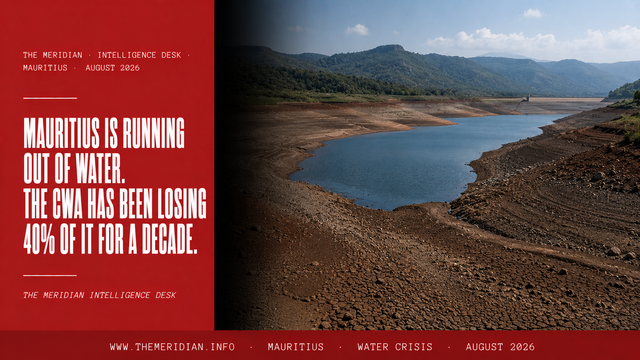
Mauritius is an island surrounded by ocean. It receives 4,000mm of annual rainfall on its central plateau. Its rivers run year-round, flowing from the upland catchments to the sea. Only 7% to 9% of that rainfall is captured and utilised. The CWA network loses up to 40% of the water it does capture through leaks before it reaches a tap. Since 17 February 2025, Mauritius has enforced the Central Water Authority (Dry Season) Regulations 2025, banning car washing, garden irrigation, and swimming pool filling, under penalty of fines up to Rs 200,000 and two years imprisonment. Reservoir levels fell from 92.6% to 38.2% during 2024. The question that every Mauritian ratepayer is entitled to ask, and that the Rs 200,000 fine does not answer, is this: if the island is surrounded by the Indian Ocean, if its rivers are flowing to the sea right now, and if the CWA has been losing nearly half of every drop it collects through its own network, why is the citizen being criminalised for washing their car?
The Top FM graphic circulating on social media this week is accurate as far as it goes. The Central Water Authority (Dry Season) Regulations 2025, promulgated by Cabinet on 14 February 2025 and in force since 17 February 2025, do carry penalties of up to Rs 200,000 fine and two years imprisonment for violations. The Rs 200,000 maximum applies to non-domestic consumers, businesses and commercial operations. Domestic consumers face a fine of up to Rs 50,000. Both categories face the two-year prison term. Police patrols are actively identifying and penalising offenders. The Minister of Energy and Public Utilities has chaired enforcement meetings with the Deputy Commissioner of Police and key stakeholders. The surveillance is real. The penalties are real. What is also real, and what the graphic does not include, is the institutional failure that created the conditions these regulations are trying to manage. That failure has a name, a documented history, and a price that Mauritians have been paying for a decade through their water bills while the CWA lost nearly half of what they were paying for through its own crumbling pipes.
Mauritius is not a desert. It is not a water-scarce country in any geological or climatological sense. It is a volcanic island in the Indian Ocean, surrounded on every side by the largest body of water on the planet, receiving an annual average rainfall of 4,000mm on its central plateau catchment areas. Its rivers, including the Grand River South East, the River du Rempart, the Riviere des Anguilles, and dozens of smaller watercourses, run year-round from the elevated central uplands to the coast. The hydrology of Mauritius is abundant. The management of that hydrology is not.
Mauritius receives an impressive annual average rainfall of 4,000mm, yet only 7% to 9% of this water is effectively captured and utilised, falling short of the country's needs. Another source estimates that only 29% of the total rainfall is captured and distributed while the rest goes out to the sea through the fast-flowing rivers. Whether the capture rate is 7-9% or 29%, the conclusion is identical: the majority of the water that falls on this island, in a country experiencing a water crisis, flows unused into the Indian Ocean. Every river that reaches the coast without being intercepted by a reservoir or a capture system is a policy failure, not a natural disaster.
Mauritius is surrounded by the Indian Ocean. Its rivers are flowing to the sea right now, today, as the police are patrolling the streets looking for people washing their cars. The water crisis is not a shortage of water. It is a shortage of the infrastructure to capture and distribute the water that geography has already provided.
The Central Water Authority is the sole body responsible for distributing drinking water across Mauritius. It is a state monopoly. The August edition of The Meridian documented it in The Company Town article as one of three state monopolies extracting from their own citizens through pricing and service delivery failures. The water crisis of 2025-2026 is the operational expression of what The Company Town article analysed structurally.
Compounding the problem is an inadequate storage infrastructure and substantial distribution network leaks, where up to 40% of water is lost before it reaches consumers. Over the past ten years, leaks have increased from 56% to 73%. These two figures require a moment of analysis. The CWA network is not losing 40% of water through leaks in a network that is otherwise functional. The network leakage rate has been increasing for a decade, from 56% to 73%. The deterioration has been documented, measured, and apparently tolerated for ten years while the CWA continued to bill its customers for water that never arrived at their taps.
The water that does reach households does so through a rationing system that pre-dates the 2025 regulations. Areas like Curepipe, Rose-Hill, and Quatre-Bornes have experienced regular water cuts for years. Port Louis had water supply limited to six hours per day during previous drought periods. The Pailles region experiences restrictions even in normal times. The current crisis is an acute intensification of a chronic management failure, not a sudden natural disaster that no one could have predicted.
The CWA was promised to Mauritians as a utility that would deliver 24-hour water access by 2014. That promise was made in 2014 and has not been delivered. The network that was supposed to be modernised to achieve that promise has instead deteriorated, with leakage rates increasing from 56% to 73% over the same decade. The budget that was allocated to the CWA during that period did not produce a functioning network. It produced a network that is now losing nearly three-quarters of what it carries through its own pipes before the water reaches a household.
The CWA Director General acknowledged a structural vulnerability that compounds the water crisis with an energy crisis: the water supply is precariously linked to the energy sector. The pumps required to move water rely on heavy oil-fired electricity from the Central Electricity Board. "A failure in energy could instantly worsen the water crisis," Mr Thanoo warned, noting that while there are currently no power outages, the system remains fragile. A water utility that depends entirely on a single electricity provider, using heavy oil-fired generation, in a country simultaneously managing an aviation fuel crisis and a public debt at 88% of GDP, is a utility that has been designed with no resilience and no redundancy. The double vulnerability is not a crisis. It is a design choice, made across successive governments, that has now produced consequences that the citizen is being asked to absorb through criminal penalties for washing their car.
A research paper published in The Conversation in 2025 by academics with local knowledge of Mauritius's hydrology proposed a specific, costed, technically viable solution: ten mini-reservoirs strategically located across Mauritius to capture seasonal peak river flows, storing 500,000 cubic metres of additional water, at an estimated cost of approximately $100 million.
One hundred million US dollars. For context: the Mauritius public debt is approximately Rs 560 billion at current estimates, equivalent to roughly $12 billion. The government is paying approximately $1.2 billion per year in debt service. The infrastructure investment that could transform Mauritius's water capture capacity by capturing river flows before they reach the sea costs less than one month of debt service payments.
The solution is not technically complex. It is not financially impossible. It requires political will to prioritise infrastructure that captures the water already falling on this island rather than continuing to manage the consequences of the water that has been allowed to flow, uncaptured, into the Indian Ocean for decades. The Rs 200,000 fine does not capture a single litre of that water. Ten mini-reservoirs would.
The Meridian's August 2026 edition is built around the argument that the extraction economy operates through mechanisms that are legal, institutional, and designed. The Company Town article documented the CWA as a state monopoly that prices a service it delivers inadequately. The water crisis of 2025-2026 is that argument in its most literal form.
Mauritians pay CWA bills for water. The CWA collects those payments. The CWA's network loses up to 73% of what it carries through leaks. The consumer receives whatever is left, rationed and intermittent, and is now threatened with criminal penalties if they use it for purposes the state has classified as non-essential. The state monopoly that failed to maintain the network that lost the water is the same institution whose regulations criminalise the citizen for the consequences of that failure. The river that is flowing to the sea right now, past the sugarcane fields whose irrigation has been suspended, past the reservoirs that are at 38% capacity, past the pipes losing 73% of their content through cracks that have been widening for a decade, is not a natural phenomenon. It is the output of a political economy that chose, across multiple governments, to bill for water rather than invest in capturing it.
The Central Water Authority (Dry Season) Regulations 2025 are a legitimate emergency measure for a genuine crisis. The drought conditions are real. The reservoir decline from 92.6% to 38.2% in a single year is real. The February 2026 rainfall recording as one of the driest months in over a century is real. Climate change is making droughts more frequent and more severe across Small Island Developing States. The Meridian does not dispute any of this.
What The Meridian disputes is the framing that presents this crisis as primarily a citizen behaviour problem requiring criminal enforcement, rather than an infrastructure failure requiring capital investment. The citizen who is washing their car is not the reason the CWA network loses 73% of its water through leaks. The citizen who is filling their swimming pool is not the reason that 71 to 93% of Mauritius's annual rainfall flows uncaptured into the Indian Ocean. The citizen who is watering their garden is not the reason that ten mini-reservoirs that could capture river flows before they reach the sea have not been built, despite a research case for them published in 2025, at a cost of $100 million that is less than one month of Mauritius's annual debt service payments.
The Rs 200,000 fine is the state's answer to a problem the state created. The rivers are flowing to the sea. The pipes are leaking. The reservoirs are empty. The Indian Ocean is on every side. The solution is infrastructure, not enforcement. The political economy of the water crisis is the same political economy that The Company Town article documented in this edition: a state monopoly that has extracted payment for a service it has not delivered, and that now asks the citizen to bear the criminal consequences of its own institutional failure.
Add comment
Comments