Mauritius 2026: Anatomy of a Captured State
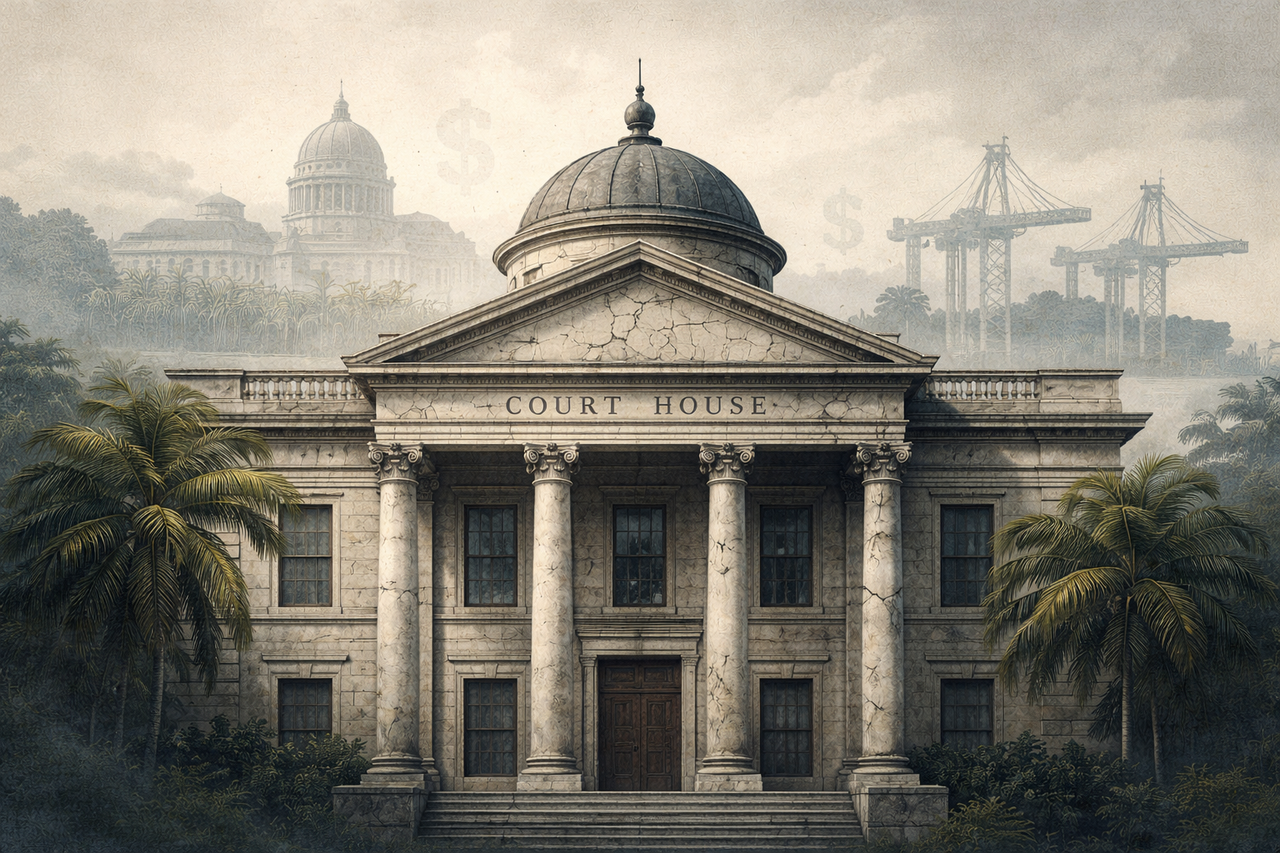
Mauritius remains Africa's highest-ranked democracy in several international indices. Elections occur on schedule. Courts convene daily. The finance minister presents budgets annually. Opposition parliamentarians deliver speeches. International observers note democratic procedures and move on.
Yet these procedures mask institutional hollowing. Mauritius demonstrates capture without collapse: a state where formal democracy persists whilst substantive accountability erodes, where the machinery of governance operates efficiently but increasingly serves incumbent preservation rather than public purpose.
Capture without rupture
Unlike the dramatic collapses seen in Sri Lanka or Lebanon, Mauritius has experienced no currency crisis, no sovereign default, no mass street uprising. GDP per capita reached USD 11,900 in 2024. Public debt, whilst elevated at approximately 85 per cent of GDP, remains serviceable. Tourist arrivals recovered to 1.3 million in 2023, approaching pre-pandemic levels. Youth unemployment fell from 25 per cent in 2021 to 16.6 per cent in 2024.
These numbers suggest competence. They obscure concentration.
Capture has proceeded quietly through three mechanisms. First, constitutional design that vests extraordinary appointment powers in the Prime Minister. Second, fiscal lock-in that transforms budgets from policy instruments into inherited obligations. Third, legal processes that move slowly enough that delay becomes strategy.
The Constitution grants the Prime Minister authority to advise the President on appointments across the state apparatus: ministers and junior ministers, heads of parastatals, regulatory bodies, statutory commissions, ambassadors, senior public offices. In practice, this advisory power is decisive. The result is an executive that shapes not only policy direction but the personnel meant to oversee implementation and enforce constraint.
This design matters most when politics collides with law. When the executive controls appointments to oversight bodies, investigates itself, and prosecutes its opponents, the boundary between lawful authority and political weaponisation becomes difficult to discern.
The concentration operates through constitutional means. The Prime Minister does not breach separation of powers formally; the Constitution grants these appointment authorities explicitly. Yet constitutional legality does not preclude institutional capture. When the same office that sets policy also appoints those who oversee implementation, regulate compliance, and investigate misconduct, checks erode regardless of formal separation. The President, whilst nominally independent, acts on Prime Ministerial advice in practice. Parliament approves appointments but lacks veto power over executive nominees. The result is a system where power concentrates legally, yet accountability weakens systemically. This is capture through design, not deviation.
The revolving prosecution
Two figures dominate Mauritian politics over the past fifteen years: Navin Ramgoolam and Pravind Jugnauth. Both have served as Prime Minister. Both have governed whilst facing legal proceedings. Both illustrate the same institutional weakness: the inability of the system to resolve high-level legal exposure swiftly, transparently and conclusively.
Mr Ramgoolam, Prime Minister from 2005 to 2014 and again from 2024, faced multiple prosecutions after losing power in 2014, including charges related to financial misconduct and electoral offences. Cases moved slowly through the courts, some spanning years without resolution. Outcomes varied; relevance here is duration. When the accused returns to office before cases conclude, and when his former defence counsel becomes Attorney-General, perception corrodes regardless of legal propriety.
Mr Jugnauth, Prime Minister from 2017 to 2024, similarly governed whilst facing constitutional challenges and allegations of electoral irregularities. Again, the issue is not guilt or innocence but timeline and opacity. Justice delayed becomes governance distorted. Legal proceedings that outlast electoral cycles create a permanent state of semi-investigation, where power and prosecution chase each other in circles.
The Attorney-General problem
The institutional tension sharpens with the role of the Attorney-General. Gavin Glover, SC, the current Attorney-General, previously acted as defence counsel for Mr Ramgoolam in earlier proceedings. This is public record. It is entirely lawful. Officials insist it is merely coincidental.
Yet in most advanced democracies, such proximity would trigger mandatory recusal protocols or independent prosecutor appointment. Mauritius has no such firewall. The Attorney-General remains both political appointee and government's chief legal officer. Whilst formal prosecution authority rests with the Director of Public Prosecutions, prosecutorial strategy, legal policy, and legislative framing remain entangled with executive priorities.
The result is not proven interference. It is persistent perception, which in institutional terms proves equally corrosive. When the public cannot distinguish political prosecution from lawful enforcement, the distinction ceases to matter politically.
Colonial laws, modern convenience
Mauritius enters 2026 still governed by colonial-era statutes that grant executive authority powers incompatible with contemporary rule-of-law standards. The provisional charge system permits arrest on suspicion without immediate formal indictment. Human rights bodies and comparative-law scholars have criticised this mechanism for decades. It endures.
That such laws persist reveals institutional priorities. Law reform has been sporadic, politically driven, and rarely systematic. The absence of a permanent, independent law-reform commission leaves outdated statutes to linger precisely because they remain useful to those in power. Colonial law becomes convenient law.
The offshore question
Economic capture mirrors legal capture, and nowhere more clearly than in the financial services sector. Mauritius operates as an offshore financial centre, hosting thousands of International Business Companies (IBCs) and Global Business Licences that channel investment, particularly into Africa and India. The sector contributes meaningfully to GDP and government revenue.
Yet this model creates dependency that constrains policy autonomy. Mauritius was placed on the European Union's tax non-cooperation blacklist in 2016, raising reputational concerns. Pressure from the OECD and Financial Action Task Force (FATF) regarding tax transparency and anti-money-laundering compliance continues. The government must balance revenue dependency against international regulatory demands, a negotiation conducted largely opaquely.
Double taxation treaties, particularly with India, remain politically sensitive. When India renegotiated terms less favourable to Mauritian conduits, revenue implications forced policy adjustment. The island's role as conduit depends on maintaining preferential treatment whilst avoiding blacklisting. This leaves little room for independent fiscal strategy.
Fiscal lock-in
Economic vulnerabilities extend beyond offshore finance. Mauritius's fiscal structure demonstrates capture through pre-commitment. The 2025–26 budget reveals that approximately 88 per cent of recurrent expenditure is locked in before any new policy initiative can be funded. Pensions absorb roughly 25 per cent, civil service wages 30 per cent, subsidies 18 per cent, and debt service 15 per cent. Discretionary spending accounts for barely 12 per cent of the budget.
This structure transforms politics into distribution of fixed resources rather than strategic allocation. Governments inherit spending commitments they cannot easily reverse. Pensions, negotiated by previous administrations, continue compounding. Subsidy systems persist because constituencies resist removal. Civil service headcount adjusts slowly regardless of productivity requirements.
The result is policy space that narrows each fiscal year. Governments promise investment in infrastructure, education, healthcare. Budget arithmetic reveals limits. Political competition becomes argument over marginal adjustments to pre-committed spending.
Protected rents
Economic structure reinforces fiscal rigidity. Large segments of the economy survive through political protection rather than competitive productivity. The sugar industry, once dominant, continues receiving subsidies despite declining global competitiveness. Import dependencies create local monopolies that resist liberalisation. Property development absorbs investment that might otherwise flow toward tradable sectors.
Tourism, contributing approximately 8.6 per cent of GDP in 2022 (with projections of 13.5 per cent by 2024), remains the primary foreign exchange earner. Yet the sector's recovery from pandemic collapse (arrivals fell to 997,000 in 2022 before recovering to 1.3 million in 2023) revealed concentration risks. When borders closed, alternatives proved limited.
Currency dependency amplifies vulnerability. Imports (fuel, food, medicine, consumer goods) are priced overwhelmingly in US dollars whilst export earnings remain concentrated in tourism and financial services. Calls for dedollarisation through trade settlement in Indian rupees or Chinese yuan grow louder. Yet diversification without scale, credibility, and reserves creates fragility rather than resilience.
A rentier state derives substantial revenue from external rents—income generated not through productive domestic activity but through control over assets, licences, or geographically concentrated resources. The term originates in Middle East scholarship (Beblawi, Luciani, Ross) describing oil-dependent economies where governments fund themselves through resource extraction rather than taxation.
In Mauritius, rentierism operates differently but recognisably: Instead of oil, rents flow from offshore financial licences (IBCs, Global Business), sugar subsidies, protected land development, tourism concessions, and privileged access to foreign exchange allocations. These income streams depend on political access rather than competitive productivity.
Why rentier systems resist reform: When governments depend on rents rather than broad-based taxation, they become accountable to licence-holders and protected sectors rather than general taxpayers. Citizens lose fiscal leverage. Élites who benefit from existing arrangements resist changes that threaten distributions. Reform becomes structurally difficult even when economically necessary.
licences/assets
capture
taxation
fragility
accountability
Monetary fragility and dollar dependence
Mauritius's economic vulnerabilities extend into monetary policy. The Mauritian rupee has experienced long-run depreciation against the US dollar, declining from approximately MUR 28 per dollar in 2010 to MUR 45–46 in 2025. Whilst central bank interventions smooth volatility, underlying pressures persist: structural trade deficits, import dependency, and limited export diversification.
Import dependence creates perpetual foreign exchange stress. Mauritius imports the overwhelming majority of food staples (rice, wheat, cooking oil), all petroleum products, most medicines, and consumer manufactures. These imports are dollar-denominated. When the rupee weakens, import costs rise, feeding inflation and compressing household purchasing power. The Bank of Mauritius maintains reserves sufficient to cover approximately four months of imports, adequate by international standards but insufficient to shield against sustained pressure.
Political debate increasingly centres on de-dollarisation: settling trade in rupees, yuan, or regional currencies to reduce dollar dependency. India and China have encouraged bilateral currency arrangements. Yet credible de-dollarisation requires scale, liquidity, and institutional depth Mauritius lacks. Rupee internationalisation without correspondent reserves and convertibility guarantees creates exchange rate risk that trading partners are unlikely to accept. The dollar's dominance reflects not coercion but convenience, liquidity, and legal enforceability—qualities alternative currencies cannot yet match at comparable scale.
Foreign exchange stress consequently becomes political stress. When reserves tighten, import restrictions follow. When inflation rises, subsidies expand—compounding fiscal pressure. When currency weakens, offshore investors question stability. Monetary policy loses degrees of freedom, constrained by external balances the economy cannot internally generate. This is not unique to Mauritius, but the island's size and import dependence amplify vulnerability.
Why voters acquiesce
Understanding capture requires explaining why voters continue electing governments that perpetuate these patterns. The answer combines rational calculation with institutional design.
First, economic performance, whilst disappointing relative to potential, avoids catastrophe. Youth unemployment fell from 25 per cent in 2021 to 16.6 per cent in 2024. GDP per capita exceeds most African states. Public services function adequately for most citizens most of the time. The comparison set is regional rather than global. Mauritius looks better than Madagascar, worse than Singapore, and voters adjust expectations accordingly.
Second, clientelist networks deliver tangible benefits. Government employment, pension access, housing schemes, and subsidy programmes create constituencies dependent on incumbent protection. Promises of reform threaten existing distributions before delivering uncertain gains.
Third, electoral system design fragments opposition. The best-loser system, intended to ensure communal representation, entrenches ethnic voting patterns and makes coalition formation necessary for victory. Parties compete by mobilising communal bases rather than building programmatic alternatives. The system rewards those skilled in ethnic arithmetic over those proposing institutional reform.
Fourth, opposition weakness creates "better the devil you know" logic. When alternatives lack credibility or cohesion, incumbents win by default. Voters recognise capture but doubt opposition capacity to govern differently.
External pressures, limited leverage
International actors possess limited tools to force institutional reform. The IMF conducts Article IV consultations and notes fiscal vulnerabilities but provides no programme lending that would create conditionality leverage. The EU blacklisted Mauritius for tax non-cooperation in 2016, prompting regulatory adjustments but not structural change. The OECD pushes transparency standards; Mauritius complies minimally whilst preserving core offshore functions.
China and India compete for influence but neither prioritises governance reform. Chinese infrastructure loans support development visible to voters (metro systems, roads, ports). Indian investment uses Mauritius as treaty conduit. Neither power benefits from disrupting arrangements that serve their interests.
Regional organisations lack enforcement capacity. The African Union and Southern African Development Community issue statements but impose no meaningful costs. Western donors, having shifted focus toward larger markets, provide limited aid leverage.
The result is external engagement that accepts rather than challenges capture. International actors work with whoever governs, adjusting to local realities rather than demanding transformation.
What could change this?
Three scenarios might force institutional reform, none imminent.
First, fiscal crisis. If debt-servicing costs crowd out essential services, if pension obligations become unsustainable, if currency pressure forces devaluation beyond manageable limits, voters might demand structural change. Yet crisis thresholds prove elusive. Mauritius has avoided collapse repeatedly through marginal adjustment rather than reform.
Second, generational shift. Youth unemployment, whilst falling, remains double the general rate. Younger voters with university qualifications face limited opportunity in protected sectors. Brain drain continues (though precise emigration statistics remain unpublished). Eventually, demographic pressure might force political realignment. Yet "eventually" extends indefinitely when alternatives lack organisation.
Third, external shock. Loss of preferential market access, FATF blacklisting, or major financial-sector scandal could force rapid policy change. Barbados faced similar pressure and reformed its offshore sector substantially. Mauritius could follow. Yet shocks prove unpredictable, and governments skilled in navigating crises often emerge strengthened rather than chastened.
Absent crisis, capture continues. The machinery operates. Forms persist. Substance erodes incrementally.
The Mauritian exception
Mauritius occupies unusual space. It is neither failed state nor developmental success, neither fully captured nor genuinely competitive democracy. Singapore, often invoked as comparison, combined authoritarianism with ruthless meritocracy and anti-corruption enforcement. Botswana preserved democratic competition whilst building capable bureaucracy. Mauritius chose different path: democratic forms married to elite circulation and clientelist distribution.
This produces stability of a particular kind. Institutions function well enough to avoid collapse, poorly enough to perpetuate dependency. Laws exist but enforcement varies by political proximity. Democracy operates but choices narrow to personnel changes rather than policy shifts.
The danger is not dramatic failure. Failed states announce themselves with visible crisis. The danger is gradual irrelevance: an economy that grows slowly, institutions that decay quietly, talent that leaves steadily, and a population that adjusts expectations downward generation by generation.
The illusion of choice
Mauritius still votes freely. Governments still change through elections rather than coups. Courts still convene. Civil liberties remain mostly intact. International rankings note these facts and conclude democracy persists.
Yet real choices have narrowed dramatically. Fiscal arithmetic constrains promises. Legal inertia delays accountability. Institutional design concentrates power. Economic structure protects rents. Electoral incentives reward communal mobilisation over programmatic competition. External actors accept rather than challenge local arrangements.
Captured states do not always collapse. More often, they stagnate whilst maintaining procedural legitimacy. They deliver enough performance to discourage risk, sufficient distribution to maintain coalitions, adequate process to satisfy international observers. They govern poorly whilst governing continuously.
The danger for Mauritius is not authoritarianism. Coups remain unlikely. Democratic forms will persist. The danger is complacency: mistaking form for substance, rankings for reality, legality for legitimacy, and continuity for success.
Unless institutions are insulated from political control, laws modernised beyond colonial convenience, economic rents challenged through competition, and fiscal policy freed from inherited obligations, Mauritius risks perfecting a particular model: procedural democracy that works brilliantly on paper, mediocrely in practice, and poorly for those without access to patronage networks.
The island has avoided the catastrophes that befell neighbours. It has not become the developmental success its advantages suggested possible. Instead, it has achieved stability through institutional capture so gradual, so legal, so procedurally correct, that neither crisis nor reform seems urgent. That achievement, if it can be called such, may prove its most durable vulnerability.