Food Security Without Famine
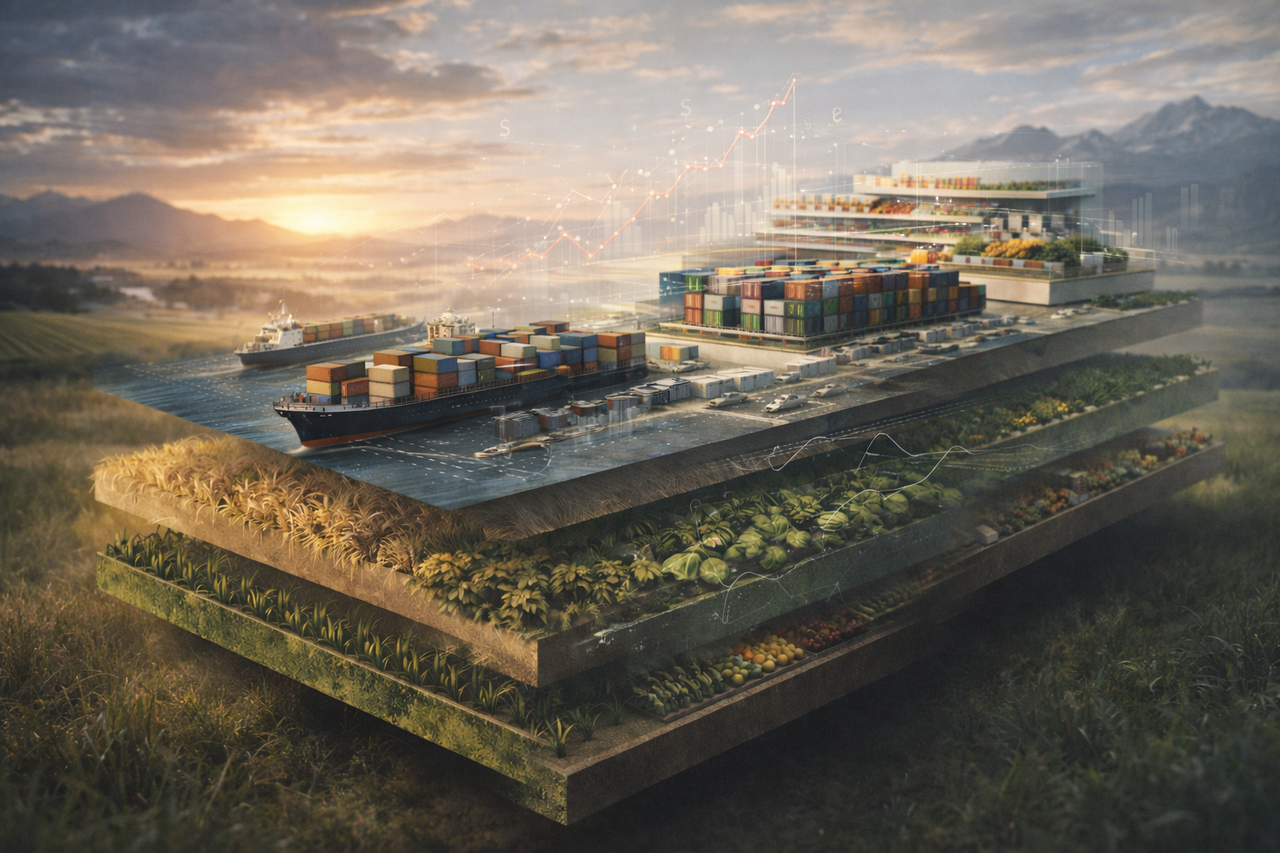
Food security in the 21st century is shaped less by agronomy than by exchange rates, corporate concentration, logistics control, and household income dynamics. The modern food crisis is not one of empty silos or catastrophic crop failures. It is a crisis of distribution, pricing power, and structural inequality embedded in global supply chains.
The quiet oligopoly at the heart of global food
At the centre of the modern food system sits a small group of firms that rarely appear in public debate, yet exert enormous influence over what the world eats and at what price. Four companies dominate global grain trading: Cargill, Archer Daniels Midland (ADM), Bunge, and Louis Dreyfus Company. Together, these firms control an estimated 70–90% of global grain trade.
They do not merely move wheat or maize from one port to another. They control storage infrastructure spanning continents, shipping and freight contracts that determine logistics costs, futures markets and hedging instruments that shape price discovery, quality standards and certification that set market access requirements, and risk pricing during volatility that determines who pays for uncertainty.
Their profits are not tied to harvest size, but to price movements, scale, and volatility. During the 2020–2023 period of global disruption, these firms reported record or near-record profits. Cargill's net earnings exceeded $6 billion in a single year. ADM and Bunge each reported multi-billion-dollar operating profits. Trading margins expanded sharply during price spikes, even as consumers paid more.
The four firms—ADM, Bunge, Cargill, and Louis Dreyfus—are collectively known as the ABCD companies. They emerged through decades of consolidation, acquiring smaller traders, building global infrastructure, and establishing near-total control over grain logistics from farm to port.
How they maintain power: Vertical integration from storage to shipping; proprietary data on global supply and demand; access to cheap financing through scale; political influence in producing and consuming countries; technical standards that exclude smaller competitors; futures market participation that shapes price expectations.
Why this matters: In competitive markets, volatility lowers profits through uncertainty. In concentrated markets, volatility raises profits through trading margins. The incentive structure is reversed. Stability benefits consumers and producers; volatility benefits intermediaries.
This is not an allegation of wrongdoing. It is a structural reality: in a concentrated system, volatility is lucrative for intermediaries and costly for households. The architecture of global food trade was designed for efficiency at scale, not for resilience or equity. When shocks occur—droughts, wars, pandemics, currency crises—the cost falls disproportionately on importing countries and low-income consumers.
Who produces, who profits
The Global South produces a substantial share of the world's agricultural output—grains, sugar, palm oil, cocoa, coffee. But it captures a disproportionately small share of the value. The reason is straightforward: fertilisers are imported, machinery is imported, fuel is imported, insurance and shipping are imported, standards are set elsewhere, and pricing is denominated in foreign currency.
Farmers sell into global markets they do not control, whilst consumers buy food priced through layers of financial intermediation. As a result, food exporters can still face food insecurity, and food-importing countries can remain dependent even when domestic production exists. This is not paradox. It is colonial continuity through market structures rather than direct political control.
The fertiliser trap
Modern agriculture is impossible without chemical fertilisers. Nitrogen, phosphorus, and potassium—NPK—determine yields. Yet the Global South produces almost none of its own fertiliser. It imports from Russia, Belarus, China, and a handful of Western producers. This creates structural dependency that mirrors oil dependence but receives less attention.
Russia and Belarus together supply approximately 40% of global potash exports. Russia alone accounts for 15% of global nitrogen fertiliser trade. When sanctions disrupted Russian exports in 2022, prices tripled. African and Asian farmers faced impossible choices: plant without fertiliser and accept lower yields, or borrow at high rates to afford inputs whose prices had exploded.
Sri Lanka's experiment in banning chemical fertilisers illustrates the trap's severity. In 2021, facing foreign exchange shortages, the government abruptly prohibited imports, mandating organic farming overnight. Rice yields collapsed by 40%. Tea production fell by 30%. A country that once exported rice became import-dependent at precisely the moment it could least afford it. The policy was reversed within months, but the damage persisted. Farmer debt rose. Food prices surged. Political stability fractured.
The fertiliser trap illustrates a broader pattern: inputs are globalised, but outputs are local. Farmers bear price risk on both ends. When input costs rise or output prices fall, they cannot hedge or diversify. Many borrow to plant, hoping prices hold. When they do not, debt accumulates. Over time, this creates structural indebtedness that makes farmers vulnerable to land loss, informal credit, and distress migration.
Why importing food often makes economic sense — until it doesn't
Many developing economies import food not because they cannot grow it, but because it is cheaper to import than to produce domestically at scale. Modern agriculture is capital-intensive. It requires machinery, irrigation, storage, logistics, and market access. As economies urbanise and education levels rise, fewer workers are willing to farm. This is not cultural failure; it is development.
The problem is that food imports are paid for in hard currency. When export revenues weaken or capital inflows dry up, the same strategy becomes a liability. Egypt imports 80% of its wheat, paid for in dollars. Lebanon, before collapse, imported 85% of its food. Small island states import 90%+ of calories consumed. Each relies on external income—tourism, remittances, commodity exports, or financial services—to finance food purchases.
This works whilst external income flows. It fails when flows stop. Lebanon's experience is instructive. Tourism collapsed during COVID-19. Remittances fell. The banking system froze. The currency lost 98% of its value. Food prices, denominated in dollars, became unaffordable overnight. Bread queues reappeared. Malnutrition rates rose. Yet grain silos stood full—owned by importers who would not release stock at subsidised prices the government could not afford.
The lesson is not that countries should retreat into autarky. It is that food systems are inseparable from balance-of-payments management. Food security, in import-dependent economies, is currency security. And currency security depends on export competitiveness, capital inflows, or external rents. When any of these fail, food becomes the transmission mechanism for macroeconomic crisis.
The dollar denomination problem
Global food is priced in dollars. Wheat futures trade in Chicago. Rice prices reference Thailand, quoted in dollars. Palm oil is denominated in dollars. Even domestic food in many countries shadows international prices adjusted for transport and tariffs. This creates a permanent currency mismatch for importing countries.
When local currencies depreciate—as they frequently do in emerging markets—food prices rise automatically, even if global prices remain stable. Egypt's pound lost 50% of its value between 2022 and 2024. Domestic wheat prices doubled, though global wheat prices had declined. Lebanese, Turkish, and Pakistani currencies experienced similar dynamics. Food inflation becomes imported through exchange rates.
Governments respond through subsidies, price controls, or import restrictions. Each imposes costs. Subsidies drain fiscal resources that could fund infrastructure or education. Price controls create black markets and shortages. Import restrictions reduce competition and entrench monopolies. None address the underlying problem: local wages are earned in depreciating currencies whilst food is priced in hard currency.
Wages fall behind food
Another pressure point lies at the household level. In many countries, food inflation has persistently outpaced wage growth, especially for lower- and middle-income workers. Even where nominal wages rise, they often fail to keep pace with the cost of a healthy diet. Households respond rationally: they substitute towards cheaper calories, reduce protein and fresh produce, and increase consumption of ultra-processed foods.
This is not poor choice. It is constrained optimisation. A kilogram of rice delivers 3,500 calories for $1. A kilogram of fresh vegetables delivers 200 calories for $2. When budgets tighten, substitution is automatic. The result is calorie sufficiency alongside nutritional deficiency. Households eat enough to avoid hunger but not enough to avoid malnutrition.
Calories without nutrition
The affordability crisis intersects with a deeper problem: the declining nutritional quality of food itself. Modern food systems prioritise yield, shelf life, and transport resilience—not micronutrient density. Staple crops contain fewer nutrients than in previous decades. Wheat grown with high-nitrogen fertiliser produces more carbohydrate but less protein and minerals. Vegetables harvested early for long-distance shipping have lower vitamin content than locally grown equivalents.
Processed foods dominate the cheapest price points. Instant noodles, biscuits, sweetened beverages, and fortified flour provide calories but little else. They are shelf-stable, require no refrigeration, and can be distributed cheaply. For poor households, they are often the most economical source of energy. Yet they drive obesity, diabetes, and cardiovascular disease at rates never seen historically.
The result is a global paradox: obesity and malnutrition rise together. In Egypt, 35% of adults are obese whilst 13% of children are stunted. In Mauritius, diabetes affects 22% of adults. In Mexico, 75% of adults are overweight, yet micronutrient deficiencies persist. These are not separate crises. They are the same crisis expressed through different symptoms. Both reflect food systems optimised for profit, not health.
Modern diets deliver sufficient calories but insufficient nutrients. Ultra-processed foods provide energy through refined carbohydrates, added sugars, and vegetable oils whilst lacking protein, vitamins, and minerals. The body registers calorie surplus (causing obesity) whilst experiencing nutrient deficiency (causing malnutrition).
Why this happens: Fresh produce requires refrigeration, spoils quickly, and costs more per calorie. Processed foods are shelf-stable, cheap, and energy-dense. For households facing budget constraints, the choice is rational but nutritionally catastrophic.
The health cost: Type 2 diabetes, cardiovascular disease, and metabolic disorders are epidemic in developing countries. Healthcare systems absorb costs that might otherwise fund education or infrastructure. Productivity declines. Life expectancy gains stall. The food system generates profit whilst externalising health costs to individuals and states.
Stress, inequality, and how people eat
Economic stress also reshapes diets. Insecure employment, debt burdens, and uncertainty push households toward convenience foods and short-term coping strategies. Fresh cooking requires time, planning, and kitchen infrastructure. Processed foods require none of these. For households working multiple jobs or facing unstable schedules, convenience becomes necessity.
At the other extreme, a global gourmet economy flourishes. Organic, artisanal, and wellness-branded foods proliferate—but only for those who can afford them. Farmers' markets in wealthy suburbs sell heirloom vegetables at prices equivalent to several days' wages for median earners. Specialty diets—paleo, keto, plant-based—require disposable income and leisure time for meal preparation.
The food system thus reproduces inequality: one segment eats too little and too poorly; another eats selectively, excessively, and symbolically. Food becomes a marker of class as much as nourishment. What people eat signals not just taste but purchasing power, time availability, and social position.
The rentier logic applied to food
Many states now manage food not through production but through distribution financed by external rents—tourism, commodities, remittances, finance. This mirrors the rentier-state model observed in Mauritius, Lebanon, and small island economies. External income funds imports. The state stabilises prices through subsidies. Political legitimacy depends on affordability, not productivity.
Food security becomes contingent on capital inflows rather than harvests. This can work—until it doesn't. When tourism collapses, remittances dry up, or commodity prices fall, food becomes unaffordable instantly. The state cannot print foreign currency. Subsidies become fiscally unsustainable. Bread prices rise. Protests follow. Governments fall.
Lebanon's trajectory illustrates this pattern perfectly. Food imports were financed through banking inflows, remittances, and tourism. When the banking system collapsed in 2019, food became the first casualty. Wheat imports continued, but at market prices households could not afford. The government lacked dollars to subsidise. Bread queues reappeared for the first time in decades. Yet silos remained full. The problem was not supply but purchasing power.
The futures market and financialisation
Food prices are not determined solely by supply and demand for physical grain. They are shaped by futures markets where financial players—pension funds, hedge funds, commodity index investors—trade contracts for future delivery. During the 2008 food crisis, financial speculation amplified price volatility. Prices rose not because harvests failed but because investors piled into commodities as an inflation hedge.
Wheat prices doubled between 2007 and 2008. Rice prices tripled. Maize prices surged 80%. Physical stocks were adequate. The spike was driven by speculation, dollar weakness, and panic buying. Food riots erupted across 30 countries. Governments fell in Haiti, Madagascar, and Mauritania. The crisis ended not through increased production but through financial deleveraging when markets crashed.
The lesson was ignored. Financialisation persists. Agricultural commodity futures are now standard portfolio diversification tools. When inflation fears rise, capital flows into food. Prices spike. Poor households pay. When markets calm, capital exits. Prices fall. Farmers lose. The system privatises gains and socialises losses.
What is missing from the global debate
What is striking is not what is discussed, but what is not. Missing from most food-security debates are corporate concentration and pricing power, currency exposure and wage dynamics, nutritional quality beyond calorie counts, and the political economy of trade and rents. Food is treated as an agricultural issue rather than a macroeconomic and distributional one.
As long as this framing persists, policy responses will remain partial. Governments subsidise bread without addressing currency weakness. They promote organic farming without ensuring farmers can afford inputs. They target malnutrition through fortification whilst ignoring processed food proliferation. Each intervention addresses symptoms, not structures.
Why famine is no longer the warning signal
The danger today is not famine. It is slow deterioration—in diet quality, health outcomes, and social resilience. Because this decline is gradual, it attracts less urgency. But its consequences accumulate over decades, shaping productivity, healthcare costs, and inequality. Food security without famine is not success. It is delay.
Famine triggers emergency response: aid convoys, international attention, political pressure. Chronic malnutrition triggers none of these. It unfolds quietly, affecting productivity rather than survival, burdening healthcare systems rather than triggering refugee flows, and eroding potential rather than causing immediate collapse. Policymakers optimised for crisis management miss the long, slow erosion.
The real choice ahead
A serious food strategy would require integrating food policy with currency and wage policy, treating nutrition as public infrastructure, reducing exposure to concentrated intermediaries, and building resilience, not slogans. It would mean recognising that food security for import-dependent states requires export competitiveness or capital controls to manage currency risk.
It would mean antitrust enforcement against oligopolistic traders, regulation of futures markets to limit speculation, regional food storage systems to reduce volatility, and wage policies that ensure purchasing power grows alongside food prices. It would mean prioritising micronutrient density over yield maximisation, supporting diversified farming over monoculture, and subsidising fresh produce rather than processed commodities.
None of this requires romanticism. It requires realism. The world's food problem is not that it produces too little. It is that it distributes badly, prices unfairly, and nourishes unevenly. That is why the world eats more and eats worse.
The world's food problem is not that it produces too little. It is that it distributes badly, prices unfairly, and nourishes unevenly. That is why the world eats more and eats worse.