Trump, Maduro and the Limits of Power
The danger is not that law is broken. International law has always been broken. The danger is that it is broken without embarrassment, without procedural effort, and without even the pretence of universality. When powerful states act as though law is optional, others learn quickly. The system that took generations to build can unravel in a single decade of indifference.
The legal framework: narrower than often assumed
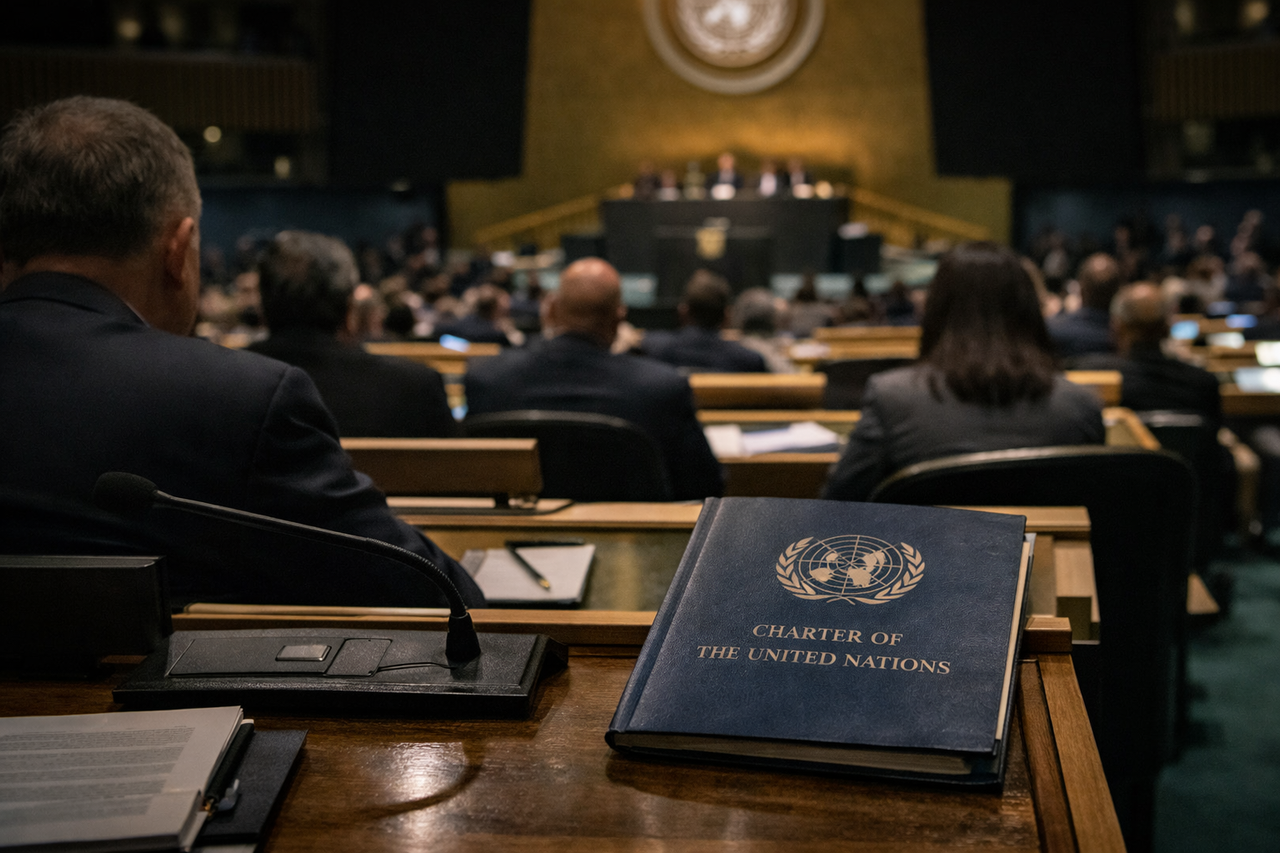
The modern international legal order rests on a simple but severe rule. Article 2(4) of the United Nations Charter prohibits the use of force against the territorial integrity or political independence of any state. There are only two recognised exceptions. The first is self-defence, in response to an armed attack, as specified in Article 51. The second is authorisation by the UN Security Council, acting under Chapter VII when international peace and security are threatened.
Venezuela satisfied neither condition. There was no Venezuelan attack on another state. There was no Security Council resolution authorising force. The justification offered instead rested on a looser concept: humanitarian necessity combined with democratic restoration. This argument has intuitive appeal. Venezuela's humanitarian collapse was real. Its governance failures were profound. Electoral legitimacy had evaporated. Refugee flows destabilised neighbours. Economic dysfunction created regional spillovers.
But international law does not recognise "governance failure" as a lawful trigger for military intervention. Nor does it permit force simply because an election is disputed or an economy collapses. The law is deliberately austere because it was designed after a century in which moral justifications were repeatedly used to disguise raw power. The architects of the United Nations system understood that elasticity invites abuse, and that abuse, once normalised, becomes systematic.
Humanitarian intervention: a contested doctrine
Proponents of the Venezuelan intervention invoked humanitarian intervention—sometimes explicitly, more often implicitly. Yet humanitarian intervention remains unsettled law, not settled doctrine. After NATO's intervention in Kosovo in 1999, many Western governments argued that force could be lawful if it prevented mass atrocities, even without Security Council approval. Others—including large parts of the Global South—rejected this outright.
The compromise that followed was Responsibility to Protect, adopted at the 2005 World Summit. R2P, however, did not legalise unilateral force. It reaffirmed that coercive measures require Security Council authorisation. Its purpose was to narrow, not widen, the circumstances of intervention. The doctrine was meant to prevent atrocities through collective action, not to legitimise unilateral military campaigns dressed in humanitarian language.
In Libya in 2011, the Security Council authorised force explicitly to protect civilians. What followed—a rapid escalation to régime change—deeply damaged trust in the doctrine. Russia, China and many developing states concluded that humanitarian language could be weaponised to achieve political outcomes never approved by the Council. The mission expanded from civilian protection to government overthrow. Authority was exceeded. Trust was shattered.
Venezuela unfolded against this background of mistrust. Without authorisation, intervention there did not revive humanitarian law. It confirmed its fragility. Every state watching drew conclusions about what constraints remain, what promises are kept, and what precedents can be cited when circumstances favour force over negotiation.
Trump's role: central, but not singular
Donald Trump's presidency matters here not because it was uniquely aggressive, but because it was openly transactional. His approach to foreign policy rejected the traditional language of liberal internationalism—values, norms, institutions—in favour of leverage, deals and outcomes. In that sense, Venezuela became less a moral question than a strategic calculation: instability on America's doorstep, refugee flows, energy markets, and geopolitical rivalry with actors unwilling to accept US primacy.
What distinguished Trump's posture was not lawlessness per se, but indifference to legal optics. Previous administrations often sought legal cover—however strained—through multilateral statements, coalition-building, or extended diplomatic choreography. Lawyers were consulted. Memos were written. International partners were courted, even if their support proved largely symbolic. The Trump administration displayed little interest in such rituals. Action preceded justification. Outcome mattered more than process.
This matters because norms survive not through perfection, but through performance. International law has always been honoured more in aspiration than in practice. Yet the gap between principle and action was traditionally mediated by procedural effort. States violated rules, but acknowledged them. They sought exceptions, but framed them narrowly. They claimed self-defence implausibly, but claimed it nonetheless. These rituals served a purpose: they preserved the fiction that law constrained power, even when power prevailed.
Trump dispensed with the fiction. In doing so, he did not merely violate norms. He signalled that norms could be ignored without consequence. That signal, once sent, cannot be easily recalled. It teaches rivals that legal justification is optional. It teaches allies that American commitments are contingent. It teaches smaller states that the system offers less protection than imagined.
The precedent problem
The most dangerous feature of the Venezuelan intervention is not what it achieved, but what it legitimised. If humanitarian collapse plus political illegitimacy plus regional instability are sufficient grounds for intervention, then a wide range of states qualify. Sudan faces state failure and mass displacement. Myanmar experiences military dictatorship and ethnic cleansing. Syria endures civil war and humanitarian catastrophe. Haiti suffers governance collapse deeper than Venezuela's ever was. Afghanistan under Taliban rule violates every principle of human rights the West claims to uphold. Parts of the Sahel operate as failed states where authority has dissolved entirely.
Even developed states experiencing constitutional crisis could, in theory, be judged similarly if criteria become sufficiently elastic. Once thresholds lose precision, intervention becomes discretionary. And once intervention is discretionary, it reflects power, not principle. The decision of where to act and where to abstain reveals not legal reasoning but strategic calculation.
This is how international law dies—not through dramatic repudiation, but through slow erosion. Rules become suggestions. Obligations become aspirations. Constraints become optional. The system persists in form whilst emptying of content. Treaties are signed but selectively honoured. Courts issue judgements that powerful states ignore. Norms are invoked by the weak and dismissed by the strong.
The quiet death of restraint
The post-1945 order was designed by people who understood catastrophe intimately. They had lived through two world wars sparked by legal exceptionalism. They had watched empires justify conquest through civilising missions. They had seen sovereignty violated in the name of superior values, only to discover that values served as cover for greed, ambition, and strategic advantage.
So they chose rules. Not because rules are perfect, but because unconstrained power is worse. They built a system premised on restraint, knowing that restraint would be tested, violated, and frequently dishonoured. Yet they believed that even imperfect rules constrain better than no rules at all. That belief sustained the international order for three-quarters of a century.
That distinction is eroding. In recent years, force has been justified not as tragic necessity, but as managerial problem-solving: stabilising regions, unlocking resources, managing migration, restoring order. Military action becomes administrative. Sovereignty becomes conditional. Legal review becomes secondary to operational tempo. Intervention is framed not as violation but as responsibility, not as exception but as sensible governance.
This is how norms die—not loudly, but through repetition. Each intervention creates precedent for the next. Each exception normalises exceptionalism. Each successful operation demonstrates that force works whilst negotiation delays. Over time, the question shifts from whether intervention is lawful to whether it is effective. Legality recedes. Pragmatism advances. Law becomes decoration.
Selectivity and credibility
A further problem lies in selective application. Venezuela was subjected to force. Others were not. Why Venezuela and not Yemen, where humanitarian catastrophe dwarfs anything Venezuela experienced? Why Venezuela and not Ethiopia, where civil war produced famine and ethnic cleansing? Why Venezuela and not Haiti, whose governance collapse is arguably deeper and whose proximity to the United States is even greater?
The answer is not legal. It is geopolitical. Venezuela possessed oil reserves, challenged American influence, and aligned with rivals. Yemen is strategically marginal to Washington despite being central to Riyadh. Ethiopia matters less than its population suggests. Haiti offers neither resources nor geopolitical threat sufficient to justify military deployment.
Selectivity undermines legitimacy because it confirms what critics of the international system have long argued: that law constrains the weak more than the strong. When intervention occurs where interests align and abstains where interests diverge, the pretence of principle collapses. Humanitarian rhetoric becomes transparent cover for strategic calculation. Future appeals to universal norms ring hollow when past applications were nakedly selective.
Once this perception hardens, compliance collapses not only amongst violators, but amongst those who once defended the system in good faith. States that believed in multilateral order conclude that order is illusion. States that invested in legal institutions discover that institutions serve power. The system's defenders become its critics. Its beneficiaries hedge their bets.
International law as infrastructure
International law is often discussed as morality. It is better understood as infrastructure—invisible when it works, indispensable when it fails. It allows trade routes to function without armed escort. It permits borders to remain stable without constant military vigilance. It enables debts to be enforced across jurisdictions. It ensures treaties are honoured even when inconvenient. It reduces uncertainty in a world where uncertainty is costly.
Investors rely on it. Supply chains depend on it. States organise their affairs around it. Small countries depend on it disproportionately because they lack the capacity to defend themselves through force. For them, law is not abstract principle. It is survival mechanism. When powerful states bypass it, they do not merely weaken abstract principles. They raise risk premia across the system. Insurance costs rise. Investment declines. Trade fragments. Hedging replaces trust.
In a fragmented, multipolar world, this is not costless. The United States may act unilaterally today, but it cannot compel others to accept American primacy tomorrow. China watches and learns. Russia adjusts its calculations. European allies grow cautious. Middle powers hedge. The global economy, which depends on stable rules to function efficiently, experiences friction. Capital becomes cautious. Contracts include escalation clauses. Long-term planning shortens.
Trump's legacy in law, not politics
Whether one admires or opposes Donald Trump is beside the point. His significance lies in what his presidency revealed rather than what it intended. He demonstrated that the enforcement of international law depends less on texts than on habits. Treaties matter insofar as states choose to honour them. Institutions function insofar as members defer to them. Norms constrain insofar as violations provoke cost.
Once habits erode, restoration is slow. Future administrations may speak the language of norms again. They may rejoin institutions Trump abandoned. They may reaffirm commitments Trump dismissed. But they will do so in a world where precedent has shifted. Rivals will cite Venezuela when justifying their own interventions. Allies will remember silence when their interests were threatened. Smaller states will hedge rather than trust.
The damage is not to American power, which remains formidable. The damage is to the system that mediated how that power was exercised. American strength does not require international law. But American interests—long-term, strategic, economic—benefit immensely from a predictable international order. Trump's legacy is to have weakened that order without replacing it with anything durable.
The danger of success
There is a final, uncomfortable truth. The Venezuelan intervention may yet "work" in narrow terms. The economy may stabilise. Refugee flows may reverse. Oil output may recover. Elections may be held. A new government may gain legitimacy. International observers may certify progress. Investors may return. The country may, within a decade, be cited as proof that intervention can succeed when executed decisively.
If that happens, the temptation to replicate the model will grow. Success legitimises method. Outcomes eclipse process. Future crises will prompt calls for action modelled on Venezuela: swift, unilateral, justified retrospectively by results rather than prospectively by law. The lesson drawn will be that force works when applied decisively, and that legal constraint impedes necessary action.
History suggests that successful violations are more dangerous than failed ones. Failed interventions discredit themselves. Successful ones teach the wrong lesson. They demonstrate that power, when applied without legal constraint, can achieve objectives. They suggest that procedure is obstacle, not safeguard. They encourage imitation by others who possess neither the resources nor the restraint to manage consequences.
The post-1945 order was built by people who understood this danger intimately. They had seen empires justify aggression through success. They had watched conquerors claim vindication through outcomes. They chose rules precisely to prevent success from becoming its own justification. They understood that power, once unleashed, rarely confines itself to its stated purpose.
A closing warning
Venezuela's crisis was real. Maduro's governance failed. None of that is in doubt. The humanitarian collapse was documented. The electoral fraud was evident. The economic dysfunction was profound. The refugee crisis was destabilising. The geopolitical implications were significant. Every criticism of the régime was warranted. Every description of suffering was accurate.
What remains in doubt is whether the world has learned the right lesson. If international law becomes conditional—applied when convenient, ignored when costly—then the system that protects sovereignty, predictability and peace will hollow out from within. Law will persist in form whilst losing substance. Treaties will be signed but selectively honoured. Institutions will convene but lack authority. Norms will be invoked but not enforced.
Force can remove governments. It cannot replace legitimacy. And legitimacy, once lost, is harder to rebuild than oil wells, institutions, or currencies. It requires trust, and trust accumulates slowly through consistent behaviour. Every violation depletes the reservoir. Every exception weakens the rule. Every success without legality teaches that legality is optional.
The limits of power exist not to protect the guilty, but to protect the future. They exist because the architects of the post-war order understood that unconstrained power, even when wielded with good intentions, creates precedents that constrain nothing. They chose rules not from naïveté but from experience. They built institutions not from idealism but from necessity. They crafted law not to guarantee justice but to reduce catastrophe.
The limits of power exist not to protect the guilty, but to protect the future. Force can remove governments. It cannot replace legitimacy. And legitimacy, once lost, is harder to rebuild than oil wells, institutions, or currencies.
That system is eroding. Whether it can be restored depends on whether powerful states recognise that their long-term interests lie in restraint, not exceptionalism. Trump's Venezuela intervention succeeded tactically. Whether it succeeds strategically depends on what happens next—not in Caracas, but in every capital watching how power behaves when law proves inconvenient.
The danger is not that powerful states will use force. The danger is that they will use it routinely, justify it casually, and defend it selectively. The danger is normalisation. The danger is that exceptional becomes ordinary, that violation becomes precedent, and that precedent becomes permission. That is how orders collapse—not through dramatic rupture, but through quiet erosion, one successful exception at a time.