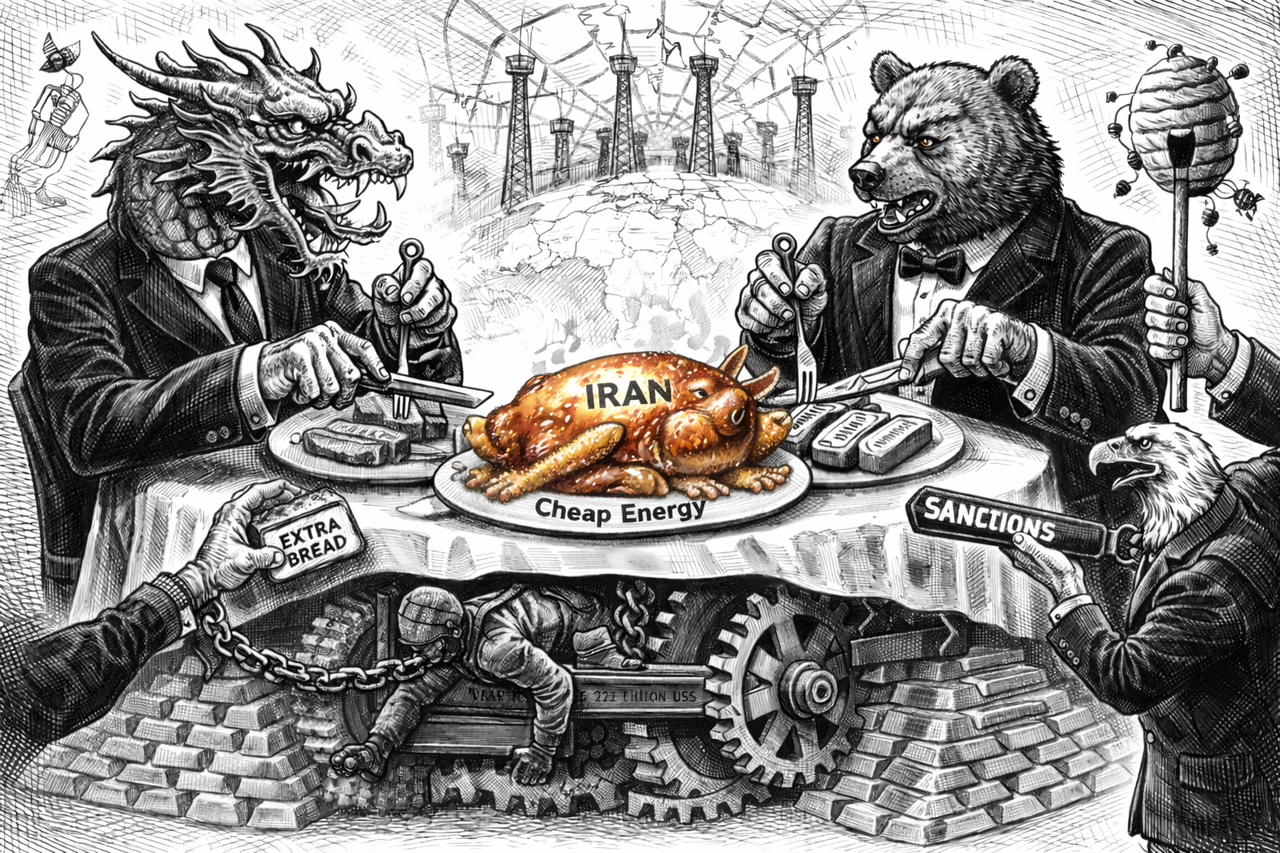
Colonialism never disappeared. It evolved. The flags came down, the gunboats departed, and the trading companies dissolved into holding structures with cleaner names. What replaced them was subtler and, in some respects, more durable: the systematic extraction of value from populations that lack the institutional leverage to resist it. In 2026, that extraction runs on fibre-optic cable, military contracts, and debt instruments denominated in currencies the borrower cannot print. The providers have changed. The logic has not.
China and Russia are the architects of the current iteration. Neither presents itself as a colonial power. China offers partnership, infrastructure, and the language of South-South solidarity. Russia offers security, cultural presence, and the implicit promise of protection from Western pressure. What both offer, in practice, is a relationship in which the terms of dependency are written by the stronger party and the costs are borne by the weaker one. The vocabulary is new. The structure is old.
The Internet of Control
The Digital Silk Road is not a development programme. It is an infrastructure dependency strategy dressed in the language of connectivity. Across Africa and Southeast Asia, Huawei now controls the majority of 4G and 5G network infrastructure, alongside a substantial share of the data centre market. The pitch is sovereignty: local data, locally processed, free from Western surveillance architectures.
The reality is the inverse. When the hardware is Chinese-built and the security layer is a Russian AI-in-a-box product, sovereignty belongs to the provider. The host government gains a network it could not otherwise afford. It also gains a network it cannot fully audit, cannot independently modify, and cannot operate without continued vendor support. That is not independence. It is dependency with better branding.
Russian cybersecurity exports are not sold as surveillance tools. They are marketed as stability products, predictive policing systems designed to identify dissent clusters before they become protests. The target market is any regime that watched Tehran in January 2026 and decided it would prefer a different outcome.
The reference to the Crimson Winter is deliberate. The systematic suppression of protests that killed more than 90,000 Iranian civilians between December 2025 and February 2026 has become both a warning and a sales demonstration. Russian firms are actively marketing the tools that could have detected those protests earlier, disrupted their organisation, and contained their spread before the cost of suppression became visible to the world. The product is digital pre-emption. The customer is any government that fears its own population.
Labour as a Raw Material
The second dimension of the new colonial economy is more direct and considerably more lethal. Russia is recruiting foreign nationals to fight its war in Ukraine at industrial scale, using networks that operate with the organisational logic of a supply chain rather than the desperation of a manpower shortage. The distinction matters. A manpower shortage produces improvised recruitment. A supply chain produces systematic extraction.
The mechanism is the Russian House network, a set of cultural representation offices maintained by the Kremlin across Africa, the Middle East, and parts of Asia. These offices were designed to project soft power: language classes, cultural events, scholarship programmes. In practice, across multiple documented locations, they have been repurposed as recruitment centres. The cultural offer remains the cover. The operational function is identifying, screening, and signing foreign nationals for military deployment.
The recruitment pitch varies by location and target demographic. In Yemen, where years of conflict have produced a generation of young men with combat experience, minimal economic alternatives, and acute vulnerability to any offer of income, the promise is security work or a pathway to Russian citizenship. Neither is what it appears to be. Investigative reporting by INPACT and All Eyes on Wagner has documented the pattern: arrival in Russia, brief orientation, deployment to high-attrition positions in Ukraine, death within weeks of arrival in a significant proportion of cases.
The European Parliament's formal condemnation on March 12, 2026 described the practice as trafficking and coercive recruitment. The language is precise. These are not volunteers in any meaningful sense. They are people whose structural circumstances have been exploited to place them in someone else's war.
The Extra Bread Paradox
There is a version of this story in which China and Russia are, at minimum, more honest than their predecessors. The 19th-century colonial powers also extracted resources, also manipulated local governments, and also recruited or conscripted local populations into their military campaigns. At least, the argument goes, the current providers build roads and power plants rather than simply taking without leaving anything behind.
The counterargument is that the infrastructure is the mechanism of extraction, not a gift that accompanies it. Belt and Road loans are denominated in yuan, subject to Chinese legal jurisdiction in many cases, and secured against assets that the borrower cannot easily replace. The power plant financed by a 20-year debt instrument at above-market rates, built by Chinese contractors using Chinese equipment, operated under a Chinese technical services agreement, is not development finance. It is a long-term claim on a sovereign asset, structured to maximise dependency and minimise the borrower's exit options.
Russia's contribution to this economy is more direct. It does not build infrastructure. It extracts labour. The Global South, in the current framework, supplies oil from Iran at a discount, minerals from Africa at below-market prices negotiated with governments whose cooperation has been secured by other means, and soldiers from Yemen at the cost of a brief orientation and a one-way ticket. The bread is real. So is the price.
| Strategy | Mechanism | Documented Impact |
|---|---|---|
| Digital | Huawei / DSR AI-in-a-box security architecture |
Total network dependency in 70% of African and Southeast Asian 4G/5G markets. Predictive policing tools marketed as post-Crimson Winter stability products. |
| Kinetic | Recruitment African and Yemeni foreign fighters |
1,400+ individuals identified across 35 countries. Investigative reporting documents high mortality within 30 days of frontline deployment. |
| Financial | mBridge / e-CNY Sanction-proof payment rails |
Enables settlement of Dark Fleet oil purchases and mercenary wages outside the dollar system. Extends the operational life of sanctioned regimes indefinitely. |
| Human | Crimson Winter State suppression, Iran |
More than 90,000 civilian deaths between December 2025 and February 2026. The regime's continued operation is underwritten by Chinese digital infrastructure and Russian energy revenue flows. |
The West's Silent Financing Role
The West is not a passive observer of this system. It is a structural participant. Every purchase of Chinese-manufactured medical equipment, electronics, or industrial goods contributes to the profitability of a manufacturing economy that runs, in part, on discounted Iranian crude processed through teapot refineries operating outside the dollar settlement system. Every fill of a European fuel tank in a period when Russian gas remains part of the continental energy mix contributes to the revenue stream that funds the Ukrainian campaign and the recruitment budget that draws fighters from Cameroon and Ghana.
This is not a moral indictment. It is a description of how integrated supply chains work in practice. The sanctions architecture is real. Its enforcement is selective and its coverage is incomplete. The gap between the policy declared and the economy actually operating is where the new colonial system lives, and it is a gap that neither side of the geopolitical divide has a strong incentive to close entirely.
The 19th-century coloniser wanted your land. The 21st-century coloniser wants your data and your disposable life. Iran is the clearest prototype: a nation whose leadership has traded tens of thousands of its own citizens for a digital shield provided by Beijing and a diplomatic lifeline provided by Moscow, neither of which was offered out of solidarity. In the two-tier world taking shape in 2026, the Global South is not becoming independent. It is being re-colonised by a system that has learned to make extraction look like partnership, and to ensure that by the time the terms become visible, the exit costs are too high to pay.