May Dispatch 26 Articles · May 2026
May 2026 Edition
May 2026 Edition · The Meridian
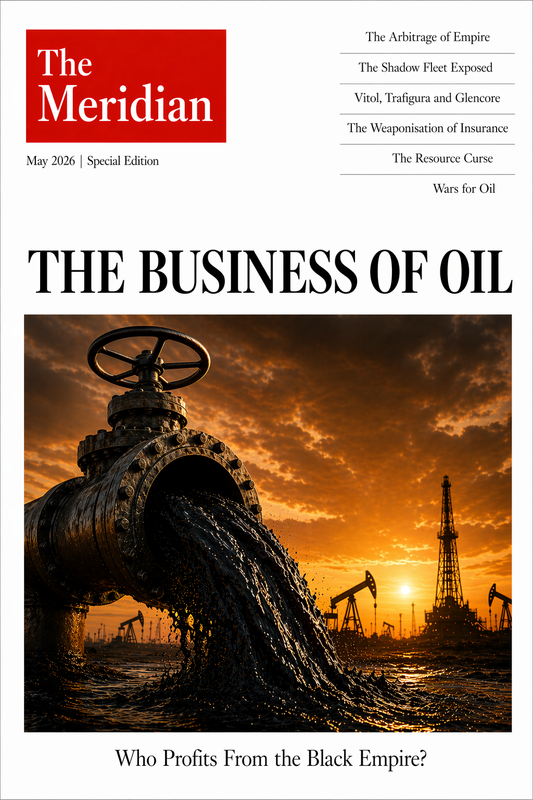
May 2026: The Business of Oil
The complete A to Z intelligence edition on the global oil economy. From geology and pricing to shadow fleets, petrodollar power, the resource curse and the cost to the Global South.
The Price of Everything
Start Here · May 2026
The Price of Everything
The Editor's Letter framing the entire edition. Every Mauritian who boards a bus or buys bread is paying a toll to a system they were never told existed.
The Arbitrage of Empire
Cover Story · Framework
The Arbitrage of Empire
The macro thesis. Oil is not a free market. It is a fractured, two-price system exploited by those with capital, ships and impunity. The connective tissue for the entire edition.
How Oil Is Made
Foundation · Geology
How Oil Is Made: The Geology of Power
The geological lottery that determined which nations inherited wealth and which inherited structural dependency.
From Wellhead to Pump
Foundation · Value Chain
From Wellhead to Pump: The Complete Value Chain
Extraction, shipping, refining, blending, distribution. Where the margins are captured at each stage and by whom.
The Official Price and the Shadow Price
Two Prices · Shadow Market
The Official Price and the Shadow Price
The G7 Price Cap and its unintended consequence: a two-tier global oil market worth billions to those who navigate between the official and shadow price.
Brent WTI and the Benchmark System
Benchmarks · Pricing
Brent, WTI and the Benchmark System
How two grades of crude became the world's financial reference points and what these numbers mean for every nation that does not set them.
Paper Oil vs Physical Oil
Futures · Contango
Paper Oil vs Physical Oil: Contango and the Futures Machine
How trading houses stored oil on supertankers during the pandemic crash and printed money without drilling a single well.
The Invisible Giants of Geneva
Trading Houses · Geneva
The Invisible Giants of Geneva
Vitol, Trafigura, Glencore. Privately held, publicly unaccountable, astronomically profitable. A forensic anatomy of commodity trading power.
Inside an Oil Major
Oil Majors · Anatomy
Inside an Oil Major: The Integrated Machine
How Shell, ExxonMobil and BP are structured: upstream, downstream, tax architecture, lobbying and shareholder return.
The Lobbying Ledger
Lobbying · Policy
The Lobbying Ledger: How Oil Buys Policy
From Washington to Brussels to Port Louis. How the oil industry sustains structural privileges through regulatory capture and the revolving door.
The Weaponisation of Insurance
Insurance · Sanctions
The Weaponisation of Insurance
How the London P&I Clubs control 90% of global maritime insurance and how the G7 turned that dominance into a sanctions instrument.
The Shadow Fleet
Shadow Fleet · Investigation
The Shadow Fleet: Rust, Risk and the Rogue Tanker Economy
Aging tankers, flags of convenience, disabled transponders, shell companies. The parallel oil economy moving a third of the world's crude.
Sanctions Evasion
Case Study · Sanctions Evasion
The New Zealand Insurer and the Anatomy of Sanctions Evasion
How a small, obscure insurer underwrote sanctioned oil shipments and how the chain of complicity works in practice.
The Resource Curse
Resource Curse · Development
The Resource Curse: Why Oil Makes Countries Poor
Dutch Disease, institutional decay, conflict incentives and the evidence from Nigeria, Angola, Venezuela and Iraq.
Who Profits Who Pays
Global South · Extraction
Who Profits, Who Pays: Oil and the Global South
How trading houses and financial intermediaries extract value from producing nations, leaving behind debt, pollution and weakened institutions.
Wars for Oil
Geopolitics · Conflict
Wars for Oil: A Structural History
From the 1973 embargo to Iraq 2003, Libya and Yemen. Not conspiracy but structure: how oil interests shaped military decisions and international law.
The Inverted Resource Curse
Mauritius · Structural Analysis
The Inverted Resource Curse: Mauritius at the Bottom of the Chain
How a commodity trader in Geneva sets the price of a Mauritian worker's morning bread. The STC levy, imported inflation and the structural trap of oil dependency.
Peak Demand
Energy Transition · Demand
Peak Demand: The Economics of a World Moving On
Why the question is no longer peak supply but peak demand, and how oil companies and producing nations are positioning for structural decline.
What Happens After Oil
Post-Oil · Diversification
What Happens After Oil? Norway, Saudi Arabia, Nigeria and the Diversification Gamble
Three models of post-oil transition. One that worked, one attempting it, one failing. The structural lessons for the Global South.
The OPEC Fracture
Breaking · Geopolitics · 28 April 2026
The OPEC Fracture: What the UAE Exit Means for the Cartel, the Price and Mauritius
The UAE leaves OPEC on 1 May 2026. Against the backdrop of the Iran war, a collapsed Hormuz and a 27 per cent OPEC output collapse, those with hard cash will prosper. Mauritius, which buys oil in dollars and earns in rupees, will pay.
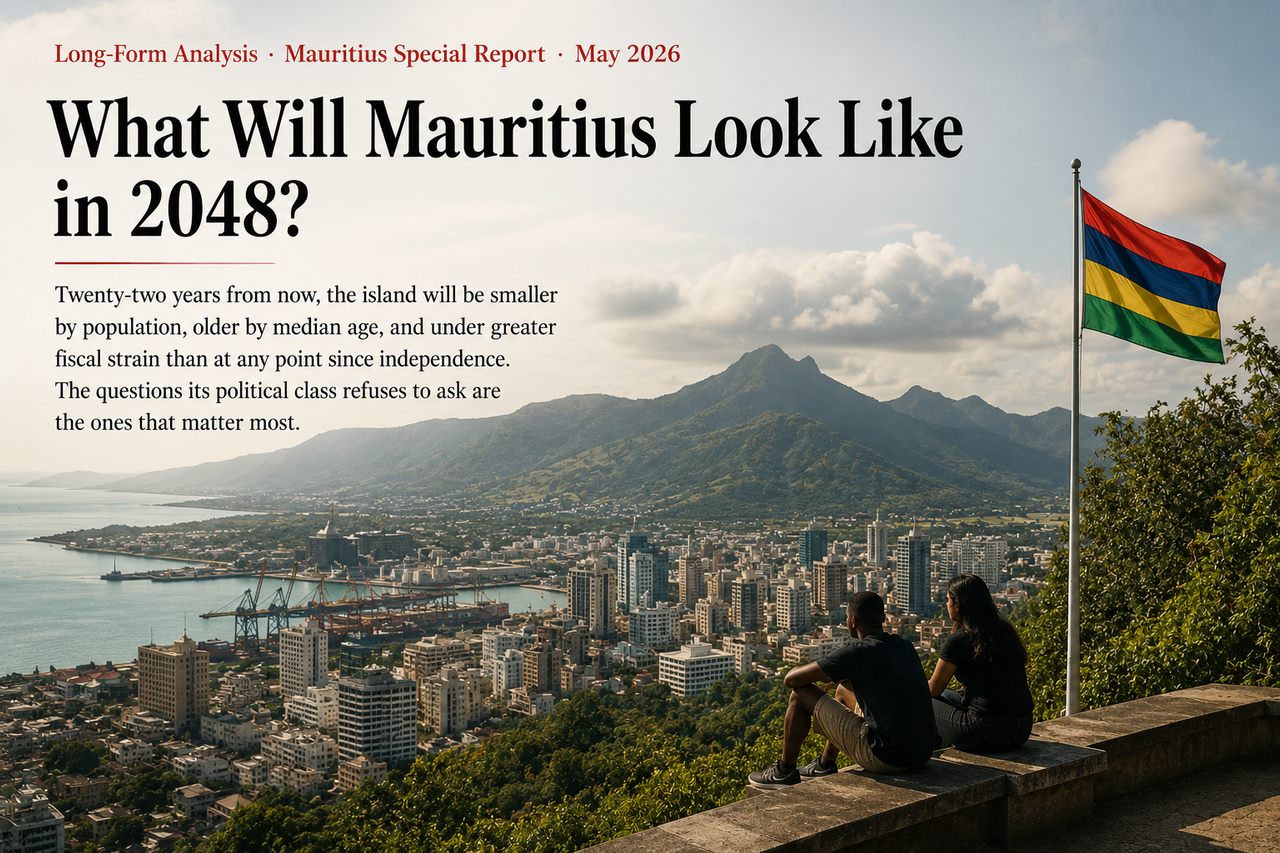
What Will Mauritius Look Like in 2048?
Mauritius · Long-Form Analysis
What Will Mauritius Look Like in 2048?
Demographic contraction, fiscal stress, climate risk and the five questions the political class refuses to ask. A data-driven portrait of the island at 80.
The Permian Paradox
Energy Economics · Permian Special
The Permian Paradox: America's Oil Boom and the Gas Nobody Wants
The United States produces more oil than Saudi Arabia and Russia combined. In the heart of that miracle, natural gas trades at negative prices. The most consequential paradox in the global energy economy right now.
Antisemitism, Israel and the Hidden History
Editorial Analysis · World Affairs · History
The Silence and the Slogan: Fourteen Questions the World Has Not Answered About Jews, Israel and the New Antisemitism
From the Nebi Musa riots of 1920 to Emperor Hadrian renaming Judaea in 135 CE. A 29-entry verified timeline. Fourteen questions. Every fact sourced to a named primary institution. The record the public conversation is not having.
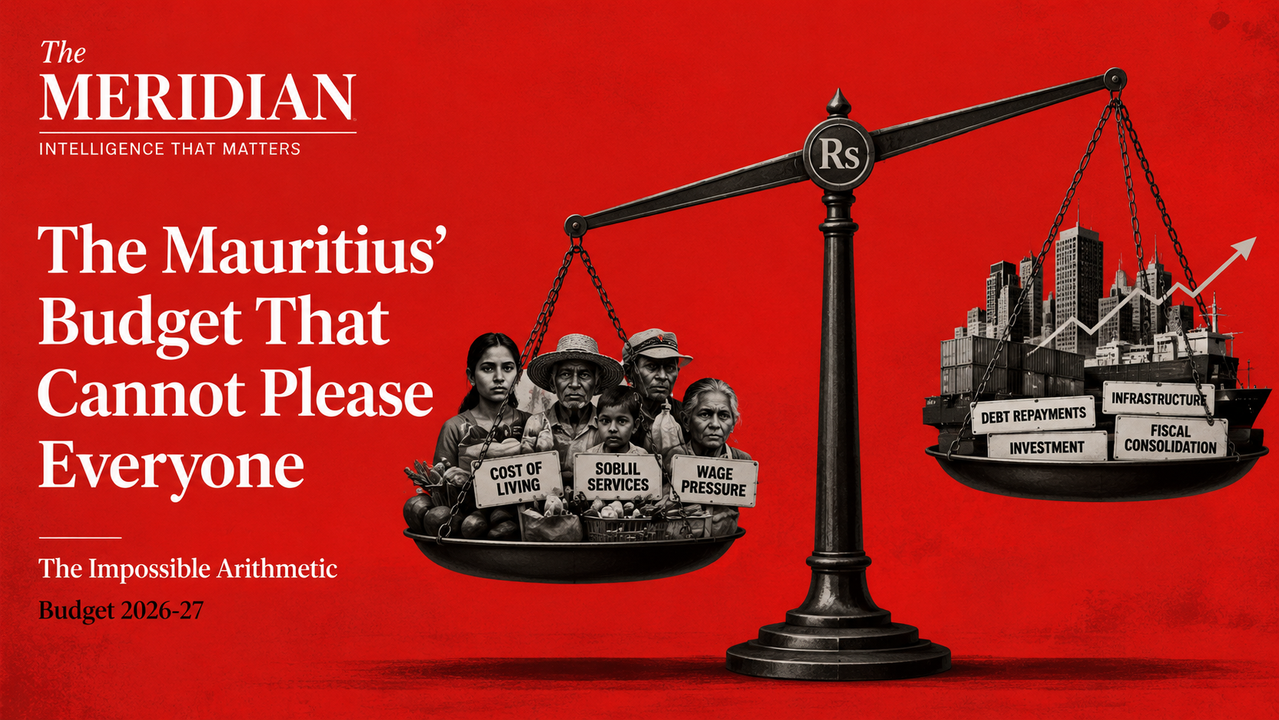
The Budget That Cannot Please Everyone
Political Economy · Budget 2026-27
The Budget That Cannot Please Everyone
Debt at 82% of GDP, a Moody's negative outlook, unsustainable pensions and social spending under pressure. The impossible arithmetic of the Mauritius budget 2026-27.
The Hormuz Endgame Three Scenarios
Geopolitics · Iran War
The Hormuz Endgame: Three Scenarios
Ceasefire, prolonged standoff or escalation. Three scenarios for how the Strait of Hormuz crisis ends and what each means for oil prices and the Global South.
1 / 26
THE MERIDIAN
Global South Perspective
Mauritius Wage Index
Mauritius · Wages · Food · Utilities · Debt · Labour Time · Household Pressure
Index Watch
Minimum wageRs 17,745 per month Living benchmarkRs 25,170 per month GapRs 7,425 short per month Chicken203 min of work for 1kg LPG203 min of work for 12kg cylinder Tomatoes130 min of work per kg Milk54 min of work per litre CEBRs 3.16 / 4.38 / 4.74 per kWh BreadRs 3.90 per 100g DebtRs 642bn benchmark the meridian · mauritius wage and cost of living index · 2026
The Meridian · Special Data Page

Mauritius Wage and Cost of Living Index

This page reads wages as a lived system. It asks what ordinary work in Mauritius can still buy, what proper food now costs in labour time, how state-managed charges shape the monthly squeeze, and whether work still leaves room for saving, education or housing security.

Rather than treating prices, rent, energy, transport, tax and debt as separate stories, it reads them together. The question is simple: does work still produce stability, or only managed survival?

Labour Time
The Cost in Human Time
Converting prices into labour minutes shows the real purchasing burden on minimum-wage work. Goods are not only shelf prices. They are measurable pieces of working time required to secure daily life.
Chicken
1kg purchase benchmark
Cost
Rs 249.95
Labour time
203 min
At the current minimum wage floor, 1kg of chicken requires 203 minutes of labour.
LPG
12kg household cylinder
Cost
Rs 250
Labour time
203 min
A standard 12kg LPG cylinder also absorbs 203 minutes of work.
Tomatoes
1kg produce benchmark
Cost
Rs 160
Labour time
130 min
A basic kilogram of tomatoes requires 130 minutes of labour.
Milk
1 litre staple
Cost
Rs 66
Labour time
54 min
One litre of milk requires 54 minutes of labour.
Eggs
Tray of 6
Cost
Rs 65
Labour time
53 min
A tray of 6 eggs requires 53 minutes of work.
Oil
1 litre cooking input
Cost
Rs 63
Labour time
51 min
One litre of cooking oil takes 51 minutes of minimum-wage labour.
Household Basket
What the Worker Must Pay First
This is a first-order household basket rather than a discretionary one: food, rent, utilities, transport, connectivity and cooking energy. These costs absorb income before saving or asset-building begins.
Modest Rent Benchmark
Market benchmarkRs 17,000 per month
Type1-bedroom outside city centre
A modest one-bedroom benchmark outside the city centre stands near Rs 17,000 per month, placing rent almost level with the minimum wage floor.
CEB Domestic Tariff
Verified tariffRs 3.16 / 4.38 / 4.74 per kWh
Minimum chargeRs 31 per month
The domestic schedule begins at Rs 3.16 per kWh for the first 25 kWh, rises to Rs 4.38 for the next 25 kWh, and then to Rs 4.74 for the following 25 kWh.
CWA Domestic Tariff
0–6m³Free
7–10m³Rs 45 minimum
Domestic water billing gives 0–6m³ free, then a Rs 45 minimum for 7–10m³. Beyond that, charges rise by usage tier.
Bus Fare Benchmark
Verified fareRs 15
Upper run signalRs 40
Fares begin around Rs 15 for short trips and can reach Rs 40 on longer runs, making daily movement a recurring monthly claim on income.
Basic Home Internet
Verified packageRs 1,200 per month
Plan50 Mbps fibre
A basic 50 Mbps fibre package at Rs 1,200 per month places connectivity within essential household infrastructure rather than optional spending.
Controlled Bread Benchmark
Verified priceRs 3.90
Unit100g pain maison
The controlled bread benchmark stands at Rs 3.90 for 100 grams following the approved rise from the earlier Rs 2.60 level.
LPG Cylinder
BenchmarkRs 250
CategoryCooking energy
Cooking gas is a threshold household cost. It stands between the household and the ability to turn food purchases into meals.
Fuel Levy Structure
Verified levyRs 7.20 per litre
PurposeLPG, flour and rice subsidy support
Fuel shapes both direct transport costs and wider price transmission across the economy. The cross-subsidy contribution stands at Rs 7.20 per litre.
Wage Structure
The Wage Gap
The legal wage floor and a minimally stable household benchmark do not align. Once rent, food, utilities and basic mobility are included, the shortfall becomes visible.
Minimum wage
Rs 17,745
The 2026 national minimum wage floor.
Living benchmark
Rs 25,170
A modest benchmark for basic household stability used in this page.
Monthly gap
Rs 7,425
The monthly shortfall between the wage floor and the household threshold.
Annual gap
Rs 89,100
The same shortfall projected across a full year.
State Pressure
Debt, Inflation, Taxes and Extraction
Wage pressure does not come from retail prices alone. It also comes from inflation, VAT, fuel-linked subsidy structures, utility charging systems and the fiscal burden of a heavily indebted state.
Headline inflation
4.1%
Headline inflation for the 12 months ending February 2026.
VAT rate
15%
The standard consumption tax embedded across much of the household price structure.
VAT revenue
Rs 64.2bn
Estimated VAT take in the budget revenue structure.
Public debt
Rs 642bn
Public-sector debt benchmark.
Debt per capita
Rs 535,000
Approximate implied burden per person from the debt benchmark.
Fuel levy
Rs 7.20
Per litre contribution used to support LPG, flour and rice subsidies.
PAYE threshold
Rs 38,462
Monthly emoluments below this threshold are not deducted PAYE.
Where VAT goes
General Revenue
It feeds the broader revenue pool that supports state expenditure across sectors.
Mauritius Labour Structure
Population, Work and Pressure
A wage floor cannot be read properly without the structure beneath it. The question is not only what a worker earns, but how many people are active in the labour market, how many remain outside it, how many young people are still under pressure, and how far foreign labour helps stabilise the system.
Population aged 16+
991,800
Mauritian population aged 16 years and over, Q4 2025.
Labour force
592,700
Economically active Mauritians, Q4 2025.
Employed
560,900
Mauritians in employment, Q4 2025.
Unemployed
31,800
Mauritians unemployed, Q4 2025.
Activity rate
59.8%
Overall labour force participation rate, Q4 2025.
Unemployment rate
5.4%
Overall unemployment rate, Q4 2025.
Male activity rate
69.8%
Male labour force participation, Q4 2025.
Female activity rate
50.5%
Female labour force participation, Q4 2025.
Youth unemployed
10,800
Unemployed persons aged 16 to 24, Q4 2025.
Youth unemployment
16.8%
Youth unemployment rate, Q4 2025.
Male unemployment
4.0%
Male unemployment rate, Q4 2025.
Female unemployment
7.1%
Female unemployment rate, Q4 2025.
What the Wage Sits On
Income and Structure

The labour market is not only about unemployment. It is about how narrow the active workforce is relative to the adult population, how uneven participation remains between men and women, and how high youth unemployment stays even when the headline national rate appears moderate.

Median monthly earnings Rs 22,000
Average monthly earnings Rs 29,800
Public sector employment 75,938
Outside labour force 399,100
The External Buffer
Foreign Labour

Mauritius does not rely only on its local labour pool. Foreign workers form part of the adjustment mechanism, especially where local participation is weak or where employers face sectoral labour shortages.

Foreign workers 26.6k
Foreign workers 26.9k
Female inactive 255,700
Male inactive 143,400
Editorial Note

Mauritius does not only face a wage question. It faces a labour-structure question: a working-age population of 991,800, a labour force of 592,700, 399,100 people outside the labour force, youth unemployment at 16.8%, and a visible reliance on foreign labour as a stabilising buffer.

Read together, these figures suggest that wage pressure is structural, not merely temporary. The wage floor is being asked to carry a labour market that remains narrow, uneven and under strain.

Comparative Labour Time
How Mauritius Looks Beside Other Wage Systems
This comparison asks not only what goods cost, but how much labour time each wage floor must surrender to secure food, transport and modest rent.
Mauritius
High-pressure benchmark
Monthly wageRs 17,745
VAT15%
Eggs (6)53 min
Milk (1L)54 min
Chicken (1kg)203 min
Bus fareRs 15
Modest rent signal~95% of wage floor
Mauritius appears as a high labour-extraction wage system. Protein and staples consume heavy working time, while modest rent sits dangerously close to the monthly wage floor.
United Kingdom
Reference comparator
Monthly wageHigher benchmark
VAT20%
Eggs (6)Lower burden
Milk (1L)Lower burden
Chicken (1kg)Far lower
Bus fareModerate
ReadingFood labour time is materially lighter than Mauritius.
In the British case, everyday food and transport absorb a much smaller share of labour time. That does not remove pressure, but it shows how compressed the Mauritian wage structure has become.
South Africa
Regional comparator
Monthly wageComparable stress
VAT15%
Protein burdenHigh
Transport burdenVisible
Rent signalHeavy
ReadingNear Mauritius
ComparisonBoth systems show severe pressure between modest wages and essential recurring costs.
South Africa and Mauritius sit closer than many readers might expect in labour-extraction terms. Both reveal the fragility of a wage structure where rent and protein take too much time to secure.
Malaysia
Middle-income comparator
Tax structureLower rate
Food burdenLighter
Rent pressureModerate
Transport burdenManageable
ReadingMore room
DirectionLess compressed
ComparisonThe broader structure appears to leave more room than the Mauritian floor currently does.
Malaysia offers a useful middle-income contrast in which the wage system remains under pressure, but less violently compressed than the Mauritian case.
Editor’s Note

The point of this page is not to dramatise prices in isolation. It is to test whether ordinary labour in Mauritius still clears the cost of a minimally stable life once food, rent, tax, utilities and mobility are counted together.

On that reading, the minimum wage appears increasingly capable of maintaining circulation, but increasingly weak at producing reserves, security or forward movement.

Comments

There are no comments yet.

Add comment