May Dispatch
26 Articles · May 2026
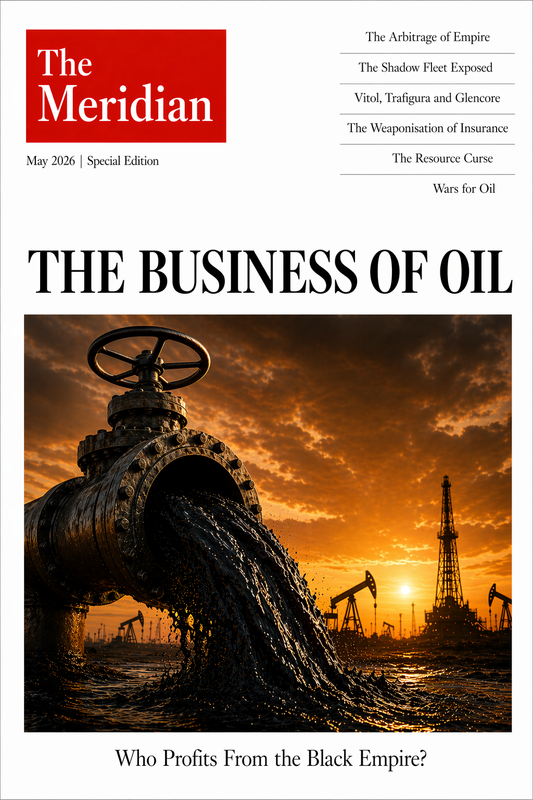
May 2026 Edition · The Meridian
May 2026: The Business of Oil
The complete A to Z intelligence edition on the global oil economy. From geology and pricing to shadow fleets, petrodollar power, the resource curse and the cost to the Global South.
Start Here · May 2026
The Price of Everything
The Editor's Letter framing the entire edition. Every Mauritian who boards a bus or buys bread is paying a toll to a system they were never told existed.

Cover Story · Framework
The Arbitrage of Empire
The macro thesis. Oil is not a free market. It is a fractured, two-price system exploited by those with capital, ships and impunity. The connective tissue for the entire edition.
Foundation · Geology
How Oil Is Made: The Geology of Power
The geological lottery that determined which nations inherited wealth and which inherited structural dependency.

Foundation · Value Chain
From Wellhead to Pump: The Complete Value Chain
Extraction, shipping, refining, blending, distribution. Where the margins are captured at each stage and by whom.

Two Prices · Shadow Market
The Official Price and the Shadow Price
The G7 Price Cap and its unintended consequence: a two-tier global oil market worth billions to those who navigate between the official and shadow price.

Benchmarks · Pricing
Brent, WTI and the Benchmark System
How two grades of crude became the world's financial reference points and what these numbers mean for every nation that does not set them.
Futures · Contango
Paper Oil vs Physical Oil: Contango and the Futures Machine
How trading houses stored oil on supertankers during the pandemic crash and printed money without drilling a single well.

Trading Houses · Geneva
The Invisible Giants of Geneva
Vitol, Trafigura, Glencore. Privately held, publicly unaccountable, astronomically profitable. A forensic anatomy of commodity trading power.

Oil Majors · Anatomy
Inside an Oil Major: The Integrated Machine
How Shell, ExxonMobil and BP are structured: upstream, downstream, tax architecture, lobbying and shareholder return.
Lobbying · Policy
The Lobbying Ledger: How Oil Buys Policy
From Washington to Brussels to Port Louis. How the oil industry sustains structural privileges through regulatory capture and the revolving door.

Insurance · Sanctions
The Weaponisation of Insurance
How the London P&I Clubs control 90% of global maritime insurance and how the G7 turned that dominance into a sanctions instrument.
Shadow Fleet · Investigation
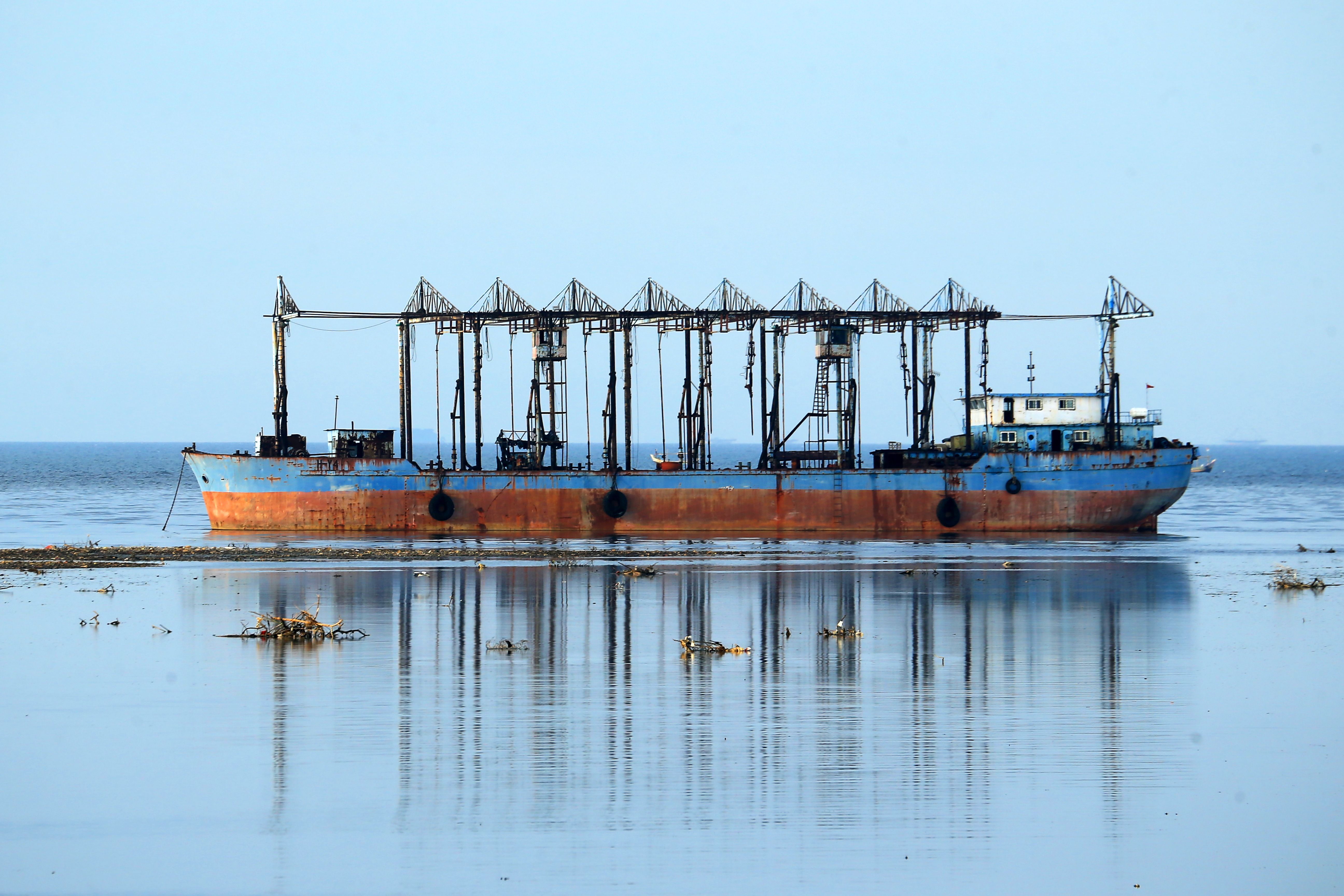
The Shadow Fleet: Rust, Risk and the Rogue Tanker Economy
Aging tankers, flags of convenience, disabled transponders, shell companies. The parallel oil economy moving a third of the world's crude.

Case Study · Sanctions Evasion
The New Zealand Insurer and the Anatomy of Sanctions Evasion
How a small, obscure insurer underwrote sanctioned oil shipments and how the chain of complicity works in practice.

Resource Curse · Development
The Resource Curse: Why Oil Makes Countries Poor
Dutch Disease, institutional decay, conflict incentives and the evidence from Nigeria, Angola, Venezuela and Iraq.
Global South · Extraction
Who Profits, Who Pays: Oil and the Global South
How trading houses and financial intermediaries extract value from producing nations, leaving behind debt, pollution and weakened institutions.
Geopolitics · Conflict
Wars for Oil: A Structural History
From the 1973 embargo to Iraq 2003, Libya and Yemen. Not conspiracy but structure: how oil interests shaped military decisions and international law.

Mauritius · Structural Analysis
The Inverted Resource Curse: Mauritius at the Bottom of the Chain
How a commodity trader in Geneva sets the price of a Mauritian worker's morning bread. The STC levy, imported inflation and the structural trap of oil dependency.

Energy Transition · Demand
Peak Demand: The Economics of a World Moving On
Why the question is no longer peak supply but peak demand, and how oil companies and producing nations are positioning for structural decline.

Post-Oil · Diversification
What Happens After Oil? Norway, Saudi Arabia, Nigeria and the Diversification Gamble
Three models of post-oil transition. One that worked, one attempting it, one failing. The structural lessons for the Global South.

Breaking · Geopolitics · 28 April 2026
The OPEC Fracture: What the UAE Exit Means for the Cartel, the Price and Mauritius
The UAE leaves OPEC on 1 May 2026. Against the backdrop of the Iran war, a collapsed Hormuz and a 27 per cent OPEC output collapse, those with hard cash will prosper. Mauritius, which buys oil in dollars and earns in rupees, will pay.
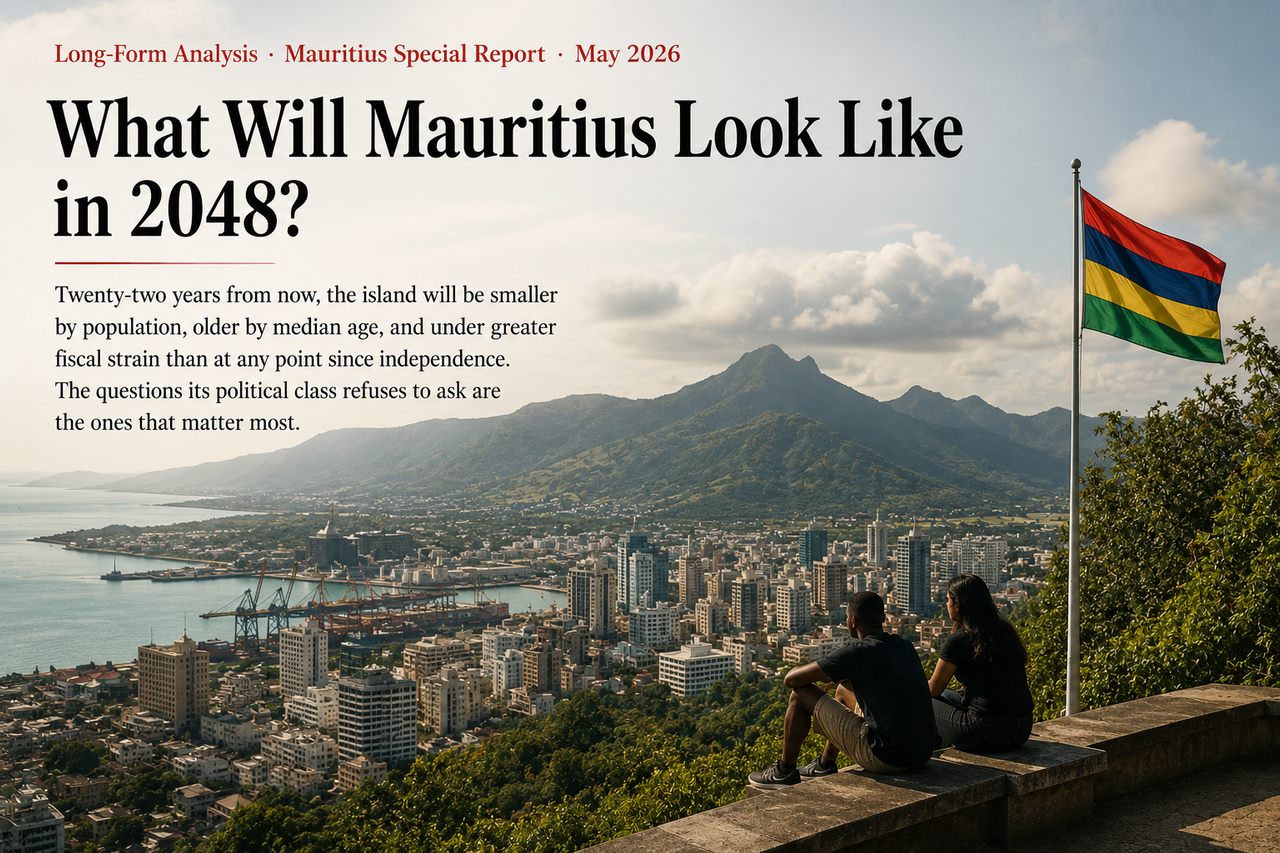
Mauritius · Long-Form Analysis
What Will Mauritius Look Like in 2048?
Demographic contraction, fiscal stress, climate risk and the five questions the political class refuses to ask. A data-driven portrait of the island at 80.
Energy Economics · Permian Special
The Permian Paradox: America's Oil Boom and the Gas Nobody Wants
The United States produces more oil than Saudi Arabia and Russia combined. In the heart of that miracle, natural gas trades at negative prices. The most consequential paradox in the global energy economy right now.

Editorial Analysis · World Affairs · History
The Silence and the Slogan: Fourteen Questions the World Has Not Answered About Jews, Israel and the New Antisemitism
From the Nebi Musa riots of 1920 to Emperor Hadrian renaming Judaea in 135 CE. A 29-entry verified timeline. Fourteen questions. Every fact sourced to a named primary institution. The record the public conversation is not having.
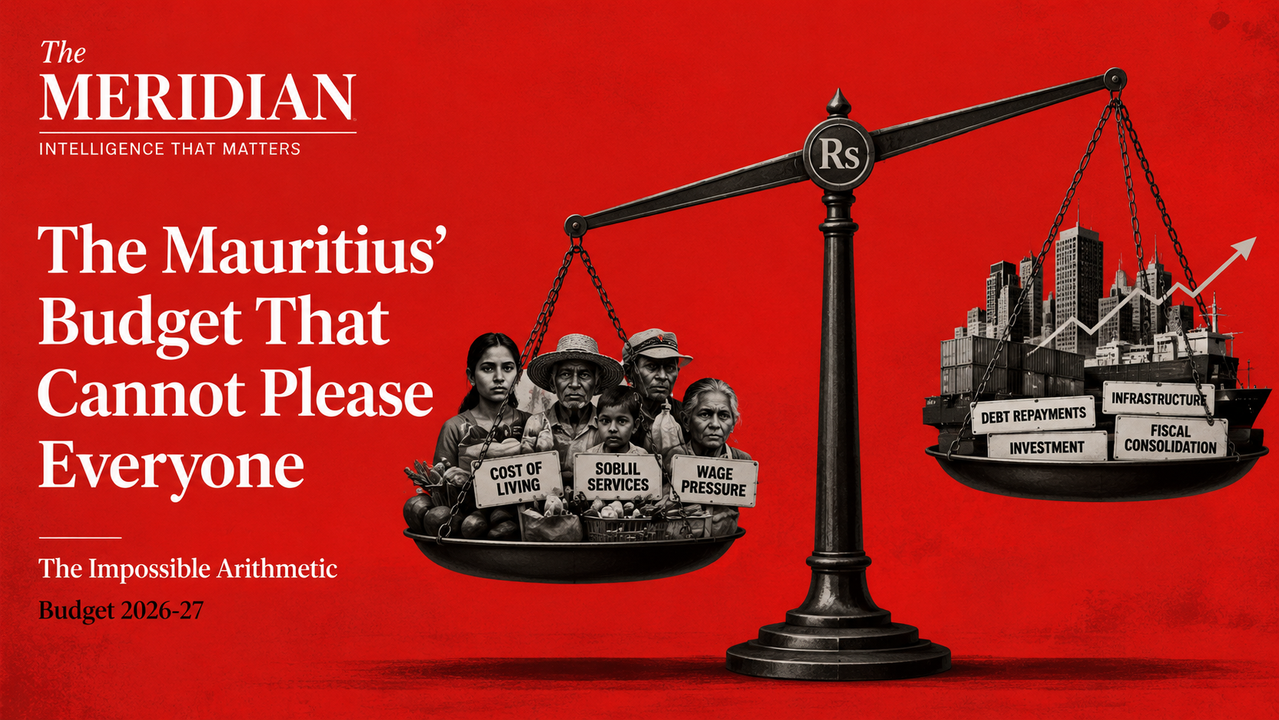
Political Economy · Budget 2026-27
The Budget That Cannot Please Everyone
Debt at 82% of GDP, a Moody's negative outlook, unsustainable pensions and social spending under pressure. The impossible arithmetic of the Mauritius budget 2026-27.

Geopolitics · Iran War
The Hormuz Endgame: Three Scenarios
Ceasefire, prolonged standoff or escalation. Three scenarios for how the Strait of Hormuz crisis ends and what each means for oil prices and the Global South.
1 / 26
THE MERIDIAN
Global South Perspective
RealPolitik Forum
Namaste · Salaam · Karibu · Bonjour · Hola · Olá · 欢迎 · Welcome
LIVE
RealPolitik Open discussion on power, economics and political reality
April Monitor The month the MMM broke
New Analysis Inflation Is Not the Crisis. It Is the Cover Story.
New Analysis Has Mauritius Become Too Dependent on Subsidies?
New Politics Is the Art of Making You Feel Free While Holding You by the Pinky Finger
New Why Mauritius Cannot Go Green: The Petroleum-Fiscal Sovereignty Trap
Focus Coalition fracture, Chagos pressure and executive control
Forum Rule Arguments matter more than slogans
Forum Desk
RealPolitik
A discussion space for readers, analysts, observers and citizens to debate power, economics and the state of the world without slogans, theatre or party noise. This is not a poll. It is a public reasoning desk.
LIVE // REALPOLITIK
The Question This Week
A sharper public forum on what is really happening, beyond slogans, performance and party noise.
Featured Analysis
Realpolitik · Analysis · Mauritius
Inflation Is Not the Crisis. It Is the Cover Story.
Every Mauritian government since independence has treated rising prices as a public relations problem rather than a structural one. The subsidy, the transfer, the price cap and the pre-election relief package are not economic tools. They are political instruments. This article names the mechanism, traces it across fifty-eight years and explains why it keeps working and who it keeps protecting.
Read the Full Analysis →
Also Under Discussion
More Questions on the Desk
Five questions widening the discussion from price pressure to structural reform, political manipulation and global disorder.



Editorial Desk
Join the Discussion
Add your argument below. Keep it civil, specific and evidence-based.
Editor's Opening Comment
This discussion begins with a simple concern: are governments solving economic problems, or merely managing public reaction to them?
Mauritius is a small import-dependent economy. Inflation is therefore never only a statistical matter. It runs through electricity, bread, fuel, shipping, rent, wages and public frustration. The political temptation is clear: cushion the visible blow, manage the anger and delay deeper reform. But if that is the dominant method, the wider cost does not disappear. It simply moves elsewhere, into firms, households, taxpayers, public debt and future instability.
Reader Reading
What Readers Are Saying
A month-to-date reading of the strongest themes emerging from RealPolitik and the wider political atmosphere.
01
Dominant Theme
April has moved from economic management to coalition fracture.
The strongest political reading of the month is no longer simply about inflation, subsidies or imported pressure. It is now about whether the governing order can hold together under strain, after the visible rupture inside the MMM.
02
Public Mood
Economic pressure still matters, but internal instability now competes for attention.
Cost of living remains central to how people judge the government. But the dramatic break involving Paul Bérenger and the MMM has widened the political conversation beyond prices alone.
03
Structural Reading
The state still looks stronger than the parties around it.
The executive continues to project administrative motion through diplomacy, parliament and energy-security language. The contrast is that one of its major political partners now looks visibly weaker and more internally contested.
04
Political Signal
The MMM rupture has become the most important political event of the month.
A governing ally remaining in office after a delegates' vote is one thing. Its historic founder then quitting the party and announcing a new movement is another. The month's central signal is now fracture, not mere tension.
The Meridian Political Monitor
April 2026 Political Balance Sheet
A structured reading of party strength, narrative control, policy credibility and visible political vulnerability in Mauritius.
Labour / PTr
78-82
→ Stable
Still the dominant executive force. Labour retains the advantage of incumbency, diplomatic reach and state agenda-setting, especially through energy-security positioning and administrative control. Its exposure remains high: delivery failures now attach more directly to it than to anyone else.
MMM
62-68
↓ Sharp Fall
No longer simply a disciplined governing ally. The delegates' decision to remain in government proved the machine still functioned, but Paul Bérenger's subsequent break and the announcement of a new movement turned internal strain into open rupture.
New Democrats
66-70
→ Stable
Still protected by coalition shelter and not carrying the heaviest blame. Their problem is not immediate weakness, but lack of distinct weight in a month dominated by executive diplomacy and the MMM split.
Rezistans ek Alternativ
64-69
↑ More Relevant
Its role as a social and ideological corrective inside the alliance now matters more. As coalition stress rises, ReA becomes more important through its ability to pressure the government from within on social direction and political legitimacy.
MSM
48-54
↑ Rising
The Budget 2025-26's structural reforms are generating visible public discomfort among households that benefited directly from MSM-era social expenditure. The MSM is accumulating retrospective capital: the 14th month bonus, expanded CSG and subsidised fuel prices are now being remembered as markers of a more protective state. MSM has moved from structural weakness to credible opposition momentum.
PMSD
38-43
→ Limited
Present, but still peripheral in the month's main political battle. It retains possible relevance in accountability and middle-class messaging, but not enough yet to dominate the story.
Method note: The Meridian Political Monitor is not a poll. It is a structured month-to-date analytical reading based on official statements, parliamentary records, public reporting, diplomatic developments and visible party behaviour. Scores are comparative and designed to reflect positioning rather than raw popularity. Revision note: MSM score revised upward from 35-42 to 48-54 following public reaction to the Budget 2025-26 fiscal consolidation measures.
Mover of the Month
Paul Bérenger
The biggest political reordering event of April so far is not a tariff, subsidy or parliamentary motion. It is Bérenger's break with the MMM and his decision to launch a new movement. Whether that project grows or not, he has already changed the month's political meaning.
Warning Light
MMM
The party has stayed in government, but at the price of a historic rupture with its founder. That raises immediate questions about leadership legitimacy, parliamentary behaviour, voter confusion and whether the party's organisational discipline can hold after the break.
Monthly Political Monitor
Latest Monitor
The latest month-to-date reading of party strength, coalition durability and political fracture in Mauritius.

Month-to-Date
The Meridian Political Monitor · Mauritius
April 2026 Political Monitor: The Month the MMM Broke
April has shifted from executive management under pressure to visible political rupture. As the government tried to project control through diplomacy, energy security and state coordination, one of its central governing partners entered open fracture. The result is a month now defined by coalition durability as much as economic strain.
Read Monitor →
The Meridian Analytics
Political Intelligence & Advisory
Disciplined political reading for parties, candidates and institutions.
Public Work
Monthly political reading turned into structured intelligence.
- Party strength and vulnerability audits
- Monthly political balance sheets
- Manifesto stress testing
- Narrative and issue-salience analysis
Confidential Work
Private analytical assignments by request.
- Campaign intelligence briefs
- Opposition risk notes
- Constituency reading
- Policy message testing
Enquiries: editor@themeridian.info
Add comment
Comments