On 28 February 2026, the United States and Israel launched coordinated strikes on Iranian military and nuclear infrastructure. Iran's response was immediate and architecturally precise: it did not attempt to fight the US Navy. It closed the strait. Within 72 hours, tanker traffic through the Strait of Hormuz had ground to a near halt, marine war risk insurance was cancelled, and the global price of crude oil had begun its climb toward $110 a barrel. The world had spent forty years assuming that a Hormuz closure would be temporary. It was wrong about both the assumption and the timeline.
What the crisis has exposed is not merely a geopolitical vulnerability. It is an engineering failure. The Strait of Hormuz is a 21st-century energy system bottlenecked by a 20th-century maritime chokepoint. The solution being discussed in Washington, Brussels and Riyadh — diplomatic pressure, carrier group deployments, emergency reserve releases — addresses the symptom. It does not address the structure. The Meridian proposes a different conversation: the permanent bypass, underground, unkillable, and already technically achievable.
I. Why the Existing Bypasses Are Already Broken
The Saudi East-West Pipeline, known as Petroline, was built in 1981 during the Iran-Iraq War. Its 1,200-kilometre dual-pipe system was converted to full crude oil capacity on 11 March 2026, reaching a maximum throughput of 7 million barrels per day. The UAE's Habshan-Fujairah pipeline adds approximately 1.5 million barrels per day. On paper, this represents 8.5 million barrels per day of bypass capacity — meaningful, but representing less than half of what normally transits Hormuz.
The more fundamental problem is that both systems are already under attack. On 3 March 2026, drones struck a fuel storage tank at Fujairah's oil terminal. On 10 March, ADNOC shut its Ruwais refinery after a drone strike. On 11 March, Shahed-136 drones struck fuel tanks at Salalah port in southern Oman — a deepwater hub that had been positioned as a workaround. The London insurance market's Joint War Committee has added Oman's waters to its high-risk maritime list. The pattern Iran has demonstrated is not random. It is targeting the bypass infrastructure specifically. A partial bypass system is only as resilient as its most exposed terminal.
Iran is not trying to block the Strait. It is trying to block every exit. The existing bypasses were sized for a short disruption. This is not a short disruption. The answer cannot be more of the same infrastructure in the same threat environment.
II. The Technology: What a Pneumatic Capsule Pipeline Actually Does
The Bullet-Pipe: How It Works
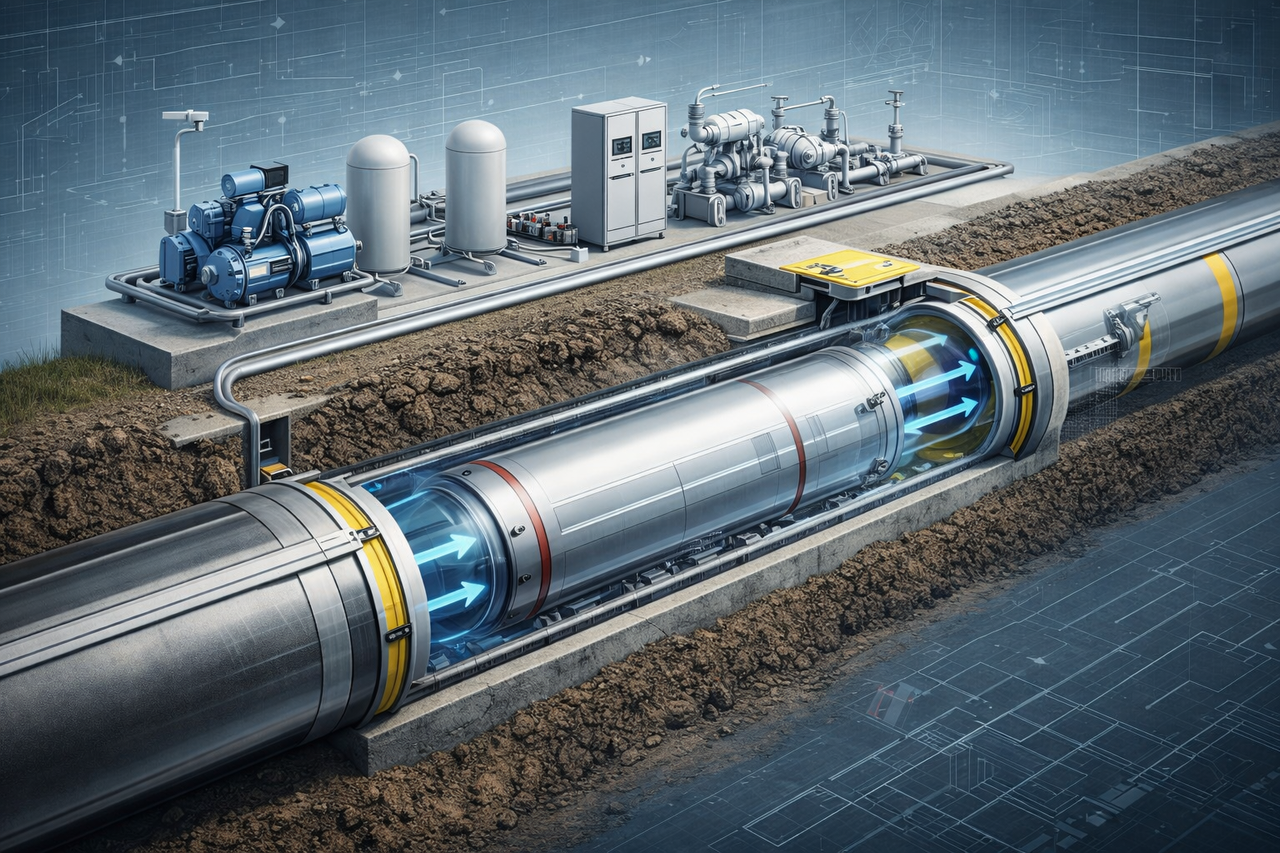
A Pneumatic Capsule Pipeline is not a conventional liquid pipeline. It does not pump oil as a fluid. Instead, it propels sealed wheeled capsules — the "bullets" — through a large-diameter pipe using compressed air or electromagnetic linear motor drives. Each capsule is a sealed container carrying a fixed payload of crude oil or condensate.
Modern large-diameter PCP systems, such as those developed at the University of Missouri's Capsule Pipeline Research Center and deployed commercially in Japan for limestone transport, use capsules rolling through pipes of approximately one metre diameter, with each capsule carrying up to two metric tonnes of cargo. Operational speeds typically run at 20 to 50 feet per second. In a scaled-up energy infrastructure application, the relevant metric is launch frequency and capsule payload rather than flow velocity.
The Meridian's Musandam Kinetic Spine proposal posits a twin-bore tunnel system of approximately 90 kilometres through the Hajar Mountains between Al Hablayn and Ash Shishah, using electromagnetic-drive PCP with 2-metre diameter pipes and capsules carrying approximately 50 barrels of crude per unit, launched at a rate of one every 2.2 seconds per bore. A twin-bore system operating at this cadence delivers approximately 2 million barrels per day per bore pair — scalable by adding parallel bores.
The critical advantage over a conventional liquid pipeline is resistance to sabotage and attack. A liquid pipeline can be bombed at any surface point and will rupture continuously. A capsule pipeline under 500 metres of mountain limestone is functionally unkillable by anything short of a nuclear weapon. The mountain is the armour.
III. The Musandam Geometry: Why the Mountain Is the Solution
The Musandam Peninsula is an Omani exclave at the tip of the Arabian Peninsula, separated from the rest of Oman by the UAE. It sits directly at the northern entrance of the Strait of Hormuz, between the Gulf and the Gulf of Oman. The Hajar Mountains that form Musandam's spine rise to over 2,000 metres and are composed predominantly of limestone — one of the most extensively tunnelled geological formations in the world, with low groundwater complexity and well-understood boring characteristics.
The route The Meridian proposes runs from the Persian Gulf coast at Al Hablayn, tunnelling southeast under the main Hajar ridge to Ash Shishah on the Gulf of Oman coast. The straight-line distance is approximately 85 to 95 kilometres depending on bore alignment. For context, the Gotthard Base Tunnel in Switzerland runs 57 kilometres through harder crystalline alpine geology at a cost of approximately $12 billion, completed over 17 years. Modern tunnel boring machine technology, combined with the more workable Musandam limestone, suggests a realistic bore cost per kilometre substantially below that benchmark.
The existing UAE Habshan-Fujairah pipeline cost $4.2 billion for 380 kilometres of surface infrastructure. A 90-kilometre subsurface bore through Musandam, at twice the engineering challenge, costs perhaps $8 to $12 billion per twin bore. For a project that permanently removes 20 million barrels per day from missile range, that is not an infrastructure cost. It is a defence budget line item.
IV. The Kinetic Spine: System Architecture
| Parameter | Specification | Basis |
|---|---|---|
| Tunnel Route | Al Hablayn (Persian Gulf) to Ash Shishah (Gulf of Oman) | Musandam geological survey; Hajar limestone formation |
| Tunnel Length | ~90 km per bore (twin bore system) | Straight-line geometry; comparable to Channel Tunnel (50km) |
| Pipe Diameter | 2 metres internal diameter | Scaled from University of Missouri PCP research; Japan commercial systems |
| Propulsion | Electromagnetic linear motor drive (no blowers) | IEEE electromagnetic PCP research; lower energy consumption than pneumatic |
| Capsule Payload | ~50 barrels crude oil per capsule | Scaled from 1.8-tonne limestone capsule; crude oil density ratio |
| Launch Frequency | 1 capsule per 2.2 seconds per bore | Derived from commercial PCP operational cadence |
| Throughput per Bore Pair | ~2 million barrels per day | 50 bbl x 27.3 launches/min x 60 min x 24 hr |
| Full System (10 bore pairs) | ~20 million barrels per day | Matching full Hormuz throughput; phased over 15-20 years |
| Mountain Cover | 300-800 metres limestone overburden | Hajar Mountains topographic data; Musandam geological profile |
| Estimated Cost (Phase 1, 2 bore pairs) | $20-30 billion | Gotthard Base Tunnel benchmark adjusted for limestone geology and PCP fit-out |
| Full System Cost (10 bore pairs) | $80-120 billion | Scaled from Phase 1; 20-day global oil price hike at $107/bbl premium covers ~$100bn |
V. The $100 Billion Arithmetic
The global oil market currently processes approximately 100 million barrels per day. The war premium on Brent crude since the Hormuz closure has added approximately $35 to $40 per barrel above pre-conflict levels. At 100 million barrels per day, that premium costs the global economy approximately $3.5 billion per day. Twenty days of that war premium — $70 billion — would fund the first four bore pairs of the Musandam Kinetic Spine, delivering 8 million barrels per day of permanently secure capacity. One hundred days funds the complete system.
This is not a hypothetical calculation. It is the actual cost of the current crisis, being paid in real time, by governments, refiners, airlines, shipping companies and consumers across Asia, Europe and the Global South. The question is not whether the world can afford the Musandam Kinetic Spine. The question is whether it can continue affording not to build it.
The tanker era was built on the assumption that a great power would always keep the sea lanes open. That assumption cost nothing to maintain — until it cost everything. The Bullet-Pipe era is built on a different assumption: that geography, properly engineered, is more reliable than any navy.
VI. The Objections — and the Answers
The standard objection to any Musandam tunnel proposal is that the Hajar Mountains present an insuperable geological challenge. This objection was made about the Alps before the Gotthard, about the English Channel before the Chunnel, and about the Seikan Strait before Japan's 54-kilometre undersea tunnel. Limestone is among the most predictable and manageable tunnel geology in the world. The objection that fails engineering review does not survive contact with a modern tunnel boring machine.
The second objection is that shifting the chokepoint does not erase vulnerability. This is technically accurate but strategically irrelevant. A capsule pipeline 500 metres underground under a mountain in Oman is not a ship in a 55-kilometre-wide strait. It cannot be mined. It cannot be boarded. It cannot be targeted by shore-based missiles. It cannot be interdicted by gunboats. The threat model that makes Hormuz dangerous does not apply underground. The Musandam Kinetic Spine does not relocate the chokepoint. It eliminates the category.
The third objection concerns Oman's sovereignty and political willingness. Oman has historically maintained relations with both Iran and the Western alliance. The construction of the Kinetic Spine would require Omani consent and almost certainly Omani co-ownership. That is not a barrier. It is the design. An Oman that co-owns the world's most strategically critical energy infrastructure is a more secure and prosperous Oman. The question of political will is a question of sequencing and incentive — both of which the Military Dollar is uniquely positioned to provide.
VII. The Strategic Case: Why the Military Dollar Funds This
The Military Dollar thesis, which The Meridian advanced in its analysis published yesterday, argues that the dollar is now backed not by oil production agreements but by functional sovereignty — the capacity to secure supply chains, project kinetic force, and control critical infrastructure globally. The Musandam Kinetic Spine is the Military Dollar's most consequential infrastructure project.
A United States that funds and secures the construction of a permanent Hormuz bypass does not merely solve an energy crisis. It purchases a structural position in the global energy architecture that no future Iranian government, no future regional war, and no future OPEC+ decision can threaten. The carrier groups in the Gulf are defending a 20th-century chokepoint. The Kinetic Spine makes the chokepoint a historical artefact.
The Global South pays the highest price when Hormuz closes. Sri Lanka, Bangladesh, Nepal, Pakistan, Kenya, the Philippines — every economy whose foreign exchange depends on Gulf remittances and Gulf oil simultaneously — has no leverage in the Strait of Hormuz crisis and no seat at the table where bypass infrastructure is discussed. A Musandam Kinetic Spine, built under a multilateral framework that includes GCC states, India, Japan, and Oman as co-owners, changes that calculus. Energy security is not a G7 issue. It is a civilisational one.
The Strait of Hormuz is a 20th-century chokepoint. The tanker is a 20th-century solution. The Pneumatic Capsule Pipeline is not a futurist concept — it is operational technology, deployed commercially in Japan, researched at scale at the University of Missouri, and now documented in electromagnetic-drive form by IEEE. What does not yet exist is the political will and the capital allocation to apply it at the scale the Hormuz crisis demands. The Musandam Kinetic Spine is not a $100 billion cost. It is a $100 billion investment that pays for itself in the first three months of the next Hormuz closure — and every closure thereafter. The mountain is free. The limestone is workable. The technology exists. What is missing is the decision. The Military Dollar has the means. The Global South has the need. The Hajar Mountains have been waiting since the Cretaceous. The question is whether the world's strategic planners are prepared to think at geological timescales rather than electoral ones.