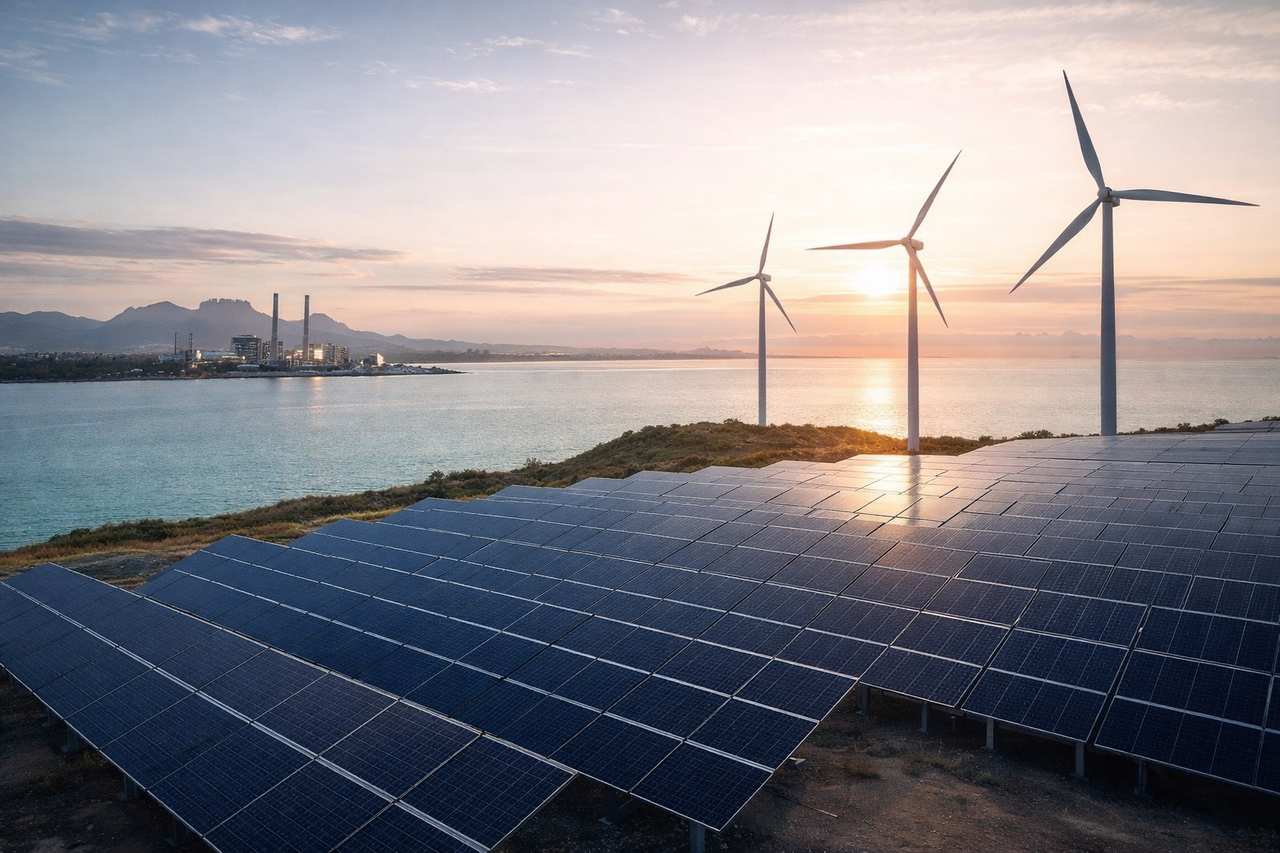
Energy, Water, and the Infrastructure Constraint
14.0 The Physical Balance Sheet Behind the Fiscal One
For a small, open island economy, energy and water are not "utility sectors". They are the physical balance sheet that sits underneath every macro-fiscal projection. When they work, growth looks easier than it is. When they fail—through price shocks, shortages, droughts, or network losses—everything else becomes more expensive: the cost of living, the cost of doing business, and eventually the cost of borrowing.
In Mauritius, energy is the most direct and unavoidable import-price transmission channel. The country's primary energy requirement is overwhelmingly imported: in 2024, 90.9% of total primary energy requirement was met from imported fuels, with only 9.1% from local renewable sources. Total primary energy requirement reached 1,614,872 tonnes of oil equivalent (toe) in 2024, up 5.0% from 2023. The mix itself is structurally import-heavy: petroleum products (61.1%) and coal (29.8%) dominate, while renewables remain a single-digit share at the economy-wide level.
Total requirement: 1,614,872 toe (+5.0% vs 2023)
Per-capita requirement: 1.28 toe (up from 1.22 in 2023)
Import dependence: 90.9% imported fuels
Energy mix:
• Petroleum products: 61.1%
• Coal: 29.8%
• Renewables: 9.1%
Energy import bill: Rs 67.3 billion (21.2% of total imports)
This is not merely an environmental statistic; it is a macro vulnerability statement. It implies that the rupee cost of energy is largely priced abroad and moved by forces outside domestic policy control.
Electricity generation translates this dependence into daily lived reality. In 2024, Mauritius generated 3,417.6 GWh of electricity, of which 81.8% came from non-renewable sources—mainly coal and fuel oil—while 18.2% came from renewables, mostly bagasse. Fuel oil and diesel together represented 42.5% of electricity generation and coal 39.1%. Peak power demand in 2024 reached 525.7 MW (February), rising compared to the previous year.
Water behaves differently—but it binds just as tightly. It is a silent productivity variable: when water becomes volatile, households and firms pay through time lost, forced storage, equipment damage, operational downtime, and private coping costs that never appear neatly in the Budget Speech. The 2024 data show rising production, but also an unavoidable structural question about system efficiency.
Total potable water treated in 2024 was 332.3 Mm³ (up 6.1% year-on-year). Yet total water sold was 131.6 Mm³. The gap between treated volume and sold volume is not a mere accounting curiosity; it is a proxy for distribution losses, leakage, unbilled consumption, and non-revenue water—the "hidden tax" households and firms pay through system inefficiency, and the fiscal pressure utilities face when they must produce far more than they can bill.
Potable water treated: 332.3 Mm³ (+6.1% vs 2023)
Total water sold: 131.6 Mm³
Revenue collectible: Rs 1,694.1 million
Production-to-sales gap: ~200 Mm³ (proxy for system losses)
Reservoir storage range: 50.3% to 95.0% across 2024
Interpretation: High seasonal volatility creates intermittency risk
The constraint intensifies under climate variability. Reservoir levels in 2024 show wide swings, with mean percentage water levels varying from 50.3% to 95.0% during the year. This matters because infrastructure stress is not linear: systems tend to fail at the margin—when storage drops, pressure falls, rationing begins, and private coping costs surge.
This is why energy and water must be treated as a single strategic system in a macro outlook. Households experience them as a single bundle—bills, shortages, and price creep—and firms experience them as a single competitiveness constraint—input costs and operational reliability. Fiscal policy then inherits the consequences: subsidies become politically attractive, capex becomes unavoidable, and inflation control becomes harder because a large share of domestic price movement is imported or infrastructure-driven rather than purely demand-driven.
The policy horizon is therefore not just "more investment", but what kind of investment, in what sequence, and with what execution discipline. The Renewable Energy Roadmap 2030 frames the ambition clearly: meeting a 60% renewable energy target by 2030 is estimated to require around USD 1,345 million (about MUR 59 billion). The same document's socio-economic analysis projects a material expansion of RE-linked jobs by 2030 (an estimated additional ~7,000 jobs).
This is the correct order of magnitude: energy transition is not a marginal tweak; it is a balance-sheet project. But it also implies trade-offs: financing, grid stability, storage, procurement quality, and institutional capacity become the real bottlenecks—not the slogan.
Mauritius' macro story cannot be told honestly without the physics. An economy that imports 90.9% of its energy requirement, generates 81.8% of electricity from fossil sources, and sells far less water than it treats is operating with an embedded cost structure and vulnerability profile that narrows fiscal space and amplifies external shocks.
Energy Security and Price Transmission: Import Dependence, Generation Mix, and the Inflation Pipeline
Energy security in Mauritius is not a slogan; it is an arithmetic identity. In 2024, the country's Total Primary Energy Requirement rose to 1,614,872 tonnes of oil equivalent (toe), up 5.0% from 2023, with per-capita primary energy requirement rising from 1.22 toe to 1.28 toe. The composition is structurally revealing: 61.1% petroleum products, 29.8% coal, and 9.1% renewables. Most critically, 90.9% of total primary energy requirement was met from imported fuels, leaving only 9.1% sourced locally.
This is the foundational vulnerability: the national "energy balance" is, in practice, an external balance.
Import Dependence is the Vulnerability; Prices are the Transmission Mechanism
Because energy is imported, the domestic price level is never fully domestic. In 2024, the import bill of energy sources reached Rs 67,323.6 million, and energy imports represented 21.2% of the total import bill—a share that is large enough to function as a macroeconomic pressure valve: when global prices move, the whole economy "hears" it.
The inflation pipeline begins upstream—global commodity markets, freight costs, and exchange-rate conditions—and then runs through the specific structure of Mauritius' fuel basket. Within total primary energy requirement in 2024, the largest fossil components were coal (29.8%), fuel oil (19.5%), diesel oil (14.1%), gasolene (13.4%), dual-purpose kerosene (7.5%), and LPG (6.5%).
Coal: 29.8% (electricity baseload)
Fuel oil: 19.5% (electricity & industrial)
Diesel oil: 14.1% (transport & logistics)
Gasolene: 13.4% (household mobility)
Dual-purpose kerosene: 7.5%
LPG: 6.5%
Critical insight: Each product maps to a different domestic pass-through surface—coal into baseload electricity, diesel into transport and logistics, fuel oil into electricity and industrial processes, gasolene into household mobility and retail distribution.
This matters because each of these products maps to a different domestic "pass-through surface": coal into base-load electricity, diesel into transport and logistics, fuel oil into electricity and industrial processes, gasolene into household mobility and retail distribution. In other words, the import basket is also an inflation basket.
Three Channels of Domestic Price Response
First, the direct consumer channel. Retail prices of petroleum products are visible, politically salient, and frequently interpreted by households as the "true" cost-of-living indicator because they translate immediately into commuting costs, delivery fees, and everyday price mark-ups. In 2024, petrol and diesel retail prices remained at elevated levels (gasolene at Rs 65.78 and diesel at Rs 63.53 per litre), capturing the reality that even when global prices cool, the domestic system does not automatically revert to a low-price equilibrium.
Second, the electricity channel. Electricity is the economy's universal intermediate good: every firm uses it, and every household feels it. When electricity costs rise, the price shock spreads across the production chain and lands back in the CPI through a thousand small margins.
Third, the logistics channel. For an island economy, shipping is not a sector; it is an unavoidable condition. Fuel costs raise freight, freight raises landed prices, landed prices raise retail prices. Even where price controls exist, they typically shift the cost into other accounts—state trading mechanisms, utility balance sheets, or delayed adjustments—rather than eliminating the underlying burden.
The Electricity System Reveals the Dependence in Operational Form
Electricity generation statistics show how import dependence becomes operational dependence. In 2024, 3,417.6 GWh of electricity was generated, and 81.8% came from non-renewable sources (mainly coal and fuel oil), while 18.2% came from renewables, mostly bagasse. The generation mix by source is particularly instructive: fuel oil and diesel (42.5%), coal (39.1%), and renewables (18.2%).
The electricity grid is, in effect, an imported-energy machine with a renewable "cap" that remains meaningful but still secondary. This means the "electricity price" is not just a function of fuel costs and local efficiency—it is also a function of procurement design, risk allocation, and the pricing logic embedded in power purchase agreements.
Demand pressure is not abstract either. Peak power demand reached 525.7 MW in February 2024 (Mauritius island), up from 508.4 MW in 2023—an increase of 9.5%. In power systems, peaks are expensive: they often require either spare thermal capacity or flexible generation, both of which in Mauritius are still closely tied to imported fuels.
The governance and market structure of generation further shapes how shocks are absorbed. Independent Power Producers (IPPs) generated 53.0% of electricity, while the Central Electricity Board (CEB) produced 47.0%, and thermal energy represented 90.8% of overall generation. This matters for two reasons: (i) the state's "energy shock absorption" capacity is partly contractual and institutional (how IPP contracts are priced and structured), and (ii) system resilience depends on a mixed ecosystem where the public sector cannot simply "command" costs away without consequences elsewhere.
The Macroeconomic Implication: Energy Imports Behave Like a Tax on Growth
When energy imports represent a large share of imports, they function like a recurring charge on the economy's expansion: more activity requires more energy, and more energy in Mauritius typically means more imports. The report's energy intensity metric helps frame the efficiency constraint. Energy intensity—defined as total primary energy requirement per Rs 100,000 of GDP (2018 prices)—stood at 0.29 toe in 2024 (unchanged from 2023).
Stability here is not necessarily comfort: it indicates that growth is not automatically becoming less energy-dependent in efficiency terms. In an import-fuel economy, flat energy intensity means the external exposure remains structurally "attached" to GDP.
What "Security" Means Under These Constraints
For Mauritius, "energy security" has two layers:
1. Supply security: ensuring that physical imports and generation capacity are not disrupted.
2. Price security: ensuring that external price swings do not destabilise household welfare, firm competitiveness, and macro stability.
The first is primarily about logistics, storage, contracting, and resilience planning. The second is about the economic architecture—how quickly prices pass through, who absorbs shocks when they do not, and whether the system pushes costs into debt, arrears, or deteriorating utility balance sheets.
The Strategic Escape Route: Renewables as a Macro Hedge
The renewable transition is often framed morally ("green growth"). For Mauritius it is also a hard-nosed balance-of-payments hedge: every unit of domestic renewable generation is a unit of reduced exposure to imported fossil volatility, even if intermittency and system costs must be managed.
The Renewable Energy Roadmap's stated ambition is explicit: to meet a renewable energy target of 60% by 2030, the report estimates USD 1,345 million of investment is required—about MUR 59 billion. It further projects significant socio-economic impacts, including an estimate of around 7,000 additional jobs by 2030 associated with the RE build-out.
This provides the scale of the transition challenge: the target is achievable only if the state can coordinate planning, financing, grid integration, and procurement at industrial pace rather than at pilot-project pace.
This is where the "security" framing becomes decisive: renewables reduce long-run exposure, but the transition itself is capital-intensive and demands credible execution. A slow transition leaves the country trapped in the worst of both worlds—continuing import exposure without building the domestic hedge.
Electricity System Economics: IPPs, Tariffs, Cost Recovery, and the Political Pricing Constraint
The electricity system is not only an engineering network; it is a pricing institution. In Mauritius, it sits at the centre of three competing imperatives: (i) keeping tariffs politically tolerable, (ii) maintaining reliability as demand rises, and (iii) financing a transition away from import-driven thermal generation. The friction is that these objectives do not naturally align. When tariffs are held down while fuel and capacity costs rise, the "gap" does not disappear; it is displaced—into weaker utility balance sheets, delayed investment, or quasi-fiscal interventions that reappear elsewhere in the state's ledger.
A Two-Part Production Structure: CEB Generation Plus External Purchases
One of the defining structural facts is that a large share of electricity supplied to the grid is not generated by the CEB itself, but acquired through purchases. In 2023, total energy generation reached 3,265.5 GWh, with 1,702.1 GWh generated by CEB and 1,563.4 GWh acquired through purchases. On this accounting, CEB supplied 52.1% of total energy generated, while 47.9% was sourced externally.
This matters for price transmission and for governance. Where the system depends heavily on purchased power, the cost base becomes partly contractual and partly insulated from short-term operational discretion. Even where contracts are well-designed, this structure tends to reduce flexibility during stress: the operator can optimise dispatch, but cannot "wish away" contracted obligations.
2023 Total Generation: 3,265.5 GWh
• CEB generation: 1,702.1 GWh (52.1%)
• Purchased power (IPPs): 1,563.4 GWh (47.9%)
2024 Total Generation: 3,417.6 GWh
• IPP share: 53.0%
• CEB share: 47.0%
• Thermal energy: 90.8% of generation
Peak demand (Feb 2024): 525.7 MW (+9.5% vs 2023)
The macro implication is subtle but important: in a dual system, the national "electricity price" is not just a function of fuel costs and local efficiency. It is also a function of procurement design, risk allocation, and the pricing logic embedded in PPAs and capacity arrangements—matters that investors and credit analysts treat as material.
Demand Pressure: Reliability Becomes More Expensive at the Margin
Rising demand raises the system's marginal cost of reliability. The CEB reports an all-time high peak demand of 525.70 MW recorded on 16 February 2024, an increase of 45.80 MW (9.54%) from the previous year's peak of 479.90 MW. It also reports the highest daily energy demand during the year at 10,931,103 kWh (also on 16 February 2024).
The operational meaning is straightforward: as peaks rise, the grid leans more heavily on flexible capacity, standby reserves, and network resilience. Those are expensive—especially in systems still anchored to imported thermal fuels. In other words, growth and electrification do not merely increase consumption; they increase the cost of preventing failure.
Tariffs and the Real Cost of "Affordability"
Electricity affordability is normally discussed in household terms, but the data show that tariff structure is also a competitiveness instrument—especially for commerce and industry. Average sales prices per kWh (excluding VAT and meter rent) for 2023 and 2024 show:
Domestic: 6.19 → 6.37
Commercial: 8.92 → 9.05
Industrial: 5.03 → 6.46
Total average: 6.99 → 7.47
Key observation: The overall average increase from 6.99 to 7.47 rupees/kWh signals that electricity prices do, in fact, move—and therefore electricity is an active transmission channel into the cost structure of the economy.
Two observations matter. First, the overall average increase from 6.99 to 7.47 rupees/kWh signals that electricity prices do, in fact, move—and therefore electricity is an active transmission channel into the cost structure of the economy, not a neutral background.
Second, the industrial tariff shift is not minor. If this reflects actual billed averages, it implies a sharp change in the cost base for productive activity—precisely the sort of movement that compresses margins, discourages tradables, and makes "productivity transformation" harder to realise in practice. Whatever the policy intent, the lived consequence is that firms will respond by raising prices, cutting labour, delaying investment, or exiting.
The Fuel-Cost Engine Under the Tariffs
Tariffs sit on top of a cost engine that remains substantially thermal. In the CEB's reporting, the 2023 electricity mix shows ~48.3% diesel & fuel oil, ~33.5% coal, and ~17.6% renewables. Statistics Mauritius shows a similar picture for 2024, with renewables rising slightly to 18.2%, but thermal still dominant.
As long as the system is anchored this way, there is a hard limit to what "tariff management" can achieve. You can smooth. You can delay. You can cross-subsidise. But you cannot repeal arithmetic. Imported fuel costs either flow into tariffs now, or into liabilities later.
The fuel inputs table underscores the physical dependence: coal tonnage used for electricity generation rises from 618,538 tonnes (2023) to 740,065 tonnes (2024), alongside fuel oil, diesel, and kerosene inputs.
Why Renewables Integration is Not Just a Climate Project But a Grid Project
The transition constraint is not ideology; it is grid physics. Renewable energy is intermittent; therefore the binding variable becomes the system's ability to stabilise frequency, manage voltage, and handle peaks without thermal backup.
The Renewable Energy Roadmap review is explicit on the measures being taken to stabilise the grid, including grid-scale Battery Energy Storage Systems (BESS). It notes funding to install 18 MW of BESS, with specific substation locations listed, and states that this 18 MW BESS will enable around 185 MW of renewable energy in the grid by 2025.
It also notes that CEB launched an invitation for bids for a 20 MW BESS intended to provide peak shaving to meet evening peak demand, with additional functionalities including frequency and voltage regulation.
In parallel, the document details grid modernisation: a shift toward GIS substations (smaller footprint, more resistant to adverse climatic conditions) and plans to construct new GIS substations and replace older AIS installations, alongside "smartening" measures such as advanced energy/distribution management systems and metering infrastructure.
The policy point is that renewable targets are only credible when the grid becomes capable of absorbing them. If grid upgrades lag, renewable ambitions stall, and the economy remains stuck in the imported inflation pipeline.
The Investor Lens: What Investors Actually Price in This System
For investors—especially those evaluating sovereign risk, utilities exposure, or large projects—the electricity system is assessed through four questions:
- Reliability: rising peak demand increases the cost of avoiding outages and brownouts; the reported peak dynamics reinforce that this is a live constraint.
- Cost recovery: average tariff movements and tariff structure determine whether the system can finance maintenance and transition without hidden arrears or quasi-fiscal rescue.
- Fuel vulnerability: thermal dependence and input quantities (especially coal and fuel oil) define exposure to imported price spikes and shipping disruptions.
- Transition execution: BESS, grid upgrades, and integration capacity determine whether renewables are an implemented engineering pathway or a repeated national aspiration.
This is why electricity is not a narrow sector chapter. It is an institutional constraint that conditions inflation, competitiveness, and fiscal credibility at once.
Section 14.3Water Security, Non-Revenue Water, and the Productivity Cost of Intermittency
Water insecurity in Mauritius is not best understood as a "weather problem". It is a systems problem with three interacting layers: (i) storage volatility at the source, (ii) physical losses in distribution, and (iii) institutional constraints that slow the conversion of capital spending into reliable service. In macro terms, intermittency behaves like a hidden tax on households and firms: it consumes time, forces private coping investment, and raises unit costs across the economy.
Storage Volatility: The Supply Baseline is Not Stable Enough to "Average Out"
Statistics Mauritius' 2024 water statistics show reservoir variability that is structurally inconsistent with continuous supply expectations. The mean reservoir level for all reservoirs moved between 50.3% and 95.0% across 2024, with several reservoirs recording sharp minimums in late-year months.
This matters because distribution fragility is most visible when storage tightens: pressure management becomes harsher, rotation becomes normalised, and the weakest pipes become the first point of failure. The system is therefore exposed not only to drought episodes, but to routine seasonal troughs that repeatedly stress the network.
The Non-Revenue Water Problem: The Physical "Leak" is Large Enough to Be Macroeconomic
At the national level, 2024 potable water treated amounted to 332.3 Mm³, while total water sold was 131.6 Mm³. Even allowing for legitimate operational uses and measurement differences, this production–sales gap implies that a large share of treated water does not convert into billable, delivered consumption.
Water treated: 332.3 Mm³
Water sold: 131.6 Mm³
Implied gap: ~200 Mm³ (proxy for system losses)
Demand structure: 66.7% of water sold under domestic tariff
Revenue collectible: Rs 1,694.1 million
Critical implication: The economy is paying to treat water that the distribution system fails to monetise and, in many instances, fails to deliver reliably.
Put bluntly: the economy is paying to treat water that the distribution system fails to monetise and, in many instances, fails to deliver reliably.
The consequences are not just technical. They are fiscal and distributional:
- Fiscal: higher unit costs (treatment, pumping, maintenance) must be spread over a smaller billed base, while repeated emergency repairs and burst responses consume operating budgets that should be financing planned renewal.
- Distributional: households with storage tanks, pumps, and backup solutions can "smooth" supply; households without those assets absorb the volatility directly as lost time and reduced welfare.
The Pipe-Age Ledger: Intermittency is Being Manufactured by Old Assets
The Central Water Authority (CWA) provides unusually direct disclosures on the age profile and fragility of the network. The potable distribution network is stated as 5,400 km, of which approximately 1,500 km are described as very old—50 to 80 years—and "obsolete, defective" with frequent bursts, inadequate capacity, and difficult-to-repair materials (including AC, CI, GI, steel, PVC).
Critically, CWA states these older pipes account for about 50–60% wastage, explicitly linking pipe condition to the non-revenue water problem.
This is the core structural diagnosis: Mauritius is not merely short of water. It is losing water at scale inside a network whose weakest segments are known, mapped, and repeatedly failing. In that setting, intermittency becomes a rational (if socially costly) operational response—because full-pressure continuous supply would simply convert more treated water into leakage.
CWA further notes that 500 km of "most critical pipelines" have been identified for urgent replacement, with the stated objective of reducing NRW and improving supply across the six Water Supply Zones.
Execution Reality: Progress Exists, But the Scale Mismatch Remains
CWA reports that 59.81 km of pipes were replaced during FY 2022/23 across the six zones, while also describing constraints (equipment, experienced manpower, logistics, weather) that slowed early execution. Even if this pace improves, the arithmetic is unforgiving: replacing the most critical 500 km is a multi-year effort at tens of kilometres per year, and replacing the broader 1,500 km of ageing pipes is a long-cycle infrastructure renewal project.
Until the replacement rate meaningfully outruns deterioration, intermittency remains structurally "priced in" to the household economy.
CWA also notes procurement fragility: bids for certain pipelaying works were re-launched after non-responsive submissions, delaying awards and reinforcing the implementation gap between intention and delivery. This is not a minor administrative footnote; it is a binding constraint on the state's ability to convert budgeted capital into realised physical capacity.
Household Stress is Visible in Complaint Data
CWA's own customer-service records quantify the social surface area of the problem. During 2022/23, 242,712 complaints were received across the six zones. The largest category by far was "No Water" (135,028), followed by "Leaks" (49,303).
Total complaints: 242,712
By category:
• "No Water": 135,028 (55.6%)
• "Leaks": 49,303 (20.3%)
• Other issues: 58,381 (24.1%)
Interpretation: A system that is merely "expensive" generates billing disputes; a system that is physically unstable generates "no water" and leak complaints at scale. Intermittency is not exceptional—it is normalised.
This distribution matters. A system that is merely "expensive" generates billing disputes; a system that is physically unstable generates "no water" and leak complaints at scale. The data therefore supports the proposition that intermittency is not exceptional—it is normalised.
The Productivity Cost: Water Insecurity as a Shadow Tax on Growth
From a productivity standpoint, "no water" is not a simple inconvenience. It imposes time costs that do not appear in GDP but reduce effective labour and household welfare:
- time spent waiting, rescheduling chores, managing storage;
- private expenditures on tanks, pumps, filters, and repairs;
- business disruptions (cleaning, food service, hospitality, light manufacturing) that translate into hidden operating costs and reputational damage.
Institutional Capacity and Financial Position
Water stability is not only a pipes-and-rainfall story. It is also an institutional-finance story. CWA reports a net deficit of Rs 580 million for FY 2022/23 and notes that cash and cash equivalents stood at Rs 171 million at year-end (down from Rs 316 million the prior year).
A utility running recurrent deficits while facing a large renewal backlog tends to drift into a reactive mode: patch bursts, ration pressure, contain political fallout, postpone deep renewal. Even with government support, the internal financial stress narrows managerial bandwidth and reduces the system's tolerance for execution delays.
Institutional Delivery and the Capex-to-Service Gap
In infrastructure, the central political economy problem is rarely whether a country spends. It is whether spending converts into service. That conversion rate—how many rupees of capital expenditure (capex) reliably become fewer outages, fewer pipe bursts, lower system losses, and lower emergency procurement—is what separates a utility that stabilises an economy from a utility that quietly taxes it.
Mauritius has long treated energy and water as "technical" domains. In reality they are the country's most physical form of governance: the ability to plan, procure, build, maintain, and disclose. When this delivery chain weakens, the result is not merely inconvenience. It shows up as higher household coping costs, higher firm operating costs, lower productivity, and a state that is forced into fiscal improvisation—subsidies, bailouts, emergency projects, and tariff politics.
The Water Case: When the Network is Older Than the Policy
On the water side, the capex-to-service gap is easiest to see because the constraint is tangible: pipes, leakage, pressure, and continuity. The Ministry's own reporting describes a national distribution network of roughly 5,400 km, with around 1,500 km identified as "defective", much of it 50–80 years old—a description that already implies the sort of lifecycle problems that no amount of "awareness campaigns" can solve.
Total distribution network: 5,400 km
Defective/obsolete pipes: ~1,500 km (50-80 years old)
System wastage attributed to old pipes: 50-60% of treated water
Critical pipelines identified for urgent replacement: 500 km
Population access to pipe-borne water: 99.6%
The core issue: Not access, but reliability, losses, and the cost of keeping supply continuous.
The stated replacement ambition—about 500 km—is framed against system wastage estimated at 50–60% of treated water, a scale of loss that effectively turns investment in treatment and storage into a partial subsidy for leakage. The report also states Mauritius has high access—about 99.6% of the population with access to pipe-borne potable water—which makes the core issue less about access and more about reliability, losses, and the cost of keeping supply continuous.
But the most revealing part is not the problem statement. It is the delivery diagnosis. The same reporting points to constraints that are not hydrological but institutional: a shortage of specialised manpower, difficulty procuring equipment, and—critically—procurement failure and contractor fragility. Bids can be non-responsive, and contractors can abandon sites, forcing works to be completed "in-house".
These are not small operational footnotes: they are the mechanisms through which capex fails to become service. A pipe replacement programme that exists on paper but repeatedly stalls at procurement, mobilisation, or contract management produces exactly the lived reality households describe—intermittency, rationing patterns, and the steady normalisation of private coping (tanks, pumps, bottled water, downtime).
Investors read this differently from voters. Voters experience water interruptions as daily stress. Investors read them as predictors: if a utility cannot reliably execute basic network rehabilitation at scale, then any national plan that depends on coordinated delivery—climate adaptation, tourism expansion, smart-city buildouts, industrial upgrading—will inherit that same execution risk.
The Electricity Case: The Grid is Now an Institutional Project
Electricity has the same delivery problem in a more modern costume. The transition is no longer just about building generation. It is about running a grid that can absorb intermittent renewables without destabilising frequency and voltage. The Renewable Energy Roadmap explicitly treats grid-scale battery energy storage systems (BESS) as a stabilisation tool—frequency regulation, voltage control, and dispatch functionality—and notes a sequence of storage initiatives, including a 20 MW BESS tender (Amaury) and an approach aimed at materially increasing the system's ability to absorb intermittent renewables.
The same roadmap goes beyond batteries into the capex-heavy spine of modern power systems: upgrading substations from traditional AIS to GIS substations, and "smartening" the grid through advanced management systems, feeder automation, and metering infrastructure. It even lists specific GIS projects and replacements as part of a reliability and injection-point strategy for renewable integration.
This is where the capex-to-service gap reappears in a new form: a grid transition is not a single project. It is a pipeline of interdependent projects—storage, substations, automation, forecasting, interconnection protocols, dispatch rules—where delay in one component can neutralise progress in another.
A battery project delayed by procurement is not just a delayed asset; it is delayed renewable absorption capacity, delayed emissions reductions, and delayed relief from imported fuel exposure in the generation mix. The roadmap itself underlines the scale of financing and project-structuring required.
Why the "Capex-to-Service Gap" Matters Fiscally
This report is not an engineering thesis; it is a sovereign risk and macro-credibility analysis. So the crucial link is fiscal.
When delivery is weak, governments are pulled into a costly triangle:
- Spend more capex (often under political pressure after visible service failure),
- Absorb more quasi-fiscal pressure (utilities that cannot execute efficiently also struggle to achieve cost-reflective operations), and
- Lose credibility (because citizens pay more but do not consistently receive better service).
Poor conversion from capex to service raises the long-run cost of the same outcome. A functioning pipe replacement programme reduces emergency repairs, reduces leakage, reduces treatment volumes wasted, and reduces the need for crisis logistics (bowsers, tankering, emergency pumping). A stalled programme does the opposite: it turns the operating budget into a permanent "firefighting" line item.
The Institutional Bottlenecks Are Not Mysterious—They Are Managerial
The documents are unusually candid about the nature of bottlenecks. The water-sector narrative is not framed as "lack of studies". It is framed as:
- old network stock requiring large-scale replacement,
- high system losses,
- constraints in manpower and equipment procurement,
- procurement non-responsiveness and contractor fragility,
- and forced reliance on in-house execution when external delivery fails.
Likewise, the energy roadmap is not "wishful thinking"; it is explicitly a programme of grid modernisation—BESS, GIS substations, and smart-grid systems—with technical rationales tied to frequency stability and renewable integration.
So the capex-to-service gap is, in practice, a governance gap:
- procurement capacity (tender design, responsiveness, evaluation speed),
- contract management (mobilisation, performance enforcement, dispute resolution),
- project pipeline discipline (sequencing, dependencies, and realistic timelines),
- maintenance culture (asset management rather than reactive repair),
- and disclosure (so that the public, Parliament, and investors can see whether delivery is improving).
What Investors Will Actually Look For
Sophisticated investors do not require perfection; they require legibility. If Mauritius wants the energy-and-water system to support investment—rather than quietly deter it—then the credibility test is not "announcing projects". It is publishing and sticking to a delivery architecture that reduces uncertainty.
Concretely, the "investor-grade" version of this story is a state that can show, year after year, that:
- project selection is tied to measurable losses and constraints (NRW reduction targets, outage reduction, feeder loss reduction),
- procurement timetables and awards are predictable,
- projects reach commissioning without recurring resets,
- and service indicators move (continuity hours, leakage, outages, technical losses).
When those metrics move, tariffs and subsidies become easier to justify because households and firms can see the exchange: pay → service → stability. When they don't, the political system tends to do what politics does everywhere: it treats the utility as a battlefield, not a machine.
Section 14.5Climate Exposure, Grid Resilience, and the Energy–Water Nexus
Mauritius' energy and water systems are increasingly being asked to do two contradictory things at once: absorb more volatility (cyclones, drought periods, fuel price spikes, demand surges) while also delivering higher reliability for a more services-heavy economy that treats downtime as an unacceptable cost. This is where "infrastructure" stops being a technical sector and becomes a macroeconomic variable.
Climate Stress Threatens System Continuity
On the electricity side, the binding constraints show up in the mix and in peak demand. The CEB's own reporting shows an energy mix still anchored in thermal generation, with renewables a minority share (17.6%), alongside coal (33.5%) and fuel oil/kerosene (48.8%). At the same time, demand is reaching new highs: peak demand hit 525.70 MW (an all-time high) on 16 February 2024, materially above the previous year's peak.
Peak demand (Feb 2024): 525.70 MW (all-time high, +9.5% vs 2023)
Energy mix (2023):
• Fuel oil/kerosene: 48.8%
• Coal: 33.5%
• Renewables: 17.6%
Climate events (2024):
• Cyclone Belal (January 2024)
• Cyclone Eleanor (February 2024)
System response: Network showed "remarkable resilience" without general breakdowns or major instabilities
These are not abstract datapoints: peak demand is the moment where system fragility reveals itself and where expensive standby capacity becomes "necessary insurance" rather than waste.
Climate stress doesn't only threaten generation; it threatens system continuity. The CEB annual report explicitly notes that the network showed "remarkable resilience" without general breakdowns or major instabilities even during Cyclone Belal (Jan 2024) and Cyclone Eleanor (Feb 2024). That's an important disclosure because it frames a baseline: the system can survive major weather events—yet doing so requires continuous reinforcement, maintenance discipline, and capex that is often invisible to the public until it fails.
The Energy Transition as Risk-Reduction Project
The energy transition, in this context, is not primarily a moral project. It is a risk-reduction project: reducing the country's exposure to imported fuel volatility while preventing renewables from destabilising the grid. The Renewable Energy Roadmap is unusually clear on the enabling condition: storage and grid modernisation.
It sets out the role of grid-tied battery storage (BESS) for frequency stabilisation and integration of intermittent renewables, and details procurement for a 20 MW BESS (Amaury) with peak shaving and stability functions. It also describes a strategic shift from older outdoor AIS substations to indoor GIS substations, explicitly because GIS is more resistant to adverse climatic conditions and improves reliability and injection capacity for renewables.
What matters for the macro story is that "more renewables" is not free. The Roadmap effectively admits the hidden bill: intermittent RE requires reinforcement so the grid stays stable, with BESS and substation upgrades treated as prerequisites rather than optional extras.
It also links the transition to national climate commitments and outlines a coal phase-out by 2030 as part of a broader emissions-reduction pathway. In other words: decarbonisation is framed as a multi-infrastructure programme, not a single policy announcement.
Water: Where Climate Variability and Institutional Delivery Collide
On the water side, this is where climate variability and institutional delivery collide directly. The Energy & Water Year 2024 statistical release shows reservoir storage behaving like a stress indicator. Across 2024, the mean water level for all reservoirs varied from 50.3% to 95.0%—a wide swing inside one year, which is precisely what intermittency looks like when translated into household reality.
It also reports that potable water treated rose to 332.3 Mm³ in 2024 (up 6.1% from 2023), while water sold was 131.6 Mm³, and revenue collectible increased to Rs 1,694.1 million. This is the critical structural insight: production, sales, and revenue are not the same thing—and the gap is where operational fragility, losses, and distribution failures hide.
The CWA annual report supplies the missing, brutal mechanism behind that gap: the distribution network itself. CWA reports a total distribution network length of 5,400 km, with approximately 1,500 km of very old pipes (roughly 50–80 years), described as obsolete/defective and responsible for "massive losses", frequent bursts, and inadequate carrying capacity. It explicitly associates these old pipes with 50–60% wastage, and notes that 500 km of critical pipes needing urgent replacement have been identified across water supply zones.
Put the two systems together and you get the energy–water nexus problem: water intermittency raises the private cost of coping (storage tanks, pumps, household time loss, business disruption), while electricity vulnerability raises the price of everything (transport, food distribution, services overheads).
Each system amplifies the other's failures. Pumps and treatment require electricity; electricity generation and grid stability are constrained by imported fuel and climate events. This is how "infrastructure" becomes inflationary without any single actor raising prices intentionally.
The Investor-Relevant Conclusion
Mauritius' resilience narrative will not be judged by strategies and speeches. It will be judged by whether the country can (1) keep the grid stable while integrating more intermittent renewables through storage and modern substations, and (2) reduce non-revenue water and burst frequency by replacing the oldest, highest-loss pipes at scale.
The documents already point to the correct diagnosis; the remaining question—always—is whether execution closes the capex-to-service gap faster than climate variability and demand growth widen it.
Section 14.6The Infrastructure Balance Sheet: Financing the Transition Without Blowing Up Tariffs or Debt
If Section 14 has one underlying message, it is that Mauritius is no longer choosing whether to invest in energy and water systems. It is choosing how to finance unavoidable investment without triggering a destabilising trio: higher inflation, higher fiscal risk, and higher political fragility.
The investment requirement is not subtle. The Renewable Energy Roadmap frames the transition as a capital programme measured in billions, not in pilots. It estimates an investment requirement on the order of USD 1.345 billion (expressed as ~MUR 59 billion in the Roadmap's own conversion) to meet the renewable build-out trajectory, and ties the pathway to grid enabling investments—especially storage and network modernisation—because intermittent generation cannot be integrated safely without stability assets (BESS) and hardened substations (GIS).
Total estimated investment: USD 1.345 billion (~MUR 59 billion)
Target: 60% renewable energy by 2030
Job creation projection: ~7,000 additional jobs by 2030
Key infrastructure components:
• Grid-scale battery storage (BESS)
• Substation upgrades (AIS to GIS)
• Smart grid systems
• Renewable generation capacity
Now place that beside the national import reality: the existing system is still driven by thermal inputs (coal and petroleum-based generation chains), which means Mauritius continues to pay for energy security in foreign currency while simultaneously needing to finance domestic infrastructure upgrades. That is the core financing trap: the country must fund the hedge while still paying the exposure.
The Four Financing Channels Mauritius Actually Has—and Their Limits
In practice, Mauritius has four broad channels for financing this infrastructure decade:
1) Tariff-based financing (cost recovery): This is the cleanest form of financing in economic theory—users pay, utilities invest, service improves. In reality, it is politically constrained and distributionally sensitive. Electricity already transmits imported price shocks into household budgets; raising tariffs aggressively during volatile periods risks amplifying cost-of-living stress. Water is even more sensitive because intermittency creates a fairness problem: citizens resist paying more for a service they cannot rely on.
2) Fiscal financing (budget transfers, sovereign-backed borrowing): This is what happens when tariffs are constrained but investment is unavoidable: the state finances the system directly, either through capital grants, transfers, or sovereign-backed borrowing. The problem is not that this is illegitimate; it is that it competes with every other public claim—health, pensions, debt service—and can quietly expand contingent liabilities if utilities cannot repay or cannot generate returns.
3) Project finance / PPP structures (risk allocation): On paper, private participation can reduce fiscal pressure. In practice, it depends on contract design. If risk is priced poorly—currency risk, demand risk, fuel-price risk—the state ends up reabsorbing it later in hidden form. The electricity system's dual structure (CEB generation plus purchased power) is already a reminder that procurement design is not a secondary detail. It is a cost structure.
4) Concessional and climate-linked finance (the "right money"): For an island climate-exposed economy, the strategic financing priority is not simply "more capital". It is cheaper, longer, and more stable capital—concessional loans, climate resilience facilities, blended finance, and transition-oriented instruments. These can reduce the burden of up-front capex and avoid excessive tariff increases. But they come with conditions: measurable targets, transparent pipelines, audited outcomes.
A credible infrastructure financing strategy behaves like a portfolio:
Short-run stabilisers: grid reliability measures, targeted storage, and high-impact pipe replacements in the worst-loss corridors (because they generate immediate service improvements and political credibility).
Medium-run capacity build: renewables scale-up tied to the grid's absorption capability (substations, dispatch, stability).
Long-run structural shift: sustained reduction in imported energy dependence and sustained reduction in non-revenue water, so operating costs fall relative to output.
The Macro Constraint: Financing Must Not Intensify the Cost-of-Living Spiral
The overarching constraint for Mauritius is that infrastructure finance must not become an accelerant to the cost-of-living problem. If capex is funded through sharp tariff adjustments in an import-price sensitive economy, inflation transmission intensifies. If capex is funded through heavy fiscal expansion without discipline, sovereign credibility weakens. If capex is funded through poorly structured contracts, risks migrate back onto the public balance sheet later.
That is why the "capex-to-service" conversion rate is the real anchor. In a high-execution system, even large capex can be absorbed because results are visible, operating costs fall, and credibility rises. In a low-execution system, even moderate capex becomes politically and fiscally toxic because the public experiences cost without improvement.
Household and Firm Coping Costs: The Shadow Price of Unreliable Utilities
When utilities are unreliable, the economy does not stop. It adapts. But adaptation is not free; it is paid for through a shadow cost system that never appears cleanly in GDP or in the Budget Speech. In Mauritius, the lived reality of intermittency—whether electricity volatility, water rationing, low pressure, or repeated bursts—creates a private "coping economy" that quietly taxes households and firms.
This coping economy is one of the most underestimated drivers of frustration, inequality, and declining confidence in institutions, because it forces citizens to finance resilience out of pocket while still paying official bills.
The Household Coping Economy: Reliability Becomes a Private Asset
On the water side, the system signals are unambiguous. The Central Water Authority's own complaint distribution shows the dominant lived issue is not billing, not customer service, but availability. In 2022/23, the six zones received 242,712 complaints, of which 135,028 were categorised as "No Water", and 49,303 as "Leaks."
This is the kind of data that reveals behaviour: households do not lodge hundreds of thousands of "no water" complaints unless intermittency is normalised.
When intermittency becomes normal, households begin to treat water continuity as something to be privately purchased and managed. The coping bill typically includes:
- Storage tanks and barrels (the basic infrastructure of domestic resilience),
- Electric booster pumps (to deal with low pressure),
- Filters and additional cleaning (where quality concerns arise during pressure fluctuations),
- Plumbing repairs (where pressure surges and bursts become frequent),
- Bottled water or supplementary purchase for drinking during interruptions,
- Time losses—which are economically real even if they are not monetised.
This coping bill is not evenly distributed. Wealthier households can smooth volatility with larger tanks, better pumps, backup filtration, and private repairs. Lower-income households are exposed to direct welfare loss: hygiene disruption, time penalties, and higher relative spending on emergency alternatives.
In this way, utility unreliability functions like an inequality multiplier. It does not only reduce welfare; it distributes the burden unevenly.
The Firm Coping Economy: Unreliability Becomes an Operating Cost
Firms experience the same system differently: as a cost shock to operations, a threat to continuity, and a reputational risk.
In electricity, price changes and volatility feed into the cost stack. Statistics Mauritius provides average electricity sale prices (excluding VAT and meter rent) and shows the overall average rising from 6.99 rupees/kWh (2023) to 7.47 rupees/kWh (2024), with notable differences across customer categories. This matters because electricity is a universal intermediate good: every service sector and industrial activity contains an electricity cost component.
But the shadow price is not only the electricity bill. Firms that cannot tolerate outages or power quality fluctuations pay for:
- UPS systems and stabilisers (to protect equipment and maintain service continuity),
- Backup generators (especially in hospitality, healthcare-adjacent services, cold storage),
- Fuel for backup generation, which itself is exposed to imported price volatility,
- Maintenance and replacement costs for equipment stressed by fluctuations,
- Insurance premiums and contingency planning, which are real costs of doing business in systems where reliability cannot be assumed.
For water-intensive or water-sensitive sectors—hospitality, food service, laundries, food processing, construction—intermittent water supply produces operating disruption and forces private mitigation:
- storage tanks at commercial scale,
- private trucking/tankering in acute periods,
- on-site filtration and treatment,
- adjustments to staffing and shift planning when water is unreliable.
The Productivity Loss: The Economy Pays in "Wasted Capacity Utilisation"
The hidden economic damage of unreliable utilities is best understood as lost capacity utilisation. Households and firms allocate real resources not to produce more, but to defend themselves against system failure.
This is why infrastructure unreliability lowers productivity even when headline employment and output remain stable: time and capital are diverted into defensive expenditure rather than expansion.
On water, the fundamental loss is amplified by system inefficiency. Statistics Mauritius reports 332.3 Mm³ potable water treated in 2024 but only 131.6 Mm³ water sold. That gap implies the country is incurring costs (treatment, pumping, chemicals, operations) for volumes that do not translate into delivered, billable service. The economic penalty is double: the utility pays to produce; the household pays to cope; the firm pays to mitigate.
The Political Economy: Coping Costs Translate into Sensitivity and Low Trust
The most dangerous feature of coping costs is that they harden into resentment. Citizens do not only become angry because of a shortage; they become angry because they are compelled to privately finance what they believe the state should deliver as a basic service.
That anger matters because it changes political behaviour. Cost-of-living pressure rises when electricity prices rise; legitimacy pressure rises when water reliability falls. When both pressures occur together, governments face a narrow policy corridor: raising tariffs becomes politically toxic; cutting investment becomes economically damaging; delaying reform becomes cumulatively destabilising.
For investors, the shadow price is not a moral concern; it is a competitiveness metric. Investors ask: how much extra capital expenditure is required to operate reliably in Mauritius compared to peer jurisdictions? How much does redundancy cost? How often do disruptions occur? What is the trend in reliability and loss reduction?
A credible state reduces these shadow costs over time. An unreliable utility environment pushes investors into defensive capital allocation: UPS, generators, tanks, redundancy. That is bad for productivity because capital that could expand output is redirected into "keeping the lights on" and "keeping water flowing."
Governance, Disclosure, and the Credibility Problem
Energy and water utilities don't just sell kilowatt-hours and cubic metres. They sell trust. Trust that the tariff reflects costs rather than convenience; trust that outages are operational failures rather than institutional habits; trust that "transition" means engineering, not branding. Once that trust breaks, every policy instrument becomes radioactive: tariff reform looks like extraction, subsidies look like political theatre, and investment plans look like brochures.
Mauritius' credibility problem is not a single scandal or a single bad year. It is a systems issue: a governance and disclosure deficit in a sector where (1) the cost base is dominated by imported fossil energy and (2) public finances and utility finances are tightly entangled.
The "Green" Narrative Sits on a Fossil Floor
Start with the physical reality. In FY 2023–2024, the CEB reports an energy mix in which non-renewables accounted for 81.67% (Fuel Oil 42.34%, Coal 39.06%) while renewables were 18.33%, including bagasse at 8.80%.
That is not a moral judgement; it is an accounting fact. It means most electricity costs remain structurally linked to global fuel markets and the exchange rate. The story becomes even more delicate when "renewable" includes sources that are seasonal or paired with fossil generation. The CEB explicitly notes that IPPs use bagasse during crop season and coal during off-crop, a reminder that the system's baseload reality remains anchored in fossil inputs even where the branding feels greener.
So when public messaging leans heavily on transition, but the grid's marginal cost is still largely fossil, you get a credibility gap: people experience price pressure and volatility while being told the system is moving to stability. This gap becomes politically explosive precisely because energy is not optional—it is the cost-of-living multiplier.
Fossil-Linked Pricing Isn't Just "Imported Inflation"—It is Amplified Inflation
The fuel-price build-up sheet dated 03 November 2025 is instructive because it shows, line by line, how pump prices are formed. For Mogas, the build-up lists the CIF component (in rupees per litre), then adds excise duty, several earmarked "contributions" (Road Development Authority; Rodrigues transport/storage; construction of petroleum storage; subsidies on LPG/flour/rice), STC operational expenses, and a transfer to a price stabilisation fund—before VAT is applied.
Two implications follow.
First, the fuel price the public experiences is not only a pass-through of international prices and FX. It is also a pass-through of domestic fiscal choices embedded inside the litre. If government uses the fuel chain to carry multiple contributions and cross-subsidies, the price becomes a policy bundle—not a pure market signal.
Second, the build-up shows VAT (15%) applied after those duties and contributions—in other words, VAT is calculated on a base that already includes excise duty and multiple levies. This is the classic "tax-on-tax" effect: when the duty stack rises, VAT rises too, even if the underlying fuel cost hasn't moved proportionally.
Audit Signals: Governance Weaknesses Compound Price Sensitivity
A credibility crisis isn't only about what is charged; it is also about whether the system is governed tightly enough to deserve what it charges.
The National Audit Office documents vulnerabilities around excise duty on petroleum products—a revenue stream that is explicitly described as significant (Rs 4.3 billion collected in FY 2023–24). The audit notes the Customs Department relied on a surveyor appointed by the importer for measurements and did not carry out independent random checks, with the NAO stressing that the revenue agency should be autonomous and seen to be autonomous.
The same audit chapter flags an arrears-reporting discrepancy: Rs 924 million disclosed as due by a major importer as at 30 June 2024, while the importer confirmed Rs 1,125 million due—a Rs 201 million discrepancy, meaning the arrears statement was understated.
Excise duty collected (2023-24): Rs 4.3 billion
Measurement assurance concern: Reliance on importer-appointed surveyor without independent verification
Arrears discrepancy: Rs 201 million understatement (Rs 924m reported vs Rs 1,125m confirmed)
Implication: Weaknesses in measurement assurance, arrears management, and reconciliation corrode public confidence that the "rules of the game" are enforced evenly.
The Balance-Sheet Loop: Utilities, Government, and the Hidden Pressure Points
The audit record shows that for water infrastructure, the direction of dependency is not "the state borrowing from the utility", but rather government loans to the utility that were not reimbursed. The NAO notes that the Central Water Authority (CWA) did not reimburse government loans for projects since 2018–19, yet loans were still being disbursed, and repayments did not resume.
On electricity, the pressure shows up as liquidity strain and debt that sits in the public-sector ecosystem. The CEB's FY 2023–24 highlights show a deficit of MUR 175.66 million and liquidity of MUR (5,921.68) million (i.e., negative working-capital position), alongside revenue of MUR 22.60 billion. The CEB also reports its bank overdraft increased from Rs 3.569 billion to Rs 4.352 billion year-on-year.
At the sovereign perimeter, the NAO notes that non-guaranteed debts of public corporations rose (to Rs 49,941.0 million), and specifically that CEB's non-guaranteed debt increased from Rs 4,625.6 million to Rs 7,090.7 million. It also records contingent liabilities in the form of government guarantees (e.g., Rs 38,640.4 million at end-June 2024).
Put plainly: even where debt is "non-guaranteed," it exists inside a state-dominated economic space where failure would be socially and politically unacceptable. That implicit backstop is why disclosure matters so much. If the public is ultimately the insurer of last resort, the public deserves insurer-grade transparency.
What Credibility Would Look Like (And Why It's Not a Slogan)
The fix is not a speech about renewables. It is disclosure architecture.
A credible energy-water transition requires the publication of hard, recurring, comparable indicators, not occasional narratives. At minimum:
- A quarterly dashboard for system costs (fuel import cost pass-through; FX sensitivity; hedging policy if any; IPP contract cost structure in aggregate).
- A transparent breakdown of tariff components and cross-subsidies, mirroring the clarity of the fuel build-up sheet (and acknowledging compounding effects like VAT being applied after duty/levy layers).
- A public timeline and queue metrics for grid connection and distributed generation requests (because credibility dies in silence and waiting).
- Stronger assurance and reconciliation practices across petroleum-linked revenues and measurements, consistent with NAO concerns about independent checks and arrears management.
- A consolidated view of the "public utilities balance sheet" showing government loans to utilities, utilities' bank borrowings, contingent liabilities, and arrears—so Parliament and the public can see the loop rather than argue inside it.
Without that transparency, the transition remains rhetorically green but financially fossil, and citizens will interpret every adjustment—whether justified or not—as a transfer from households to a system they are not allowed to audit.
Section 14.9Resilience Strategy: Diversifying Inputs, Hardening Systems, and Restoring Credibility
If Section 14.8 is the diagnosis—fossil-linked cost exposure, compounded pricing mechanics, and credibility weakened by disclosure and control gaps—then Section 14.9 is the treatment plan. In an island economy, resilience is not a feel-good word. It is an engineering and financing programme that reduces three things: (i) imported price transmission, (ii) service intermittency, and (iii) fiscal surprise.
Mauritius does not need to "choose" between affordability and transition. It needs to stop pretending they are separate. Affordability is a function of system design, and system design is a function of procurement integrity, planning competence, and the quality of disclosure.
Hardening the Import Pipeline: Reduce the "Energy Shock Coefficient"
Because Mauritius' electricity system remains overwhelmingly dependent on fossil inputs, the true resilience objective is not simply "more renewables," but less sensitivity—less sensitivity to oil price spikes, shipping disruptions, and FX swings.
That requires four complementary moves:
First, the country must treat fuel procurement and storage as a resilience asset. If the STC price structure shows that fuel is used as a fiscal conveyor belt—with multiple contributions and VAT calculated on a base that includes excise and levies—then the resilience agenda must include publishing the full chain: procurement cost, stabilisation flows, and the fiscal components.
Second, Mauritius needs to reduce the share of power generation whose cost is set by imported fossil fuels at the margin. The CEB's own mix makes the problem visible: fuel oil and coal dominate, while renewables remain under one-fifth of supply. This means the "shock coefficient" remains high. The strategic target should therefore be expressed as: reduce the marginal fossil share, not merely "increase renewables share."
Third, the country should stop hiding behind seasonal "green" accounting. Bagasse matters, but the system must honestly disclose the seasonal and contract structure: what portion is crop-season biomass, what portion is off-crop coal, and what the true cost per kWh is in each period.
Fourth, the state must adopt a formal rule: no resilience plan without a quantified price-transmission objective. A plan that cannot state how it lowers the pass-through from fuel prices to tariffs (or to inflation) is not a resilience plan; it is a project list.
Moving from "Projects" to a Resilience Ledger
The core institutional failure in Mauritius' utilities is the capex-to-service gap: spending that does not reliably translate into fewer outages, fewer bursts, and fewer coping costs. When this happens, the public experiences a permanent state of "works" without the relief of results.
The remedy is to build a resilience ledger—a small set of public metrics that turn political claims into measurable outcomes:
- grid reliability metrics (outage minutes, restoration time after storms),
- feeder-level and region-level performance (where the fragility concentrates),
- capex completion and commissioning rates,
- maintenance backlog size (and whether it is shrinking),
- procurement timelines (from tender to commissioning),
- and cost-per-outcome (what it costs to reduce outages by X%).
This is not idealism. It is investor-grade discipline. Without it, every capital programme becomes suspect, and the sector remains trapped in reactive maintenance cycles.
Water Resilience: Treat Intermittency as an Economic Tax
Water intermittency is not only a social frustration; it is a productivity tax. It forces households into storage, firms into redundancy, and entire regions into time loss and micro-costs that never appear in GDP statistics.
The Audit Report 2023–2024 shows a telling governance pattern: Government loans to CWA were not reimbursed, yet additional disbursements continued, and repayment did not resume. That is a classic "soft budget constraint": the entity's financing becomes political rather than performance-based.
The resilience strategy here is blunt:
- Make non-revenue water (NRW) and pipe-age a national KPI, not a technical footnote.
- Ring-fence a multi-year pipe replacement programme with milestone transparency.
- Tie financing flows to operational outcomes: reductions in NRW, increase in continuity, and fewer emergency interventions.
- Force procurement and project management into the open: repeated contractors, repeated failures, repeated delays must be auditable patterns, not public rumours.
Restoring Legitimacy in Pricing: Stop Governing by Opacity
Because the STC price structure shows layered duties, contributions, and VAT applied after duty/levy layers, the state needs to stop pretending the public cannot read arithmetic.
A resilience agenda that does not confront this will fail politically because people interpret the structure as compounded extraction during hardship.
So the strategy must include a transparency reform that costs almost nothing to implement:
- publish a monthly "fuel price reconciliation":
- CIF cost,
- excise,
- each contribution line,
- stabilisation flows in/out,
- VAT base and VAT amount,
- margins,
- and a plain-language summary of what changed and why.
This single act lowers institutional fragility because it reduces the incentive for conspiracy, rumour, and politically destabilising price narratives.
Section 14.10Assessment: Can an Import-Dependent Utility System Be Made Affordable Without Losing Credibility?
Yes—but only if Mauritius stops trying to buy affordability with opacity.
The central dilemma for an import-dependent island utility system is not philosophical. It is arithmetic. When a country generates most of its electricity from imported fuels, and when its fuel chain is embedded inside a layered tax-and-contribution structure, affordability cannot be engineered by wishful messaging.
It can only be achieved through one of three mechanisms: (1) reducing the import component, (2) reducing the system's inefficiencies and losses, or (3) subsidising the price—explicitly or implicitly—through the public balance sheet. Mauritius has historically relied heavily on the third mechanism, while communicating the outcome as though it were the first.
Affordability is Possible, But the Method Matters
An import-dependent system can be affordable if the state does two things at once:
- it reduces the marginal fossil cost base over time through grid-integrated renewables, storage, efficiency, and reliability investments; and
- it makes the pricing chain legible, so households understand what is cost, what is tax, what is cross-subsidy, and what is stabilisation.
Without that second condition, even a technically successful transition will fail politically, because people will not believe it. In Mauritius, belief is not a soft variable; it is a binding constraint.
Why Credibility Breaks: The Public Sees the "Bill Stack" But Not the Ledger
Mauritius' fuel price build-up shows a layered construction: CIF, excise, multiple contributions (including cross-subsidies), stabilisation funding, then VAT applied after the duty and contribution layers—meaning VAT is charged on a base that already includes other levies. That compounding is not hidden in principle; it is literally part of the structure. The issue is that the state does not treat it as a democratic fact requiring explanation.
At the same time, the "green story" can be too flattering relative to the cost base. CEB's own figures for 2023–24 show renewables at 18.33% and non-renewables at 81.67%, with fuel oil and coal dominating. Bagasse matters, but even the operational narrative recognises that co-generation is seasonal and paired with coal outside crop season.
The Hidden Subsidy Problem: Affordability Purchased by Deferred Truth
A system can keep bills lower by absorbing costs elsewhere—through stabilisation funds, quasi-fiscal transfers, arrears, delayed maintenance, and soft-budget financing of utilities. In the short term, this can look like competence. Over time, it becomes fragility, because the state accumulates obligations without publishing the reconciliation.
The audit evidence points directly at the mechanism: the Auditor-General documents government loan arrangements and persistent non-repayment on the water side, reflecting the kind of soft constraint that allows infrastructure underperformance to persist without a hard financial reckoning. Meanwhile, the audit also signals control weaknesses and reconciliation issues within petroleum-linked revenue administration.
What a Credible Affordability Path Looks Like (The Minimum Viable Truth)
An import-dependent utility system can be made affordable without losing credibility if Mauritius implements a "minimum viable truth" package—small, boring, but decisive:
- 1. Publish the full price reconciliation every month: Not just the pump price, but the pump price as a ledger: CIF, excise, each contribution, stabilisation in/out, VAT base and VAT amount, margins. If VAT is charged on top of duties and contributions, say it plainly and show it numerically.
- 2. Publish a generation-cost reconciliation: CEB should publish a quarterly cost map: weighted-average generation cost, marginal cost, IPP purchase costs in aggregate, fuel cost pass-through, and the seasonal profile of bagasse vs coal in co-generation.
- 3. Make reliability and NRW national KPIs: Affordability is not only price. It is also reliability. Publish outages, restoration times, water continuity metrics, and NRW trajectories.
- 4. End the soft-budget equilibrium: If utilities are financed through repeated government loans without repayment or through perpetual overdraft dependence, the public learns that the system never becomes efficient; it only becomes more indebted.
The Core Judgement
Mauritius can make an import-dependent utility system affordable. But it cannot do it by staying import-dependent and staying opaque.
Affordability without credibility is temporary. It is purchased by delaying the moment when costs become visible. That delay accumulates institutional resentment, operational backlog, and fiscal vulnerability until one of three hard events forces the truth out: a fuel shock, a balance-sheet crisis, or a service breakdown that cannot be patched.
Mauritius does not need perfect energy independence to become affordable—but it does need the courage to publish the ledger that explains what people are paying for, and why.
Section 14 examines how energy import dependence, electricity system economics, water intermittency, and institutional delivery constraints shape Mauritius' growth capacity, household welfare, and fiscal credibility.
Section 14 of 14 • Mauritius Real Outlook 2025–2029
Analysis • The Meridian