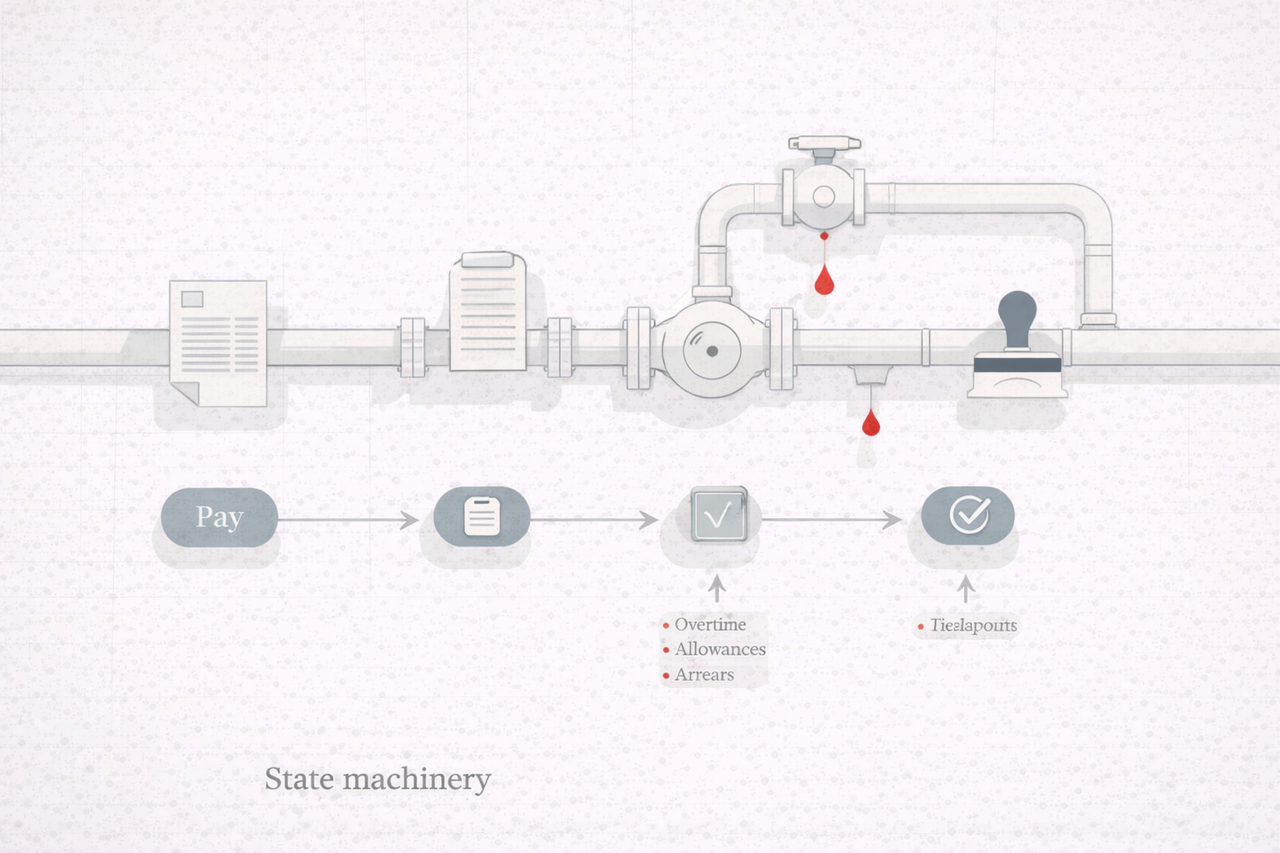
The State as Compensation Machine: Wage Bills, Allowances, and the Credibility Tax
16.0 Why This Section Exists: The Wage Bill is Now Macroeconomics
Mauritius does not have the luxury of treating public administration as "internal housekeeping". In an import-dependent economy, credibility is a hard currency of its own. When households pay for external fragility through prices and depreciation, they watch the State's internal discipline with the sharpness of creditors. The wage bill, overtime, and allowances are therefore not merely HR topics. They are a macro signal: a live test of whether the State can govern scarcity without theatrics.
The Budget's own macro frame makes the constraint explicit: public finances are under strain, with government setting out a consolidation path that includes cutting overtime costs, reviewing (and phasing out) allowances and benefits, and tightening procurement and spending controls. That language matters. It quietly admits what the public often feels: the State is trying to reduce pressure not only through "growth", but through discipline inside the machine.
This is the hinge of Section 16. The public sector's compensation structure has evolved into something more complex than a salary schedule: it is a web of benefits, leave monetisation, passages, pensions, and allowances that operate like a parallel welfare system—one tied to employment status rather than household need.
The structure of centrally managed government expenses shows how quickly "compensation" becomes a fiscal ecosystem. In Programme 2701 (Centrally Managed Expenses of Government), Compensation of Employees alone moves from Rs 2,980,000 thousand in 2024/25 estimates to Rs 3,220,000 thousand in 2025/26 estimates, rising further in planned years. Inside that are not just base emoluments, but items that reveal how the state converts service into cash equivalents—including cash in lieu of leave (on retirement), allowance in lieu of passages, and social contributions tied to pension and protection schemes.
Compensation of Employees (Rs '000):
• 2024/25 estimates: Rs 2,980,000 thousand
• 2025/26 estimates: Rs 3,220,000 thousand
• Rising trajectory in planned years
Components include:
• Base emoluments (salaries)
• Cash in lieu of leave (on retirement)
• Allowance in lieu of passages
• Social contributions (pensions, protection schemes)
• Various allowances and benefits
Implication: "Compensation" is not a single line item but an ecosystem of cash equivalents that converts employment into welfare distribution.
This matters because, in a small island economy under import and FX pressure, the wage system becomes more than remuneration: it becomes macroeconomic shock absorption. When private-sector dynamism slows, the state's pay architecture quietly becomes the national stabiliser—and therefore the national constraint.
That is the core tension of this section: Mauritius may want a productive state, but it also runs a compensatory state. The two can coexist only if governance is unusually disciplined. When governance is not, compensation becomes drift—and drift becomes permanent expenditure.
The public sector serves multiple functions simultaneously in Mauritius:
1. Service delivery: Education, health, infrastructure, regulation
2. Employment stabilization: Absorbing labor market pressure when private sector growth weakens
3. Social insurance: Providing stability, pensions, and benefits that function as welfare
4. Political coalition management: Distributing patronage and maintaining support networks
When these functions conflict—when fiscal pressure demands restraint but political economy demands expansion—the compensation system becomes the battlefield where the contradictions play out.
Pay Pressure Becomes Policy: Minimum Wages, Interim Allowances, and the Compression Trap
The Pay Research Bureau's 2026 review is blunt about what happened to purchasing power in recent years: erosion is described as "significant," tied to the post-2021 price cycle, with the document pointing to a sustained loss of real incomes over the period. Once purchasing power becomes unstable, pay becomes the main battlefield—not between classes, but between fiscal constraint and political survival.
Two policy moves define the recent phase of wage pressure management. First, the national minimum wage step-change: the review notes the National Minimum Wage was raised to Rs 15,000 as from January 2024, and that the lowest salary point in the public sector was adjusted to Rs 16,500. Second, the state attempted a pressure-release valve: an interim allowance of 5% (capped at Rs 2,000) was introduced from 1 July 2024, explicitly framed as a response to cost-of-living strain.
The policy sequence:
• National Minimum Wage raised to Rs 15,000 (January 2024)
• Public sector lowest salary point adjusted to Rs 16,500
• Interim allowance of 5% (capped at Rs 2,000) introduced from 1 July 2024
The trap: When the floor rises quickly, governments face three unattractive options:
Option 1 - Compress pay scales: Reduce differentials between grades, destroying promotion incentives and career progression value
Option 2 - Raise the whole ladder: Maintain differentials but increase entire wage bill proportionally—expensive and inflation-amplifying
Option 3 - Patch with allowances: Create targeted top-ups for middle grades to preserve incentives—generates complexity, opacity, and claims inflation
Mauritius chose Option 3: The interim allowance is a patch that acknowledges the compression problem while avoiding full structural adjustment of the pay scale.
When Internal Pay Pressure Becomes External Policy
The Budget Annex shows how wage pressure spills beyond the public sector: government financial assistance is designed to help employers meet minimum wage/salary compensation requirements, with specified monthly support amounts and time windows. Once the state is subsidizing wage adjustments externally while managing wage pressure internally, "pay" stops being an HR topic. It becomes an economy-wide intervention.
The macroeconomic signal is uncomfortable but clear: when the state must simultaneously raise its own wage floor, compress its own pay scale, and subsidize private sector compliance with minimum wage rules, the country is discovering that cost-of-living pressure has overwhelmed the wage architecture faster than productivity growth can validate it.
The Staffing-Cost Feedback Loop
The staffing side then feeds the cost side. The Public Service Commission annual report records that recruitment exercises were interrupted by institutional transition and resumed after municipal elections, while also stating that thousands of vacancies were filled during the review period. Where recruitment lags, services don't stop—they stretch. And stretching often means overtime, which is how hidden wage bills are born.
The National Audit Office findings in health reveal the mechanism clearly:
Overtime pressure linked to:
• Extended operating hours (Area Health Centres and mediclinics operating to 22:00 and on Sundays)
• Staff shortages (additional staffing requests not fully entertained in budgets)
• Services bridging gaps through overtime rather than structural capacity
Control failure indicators:
• Overtime paid exceeding voted provisions by more than 4x since 2020-21
• Discrepancy between Treasury Abstract figures and ministry workings
• Overtime charged under Basic Salary after funds exhausted—explicitly flagged as non-compliant with Financial Regulations
Translation: Overtime stops being an operational tool and becomes a budget-breaching financing method. Once that happens, you don't just have a staffing problem. You have a controls problem.
This is the pivot of 16.1: pay pressure becomes policy, and once it does, the state's compensation machine starts behaving like an informal macro-stabiliser—messy, politically sensitive, and extremely hard to unwind without triggering organized resistance.
Section 16.2The Overtime State: When "Urgent Tasks" Become a Parallel Salary
Overtime is supposed to be the emergency lane of public administration: used only when work is unavoidable, authorized in advance, monitored tightly, and constrained by the availability of funds. The PRB framework even spells this out—approval remains at the level of supervising officers and officers-in-charge, but with explicit duties: overtime should be "absolutely necessary", "cost-effective", pre-authorized, and strictly monitored to prevent excess.
In practice, overtime becomes something else when staffing gaps harden into a permanent condition. The National Audit Office's findings in the health sector read like a case study in how a service quietly drifts from planned staffing to cash-patched continuity.
The Scale of Overtime Drift
Over four years, the Ministry of Health and Wellness spent about Rs 2.6 billion on overtime against a budgeted provision of about Rs 577 million—not a minor overshoot, but a structural mismatch between what government budgets and what the system requires to keep functioning.
Total overtime spent: ~Rs 2.6 billion
Total budgeted provision: ~Rs 577 million
Overshoot: 4.5x budgeted amount
Specific instances documented:
• Overtime exceeding monthly salary by 100%+ (common)
• Overtime exceeding monthly salary by 200%+ (multiple cases)
• Staff working day and night shifts for 5-12 consecutive days
Control breakdown:
• Overtime budget exhausted by October 2023
• Subsequent payments charged under Basic Salary (non-compliant with Financial Regulations)
• Discrepancy between Treasury Abstract and ministry internal workings
Once that pattern is normalized, the consequences stop being merely fiscal. They become operational, legal, and human. The Audit Office documents cases where overtime is not simply topping up income, but overtaking the salary itself: among the grades scrutinized, there were instances where overtime exceeded monthly salary by more than 100%, and in some cases more than 200%.
That is not "extra hours"; that is an alternative pay architecture—one that rewards stress, shortage, and institutional failure rather than performance or outcomes.
When Overtime Breaks Worker Protection Rules
The deeper problem is that overtime, once entrenched, starts to pull the system out of compliance with the very worker-protection logic that shift systems are supposed to enforce. PRB guidance on shift design is clear:
- Avoid back-to-back full shifts except when unavoidable
- Aim for at least 11 hours of rest between shifts
- Do not trap employees permanently on nights
- Maintain reasonable scheduling that prevents burnout
Yet the Audit Office observed patterns at Brown Sequard Hospital where staff worked day and night shifts for five to twelve days at a stretch, including an attendant working day and night shifts for up to 12 consecutive days. The report explicitly frames this as misalignment with requirements in the Workers' Rights Act (July 2024) and PRB shift guidance.
Stage 1: Ministry cannot staff properly → pays overtime to compensate gap
Stage 2: Overtime costs exceed budget → continue paying anyway (service cannot stop)
Stage 3: Budget exhausted → charge overtime under different line items (Basic Salary)
Stage 4: Financial controls fail → discrepancies emerge between Treasury and ministry records
Stage 5: Worker protection rules violated → staff burnout, health risks, legal non-compliance
Result: Overtime stops being a payroll item and becomes a systemic control failure with human, fiscal, and legal consequences.
The PRB Rate Structure: Why Overtime Becomes Politically Explosive
The PRB rules themselves show why overtime becomes politically combustible once it spreads. Rates are structured to pay a premium for strain:
Weekday daytime overtime: 1.5× base rate
Night overtime: 2× base rate
Sundays/public holidays/cyclone days: 2× base rate
Eligibility expansion:
• Full overtime eligibility: up to Rs 60,600 basic salary
• Partial-rate overtime (80% of prescribed rate): up to Rs 77,750
Rationale: Many essential services rely on lower and lower-middle salary bands to keep running—widening eligibility acknowledges operational reality.
Problem: Once eligibility expands and rates multiply for common scenarios (night work, Sunday work), overtime costs can balloon even with modest hour increases.
Eligibility is also widened at the lower and lower-middle salary bands: the PRB recommends overtime eligibility up to Rs 60,600 basic salary, and partial-rate overtime (80% of the prescribed rate) up to Rs 77,750, precisely because many services rely on those grades to keep running.
The Sunday Problem: When Administrative Details Become National Arguments
Then comes the "Sunday problem"—the kind of administrative detail that turns into a national argument overnight. PRB 2026 records that a 2024 circular letter introduced additional Sunday compensation for shift/roster workers pending the 2026 report, but this triggered representations about disparities:
- Employees who work Sundays but aren't categorized as shift/roster felt excluded
- Those paid at overtime or hourly rates perceived the system as uneven
- Ministry of Finance flagged perceived misinterpretation of the measure's original intent
- PRB was asked to address the emerging fairness controversy
This sequence reveals how compensation systems become politically combustible:
1. Policy introduced: Sunday compensation for shift/roster workers (fairness intent)
2. Implementation creates gaps: Other Sunday workers feel unfairly excluded
3. Classification disputes multiply: Who counts as "shift/roster"? Who deserves compensation?
4. Finance flags concern: Original intent being misinterpreted or gamed?
5. PRB forced to re-examine: Policy becomes contested terrain
This is the state discovering, in real time, that once you add pay patches, you also add pay politics. Every inclusion creates a perceived exclusion. Every allowance creates a claim for equivalence.
Working Time Rules: The Illusion of Control
The PRB keeps the official frame deliberately calm: the standard working week remains broadly 33¾ to 40 hours for most categories (with special cases like Surveillant at 60 hours), and the Bureau explicitly makes no proposal to change working hours, judging the current provisions "still appropriate."
On paper, this signals stability: the state says it knows what a normal week is, and it intends to keep it that way. Yet the same chapter reveals how managerial discretion and operational "exigencies" can quickly turn the standard week into a flexible, negotiable base layer.
Flexitime bands (for eligible five-day week officers) are set out with detailed time windows and core hours—administratively sophisticated, but also a reminder that attendance design is a policy lever, not a neutral routine. When systems are healthy, flexitime improves productivity. When systems are weak, it becomes another surface where discipline, monitoring, and equity can slip.
The Economic Meaning: Overtime as Shadow Wages
When overtime becomes large and persistent, it behaves like a shadow wage system:
- It raises take-home pay for some cadres without transparent long-run affordability
- It blurs whether the state is paying for work or paying for staff shortages
- It quietly depreciates human capital inside the state itself—through fatigue, error risk, morale decay
- It normalizes "crisis scheduling" as operational standard
- It creates dependency: workers organize household budgets around overtime income
The PRB framework tries to keep work hours orderly; the NAO evidence shows what happens when reality breaks through the framework. The gap between the two is where administrative leaks become a second operating system—one funded through exceptions that have quietly become rules.
Section 16.3The Allowance State: When "Urgent Tasks" Become a Shadow Wage System
Overtime is the loud part of the compensation machine. Allowances are the quiet part—the thousands of smaller, "justified" add-ons that accumulate into a parallel wage architecture the state struggles to map, explain, and reform. Once allowances become routine rather than exceptional, payroll stops behaving like a transparent scale and starts behaving like a negotiated ecosystem.
Who is "on special duty"? Who is "acting"? Who is "responsible"? Who is rostered? Who is attached to a particular post? Who has the right signature? Who gets counted? These questions multiply, and with them, the complexity of actually knowing what the state pays for compensation.
The PRB's Attempt at Control
The PRB's own language around allowances is revealing. These instruments are repeatedly framed as temporary, conditional, authorized, and non-automatic. But those words only hold when the institution underneath is properly staffed, properly planned, and disciplined in execution.
When staffing gaps harden, approvals become habitual. When job design is weak, "special duty" becomes a permanent workaround. When vacancies sit unfilled or recruitment lags, "acting" becomes a substitute for proper appointment. In other words, allowances flourish most in systems that are already failing.
Special Duty & Extra Duty: The State Pays for Understaffing One "Urgent Task" at a Time
The PRB framework around Special Duty and Extra Duty Allowance is, on paper, tightly fenced:
Eligibility: Staff who must remain beyond normal working hours for urgent tasks
Workload threshold: Minimum 25 hours beyond normal hours in the month to qualify
Quantum limit: Maximum of 3× the value of the increment attached to the salary point (or last incremental movement for flat-salary cases)
Non-personal status: Can be withdrawn when duties are no longer performed
Authorization: Requires formal approval, not automatic entitlement
Intent: These are not decorative clauses—they are the PRB trying to stop "urgent task" pay from becoming permanent entitlement.
That design matters because Special Duty pay is a classic institutional symptom: it grows fastest where basic staffing and workflow are weak. Ministries that cannot recruit fast enough, cannot redesign processes, or cannot digitize approvals will discover that "urgent tasks" are always urgent.
What starts as continuity insurance becomes organizational habit—and once it becomes habit, it produces three corrosive effects:
First, it changes behavior inside the bureaucracy. Staff begin to organize their lives around allowances, not outcomes. Managers begin to schedule work in ways that preserve allowance eligibility. A payment designed to be occasional becomes a predictable part of monthly income. At that point, any attempt to rationalize it is experienced as a pay cut, even if the formal salary scale remains intact.
Second, it makes inefficiency financially self-sustaining. If the state repeatedly pays allowances to compensate for structural problems (delays, staffing shortages, outdated workflows), the system's failure mode becomes funded. It is easier to keep paying for the workaround than to fix the machinery.
Third, it corrodes transparency. Allowances are harder for the public to understand than base pay. They are easier to justify in internal memos ("urgent", "exceptional", "service needs"), and harder to aggregate into a simple national narrative of what public compensation really costs.
Allowances are individually defensible, collectively explosive:
Individual defense: "This officer worked 30 extra hours this month on urgent citizen services—shouldn't they be compensated?"
Collective explosion: When thousands of officers across dozens of ministries all receive "urgent task" allowances month after month, the aggregate cost becomes substantial—and the question shifts from "should we compensate?" to "why is the system chronically dependent on exceptions?"
This is the political trap: opposing any individual allowance looks like punishing hard work; allowing all allowances collectively looks like fiscal indiscipline.
Acting and Responsibility Allowances: When Vacant Posts Produce Pay Drift
Acting allowances are the most revealing part of the pay architecture because they sit at the boundary between two realities: the formal hierarchy of posts, and the messy reality of day-to-day responsibility.
When institutions are healthy, acting is rare and short—someone fills in temporarily during leave or illness, then returns to their normal role. When institutions are strained, acting becomes permanent—sometimes for months, sometimes for years—because vacancies remain open, recruitment takes too long, or political/administrative friction blocks proper appointments.
The PRB tries to control this by placing conditions around qualification, duration, and entitlement. Responsibility Allowance—paid where an officer performs the duties of a higher post without being formally appointed to act—has its own strict structure:
Condition 1: Payable only when officer performs ALL duties of the higher post
Condition 2: If fully qualified → computed same as Acting Allowance
Condition 3: If not fully qualified → computed at 80% of Acting Allowance rate
Condition 4: Not paid for days officer is absent (no duties = no allowance)
Short-term acting (3-6 days): 80% of normal Acting/Responsibility Allowance if acting in Accounting/Responsible Officer position for 3+ consecutive days but less than 7
Extended acting (4+ months): Eligible for benefits attached to post after continued actingship of at least 4 months (with specific exclusions)
Overseas mission: Officer acting in higher office on official mission may be paid special allowance equivalent to acting allowance they would have drawn
On the surface, this looks like technical HR mechanics. In reality, it's the PRB acknowledging a major governance problem: acting and responsibility allowances can become the default promotion ladder in a slow or politicized appointment system.
And when that happens, the state's pay system begins to behave like a patchwork of quasi-promotions rather than a coherent structure.
The Deep Consequences of Allowance Dependency
A healthy system promotes people into posts and pays them accordingly. A strained system leaves posts empty, keeps people "acting", and pays the difference through allowances. That has deep consequences:
1. It blurs accountability. When a person carries responsibility without stable appointment, the institution creates ambiguity: who is truly responsible? Who can sign? Who can be sanctioned? Who can be audited? Acting arrangements that persist for years generate organizational confusion about authority and liability.
2. It encourages grade drift. If acting becomes long-term, the wage bill grows through allowances while the underlying post structure remains unresolved. The state ends up paying acting allowances year after year instead of either promoting the person or restructuring the position.
3. It creates perceived unfairness. Two people at similar grades can receive materially different take-home pay depending on whether they are placed into acting/responsibility positions—even when performance differences are unclear. This breeds resentment and makes the pay system feel arbitrary rather than merit-based.
The deeper point is not to moralize about public workers. Allowances are not inherently illegitimate. They exist because service delivery is messy and the state must adapt.
The problem is what allowances signal when they proliferate:
• Staffing misaligned with service needs
• Workflows outdated, requiring manual "heroics"
• Appointments/promotions too slow to match operational reality
• Compensation system used to stabilize institution through cash rather than reform
That is why allowances become a credibility problem. Citizens see a state that asks for discipline—restraint, compliance, sacrifices—while the compensation system inside the state becomes increasingly complex, opaque, and politically combustible.
And once allowances become embedded in household budgets—when thousands of public servants organize their monthly spending around "base salary + acting allowance + special duty + overtime"—reform is no longer a technical matter. It becomes a political confrontation with thousands of micro-expectations.
The Duty-Free State: Travelling and Car Benefits as Parallel Compensation Channel
If overtime is the emergency valve, travelling and car benefits are the quiet entitlement architecture—a non-salary channel that can be politically easier to expand than base pay, but harder to unwind once it becomes part of "normal" expectations.
The PRB is explicit that travelling and car benefits are a major component of total remuneration, and that over time they have been enhanced and extended to a wider pool of employees. It also traces the modern shape of the system to the duty-free scheme introduced in 1987, which progressively shifted the structure of benefits toward duty remission and car-linked facilities.
The Policy Contradiction: Containing Vehicles While Subsidizing Access
What makes this chapter economically interesting is that the PRB also acknowledges the state is managing a real-world contradiction: it is trying to contain the growth of the vehicle fleet and encourage "greener technologies", while simultaneously running a benefit structure that has historically widened access to car ownership through the public payroll.
That contradiction sharpened in the last cycle. The PRB records that excise duty on hybrid and electric cars was abolished in July 2022, then reintroduced from 06 July 2025, alongside significant increases on conventional (fuel-propelled) cars—citing surging imports, congestion limits, and accident trends as part of the policy rationale.
While the state is tightening the tax screw on cars in the economy (to control imports, reduce congestion, manage accident trends), it is simultaneously negotiating how much car-access it embeds as an employment benefit.
Translation: Compensation policy and import/transport policy are stepping on each other's toes. The state cannot credibly pursue vehicle fleet containment while expanding vehicle benefits as a substitute for cash salary increases.
This is the quiet macroeconomic feedback: public sector benefits create import demand, which pressures FX, which the state then tries to control through taxation—creating a loop where compensation design directly conflicts with external balance management.
The Scheme: Tiered Remission, Engine Ceilings, and "Cash in Lieu"
The PRB explains the original logic: the duty-free car scheme was designed for Heads of Departments and senior officers, later extended by status and the need for extensive official travelling. It then sets out the broad categories currently covered:
100% duty remission: Senior officers and certain professionals (listed in annex)
70% remission (up to 1400cc) OR 100% remission (up to 1200cc): Officers performing extensive field duty
Fixed duty remission (Rs 115,000): Certain grades requiring regular official travelling
Once-in-a-lifetime eligibility: Some categories with single-event access
Example senior bracket:
Officers drawing Rs 122,000+ (without official chauffeur/self-driven car):
• 100% duty exemption up to 1850cc/200kW
• Renewable once every 5 years
• Alternative: Monthly car allowance of Rs 11,590 in lieu of duty exemption
Where the political economy gets intense is in the detailed ladders—because once a benefit is parameterized (salary threshold, engine ceiling, renewal period), every revision becomes a distributive fight.
The PRB notes it received representations to extend eligibility, raise engine thresholds, and increase the duty exemption rate for those at 70% remission; and it frames its evaluation as criteria-based, using a survey on travelling and car benefits to test claims of parity and operational need.
Why This Matters for the "Compensation Machine" Thesis
This is not a morality play about public officers. It's a state design story with three key dynamics:
1. Non-salary benefits widen silently. PRB itself says these benefits are part of the total reward package and have been repeatedly enhanced over time. Unlike base salary increases (which are politically visible and fiscally transparent), benefit expansions can happen through administrative adjustment—making them easier to grant but harder to track comprehensively.
2. Allowances are revised unevenly under fiscal stress. The PRB openly states it did not find it reasonable to apply the same percentage increase across allowances given the difficult financial situation. This creates a new dimension of perceived unfairness: not only between public and private sectors, but within the public sector itself—where some benefit categories receive uplift while others are frozen.
3. Macro conditions make every benefit heavier. The PRB economic outlook flags a large projected trade deficit (around Rs 210 billion for 2025), continued rupee depreciation pressures, and the imperative to contain government expenditures amid tight fiscal space.
Once you connect these elements, travelling and car benefits become more than "HR policy":
They influence import demand (vehicles entering the country)
They shape household expectations (public sector = car access)
They affect public/private fairness perceptions (private sector workers don't get duty exemptions)
They live in a politically protected zone (harder to reform than cash because they signal "status" and "dignity", not just money)
And in the budget architecture, you can see how large centrally-managed staff-related lines become when compensation is treated as an ecosystem of linked promises—passage-related allowances alone sit at very high headline numbers in centrally managed expenses.
Task Work: When Output Pay Becomes a Timekeeping Loophole (and a Coping Tool)
By the time a state is relying on overtime to keep core services functioning, it has already accepted a dangerous premise: continuity will be bought through pay patches rather than built through staffing, systems, and workflow redesign. "Task work" sits in the same family of coping mechanisms—but with a different political chemistry.
Overtime is visible (it shows up as large sums and headline overshoots). Task work is quieter: it reshapes the workday itself, often blurring the boundary between productivity and presence.
The Theory: Output Pay Instead of Attendance Theater
In theory, task work is a rational instrument. It exists for a simple reason: some public services are best measured by outputs rather than by time. In those environments, paying people on "hours present" can reward slowness, not efficiency. Task work, properly designed, tries to reverse that. If a crew completes the specified task for the day—clearing a defined stretch, finishing a prescribed routine, meeting a measurable quota—the system should not force them to simulate productivity by sitting idle.
The state, in that ideal model, buys results.
The PRB's treatment of task work reflects that logic. It frames task work as a structured mode of employment with explicit administrative duties: a task rate must be approved; tasks must be clearly assigned; work done must be verified; and supervisors are responsible for monitoring the system so that "task completed" is not merely asserted but evidenced.
Task rate approval: Must be formally authorized
Task assignment: Must be clearly defined and measurable
Work verification: Completion must be evidenced, not just claimed
Supervisor responsibility: Monitoring system integrity
Purpose: Replace attendance theater with output measurement
Risk: If verification is weak, outputs become symbolic and time becomes unpriced
The Reality: When Mauritius' State Capacity Meets Task Work
But Mauritius is not operating in an "ideal model" environment. It is operating in a state-capacity environment—one defined by staffing gaps, uneven supervision, weak measurement culture, and intense pay politics.
In that environment, task work develops a second life: it can become not just a productivity tool, but a timekeeping workaround—and sometimes a de facto early-release regime that the state cannot openly defend, but also struggles to dismantle.
The design promise is clean: outputs replace attendance theatre. Yet the risk is also clean: if verification is weak, outputs become symbolic, and time becomes unpriced. Once that happens, task work can produce exactly what a stressed public administration cannot afford—an erosion of credibility.
Task work is only as honest as the supervisor's measurement. If you have:
- Supervisors with too many teams and too little time
- Weak spot-check culture
- Missing digital logs or verification systems
- Political environment where confrontation is costly
...then task work can drift from "pay for output" to "pay with reduced presence."
The system does not collapse; it quietly normalizes a mismatch between what taxpayers think they are funding and what is actually being delivered.
Task Work as Shadow Subsidy of Understaffing
There is also a structural reason task work spreads when a state is stretched: it becomes a substitute for workflow redesign. If ministries cannot modernize processes, cannot reduce duplication, and cannot fix bottlenecks, they often compensate staff through arrangements that feel like relief—faster completion targets, earlier exits, informal flexibility.
Task work then becomes an internal political currency: a non-cash benefit disguised as "efficiency." It is easier to grant operational flexibility than to redesign the system that generates overload in the first place.
And once such flexibility becomes embedded, any attempt to tighten it is experienced not as "better governance," but as "taking something away." That's the political trap. You cannot improve controls without triggering the perception of a pay cut—even when the reform is simply enforcement of the original rules.
The Collision Point: Task Work and Overtime
The PRB's own framing makes clear that task work is not supposed to be an unbounded privilege. The moment task work spills beyond the prescribed structure—when tasks are not clearly set, when completion is not verified, when time is not monitored—it begins to collide with overtime logic.
If workers complete tasks quickly and then are called back (or kept on) for additional duties, the system becomes ambiguous: are you paying for outputs, or paying for time again? PRB guidance explicitly links overtime to task work conditions, indicating how additional hours may be treated when work exceeds the standard framework.
Once task work and overtime overlap without tight controls, you get the worst of both worlds:
- Output pay without rigorous verification, and
- Time pay without clean authorization boundaries
That is how a compensation tool becomes a leakage channel.
Special Duty & Extra Duty: When "Urgent Work" Becomes Standing Entitlement
Special Duty / Extra Duty Allowance exists for a very specific gap in the pay architecture: senior officers who are not eligible for overtime, but who are nevertheless expected to regularly work long hours beyond normal office time because the job itself is structured around deadlines, urgent tasks, and time-bound reports.
In PRB terms, it's explicitly framed as compensation for "unusually long hours" tied to mandatory/administrative timeframes or the nature of duties—not a lifestyle perk, but a pressure valve for senior responsibility.
The Border Between Measurable Work and Unverifiable Expectation
Where it gets politically and fiscally sensitive is that this allowance sits right on the border between measurable extra work and unverifiable expectation. The PRB notes that, under existing provisions, senior officers up to Deputy Permanent Secretary level were eligible for an allowance equivalent to three times the increment reached in their salary scale, subject to a minimum of 25 excess hours per month—a threshold meant to stop the allowance becoming automatic.
Previous framework:
• Eligibility: Senior officers up to Deputy PS level
• Quantum: 3× increment
• Threshold: Minimum 25 excess hours per month
• Purpose: Compensation for "unusually long hours"
2026 recommendation:
• Quantum: 10% of monthly salary OR 3× increment, whichever is higher
• Threshold: Maintains 25 excess hours gate
• Approval: Requires Supervising Officer sign-off
• Time-off alternative: If less than 25 hours, may grant equivalent time-off instead of cash
Critical change: "Whichever is higher" transforms allowance from small technical compensation into potentially significant monthly add-on for senior posts.
But the PRB also acknowledges the pressure to expand it: unions and some management bodies pushed for the allowance to apply to more professional grades even where the 25-hour minimum isn't met, while the Ministry of Public Service and Administrative Reforms (MPSAR) asked for harmonization of how additional hours are compensated.
The Bureau's response is telling: it "examined" requests and moved to "ease implementation"—a polite phrase that usually means the system was already straining in practice.
The Project Work Track: Pricing "Deadline Surges"
Then the PRB adds a second track for "specific assignments/projects" where officers have no other form of compensation: an hourly-rate allowance up to a maximum of one-third of monthly salary, provided the assignment lasts at least two weeks, and subject to MPSAR approval.
In plain governance terms, that's a formal admission that the state increasingly runs on project bursts and deadline surges—and needs a way to "price" that effort without calling it overtime.
The safeguard PRB tries to preserve is time-off: if an officer puts in less than 25 extra hours, they may (subject to exigencies) be granted equivalent time-off instead of cash.
That is the correct idea in theory—cash should be the last resort. But in an overstretched administration, time-off often becomes the least usable option. When everyone is "urgent," nobody can actually leave.
The result: cash allowances become the default, and the time-off alternative exists primarily on paper.
Why This Matters: Overtime for Operational, Special Duty for Senior
Overtime (Section 16.2) is the parallel salary for operational grades. Special Duty/Extra Duty is the parallel salary for senior grades. Once both exist at scale, the wage bill stops being mainly "salary" and becomes a layered structure of add-ons—each defensible on paper, but collectively hard to map, audit, and unwind without triggering political backlash.
This is the compensation architecture problem in miniature: every individual component has a rational justification, but the aggregate effect is a pay system that has become too complex to govern transparently and too politically sensitive to reform cleanly.
Section 16.7Salary on Promotion: When Advancement Becomes a Fiscal Instrument
Promotion is where motivation, fairness, and fiscal control collide—usually at speed, usually in public. The PRB draws an important distinction that shapes everything downstream: "class-to-class" promotion is a move into responsibilities of a different nature (and is meant to be selection-based), while "grade-to-grade" promotion is a step up in the same hierarchy, with the mode determined case-by-case and written explicitly into schemes of service.
That architecture matters, because it determines whether the state is "rewarding merit" or "managing progression."
The Pay Mechanics: Backdating and Fiscal Control
But the real pressure point is not the definition—it's the pay mechanics. The PRB position is deliberately conservative on backdating: for grade-to-grade promotion, the effective date is the date of assumption of duty. Even when promotions are treated as earlier for seniority in specific edge cases (interdiction then cleared, "under report" cases later dismissed, scholarship/leave situations), the PRB still separates the two: for pay purposes, it remains the date of assumption of duty.
That is the state trying to prevent promotions from turning into open-ended retroactive liabilities.
Class-to-class promotion: Different nature of responsibilities, selection-based
Grade-to-grade promotion: Step up in same hierarchy, mode case-by-case
Pay effective date: Date of assumption of duty (not backdated for pay purposes)
Seniority exceptions: Some edge cases allow earlier seniority dating, but pay still from assumption
Gatekeeping instrument: "Report on Fitness for Promotion" as sole basis
Purpose: Prevent promotions becoming retroactive fiscal liabilities while maintaining merit framework
Promotion as Retention Lever and HR Patch
At the same time, the system is quietly telling you how promotions are actually used in Mauritius: not only as advancement, but as a retention lever and an HR patch. The PRB explicitly frames promotion governance around a single gatekeeping instrument—the "Report on Fitness for Promotion" as the sole basis used for promotion purposes—a sign of how much the system depends on controllable paperwork when promotions carry real fiscal consequences.
Then the workaround layer appears: when recruitment and retention fail, pay progression gets "customized." The PRB notes the role of MPSAR in approving higher entry points / salary adjustments (subject to constraints—not exceeding the top salary of the grade), paying for the post holder's qualifications without redefining the post's salary.
In plain terms: when the labour market doesn't cooperate, the system bends—carefully, administratively, and with approvals—rather than reforming fast enough to avoid bending in the first place.
When Acting Fills the Promotion Vacuum
And when promotion is delayed, acting fills the vacuum—often for long periods—creating a parallel reality where people perform higher duties while the formal promotion pipeline lags. The PRB's acting rules matter here because they effectively price "temporary promotion": the acting allowance is structured as the difference between the higher post's initial/flat salary and the officer's substantive salary, with minimum protections (at least three increments' worth), and special handling where salary scales overlap.
That's rational on paper—but in a system with chronic vacancies, acting can stop being "developmental" and start being a substitute for timely promotion decisions.
1. Fiscal control lever: Anchoring pay to assumption of duty, not seniority narratives, prevents retroactive liability explosion
2. Legitimacy instrument: "Fitness for promotion" documentation governs disputes over fairness and merit
3. Labour market patch: Approved adjustments and acting mechanisms compensate when state cannot recruit/retain cleanly
Result: In an ideal system, promotion pay rewards increased responsibility. In a stressed system, it becomes a political lever to keep posts staffed, manage wage pressure, and defuse fairness disputes—while creating new tensions over who advances and why.
Incremental Credit and Incremental Movement: The Quiet Engine of Pay—and the Quiet Politics of "Deserving"
In a functioning pay system, increments are meant to behave like gravity: predictable, earned, and mostly invisible. The PRB frames it exactly that way—most public-sector grades sit on incremental scales, and movement along that scale is not automatic. Increments are supposed (in principle) to be earned through satisfactory performance, using an evaluation process that determines whether an increment is granted—and in cases of underperformance or specific circumstances, it can be withheld, stopped, or deferred.
That design choice matters because it tells you what the state thinks it is purchasing. Not just time served—but competence that can be rated and verified.
When Performance-Related Increment Becomes Increment as Entitlement
The political problem, of course, is that "objective evaluation" is a beautiful phrase in a document and a very messy experience inside a ministry. When pay progression is tied to ratings, the appraisal culture becomes part of the wage bill.
If appraisal is weak, captured, or purely ceremonial, "performance-related increment" degenerates into "increment as entitlement"—and the state loses one of its few levers for productivity discipline.
The Public Service Commission noted that some promotion cases could not proceed due to:
- Absence of performance appraisal reports
- Appraisals not signed
- Appraisals not submitted on time
- Appraisals containing "many discrepancies"
Translation: The HR machine that determines "who deserves increment/promotion" is itself unreliable.
When the performance measurement system breaks down, increment decisions become either:
• Automatic (everyone gets it, performance irrelevant)
• Arbitrary (based on relationships, not metrics)
• Contested (every withholding triggers grievance)
None of these outcomes support productivity discipline.
The Long-Service Increment: When Careers Flatline
Then comes the second layer: what happens when careers flatline. The PRB explicitly recognises the structural bottleneck in many cadres—few or no promotional posts—which leaves long-serving employees stuck at the top of their salary scale for years.
The long-service increment was introduced to address exactly that stagnation, and PRB 2026 signals further "amelioration," framing it as a morale and performance tool rather than a mere sweetener.
This is the state acknowledging a hard truth: when organizational charts don't allow upward movement, pay must move horizontally—or the institution risks losing experienced staff to demoralization or departure.
Incremental Movement Beyond Top Salary: The Shadow Promotion Track
But the most revealing mechanism—and the one that quietly rewires incentives—is incremental movement beyond top salary. PRB describes incremental movement being granted for:
Eligibility triggers:
(i) Acquiring additional/higher qualifications
(ii) Successfully completing a sponsored course
(iii) Performing additional/higher duties that would normally sit at the next level
Governance conditions:
• Officers must have drawn top salary for at least 1 year
• Movement by 1, 2, or 3 increments in Master Salary Scale
• Requires evidence of being "consistently efficient and effective"
• Based on Performance Appraisal Reports over preceding 2 years
• No adverse reporting on conduct
Translation: "If we can't promote you fast enough, we'll sometimes pay you as if you partially climbed."
And PRB sets the governance guardrails: certain categories of officers who have drawn their top salary for a year may move by one, two, or three increments in the Master Salary Scale—but only after being "consistently efficient and effective," evidenced by Performance Appraisal Reports over the preceding two years, and with no adverse reporting on conduct. PRB 2026 notes this arrangement is being maintained.
Stabilizer and Risk: The Economic Dual Nature
Economically, this is a stabilizer and a risk—at the same time.
It's a stabilizer because:
- It is cheaper than constant regrading exercises
- It reduces the anger of long-service stagnation (the kind that turns institutions into slow-motion strike machines)
- It provides a retention mechanism when promotion pipelines are clogged
- It acknowledges that organizational charts cannot always accommodate merit-based advancement
It's a risk because:
- Once "incremental movement" becomes a widespread substitute for career progression, it turns into a shadow promotion track
- Shadow tracks are harder to audit (less visible than formal promotions)
- Shadow tracks are easier to politicize (discretion in "consistently efficient" judgments)
- Shadow tracks create expectations that any reform will be accused of "stealing"
This is where the compensation machine becomes psychologically dangerous: increments feel small, but they become identity. They are how a public officer narrates progress when the organizational chart doesn't.
Once that happens, the fight is no longer about pay scales—it's about dignity, hierarchy, and who gets recognized.
A government attempting to rationalize incremental movement faces not just fiscal resistance, but existential resistance: "You're taking away my only path to recognition."
The Quiet Politics of "Deserving"
The increment system reveals a fundamental governance challenge: in a system where advancement is limited by organizational structure rather than merit, the state must either:
- Accept stagnation (and lose morale, productivity, retention)
- Create shadow advancement (incremental movement, allowances, acting arrangements)
- Restructure fundamentally (flatten hierarchies, redesign career paths, expand lateral opportunities)
Mauritius has chosen the second option—shadow advancement through incremental movement, allowances, and acting arrangements. This choice is politically safer than restructuring, fiscally cheaper than formal regrading, and psychologically more acceptable than telling long-serving officers "there is no advancement available."
But it creates the compensation machine problem at its most concentrated: a system where "pay for what you do" has been gradually replaced by "pay for who you are, how long you've served, which allowances you've accessed, which acting roles you've occupied, and which incremental movements you've qualified for."
The Acting State: When Vacancies Become Normal, and "Temporary" Becomes a Wage System
In the PRB's own framing, acting appointments are meant to be a pragmatic management tool: when there is an operational need and a vacant post must be covered, management may appoint an officer to act—an administrative arrangement, discretionary, and not automatically triggered by every vacancy. In other words: acting is supposed to be exceptional, purposeful, and temporary, not a default mode of running government.
The PRB also admits the other, more political function of acting: it's a mechanism to test suitability for substantive promotion—especially in long-term acting—and, even short-term, a way to "try out" officers for development purposes. That's sensible in principle, but it has a dangerous side-effect in a system with chronic vacancies: the state can drift into running whole layers of hierarchy on "trial mode"—with real responsibilities carried by people who do not hold the post substantively.
The Three-Year Cap That Wasn't
What's striking is the representation the PRB records: federations asked that actingship be capped at three years. The PRB's response is revealing: rather than setting a hard cap, it says the more appropriate solution is for Responsible Officers to ensure permanent vacancies are filled "without undue delay"—and then it changes nothing, maintaining the existing framework.
That's the report acknowledging, politely, the underlying disease: persistent unfilled vacancies are what make acting explode into a quasi-permanent structure.
Stage 1: Post becomes vacant (retirement, transfer, promotion)
Stage 2: Recruitment delayed (bureaucratic friction, political indecision)
Stage 3: Officer appointed to act "temporarily"
Stage 4: Acting continues for months, then years
Stage 5: Officer performing duties, receiving allowance, becoming embedded
Stage 6: Substantive appointment becomes politically complicated (other candidates, fairness claims)
Stage 7: Acting continues indefinitely, becoming the operational reality
Result: The state runs on "trial mode" as permanent architecture, with acting allowances becoming structural wage costs rather than temporary measures.
How the Money Works: Acting Becomes Shadow Wage Architecture
Now look at how the money works—because this is where "acting" becomes part of the shadow wage architecture.
General computation: Difference between initial/flat salary of higher post and officer's substantive salary
Minimum protection: Must not be less than value of 3 increments at officer's current incremental point
Overlapping scales: When scales overlap, allowance becomes 3 increments' worth, with ceiling so total emoluments don't exceed maximum of higher post
Critical insight: Structure embeds minimum uplift even when pay bands overlap—so actingship reliably produces pay bump, not just "experience"
Responsibility Allowance applies when someone is assigned duties of a higher post "for administrative convenience" where the mode of appointment is by selection (including from outside the service). The PRB keeps the provision and sets the payment logic:
- If fully qualified → Responsibility Allowance = Acting Allowance
- If not fully qualified → 80% of Acting Allowance
- If appointment by selection with no extra qualification required → equals Acting Allowance
Translation: the system provides a standardized pay bridge for higher duties, calibrated by qualification status—but still structurally tied to acting-level pay.
The Qualifying Rules: How "Temporary" Becomes Routine
Then come the qualifying rules, which show how this becomes routine:
Standard threshold: Paid after 7 continuous days in higher office (including weekends/public holidays)
Accounting/Responsible Officer exception: Can be payable even under 7 days
Absence rule: No allowance paid for absence periods of 7 days at a stretch
Overseas mission: Officers acting and sent on mission get special allowance equivalent to what they would have drawn acting
Short-term acting (Accounting/Responsible Officer):
• 3 to less than 7 days: 80% of normal acting/responsibility allowance
• Below 3 days: No formal actingship/payment
CRITICAL CLAUSE - The 4-Month Trigger:
Where someone acts/assigned duties in Accounting/Responsible Officer position against vacancies (or vacancies likely to become permanent), after 4 months of continued actingship they become eligible for ALL benefits attached to the post except car benefits.
That last clause is the tell. Once acting stretches long enough, it stops being "just an allowance" and starts pulling in the benefit ecosystem of the higher office.
The longer vacancies remain unfilled, the more the state ends up creating two parallel truths:
- The formal establishment chart (who holds what substantively)
- The operational establishment (who actually does the job—and is increasingly compensated like it)
The Workmen's Group: Widening the Bridge
Finally, the PRB even provides a special computation method for the Workmen's Group: Responsibility Allowance is computed on the same basis as Acting Allowance even if the employee is not fully qualified, and paid for the full actingship period when it exceeds the continuous-day threshold, otherwise by actual days worked.
That is the system explicitly widening the bridge—because it knows essential services depend on these grades.
The result is a compensation machine that grows tendrils precisely where staffing and promotion systems are weakest. Acting was designed as a temporary bridge. It has become permanent architecture.
Section 16.11Meal Allowance: When Feeding the Shift Becomes Part of the Wage Architecture
Meal allowance looks minor on paper, but it sits right on the fault line between legitimate worker protection and quiet wage expansion. In a public sector where services increasingly run beyond "office hours", food becomes a basic operating input: if you keep people on duty late, on nights, on weekends, you either organize meals—or you compensate the fact that normal life logistics collapse.
When "Exceptional Hours" Become the Default
The governance problem starts when "exceptional hours" become the default. The National Audit Office's health-sector findings describe exactly that kind of drift: overtime spending massively overshot voted provisions, and patterns were observed where staff worked day and night shifts for five to twelve days at a stretch in ways flagged as misaligned with worker-protection logic and shift guidance.
Once this becomes normal, meal allowance stops being a welfare detail and starts behaving like a second-order overtime benefit—another payment that grows automatically when rosters, staffing and planning fail.
This matters because PRB-style controls for overtime are very explicit: overtime should be unavoidable, authorized in advance, recorded, and strictly monitored at supervisor level.
Meal allowance needs the same philosophy, otherwise it becomes the classic "small leak" that turns into a system:
• Eligibility triggered by long hours: Piggybacks on same incentives that make overtime politically explosive
• Eligibility rules differ across grades/agencies: Generates familiar resentment ("same hours, different treatment")
• Approval process is loose: Becomes soft target for "automatic" claiming, especially where rosters chaotic and overtime already used as continuity finance
The Real Design Question
The real design question: does the state treat meal allowance as a controlled duty expense (tied to approved rosters and verifiable shift conditions), or as another wage patch that expands whenever staffing gaps expand?
In systems with weak controls, meal allowances follow the same drift pattern as overtime:
- Budgeted conservatively (because it's "just meals")
- Claimed widely (because shifts are long and frequent)
- Verified weakly (because supervisors are stretched)
- Overspends quietly (because amounts per person are small, aggregate is large)
What to Lock Down (So It Doesn't Become Parallel Salary)
To prevent meal allowance from becoming another uncontrolled compensation channel:
1. Tie to roster/shift records: Not ad hoc claims—allowance should automatically follow documented shift patterns, not employee assertions
2. Mirror overtime approval controls: Authorize → Record → Audit pipeline with same rigor as overtime
3. Publish ministry-level totals quarterly:
• Total spend
• Headcount benefiting
• Average per beneficiary
• Trend vs. budgeted provision
Purpose: Make leakage visible early—before it becomes "normal" and politically protected
The danger is not that workers receive meal allowances. The danger is that meal allowances become yet another automatic add-on in a compensation system already layered with overtime, acting allowances, special duty payments, and incremental movements—each individually justified, collectively unsustainable, and politically impossible to unwind once embedded in household budgets.
Meal allowance exemplifies the "small leak" problem in compensation architecture:
Year 1: Introduced for genuine edge cases (night shifts, emergency operations)
Year 2: Eligibility quietly expands (extended hours, Sunday work)
Year 3: Becomes expected (staff organize finances around it)
Year 4: Controls weaken (verification too burdensome, approval becomes rubber stamp)
Year 5: Budget overshoots consistently (but amounts too "small" to fight politically)
Year 6: Embedded in wage expectations (any reduction triggers grievance)
Result: A "minor" allowance has become structural compensation, adding fiscal pressure without improving service delivery or productivity.
Subsistence Allowance: The Per-Diem Economy, and Why It Quietly Distorts Behaviour
Subsistence allowance looks harmless on paper: a practical reimbursement tool so public officers aren't personally financing meals and lodging when duty takes them away from home. In a functional system, it's a neutral lubricant—you travel, you do the job, you're covered, you move on.
But inside a stressed public service, subsistence tends to mutate into something more political: a micro-income stream that employees plan around, managers use to "make deployments possible," and ministries struggle to control because the claims are dispersed, frequent, and easy to normalize.
The Two Forces That Push Subsistence Toward Compensation
Two forces push subsistence in that direction:
First, fiscal constraint meets fairness pressure. PRB 2026 explicitly signals that, given difficult national finances, allowances are not all increased uniformly—different rates are applied depending on "utility and other characteristics." That is a rational macro stance (you can't inflate every line item equally), but it also means subsistence rates can easily lag real costs—and when that happens, travel becomes a grievance ("I'm subsidizing government work"), not a tool.
Second, once pay becomes a patchwork, subsistence stops being "expenses" and starts behaving like "compensation." PRB is clear that a public employee's reward package is not just basic salary; it's the full suite of monetary and non-monetary conditions of service, which collectively serve to attract/retain staff and keep the machine running.
In that ecosystem, subsistence allowance is no longer psychologically treated as reimbursement; it becomes part of the expected bundle—particularly in grades or functions where mobility, inspections, field duty, and inter-island work are routine.
Officers in these roles begin to organize their household budgets around the assumption of regular subsistence payments. When that happens, any attempt to reduce travel (even for efficiency reasons) is experienced as income reduction.
The state has unintentionally created a compensation dependency on what was meant to be a neutral expense reimbursement.
The Governance Risks: When Travel Becomes the Payoff
That's where the governance risk kicks in:
1. Incentive distortion. If the allowance is generous (or weakly audited), the system quietly rewards being away rather than being effective. You get a "mission culture" where travel becomes the payoff—and the work becomes the justification. Officers may advocate for travel-intensive approaches to problems that could be solved through local coordination, digital communication, or better planning.
2. Control dilution. Hundreds of small claims across units create a low-visibility spending river. Individually trivial; cumulatively real. Unlike large contracts or major procurement that attract scrutiny, subsistence claims are dispersed, routine, and administratively burdensome to audit systematically. This makes subsistence a classic "small leak" channel.
3. Equity conflict. Officers whose roles don't travel begin to see others' subsistence as a "hidden top-up." This is exactly how payroll politics spreads: not via one big scandal, but via thousands of small comparisons. "Why does their grade get to travel twice a month while we're stuck here doing the same work for less total pay?"
4. Planning failure camouflage. When staffing and deployment planning are weak, subsistence becomes the workaround. That's when reimbursement turns into informal stabilization: the state keeps services moving by paying the friction. If you cannot staff regional offices properly, you send central officers on frequent missions. If you cannot recruit locally, you deploy from the capital. The subsistence bill grows—not because travel is essential, but because organizational design is broken.
Healthy system: Travel is undertaken when physical presence is genuinely necessary, minimized through better technology/coordination, and managed to keep officers close to families/communities
Distorted system:
• Officers seek travel assignments (subsistence supplements income)
• Managers use travel opportunities as informal rewards/favors
• Planning defaults to "send someone" rather than "solve locally"
• Subsistence becomes embedded income expectation
• Reform (reducing unnecessary travel) triggers resistance ("you're cutting my pay")
Result: The state ends up paying for movement that doesn't always produce proportional value, while creating dependency on allowances that were meant to be neutral cost recovery.
What Controls Would Look Like
To prevent subsistence from becoming another uncontrolled compensation channel, the state needs:
1. Mission justification requirements:
• Clear objective for travel (what cannot be done remotely/locally)
• Pre-approval at appropriate level (not rubber-stamped)
• Mission report linking travel to outcomes
2. Rate rationalization:
• Align rates with actual costs (neither windfall nor personal subsidy)
• Regular review to prevent lag from creating grievances
• Transparent methodology (so adjustments are defensible)
3. Aggregate visibility:
• Quarterly reporting: total subsistence spend, number of missions, average per officer
• Ministry-level comparisons (identify outliers)
• Trend analysis (is travel growing faster than service delivery justifies?)
4. Structural alternatives:
• Invest in regional capacity (reduce need for central deployment)
• Strengthen digital collaboration tools
• Design roles to minimize routine travel requirement
The Psychological Trap
The subsistence allowance trap is psychological as much as fiscal. Once officers experience regular subsistence payments as part of their income flow, three things happen:
- They plan household budgets around it (mortgage, school fees, regular expenses)
- They perceive any reduction in travel opportunity as unfair targeting
- They resist organizational changes (better technology, stronger regional offices, workflow improvements) that would reduce travel need
At that point, subsistence is no longer a reimbursement mechanism. It is a compensation component that the state cannot easily adjust without triggering organized resistance—even when the adjustment would improve efficiency and service delivery.
Out-of-Pocket Allowance: When "Small Reimbursements" Become a Shadow Wage
An out-of-pocket allowance is meant to solve a boring, practical problem: officers incur minor, work-related expenses (small local transport, incidental stationery/communications, ad-hoc field costs) that are too frequent to run through slow procurement, and too small to justify a formal tender universe. In theory, it protects service delivery from bureaucratic friction.
In practice, this is where compensation systems develop "micro-entitlements": lots of small, individually defensible payments that—once normalized—start behaving like an informal salary supplement.
The Total Reward System Warning
The PRB itself frames Conditions of Service as a total reward system that has to be carefully managed because it represents a substantial and ongoing cost to the State, not just a collection of HR perks. That warning matters more for allowances than for base pay, because allowances are where complexity quietly multiplies.
When a payment is expected monthly (or treated as "automatic"), it stops being a cost-recovery tool and becomes a wage component—without the transparency and discipline that usually follows wages:
• No grading logic (who deserves more based on role/performance)
• No performance logic (payment disconnected from outcomes)
• No clear ceilings (amounts drift upward through precedent)
• No public visibility (buried in dispersed claims rather than transparent salary schedules)
This is exactly why PRB chapters on claims keep emphasizing constraints like "most economical route", and the need to revisit long-standing claim practices in the name of equity and fairness.
That's the PRB admitting—politely—that benefit systems drift unless rules are periodically tightened.
Two Governance Problems That Always Appear
Two governance problems usually appear once out-of-pocket payments spread across grades and ministries:
First: The shift from reimbursement logic to entitlement logic.
When a payment becomes routine, officers begin to organize household budgets around it. What the state intended as "cost recovery for exceptional circumstances" becomes "expected monthly supplement." At that point, any attempt to rationalize the allowance is experienced as a pay cut, even when the rationalization is simply enforcing the original purpose.
This is the same political trap documented with overtime and Sunday compensation: individually defensible claims aggregate into a compensation layer that cannot be touched without triggering organized resistance.
Second: Verification fatigue.
The more "small" claims a system produces, the more it depends on supervisors actually checking, rejecting, documenting, and escalating exceptions. But supervisors are busy, and ministries under stress default to approval as a workflow hack.
Clean system:
• Officer submits claim with receipts/proof
• Supervisor verifies legitimacy and necessity
• Questionable claims are rejected or queried
• Patterns of abuse are identified and escalated
• System maintains integrity through active oversight
Stressed system:
• Supervisor overwhelmed by volume of small claims
• Rejection triggers confrontation and paperwork
• Easier to approve than to audit
• Approval becomes rubber stamp
• Claims normalize regardless of actual necessity
Result: A clean concept (reimburse costs) becomes a messy political argument ("you're cutting my pay") when government tries to rationalize it later.
Not Corruption by Definition—But Predictable Drift
Out-of-pocket benefits aren't "corruption by definition". They're a predictable by-product of a state that doesn't modernize procurement workflows and field-duty logistics.
If it takes three weeks and five signatures to procure a notebook, officers will front costs personally. If official transport is unavailable or unreliable, officers will use taxis and claim reimbursement. If communication tools are outdated, officers will use personal mobile data and submit claims.
The allowance exists because the system is friction-heavy. But once allowances become widespread, they create a shadow wage structure—hard to map, hard to audit, and politically explosive to reform—because each allowance has a constituency.
Minimum Control Standards: The Reform Test
To prevent out-of-pocket allowances from becoming another uncontrolled compensation channel, the state needs:
1. Definition discipline: Precisely define what qualifies as out-of-pocket (and what does not)
• Eligible expense categories (transport, communication, materials)
• Exclusions (personal expenses, routine supplies that should be procured centrally)
• Thresholds (amounts requiring different approval levels)
2. Proof discipline: Receipts or digital proof by default, with narrow exceptions
• No "bulk monthly allowance" without documented expenses
• Digital submission of claims with attached proof
• Random audits to verify claim accuracy
3. Ceiling discipline: Hard caps, with exception approval logged and reviewable
• Monthly/quarterly limits per officer
• Approval requirements for amounts exceeding caps
• Transparency: exceptions published for audit scrutiny
4. Digitization: Claims submitted and tracked digitally (so patterns are visible, not anecdotal)
• Online claims system replacing paper trails
• Dashboard showing ministry/unit totals and trends
• Outlier detection (officers claiming far above average)
5. Auditability: Sample audits + sanctions for systematic abuse (otherwise rules are theater)
• Regular random sampling for verification
• Consequences for false claims
• Public reporting of audit findings
The Shadow Wage Problem
The fundamental issue with out-of-pocket allowances is the same as with all the compensation layers documented in this section: they create a parallel wage architecture that operates outside the transparent, rule-bound logic of formal salary schedules.
When an officer's total monthly income is:
- Base salary (Rs X)
- + Overtime (variable, Rs Y)
- + Acting allowance (if applicable, Rs Z)
- + Special duty allowance (if qualifying, Rs A)
- + Meal allowance (if shifts qualify, Rs B)
- + Subsistence allowance (if traveling, Rs C)
- + Out-of-pocket reimbursements (routine, Rs D)
- + Car benefit or cash equivalent (if eligible, Rs E)
- + Incremental movements beyond scale (if long-serving, Rs F)
...then the "wage bill" stops being the sum of salaries and becomes a complex, opaque aggregation of individually justified but collectively unmanaged payments.
This is why reform is so difficult. The state cannot simply "cut allowances" without understanding that it has created dependency. Officers are not gaming the system maliciously—they are responding rationally to the compensation structure the state designed. But the structure itself has become unsustainable, opaque, and politically combustible.
Section 16.14Uniforms: When Clothing Becomes Procurement—and Procurement Becomes Governance
Uniforms look like a minor "conditions of service" line item until you zoom in on what they actually are: an operating input (safety, identification, standardization) that is delivered through the most failure-prone part of the state—procurement. And that's where a simple question ("Did officers get their uniforms on time, in the right quality, at the right cost?") turns into a governance test.
The Two Design Options—Both Problematic
At the design level, there are only two ways to do uniforms:
1) Issue-in-kind (state buys, stores, distributes).
This is cleaner on paper because it keeps uniforms as uniforms—not cash. But it relies on disciplined procurement planning, transparent tendering, functioning stock control, and predictable distribution. When any of these elements fails, the system produces delays, quality disputes, and emergency purchases.
2) Pay an allowance (officer buys privately).
This is faster and shifts the logistics burden to the employee. But it comes with a political trap: once paid as cash, a uniform benefit behaves like a mini-salary—hard to audit for "value", hard to standardize, and even harder to reduce without triggering the "you cut our pay" reaction.
Now plug this into what the National Audit Office keeps flagging across government procurement:
- Non-adherence to e-procurement requirements
- Incomplete procurement registers
- Weak disclosure of contract awards
- Repeated bid cancellations inflating cost estimates
MoETEST Central Supplies Division example: Procurement non-compliance risks (paper-based processing despite e-procurement requirements), missing key data in registers (dates, awards, contract amounts), cancellations and delays pushing cost estimates sharply upward (some by more than 50%).
Translation: Classic conditions for opacity and avoidable waste—exactly the environment where basic supply items become recurring "late/low-quality/overpriced" dramas.
How Uniforms Suffer in Weak Procurement Environments
Uniforms suffer in that environment in predictable ways:
- Delivery slippage becomes normal: Tenders take too long, specs change midstream, or exercises get cancelled and re-run
- Quality disputes multiply: Fabric, safety standards, durability, sizing issues
- "Emergency purchases" creep in: The procurement version of overtime—always urgent, always justified, always expensive
- Allowances become the workaround: Which then becomes the entitlement
The deeper institutional point matches what we already saw with overtime: when controls are weak, the system quietly drifts into improvisation.
PRB rules on overtime explicitly insist that approving officers ensure work is absolutely necessary, cost-effective, authorized in advance, and strictly monitored—because without that discipline, a "support tool" becomes a permanent leak.
Uniforms follow the same logic: without tight procurement and distribution controls, a basic operational input turns into a recurring fiscal irritant and a credibility problem.
Why It Matters Economically (Even If It Sounds Petty)
Uniforms sit at the intersection of frontline service delivery (police, prisons, fire, health, inspectors) and public trust. When the state cannot reliably supply the basics—correct kit, on time, at fair cost—it sends a quiet signal:
We struggle to do the small things, so don't expect mastery of the big ones.
This is not merely symbolic. Frontline services depend on visible authority and professional presentation. When police uniforms are delayed or substandard, it affects public confidence. When health workers lack proper protective clothing, it creates safety risks. When inspectors appear in makeshift uniforms, regulatory authority is undermined.
The procurement failure cascades from administrative inefficiency into service credibility into public trust. And public trust, once lost, makes every other reform harder—because citizens discount government commitments across all domains.
Section 16.15Family Protection Schemes: When the State's HR Rules Become Social Policy
In a small island state, "family protection" is not a soft add-on. It's labor-market infrastructure. When households are stretched by caregiving, illness, childcare, domestic instability, or adoption processes, the employer that absorbs (or refuses) that pressure shapes attendance, retention, productivity—and ultimately emigration decisions.
This is why the PRB's family-facing provisions matter: they are a quiet attempt to prevent family stress from becoming a public-sector performance problem.
Family Responsibility Leave: The State Admits Reality
The PRB's own logic is blunt: if you force public officers to use Sick Leave to care for sick children or elderly parents, you defeat the purpose of sick leave itself—and you create incentives for misclassification, conflict, and silent absenteeism.
That is why Family Responsibility Leave was introduced (2016), and why PRB 2026 tightens and expands it.
Previous framework:
• Up to 3 consecutive days
• Charged against Casual Leave
• If Casual Leave exhausted, offset against accumulated Vacation Leave
PRB 2026 enhancement:
• Up to 10 days' leave
• Offset (at officer's option) against any paid leave entitlement
• Purpose: Care for child/adopted child, spouse, parent, or grandparent with healthcare-related issues
• Additional leave (if needed) charged to Vacation Leave
• Procedural conditions: Notification on day one, documentation requirements
What this signals: The state admitting that family care is not a rare exception—it is a routine operational reality.
Read that carefully: this is the State admitting that family care is not a rare exception—it is a routine operational reality. And the more the public sector becomes the "safe employer" in a pressured economy, the more these family-friction rules become a de facto population policy: they influence whether workers can remain in post, whether they burn out, and whether the household feels forced to "solve" stress by migration.
The Wider Family Protection Ecosystem: Strong HR, Weak Institutions
But the real tension is that HR protections can be strengthened while the wider family-protection ecosystem remains administratively weak.
The National Audit Office's findings on Gender-Based Violence (GBV) are a warning flare:
Budget allocation: Rs 54.5m under "Family Welfare and Protection from GBV"
Utilization: Rs 45.8m (FY 2023-24)
Cases recorded:
• FY 2022-23: 6,506 GBV cases
• FY 2023-24: 6,112 GBV cases
Critical gaps identified:
• Absence of comprehensive integrated database
• Missing KPIs for measuring effectiveness
• No shelter for male victims operated by the Ministry
• Lack of formal frameworks/MoUs for shelter governance
Translation: When family risk is rising but measurement and coordination are weak, the state ends up paying twice: once in HR concessions, and again in downstream policing, health costs, and lost productivity.
Governance Drag: Modernization Stalled
Even where the intent is modernization, governance drag shows up. The Audit Report notes overlapping roles and outdated legislation around welfare/community centres, alongside a proposal to repeal the SILWF Act and introduce a new Family and Community Welfare Fund Act, with both relevant Acts still under review as of October 2024.
That matters because "family protection" cannot just be leave entitlements—it needs functioning institutions behind the paper. Without integrated databases, clear KPIs, properly governed shelters, and modern legislative frameworks, the HR protections become isolated gestures rather than systematic support.
The Public Sector as Absorber-of-Last-Resort
The pattern is clear: PRB-style family protection is the State trying to stop household fragility from spilling into service fragility. But if the surrounding welfare and protection architecture is under-measured and under-governed, the public sector becomes the absorber-of-last-resort.
This creates several problems:
- Fiscal pressure: Family protection benefits grow as household stress rises, but without corresponding improvement in family support services
- Performance impact: Officers manage family crises through leave rather than through effective external support systems, reducing available working time
- Equity gaps: Public sector workers access family protections that private sector workers do not, widening the public-private divide
- Migration incentive: Professionals assess not just wages but family support systems when considering emigration—weak institutions accelerate brain drain
Risk, Insurance and Compensation: The State as Insurer of Last Resort
Risk costs are where public administration stops looking like "service delivery" and starts looking like an insurance company with a flag.
On paper, Mauritius budgets for risk in small, tidy labels—insurance and compensation arising out of government liability. But those two lines are a quiet admission that the state is permanently exposed to tail-risk: accidents in public facilities, claims linked to errors, liability events, and the ordinary friction of a system that touches millions of people every day.
In the Government Expenses estimates, "Insurance" appears as a small provision, while "Compensation arising out of Government Liability" is budgeted in the tens of millions of rupees and is planned forward across years—meaning it's not treated as a one-off anomaly, but as a recurring feature of the state's financial anatomy.
Insurance: What you buy—a premium you can cap, negotiate, and design
Liability compensation: What happens when risk leaks out of control—when harm occurs, disputes escalate, and the state becomes payer-of-last-resort
Key difference: Insurance is predictable and controllable. Liability is reactive and potentially unlimited.
The Governance Problem: When Liability Becomes "Normal"
The fiscal problem is not the existence of claims; any modern state will face them. The governance problem is when liability becomes "normal", but the system still behaves as if risk is an afterthought:
- Weak incident reporting (problems not logged systematically)
- Inconsistent audit trails (hard to trace what went wrong, who was responsible)
- Patchy internal controls (gaps in safety protocols, supervision, maintenance)
- No hard feedback loop linking recurring claims to operational reform
Stage 1: State struggles with staffing, fatigue, process breakdown
Stage 2: More incidents happen (accidents, errors, failures)
Stage 3: More claims proliferate (compensation demands rise)
Stage 4: Money quietly shifts from building capacity to paying for failure
Stage 5: Risk spending becomes silent substitute for reform
Result: The state pays for consequences instead of investing in prevention. Liability compensation grows as recurring budget line rather than triggering systematic improvement.
This is the structural trap: the more the state struggles with staffing, fatigue, and process breakdown, the more incidents happen; the more incidents happen, the more claims proliferate; and the more claims proliferate, the more money quietly shifts from building capacity to paying for failure.
Risk spending is then no longer protection—it becomes a silent substitute for reform.
Section 16.17Funeral Grant: A Small Payment That Reveals the State's "Human" Obligations
The Funeral Grant sits in that awkward space between compassion and bureaucracy: it's not a pension right, not a salary entitlement, but a recognition that when a public officer dies, someone must pay immediate costs before any longer administrative process even starts.
PRB 2026 notes that the current Funeral Grant is Rs 10,000, payable to the person who bore the funeral expenses, but only where the officer held a substantive position or had at least one year of continuous service. The usual recipient is the heir or a near relative (with a specified family list).
The Bureau explicitly links this concept to the Workers' Rights Act 2019 "Death Grant" logic (12 consecutive months' employment), and frames it as a standard employer practice internationally: some form of immediate support at the point of death.
The Humane Reform: Extending Eligibility
But then PRB makes the key pivot: it argues the funeral expense is the same whether the officer was substantive or not—so eligibility should follow the reality of the expense, not the employment label.
Current provision:
• Amount: Rs 10,000
• Eligibility: Substantive position OR at least 1 year continuous service
• Recipient: Person who bore funeral expenses (heir or near relative)
PRB 2026 Recommendation 1:
• Amount: Raised to Rs 12,000
• Eligibility: Extended to ANY officer who dies while in employment (removes substantive/1-year restrictions)
• Logic: Funeral expense is the same regardless of employment label
In governance terms, this is a "small" reform that matters because it shows how the state increasingly governs pay and benefits through edge-case fixes: humane, defensible, politically difficult to oppose—but still part of the broader pattern where the compensation system grows by many increments rather than by one coherent architecture.
Section 16.18Communication Facilities: When Connectivity Becomes a Wage Item (and a Control Problem)
PRB 2026 treats communication facilities as conditional: granted based on status, nature of work, posting, and—importantly—remote work requirements. Officers working from home may receive a Cell Phone Allowance and/or Internet Allowance, subject to concurrence of the Responsible Officer, who is explicitly tasked with ensuring prudent use of public funds.
The Expansion Pressure
The policy story here is clear: in the 2021 PRB round, internet-related provisions were expanded, and Internet Allowance eligibility widened for officers whose duties require interaction with international organizations, research away from the workplace, or meaningful online access as part of work design.
For PRB 2026, the key demand from unions/management is straightforward: raise the quantum (and expand access), with proposals ranging from monthly mobile data packages to equipment provision (laptops, phones, internet).
PRB's response: "Moderate increase + tighter logic"
Internet Allowance:
• Revised to Rs 900 monthly (per MPSAR circular framework)
• Workplace internet provision remains under MPSAR authority
• Broadened eligibility criteria with work justification requirement
Eligibility conditions:
• Degree-level grades
• Defined after-hours international coordination
• Structured research requirements
• Remote server access needs
• Regular extra hours to meet tight schedules
• Requires prior MPSAR authority and availability of funds
The Double-Payment Risk
Then comes the part that matters politically: double-payment risk. PRB explicitly addresses overlap between Internet Allowance and Work-From-Home allowances, recommending officers be paid under one regime only, whichever yields the higher quantum, to avoid duplicate support for the same underlying cost.
The Control Imperative
Finally, PRB is blunt about controls: because public funds are involved, management must maintain and update control measures to prevent inappropriate or abusive misuse, and MPSAR should enforce uniform, consistent implementation across the civil service—extending guidelines to parastatals, local authorities, and Rodrigues as well.
This is a classic modern-state dilemma:
Once connectivity becomes necessary for work → It naturally becomes a benefit
Once it becomes a benefit → It naturally becomes a fairness battle
Once it becomes a fairness battle → It requires controls strong enough to survive politics
Communication allowances are "small money" with big equity consequences. Everyone can see who has internet allowance and who doesn't—creating internal comparison dynamics that drive expansion pressure regardless of actual work necessity.
Foreign Service Allowance: The Hard-Currency Edge of the Pay System
Foreign Service Allowances are where the compensation machine meets external reality. Even inside the travelling/car benefits chapter, PRB explicitly flags how overseas-related entitlements operate for home-based staff posted in missions: travel facilities "similar to their counterparts in Mauritius," but payable in hard currency at a fixed exchange rate.
That single line is a big deal because it tells you what kind of state you are running: an HR rule quietly becomes an FX rule, and someone—Treasury, the mission, the centralized payment mechanism—absorbs the currency risk embedded in "fixed rate" benefits.
Three Fault Lines
Foreign Service Allowances create three characteristic fault lines:
1. FX risk + perception risk
Any allowance paid in hard currency (or indexed through a fixed conversion rule) creates an implicit promise: the state will protect the beneficiary from currency volatility. That can be justified (cost-of-living abroad is real), but it becomes politically combustible when domestic wages are under pressure.
When rupee depreciation accelerates and domestic officers watch purchasing power erode while posted officers receive hard-currency compensation, the equity question becomes impossible to ignore: why does geography determine currency protection?
2. Equity and comparability
Overseas postings create "two Mauritiuses" inside one payroll: domestic officers living inflation in rupees, and posted officers partially shielded by hard-currency structures.
Domestic officer experience:
• Salary in rupees
• Subject to full force of domestic inflation
• No FX protection
• Cost-of-living pressure direct and immediate
Posted officer experience:
• Allowances in hard currency or at fixed rates
• Partially shielded from rupee depreciation
• Cost-of-living adjustments may include overseas inflation indices
• Perception of privilege even when genuine costs justify benefits
Result: Internal resentment unless rules are crystal clear and publicly defensible. Posted officers become targets of fairness complaints regardless of actual circumstances.
3. Control, audit trail, and consistency
The same logic PRB applies to communication facilities (avoid overlap, enforce consistent implementation, prevent misuse) becomes even more important when allowances are larger, and when mission-specific practices can drift over time.
Without strong central oversight, different missions may develop different interpretations of allowance rules, creating inconsistency that undermines both fiscal control and perceived fairness.
Assessment: Can the Compensation Machine Be Reformed Without Breaking the State?
Section 16 has documented a compensation architecture that has evolved far beyond a simple salary schedule. Mauritius runs a layered pay system where base salary is supplemented by:
- Overtime (budgeted at Rs 577m, spent Rs 2.6bn in health alone over four years)
- Sunday compensation (triggering representations about fairness)
- Acting and responsibility allowances (1,763 approved in one PSC reporting period)
- Special duty allowances (now "10% of salary OR 3× increment, whichever is higher")
- Task work arrangements (output-based but verification-dependent)
- Duty-free car benefits (tiered by salary, engine capacity, renewal periods)
- Monthly car allowances in lieu (Rs 11,590 for senior brackets)
- Cash in lieu of leave, passages, and various other allowances
Each component has a rational justification. Collectively, they create a system that is:
- Fiscally opaque (actual compensation costs exceed headline salary figures)
- Politically combustible (every adjustment triggers fairness disputes)
- Administratively complex (requires strong controls that audit evidence suggests are weak)
- Difficult to unwind (allowances become embedded in household budgets)
Mauritius runs a compensatory state, not just a productive state. The public sector serves multiple simultaneous functions: service delivery, employment stabilization, social insurance, and political coalition management.
When these functions conflict—when fiscal pressure demands restraint but political economy demands expansion—the compensation system becomes the battlefield where contradictions play out.
The state cannot simply "cut costs" without addressing why costs grew: structural vacancies, weak workflows, delayed reforms, and the use of pay patches as substitutes for institutional capacity.
What Reform Would Actually Require
Reforming Mauritius' compensation machine is not technically complex. It is politically brutal. The requirements are clear:
1. Strengthen verification and control systems
- Digitize overtime and allowance approval/verification (eliminate paper trails that enable drift)
- Implement real-time monitoring dashboards (ministries, Treasury, Parliament can see costs as they accrue)
- Establish hard caps on overtime as % of budgeted salary costs (force hiring decisions instead of infinite overtime)
- Require quarterly public reporting on allowances by category and ministry (transparency reduces gaming)
2. Accelerate recruitment and reduce vacancy duration
- Fix the HR processing bottlenecks (performance appraisal delays, missing paperwork, approval backlogs)
- Set maximum acting duration (e.g., 12 months before post must be filled or redesigned)
- Make vacancy duration a performance metric for permanent secretaries
- Use time-limited contracts for specialized roles rather than permanent acting arrangements
3. Redesign workflows to reduce "urgent task" dependency
- Digitize approvals and routine processes (reduce manual bottlenecks that create "special duty" workload)
- Standardize operating procedures (so special skills aren't required for routine work)
- Build redundancy into critical functions (so one person's leave doesn't trigger crisis overtime)
- Invest in automation for high-volume administrative tasks
4. Phase out duty-free car benefits, replace with transparent cash
- Freeze new duty exemptions, allow existing ones to expire
- Offer cash salary equivalents for those giving up car benefits
- Align compensation policy with transport policy (cannot simultaneously restrict vehicle imports and subsidize vehicle ownership)
- Make total compensation (salary + cash allowances) fully transparent and taxable
5. Build political coalition for reform
- Frame reform as fairness enhancement (consistent rules, merit-based progression)
- Protect low-income workers (reforms target high-allowance categories, not base wages)
- Demonstrate service improvement (reforms enable better delivery, not just cost cuts)
- Publish comparative data (show how compensation has grown vs. service quality indicators)
The Fiscal-Credibility Feedback Loop
The most dangerous aspect of the current compensation architecture is not the absolute cost—it is the credibility cost. When citizens see:
- Overtime exceeding budgets by 4x
- Officers earning 100-200% of salary through overtime
- Staff working 12 consecutive day/night shifts
- Thousands of acting appointments becoming permanent
- Duty-free car benefits expanding while import controls tighten
- Allowance disputes creating perceived unfairness
...they conclude that the state cannot govern itself. And once that conclusion hardens, every other reform becomes harder—because citizens discount government commitments across all domains.
Can It Be Fixed?
Yes—but only if Mauritius accepts that compensation reform is not an HR project. It is a governance project that requires:
- Political will to confront organized interests and accept short-term resistance
- Administrative capacity to build verification systems and enforce controls at scale
- Fiscal discipline to stop using allowances as substitutes for salary rationalization
- Institutional honesty to admit that the current system has drifted into unsustainable complexity
The alternative is drift—continued growth of the wage bill through allowances, continued erosion of fiscal space, continued deterioration of public trust, and continued displacement of investment in future capacity (education, infrastructure, innovation) by current consumption (compensation patches).
In an import-dependent economy under external pressure, that drift is not politically neutral. It becomes a macroeconomic constraint—and eventually, a credibility crisis.
Section 16 examines how Mauritius' public sector compensation architecture has evolved into a complex machine of 20 subsections covering allowances, overtime, benefits, incremental movements, acting arrangements, procurement failures, family protection, risk management, funeral grants, communication facilities, and foreign service provisions—functioning as shock absorber rather than production system, creating fiscal opacity, political combustibility, and credibility erosion that extends far beyond the wage bill itself.
Section 16 of 16 • Mauritius Real Outlook 2025–2029 • Final Section
Complete 20-subsection analysis: 16.0 through 16.20
The State as Compensation Machine • Analysis • The Meridian