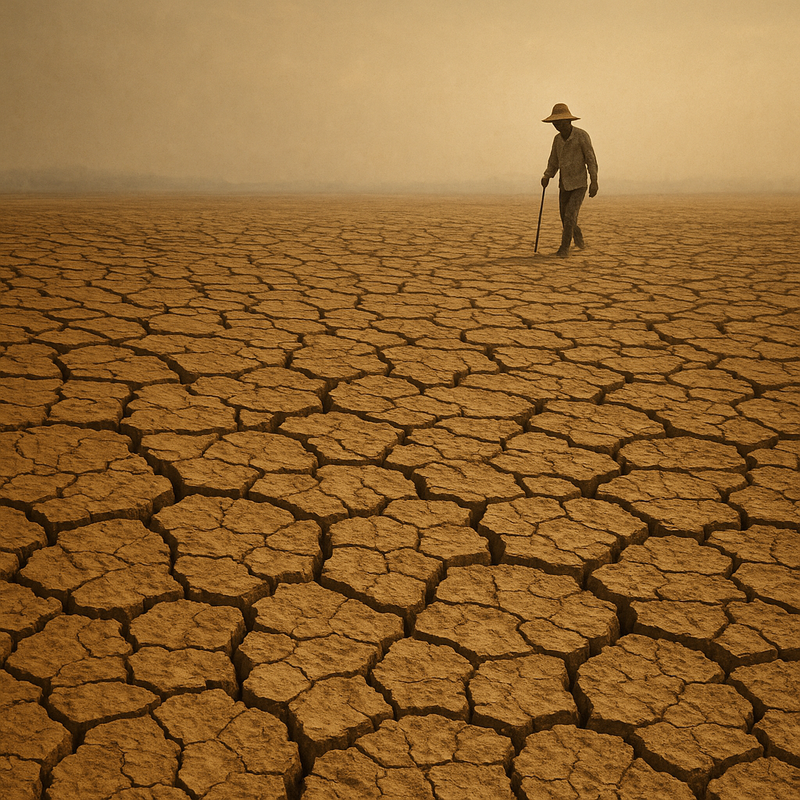
Breadlines and Fault Lines
Food Security, Climate Shock and the New Politics of Hunger in the Global South
In March 2022, Egypt's Ministry of Supply announced bread rationing for the first time in decades. The trigger was not domestic shortage. Egyptian wheat harvests had been reasonable. The trigger was that Russia and Ukraine, which together supplied 85% of Egypt's wheat imports, were at war. Overnight, Cairo faced a choice: drain foreign exchange reserves to buy expensive wheat from alternative suppliers, or watch bread lines lengthen in a country where subsidised baladi bread feeds 60 million people daily.
Egypt chose to spend the reserves. By mid-2023, the Egyptian pound had lost two-thirds of its value against the dollar. Import costs for wheat, vegetable oil, and fertiliser surged even as global commodity prices stabilized. Inflation hit 40%. The government secured a $3 billion IMF programme, with conditions including gradual subsidy cuts. Two years after the Black Sea corridor closed, Egyptian households were still paying the bill in currency devaluation, austerity, and deteriorating diets.
This is the new arithmetic of food security: climate shocks, geopolitical leverage, and sovereign debt now intersect at the dinner table. The UN estimates that 670-730 million people are undernourished globally, roughly one in eleven humans, and 2.3 billion experience moderate or severe food insecurity. The centre of gravity has shifted decisively towards Africa and South Asia, where import dependence, currency vulnerability, and climate stress overlap.
Food security in 2026 is no longer about production alone. Global harvests are sufficient. The crisis lies in who can access calories, at what price, through which currency, and under which climate. The Global South has become the arena where these constraints collide simultaneously. Converting breadlines into fault lines of the emerging world order.
The New Geography of Hunger
The geography of hunger has changed in three decisive ways. First, it has urbanized. Food insecurity is no longer confined to rural drought zones but has moved into the informal settlements of Nairobi, Lagos, Dhaka, and Lima, where food is purchased, not grown. Second, it has financialized. Access to calories now depends on exchange rates, credit ratings, and shipping insurance as much as rainfall. Third, it has become more politically visible. Food riots remain one of the few signals that can puncture authoritarian control.
Africa alone hosts over 300 million undernourished people. On current trajectories, the continent will account for the majority of the world's hungry by 2030. This is not because Africa cannot produce food. the continent holds 60% of the world's remaining uncultivated arable land. It is because investment flows into export crops and land acquisitions rather than domestic storage, processing, and rural infrastructure that serves local populations.
| Region | Core Drivers | Political Expression |
|---|---|---|
| Sahel & Horn of Africa | Conflict, drought, displacement, high import bills | Fragile states, aid dependence, insurgency recruitment |
| North Africa | Wheat import dependence (80%+), subsidy burdens, youth unemployment | Bread protests, subsidy reforms, fiscal stress |
| South Asia | Monsoon volatility, rural indebtedness, heat stress on wheat | Farmer protests, migration, contested subsidy regimes |
| Small Island States | Near-total food import dependence (90%+), tourism shocks | Balance-of-payments crises, forced dietary shifts |
| Urban Latin America | Inflation, currency weakness, ultra-processed diet shifts | Cost-of-living protests, nutrition transition backlash |
When Food Security Collapses: Three Recent Crises
The abstract language of "food insecurity" conceals specific human catastrophes. Recent crises in Sri Lanka, Zambia, and Sudan illustrate how food access unravels when multiple shocks converge, and how political systems respond or fail.
Sri Lanka 2022: In April 2022, Sri Lanka banned all chemical fertilizer imports as part of an overnight shift to "organic agriculture." The policy was reversed within months, but the damage was done. Rice yields fell 20-30% in the 2021-2022 season. Combined with currency collapse (rupee lost 80% of value), inflation hit 70%, and food inflation exceeded 90%. Rice. The staple for 22 million people. became unaffordable for millions. The government defaulted on its debt in May 2022. Protests forced the president to flee. The food crisis was not the only cause of state collapse, but it was the most visible and visceral.
Zambia 2020-2023: Zambia defaulted on its external debt in 2020. The first African sovereign default during the pandemic. The country is a major copper exporter but a net food importer, dependent on maize as the national staple. Drought in 2018-2019 damaged harvests. Currency depreciation made imported wheat and vegetable oils expensive. By 2023, over 50% of Zambians experienced food insecurity. The government secured debt restructuring only after three years of negotiations, during which fiscal space for food subsidies and agricultural support remained constrained. The lesson: debt crises and food crises are the same crisis for import-dependent countries.
Sudan 2023-present: Sudan's civil war, which erupted in April 2023, has created one of the world's worst humanitarian catastrophes. Pre-war, Sudan imported 87% of its wheat. The conflict disrupted ports, roads, and markets. By late 2023, 18 million people, nearly 40% of the population. faced acute food insecurity. Famine conditions emerged in displacement camps. Agricultural production collapsed in conflict zones. International aid flows were insufficient and dangerous to deliver. Sudan's crisis shows that when state authority fractures, food systems fragment first, and hunger becomes a weapon.
| Country & Year | Trigger Events | Food Impact | Political Outcome |
|---|---|---|---|
| Sri Lanka (2022) | Fertilizer ban + currency collapse (-80%) + debt default | Rice yields -20-30%; food inflation 90%+; imports unaffordable | Mass protests, president fled, government collapsed |
| Zambia (2020-2023) | Debt default + drought + copper price volatility + COVID | 50%+ population food insecure; maize prices surged; imports strained | 3-year debt restructuring negotiations, subsidies cut |
| Sudan (2023-present) | Civil war + 87% wheat import dependence + aid access blocked | 18M facing acute food insecurity (40% population); famine conditions | State collapse, hunger as weapon, humanitarian catastrophe |
The Household Budget Reality: Who Actually Pays
Food inflation is not an abstract macroeconomic variable. It is a daily choice about which child eats, which meal gets skipped, which asset gets sold. For households in the bottom income quintile across the Global South, food accounts for 50-65% of total expenditure. When bread prices double, it is not a budget adjustment. it is a survival crisis.
Here is what food inflation actually means at the household level, with specific numbers from recent crises:
| Country & Year | Monthly Income (Poor Household) | Food Expenditure Before Crisis | Food Expenditure After Crisis | What Gets Cut |
|---|---|---|---|---|
| Egypt 2022-2023 | ~$200-250 equivalent | $110-130 (50-55%) | $165-190 (70-75%) | Healthcare, education, transport; debt accumulation |
| Pakistan 2022 | ~$150-180 | $90-100 (60%) | $135-155 (80-85%) | Electricity bills unpaid, children withdrawn from school |
| Kenya 2023 | ~$120-150 | $65-75 (55%) | $95-110 (75-80%) | Medical care delayed, productive assets sold |
| Ghana 2022-2023 | ~$100-130 | $55-65 (55%) | $80-95 (75%+) | Shift to single meal/day; informal borrowing at 40%+ rates |
| Sri Lanka 2022 | ~$130-160 | $70-80 (55%) | $110-125 (80%+) | Cooking fuel rationed, protein eliminated from diet |
| Country & Item | Pre-Crisis Price | Peak Crisis Price | % Increase | Impact |
|---|---|---|---|---|
| Egypt: Bread (subsidized loaf) | 5 piasters (~$0.003) | Rationed/20 piasters (~$0.012) | 300%+ | 60M people depend on subsidized bread daily |
| Pakistan: Wheat flour (per kg) | 60 PKR (~$0.40) | 140 PKR (~$0.50) | 130% | Staple for 220M people; poor spend 40% of food budget on wheat |
| Kenya: Maize flour (per kg) | 100 KES (~$0.85) | 230 KES (~$1.60) | 130% | Ugali (maize porridge) is daily staple; drought + import costs |
| Sri Lanka: Rice (per kg) | 120 LKR (~$0.60) | 400 LKR (~$1.10) | 230% | Currency collapse + fertilizer shortage hit both price and supply |
| Ghana: Bread (standard loaf) | 4 GHS (~$0.35) | 12 GHS (~$0.80) | 200% | Wheat 100% imported; currency weakness + global prices |
| Lebanon: Bread (standard) | 1,500 LBP (~$1.00) | 15,000+ LBP (~$0.50) | 900%+ (nominal) | Currency collapse made USD price fall but unaffordable in local terms |
Climate Shocks Coming in 2026: What the Weather Models Show
The 2020-2024 period demonstrated how quickly climate extremes can destroy food security. The 2026 outlook is sobering: major producing regions face elevated risks from predictable climate patterns and unpredictable extreme weather events.
El Niño to neutral transition (2025-2026): The strong El Niño of 2023-2024 is transitioning to ENSO-neutral conditions in early 2025, with some models suggesting La Niña development by mid-2026. This pattern historically brings increased rainfall to parts of Southeast Asia and drought risks to southern Africa and parts of South America. For 2026 growing seasons, this translates to: heightened drought risk in Zimbabwe, Zambia, and Malawi (maize belt); potential flooding in Indonesia and Philippines (rice production); and uncertain rainfall patterns in India's monsoon region.
Heat stress on wheat and rice: Global temperatures in 2024 exceeded 1.5°C above pre-industrial levels for extended periods. By 2026, the Indo-Gangetic Plain, which produces wheat for 500 million people. faces increasing spring heat stress. Every 1°C above optimal wheat temperatures reduces yields by 4-6%. Models suggest March 2026 temperatures could reach crop-damaging thresholds in Punjab, Haryana, and Uttar Pradesh. Similarly, nighttime temperatures during rice flowering in Bangladesh, Vietnam, and southern China are projected to remain elevated, reducing grain fill and quality.
Brazil and Argentina soy risks: The Cerrado and Pampas regions. responsible for 60% of global soybean exports. experienced drought stress in 2023-2024. Long-range forecasts suggest continued volatility in 2026, with La Niña potentially bringing moisture stress to parts of Brazil's Mato Grosso and drought to Argentina's Buenos Aires province. Any significant yield reduction will spike global vegetable oil and animal feed prices, hitting import-dependent countries in Africa and the Middle East.
Russia and Ukraine uncertainties: By 2026, the Black Sea grain corridor's future remains uncertain. Even if the war winds down, reconstruction of Ukrainian agriculture will take years. Russia continues to use food and fertilizer exports as geopolitical leverage. European wheat production faces its own heat and drought stress. The world cannot assume the Black Sea breadbasket will return to pre-2022 reliability in 2026.
| Region | Primary Crop | 2026 Climate Risk | Global Impact if Disrupted |
|---|---|---|---|
| Indo-Gangetic Plain (India/Pakistan) | Wheat | Heat stress March-April (1.5-2°C above optimal) | 500M+ people depend on region's wheat; India may restrict exports |
| Southern Africa (Zimbabwe, Zambia, Malawi) | Maize | Drought risk if La Niña develops | Regional food crisis; 30M+ at risk of food insecurity |
| Brazil Cerrado (Mato Grosso) | Soybeans | Moisture stress, irregular rainfall | Global vegetable oil prices spike; animal feed costs rise |
| Argentina Pampas | Soybeans, wheat | Drought continuation from 2023-2024 pattern | Soy supply tightens; wheat exports reduced |
| Southeast Asia (Vietnam, Thailand) | Rice | Flooding risk; nighttime heat stress | Rice export disruptions affect 50+ importing countries |
| East Africa (Ethiopia, Kenya) | Maize, wheat | Continued drought cycle; rainfall deficits | Humanitarian crisis deepens; 20M+ already food insecure |
| Black Sea (Ukraine/Russia) | Wheat, corn | Geopolitical disruption continues; infrastructure damage | MENA and Africa wheat supplies uncertain; prices volatile |
| Region | Fertilizer Affordability Impact | Yield Consequence |
|---|---|---|
| Sub-Saharan Africa | Farmers cut application rates 30-50% | Maize yields down 15-25% in 2023-2024 |
| South Asia | Government subsidies strained; farmers delay purchase | Wheat productivity gains stalled; debt burden increased |
| Southeast Asia | Rice farmers shift to lower-input varieties | Export potential reduced; domestic prices rise |
2026 Geopolitical Scenarios: Elections, Trade Wars, and Food Blocs
Food security in 2026 will be shaped as much by ballot boxes and trade negotiations as by rainfall and harvests. Three geopolitical dynamics will dominate: post-US election trade policy shifts, BRICS+ food corridor expansion, and potential protectionist responses to agricultural stress.
US trade policy post-2024 elections: The new US administration (inaugurated January 2025) will shape agricultural trade through 2026. If protectionist policies expand. higher tariffs, stricter food safety standards used as non-tariff barriers, or renegotiated trade deals. major agricultural exporters like Brazil, Argentina, and Southeast Asian rice producers could face market access challenges. Conversely, if the administration prioritizes food security partnerships with Africa and Asia, development finance for agricultural infrastructure could increase. The direction will become clear in Q1 2026.
BRICS+ expansion and food corridors: The expanded BRICS bloc (Brazil, Russia, India, China, South Africa, plus Egypt, Ethiopia, Iran, UAE, Saudi Arabia as of January 2024) represents 45% of global population and includes major food producers and consumers. By 2026, infrastructure projects financed by BRICS New Development Bank, grain terminals in Africa, fertilizer plants in Ethiopia and Nigeria, payment systems bypassing dollar settlements, will begin operationalizing. This creates parallel food supply chains: Global South countries trading food and fertilizer with each other, reducing reliance on traditional Western-dominated routes and currencies. The shift will accelerate if sanctions, currency controls, or political disputes make dollar-denominated trade more difficult.
Export ban triggers: If 2026 sees simultaneous harvest failures in multiple breadbaskets (India wheat, Argentina soy, East Africa maize), a cascade of export restrictions will follow. India has proven willing to ban rice exports to control domestic prices. Indonesia may restrict palm oil again. Russia could weaponize wheat and fertilizer exports. Each restriction amplifies global price spikes and forces import-dependent countries into bidding wars. The 2026 risk is that governments have learned from 2022: protect your own population first, consequences for others second.
| Scenario | Key Drivers | Winners | Losers | Probability |
|---|---|---|---|---|
| Status Quo Fragility | Existing trade routes persist; incremental BRICS growth; moderate climate shocks | Major exporters (US, Brazil); established traders (ABCD companies) | Import-dependent low-income countries face continued vulnerability | 40% |
| BRICS Food Bloc Acceleration | Rapid South-South trade expansion; local currency settlements; new infrastructure | BRICS+ members; African countries gaining alternative suppliers; reduced dollar dependence | Traditional exporters face shrinking market share; Western grain traders | 35% |
| Cascading Protectionism | Multiple harvest failures; export bans proliferate; food nationalism rises | Large producers with domestic surplus (Brazil, Russia); self-sufficient economies | Small import-dependent states; urban poor globally; humanitarian crisis | 25% |
| Country | Primary Vulnerability | 2026 Trigger Risk | Population at Risk |
|---|---|---|---|
| Sudan | Civil war + 87% wheat import dependence | Continued conflict blocks ports and aid; famine spreads | 18M+ (40% population) |
| Lebanon | Economic collapse + 90% wheat imports | Currency worthless; cannot finance imports; political paralysis | 4M+ (60% population) |
| Egypt | 85% wheat imports + debt crisis + currency collapse | Subsidy cuts trigger protests; pound devaluation continues | 20M+ urban poor |
| Pakistan | Climate shocks + IMF conditionality + political instability | Floods/heat damage crops; subsidy cuts amid 25% inflation | 40M+ food insecure |
| Haiti | Gang violence + 70% food import dependence | Port access blocked; humanitarian aid cannot reach population | 4.5M+ (50% population) |
| Somalia | Drought + conflict + aid dependence | Fifth consecutive failed rainy season; livestock deaths | 6M+ acute food insecurity |
| Zimbabwe | Currency instability + drought risk + debt | La Niña drought damages maize; hyperinflation returns | 7M+ need food assistance |
| Tunisia | 70% cereal imports + debt distress + political crisis | IMF subsidy reform triggers unrest; wheat shortage | 2M+ urban food insecure |
| Yemen | War + near-total import dependence + port blockades | Conflict escalation blocks Red Sea food shipments | 17M+ (60% population) |
| Madagascar | Climate famine + extreme poverty + weak infrastructure | Cyclones + drought repeat 2021 famine conditions | 3M+ acute food insecurity |
Weaponized Grain and Export Bans
Food has always been political. In the 2020s it became overtly weaponized. The Russian state used grain and fertilizer access as bargaining chips with sanctioning countries. Major producers imposed export bans and quotas to "protect domestic consumers" but in practice exported volatility to poorer importers.
India's 2022 restrictions on non-basmati rice exports affected 50+ importing countries across Africa, the Middle East, and Southeast Asia. Indonesia's brief 2022 halt on palm oil exports created panic buying across dependent markets. Argentina has periodically restricted wheat and beef exports. These measures protect domestic consumers in the short term but create cascading effects: global prices spike, import bills surge for net food importers, and long-term supply relationships fracture.
For many African and Asian governments, this is the cruel paradox of the open world economy: precisely when global markets are most needed, they are least available. Food sovereignty in 2026 does not mean autarky. It means reducing vulnerability to other countries' domestic politics.
From Price Spikes to Street Protests: The Bread Riots Timeline
Food is the most direct connection between global commodity markets and domestic political stability. When bread prices spike, protests follow. often within weeks. The 2010-2011 Arab Spring was preceded by wheat price surges. The 2018 Sudan uprising began with bread protests. The 2022 Sri Lankan revolution was triggered by food and fuel shortages. Authoritarian regimes understand this instinctively, which is why food subsidies are often the last budget line they will cut, and why subsidy reforms so often trigger upheaval.
Here is the recent timeline of major food-driven protests across the Global South:
| Date & Location | Trigger | Price Increase | Political Outcome |
|---|---|---|---|
| Sudan, Dec 2018 | Bread price tripled (from 1 to 3 SDG per loaf) | +200% | Protests escalated; Omar al-Bashir ousted April 2019 |
| Lebanon, Oct 2019 | WhatsApp tax + bread subsidies threatened; lira collapse | Currency-driven food inflation 100%+ | Government resigned; political crisis continues |
| Ecuador, Oct 2019 | Fuel subsidy cuts (indirectly raised food transport/prices) | Fuel +120%, food +15-20% | 11 days of protests; government reinstated subsidies |
| Chile, Oct 2019 | Public transport fare hike amid high living costs | Cost-of-living crisis including food | Mass protests; constitutional reform process initiated |
| Iraq, Oct 2019-Feb 2020 | Unemployment + cost-of-living including food prices | Youth unemployment 25%+; food stress | Prime Minister resigned; ongoing instability |
| Sri Lanka, Mar-Jul 2022 | Currency collapse, fertilizer ban, food/fuel shortages | Food inflation 80-90%+ | President Gotabaya Rajapaksa fled country; government fell |
| Peru, Dec 2022-Jan 2023 | President Castillo ousted; fertilizer costs + food prices | Food inflation 15-20% | Deadly protests; political crisis; 60+ deaths |
| Kenya, Mar-Jul 2023 | Maize flour prices doubled; proposed tax increases | Maize +130%; general food +13% | Mass protests; government backtracked on taxes |
| Nigeria, Aug 2023 | Fuel subsidy removal; food inflation surge | Food inflation 30%+ | Labor strikes; negotiations ongoing |
| Egypt, 2022-2023 | Bread rationing fears; IMF subsidy reform pressure | Controlled but pound collapsed 65% | Government maintains subsidies to avoid unrest; fiscal crisis deepens |
The Subsidy Double Standard
When food crises push governments in the Global South to expand subsidies and support prices for farmers, they are told these policies are "market distortions" that must be reformed. The IMF and World Bank routinely demand subsidy cuts as conditions for loans. Yet the world's wealthiest economies subsidize their own agriculture to the tune of $720 billion annually, nearly ten times what they provide in total development assistance.
OECD countries provided $817 billion in agricultural support in 2022 (latest comprehensive data), including direct payments to farmers, price supports, and tariff protection. The European Union's Common Agricultural Policy (CAP) accounts for roughly €55 billion annually ($58-60 billion). The United States spent $38 billion on agricultural subsidies in 2022, with additional support through crop insurance and disaster payments. Japan, South Korea, and Switzerland provide some of the highest per-farmer support rates globally.
This support allows wealthy-country farmers to underprice Global South producers in international markets, making it harder for African, Asian, and Latin American countries to build competitive agricultural sectors. When India provides support to rice and wheat farmers, it is criticized as trade-distorting. When the EU provides direct income support to French and German farmers, it is agricultural policy. The hypocrisy is structural and deliberate.
The result: Global South governments are trapped. Cut subsidies as demanded by creditors, and farmers protest or fail. Maintain subsidies, and fiscal space narrows while being accused of "inefficiency." Meanwhile, wealthy countries protect their farmers with no such constraints.
Import Dependence, Currencies and the Food-Debt Spiral
Food security can no longer be analyzed separately from sovereign finance. Many low- and middle-income countries are now structurally net food importers. They pay for wheat, rice, maize, vegetable oils, and fertilizers in hard currency, primarily dollars or euros, while earning export revenues in a narrow set of commodities or low-value manufactures. This creates a dangerous triangle: food import bills, currency depreciation, and external debt.
Countries such as Egypt, Tunisia, Kenya, Ghana, Pakistan, and Sri Lanka illustrate this spiral in different ways. In each case, high cereal import dependence, limited foreign exchange buffers, and debt service obligations have collided. Food security is no longer just a humanitarian concern for these states. it is the hinge on which macroeconomic survival rests.
| Stage | Mechanism | Outcome |
|---|---|---|
| 1. External shock | Higher global grain & fertilizer prices | Import bill rises in dollars |
| 2. FX pressure | Reserves strained, currency weakens | Local prices rise even if global prices stabilize |
| 3. Fiscal squeeze | Higher subsidy costs and interest payments | Less space for health, education, climate adaptation |
| 4. Sovereign risk | Ratings downgrades, higher borrowing costs | Debt rollover difficulties, IMF programmes |
| 5. Social stress | Food inflation hits urban poor hardest | Protests, instability, political volatility |
The Household Food Burden: Who Pays with Their Plate
Food security is ultimately measured not in national statistics but in household choices: what to buy, what to skip, who eats first. The burden of food costs falls disproportionately on the poorest households, where food expenditure can consume 50-70% of total income. compared to 10-15% in wealthy countries.
When food prices rise 20%, a household in rural Nigeria or urban Bangladesh faces impossible trade-offs: eat less, eat cheaper (and less nutritious) food, pull children from school to work, sell productive assets like livestock or tools, or borrow at predatory interest rates. Each coping strategy entrenches poverty. Reduced nutrition harms cognitive development in children. Asset sales eliminate future income. Debt becomes a trap.
The contrast with wealthy countries is stark. In the United States, the average household spends 11% of income on food. In Germany, it's 12%. In Nigeria, it's 59%. In Bangladesh, 53%. In Kenya, 50%. For the world's poorest 40%, food is not just the largest expense. it is an existential constraint that shapes every other life decision.
| Coping Strategy | Immediate Impact | Long-Term Consequence |
|---|---|---|
| Reduce meal frequency | Hunger, reduced energy | Malnutrition, stunting in children, lost productivity |
| Switch to cheaper calories | Less protein, vitamins, diversity | Obesity + undernutrition ("hidden hunger"), NCDs |
| Sell productive assets | Temporary cash relief | Loss of future income (no livestock, tools, land) |
| Borrow at high interest | Food purchased on credit | Debt trap (20-40% annual interest from informal lenders) |
| Remove children from school | Children work or save school fees | Lost education, reduced lifetime earnings |
| Migrate for work | Temporary income abroad/city | Family fragmentation, hazardous labor, exploitation |
Land, Inputs and the New Politics of Control
Beneath the volatility of prices lies a quieter struggle over who controls the means of food production: land, seeds, water, fertilizer, and data. The last fifteen years have seen repeated waves of large-scale land acquisitions, contract farming schemes, and input credit programmes across Africa, Latin America, and parts of Asia. Some have brought investment and technology. Many have locked smallholders into asymmetric relationships they barely understand.
Land and water: Long-term leases over hundreds of thousands of hectares have transferred practical control of land and water from communities to foreign firms or domestic elites. When projects succeed, they often prioritize export crops or biofuels over staples. When they fail, land lies under-utilized or becomes the terrain of local conflict.
Seeds and fertilizer: A handful of multinational companies. Bayer, Corteva, Syngenta, Yara. dominate global markets for commercial seeds, crop protection products, and fertilizers. Their technologies have undeniably raised yields in many settings. But proprietary hybrids and input-intensive packages can erode local seed diversity and create lock-in effects for smallholders. When credit tightens or subsidies are cut, farmers are left with debt and degraded soils.
Data and digital agriculture: The latest frontier is digital. Satellite-based farm monitoring, app-based advisory services, and digital input credit chains are expanding rapidly. These tools can be powerful. But the ownership of agri-data, who controls information on yields, practices, and farmer behavior, will increasingly shape bargaining power in value chains. In the worst case, digitalization reproduces old patterns: Global South farmers producing raw value whose data, like their crops, is extracted elsewhere.
Who Captures Value? Farmer Poverty vs Corporate Profits
The food system generates enormous value. The question is: who captures it? Smallholder farmers in Africa and Asia, who grow the majority of the world's food. operate on razor-thin margins, often earning less than $2-3 per day. Meanwhile, the corporations that sell them inputs and buy their output record profit margins of 10-25%. This is not a natural outcome. It is a designed system of value extraction.
Here is what the profit distribution actually looks like:
| Actor in Value Chain | Typical Net Margin / Income | Example / Context |
|---|---|---|
| Smallholder Farmer (Sub-Saharan Africa) | 5-15% net margin on farm gate price | Annual income: $400-1,200; vulnerable to price, weather, input cost shocks |
| Smallholder Farmer (South Asia) | 8-20% net margin (highly variable) | Annual income: $600-2,000; debt burden common; suicide rates linked to harvest failure |
| Agricultural Input Companies | 15-25% net profit margin | Bayer 2023 EBIT margin: 15.5%; Yara 2023: 13%; Corteva 2023: 16% |
| Grain Trading Companies (ABCD) | 2-5% net margin (high volume) | Cargill 2023 profit: $4.6B; ADM 2023: $3.4B; Bunge 2023: $2.2B |
| Food Processing/Retail | 5-15% net margin | Nestlé 2023: 14.1%; Unilever 2023: 13%; capture value from branding |
| Farmer Share of Retail Price | 10-30% (varies by crop) | Example: Cocoa farmers receive ~6% of final chocolate bar price |
| Input Sector | Top 3-4 Companies | Combined Market Share |
|---|---|---|
| Commercial Seeds | Bayer (Monsanto), Corteva, Syngenta, BASF | ~60-70% global market |
| Agrochemicals | Syngenta, Bayer, BASF, Corteva | ~65% global market |
| Fertilizers (Nitrogen) | Yara, CF Industries, Nutrien, EuroChem | ~40-50% traded market |
| Grain Trading | Archer Daniels Midland, Bunge, Cargill, Louis Dreyfus (ABCD) | ~70-80% global trade |
Who Profits from Hunger? Grain Traders and Food Price Volatility
The 2020-2022 food price spike that devastated household budgets across the Global South also generated extraordinary profits for the companies that control global grain trade. The four largest grain trading companies. Archer Daniels Midland (ADM), Bunge, Cargill, and Louis Dreyfus, collectively known as "ABCD". control 70-80% of global grain trade. They are privately held or publicly traded corporations answerable to shareholders, not to the food security needs of nations.
In 2022, as wheat and maize prices surged following the Russia-Ukraine war, these companies posted record or near-record profits. Cargill, the largest private company in the United States, reported $6.5 billion in profit for fiscal year 2022. the highest in its 157-year history. ADM earned $4.3 billion in net income in 2022, more than double the previous year. Bunge's 2022 net income reached $2.5 billion, up 58% from 2021. Louis Dreyfus does not fully disclose earnings but reported strong performance.
These profits were not the result of increased efficiency or expanded production. They resulted from higher prices and volatility. precisely the conditions that pushed millions into hunger. The four companies earn from storage, transportation, financing, and trading, capturing value at every node of the global food supply chain. For them, price spikes are opportunities. For households in Nairobi, Dhaka, Cairo, or Lima, they are disasters.
The contrast with humanitarian food aid is stark. In 2022, the World Food Programme. the UN agency that feeds millions in emergencies. had a budget of $14.2 billion. Cargill's profit alone was nearly half that amount. The combined profits of the ABCD traders exceeded $13 billion in 2022. almost equal to the entire WFP budget. The system is designed to extract profit from hunger, not eliminate it.
| Entity | 2022 Profit/Budget | Business Model |
|---|---|---|
| Cargill | $6.5B profit | Private grain trader; profits from volatility and storage |
| ADM (Archer Daniels Midland) | $4.3B profit | Public company; doubled profits during price spike |
| Bunge | $2.5B profit | Public company; +58% profit increase in 2022 |
| Louis Dreyfus | $1-2B profit (est.) | Private company; limited disclosure |
| ABCD Combined | ~$13B+ profit | Control 70-80% of global grain trade |
| World Food Programme | $14.2B budget | UN humanitarian agency feeding 150M+ people in emergencies |
Regional Lenses: Africa, Asia, Latin America, MENA
Africa: Importer today, breadbasket tomorrow? Africa remains a net food importer, especially for wheat, rice, vegetable oils, and fertilizer. Urban populations increasingly depend on imported staples, while local supply chains struggle with storage losses (30-40% for some crops), weak rural roads, and limited agro-processing. Yet the continent holds 60% of the world's remaining uncultivated arable land, growing regional markets, and young populations. The question is whether investment flows will build African-owned processing, storage, and logistics, or simply deepen dependence on external financiers and input providers.
South Asia: From Green Revolution to Heat Revolution. South Asia's food story has long been told as a Green Revolution success. That narrative is fraying. Groundwater depletion in north India and Pakistan, heat stress on wheat yields (every 1°C above optimal reduces yields 4-6%), and rural debt crises have made agriculture both politically sensitive and economically fragile. Government procurement, minimum support prices, and fertilizer subsidies remain pillars of political legitimacy, yet they also constrain fiscal space. Climate-resilient crops, water governance, and urban food planning will define the region's food stability more than further yield gains alone.
Latin America: Export powerhouse, unequal plates. Latin America and the Caribbean are major net exporters of soy, maize, beef, coffee, and sugar. The region is central to global food supply. Yet domestic food insecurity remains high in parts of Central America, the Andes, and the urban peripheries of Brazil and Argentina. Export-oriented agribusiness coexists with ultra-processed diets and pockets of undernutrition. Food sovereignty debates here center less on imports and more on who benefits from export booms, and who pays the environmental costs.
MENA: Wheat, water, and war. The Middle East and North Africa import over 50% of the calories they consume, particularly cereals. Chronic water scarcity, constrained arable land, and conflict in Syria, Yemen, Sudan, and beyond have made self-sufficiency impossible in many cases. Subsidized bread and fuel have historically acted as pressure valves. As fiscal pressures mount and donors tire, regimes face a harsh calculus: cut subsidies and risk unrest, or preserve them and risk fiscal crisis. Either way, wheat shipments from the Black Sea or the EU carry political destiny alongside grain.
| Region | Net Trade Position | Primary Vulnerability | Political Sensitivity |
|---|---|---|---|
| Sub-Saharan Africa | Net importer (cereals, oils) | Currency weakness, storage losses, land tenure | Urban food riots, rural land conflicts |
| North Africa & Middle East | Heavy net importer (80%+ wheat) | Import dependence, water scarcity, subsidy costs | Bread protests, regime stability, fiscal crisis |
| South Asia | Mixed (India exporter, others importers) | Groundwater depletion, heat stress, rural debt | Farmer protests, subsidy politics, electoral leverage |
| Southeast Asia | Rice exporter, other imports | Export bans transmission, climate disasters | Domestic price stability vs export revenues |
| Latin America | Major net exporter (soy, maize, beef) | Export concentration, diet quality, deforestation | Indigenous land rights, agribusiness power |
| Small Island States | Near-total import dependence | Shipping costs, tourism shocks, climate threats | Balance-of-payments crises, sovereignty |
From Farm to Power: Agriculture as Industrial Strategy
For decades, development strategies treated agriculture as a sector to "modernize" and then leave behind, as economies shifted to industry and services. The 2020s have reversed this logic. Agriculture has resurfaced as industrial strategy and foreign policy combined. Countries compete not only to secure supply, but to capture value at each step of the chain: inputs, production, processing, storage, logistics, retail, and increasingly, data and branding.
Emerging examples include India's push into fertilizer joint ventures abroad, Brazil's role in tropical agriculture research, Morocco's phosphate diplomacy in Africa, and the Gulf states' acquisitions of farmland, ports, and logistics assets across Africa and Asia. Each represents a different route to the same objective: transforming food from a vulnerability into leverage.
The Digital Agriculture Revolution: What Changes by 2026
While climate and geopolitics dominate headlines, a quieter transformation is underway: the digitalization of Global South agriculture. By 2026, technologies that were experimental in 2020 will be operational at scale, reshaping how farmers access information, credit, and markets.
Mobile money and digital credit: As of late 2024, over 500 million farmers across Africa and Asia have mobile phones. By 2026, digital payment platforms integrated with agricultural input suppliers and output buyers will reach 200+ million smallholders. Kenya's M-Pesa model is expanding: farmers receive weather advisories via SMS, purchase fertilizer on mobile credit, and receive crop insurance payouts automatically when satellite data confirms drought or flood. India's JAM trinity (Jan Dhan bank accounts, Aadhaar digital ID, Mobile connectivity) now channels subsidy payments directly to 120 million farmers, reducing leakage and delays. By 2026, similar systems will be operational in Nigeria, Ethiopia, Bangladesh, and parts of West Africa.
Satellite monitoring and precision agriculture: Commercial satellite data providers (Planet Labs, Maxar, European Space Agency Copernicus) now offer near-daily imagery at 3-5 meter resolution. By 2026, governments and NGOs will use this data to monitor crop health, predict yields, and trigger early action before food crises escalate. Example: Ethiopia's government can now identify moisture stress in Tigray or Somali regions 30-45 days before harvest failure, enabling pre-positioning of food stocks. Private companies offer farmers smartphone apps that use satellite data plus AI to recommend optimal planting dates, fertilizer application rates, and pest control timing. services that were once only available to industrial farms.
Blockchain for supply chain transparency: By 2026, several African and Latin American countries will pilot blockchain-based systems to track grain from farm to market, reducing fraud in procurement and ensuring farmers get fair prices. Rwanda's coffee sector already uses blockchain to certify origin and quality, increasing farmer earnings by 20-30%. Similar pilots are expanding to cocoa (Côte d'Ivoire), cashews (Tanzania), and rice (India).
The data sovereignty question: The risk is that digitalization reproduces old extraction patterns. If foreign tech companies own the platforms, control the data, and capture the value, farmers gain convenience but lose agency. By 2026, debates over agricultural data sovereignty will intensify: who owns yield data? Can governments access private company data for food security planning? Will farmers control their own information? These questions will shape whether digital agriculture empowers smallholders or simply creates new dependencies.
| Technology | 2024 Adoption | 2026 Projection | Primary Regions |
|---|---|---|---|
| Digital subsidy/credit platforms | 150M farmers | 280M+ farmers | India, Nigeria, Ethiopia, Kenya, Bangladesh |
| Weather/advisory SMS services | 300M farmers | 500M+ farmers | Sub-Saharan Africa, South Asia, Southeast Asia |
| Satellite-based crop monitoring (gov't use) | 25 countries | 45+ countries | Expanding in Africa and Latin America |
| Index-based crop insurance | 15M farmers | 35M farmers | India, Kenya, Ethiopia, Senegal, Rwanda |
| E-commerce platforms (farm-to-market) | 10M farmers | 40M farmers | India, China, Nigeria, Kenya, Indonesia |
| Precision agriculture (AI recommendations) | 5M farmers (pilot phase) | 20M farmers | India, Brazil, Kenya, South Africa |
Colonial Legacies and Contemporary Land Grabs
The Global South's structural food dependence is not accidental. It is the legacy of colonial agricultural systems designed to extract cash crops for export. cotton, cocoa, coffee, tea, rubber, palm oil. rather than produce food for local populations. These patterns persist today, reinforced by new waves of large-scale land acquisitions.
Colonial roots of import dependence: Under British rule, India shifted millions of hectares from food crops to indigo, opium, and cotton. African colonies were organized around cocoa, coffee, and groundnuts for European markets. Caribbean islands produced sugar on plantations, not food for residents. When independence came, these economies remained structured around export commodities. The infrastructure. roads, ports, storage. was built to move crops out, not distribute food within. Sixty years after decolonization, many countries still export what they don't eat and import what they can't afford.
The 2008-2015 land grab surge: Following the 2007-2008 food price crisis, governments and private investors in the Gulf, China, South Korea, and Western financial firms began acquiring vast tracts of land in Africa, Latin America, and Southeast Asia. The World Bank documented over 46 million hectares of large-scale land acquisitions between 2008 and 2010 alone. Land Matrix, an independent monitoring initiative, tracks over 1,000 concluded deals covering 40+ million hectares. an area larger than Germany.
Many deals were framed as "win-win": foreign investment for agricultural development. Reality has been mixed at best. Projects prioritized export crops (biofuels, animal feed, palm oil) over staple foods. Land was acquired from communities with weak tenure rights, often through opaque negotiations with governments. When projects failed. as many did. land remained under-utilized or disputed, while displaced communities lost access to farmland, grazing areas, and water. The new land grabs, like the old colonial plantations, structure agriculture around external demand, not local food security.
2. United States
3. Saudi Arabia
4. UAE
5. India
2. Indonesia
3. South Sudan
4. DRC
5. Brazil
| Notable Deal Example | Investor | Target Country | Size | Intended Use |
|---|---|---|---|---|
| Daewoo Logistics (failed) | South Korea | Madagascar | 1.3M hectares | Corn, palm oil for export; deal cancelled after protests |
| Saudi Star Agricultural | Saudi Arabia | Ethiopia | 140,000 ha | Rice for export to Saudi Arabia |
| ZTE Energy (Sino-Africa) | China | DRC | 2.8M ha | Palm oil plantation; displaced communities |
| Jarch Capital | US private equity | South Sudan | 400,000 ha | Jatropha biofuels; project largely failed |
The Vulnerability Economy: Climate, Debt and Diets
At the micro level, food is a daily choice: what to buy, what to skip, who eats first. At the macro level, food has become the clearest expression of what The Meridian has called the "vulnerability economy": a system in which climate risk, debt dynamics, and basic survival are intertwined in feedback loops.
Climate change raises the probability of harvest failures, floods, and storms. These shocks increase humanitarian needs and weaken fiscal positions. Governments borrow, often in foreign currency, to finance reconstruction, food imports, and social protection. Rising interest rates and repeated shocks then make this borrowing unsustainable. The country enters an IMF programme, where food subsidies, agricultural support, and public employment are often scrutinized as "distortions" or "inefficient spending."
Diets absorb these pressures. They shift from diverse staples and fresh foods to cheaper, more filling, ultra-processed options. Malnutrition thus becomes double-sided: undernutrition and obesity, often within the same households. The vulnerability economy does not only weaken states. It weakens bodies.
The Child Malnutrition Crisis: Stunting, Wasting, and the Obesity Paradox
Food insecurity writes itself onto children's bodies. Chronic undernutrition causes stunting. irreversible height deficits that reflect years of inadequate calories and nutrients. Acute malnutrition causes wasting. visible thinness and muscle loss. And increasingly, the same communities experiencing undernutrition also show rising child obesity, as families shift to cheap, calorie-dense, nutrient-poor ultra-processed foods. This is the triple burden of malnutrition: too little food, the wrong kind of food, or both at once.
Here are the numbers, by region and indicator:
| Region | Stunted (Growth Deficit) | Wasted (Acute Malnutrition) | Overweight |
|---|---|---|---|
| Sub-Saharan Africa | 59 million (30% prevalence) | 13 million (6.5%) | 10 million (5%) |
| South Asia | 79 million (31%) | 31 million (13%) | 7 million (3%) |
| East Asia & Pacific | 28 million (14%) | 8 million (4%) | 10 million (5%) |
| Middle East & North Africa | 11 million (18%) | 3 million (5%) | 6 million (10%) |
| Latin America & Caribbean | 6 million (9%) | 1 million (1.5%) | 7 million (10%) |
| Global Total | 148 million (22%) | 45 million (6.7%) | 39 million (5.8%) |
| Country | Child Stunting Prevalence | Child Overweight Prevalence | Explanation |
|---|---|---|---|
| Egypt | 22% stunted | 15% overweight | Subsidized bread + ultra-processed imports; micronutrient deficiency + calorie excess |
| South Africa | 27% stunted | 13% overweight | Inequality: poor households experience both undernutrition and obesity |
| Guatemala | 47% stunted (highest in Americas) | 8% overweight | Indigenous communities face chronic undernutrition; urban areas see processed food shift |
| India | 36% stunted | 3% overweight (but rising fast) | Massive absolute numbers: 120M+ stunted; urban overweight doubling per decade |
| Indonesia | 31% stunted | 8% overweight | Rural undernutrition persists while cities see fast-food expansion |
| Mexico | 14% stunted | 35% overweight (children 5-11) | Ultra-processed food market penetration among highest globally |
| Crop/Category | Post-Harvest Loss Rate | Economic Loss (Annual) | Primary Causes |
|---|---|---|---|
| Grains (maize, rice, wheat) | 15-25% of production | $4 billion+ across Africa | Poor storage, pests, moisture, lack of silos |
| Roots & tubers (cassava, yams) | 30-40% | $2 billion+ | High water content, rapid spoilage, no processing |
| Fruits & vegetables | 35-50% | $3 billion+ | No cold chain, poor roads, limited processing |
| Legumes (beans, pulses) | 15-30% | $500 million+ | Storage pests, lack of hermetic bags |
| Fish (fresh, artisanal) | 20-40% | $1 billion+ | No ice/refrigeration, limited smoking/drying capacity |
Three simultaneous breadbasket shocks (40% probability): Indo-Gangetic wheat belt, southern Africa maize corridor, and Brazil/Argentina soy region all experience climate-related yield reductions of 15%+ in 2026 growing seasons. Result: food price spike comparable to 2022; 5-8 major producers implement export restrictions; 100M+ additional people pushed into food insecurity.
Currency-triggered food crises in 8-12 countries (65% probability): Egypt, Pakistan, Tunisia, Kenya, Ghana, Nigeria, Bangladesh, and potentially Turkey experience food inflation >30% as currency depreciation magnifies dollar-priced import costs. Urban protests in at least 4 countries; IMF programmes with subsidy cut conditions in 6+ countries by Q3 2026.
BRICS+ food corridor operationalization (70% probability): First grain shipments through BRICS-financed infrastructure (Ethiopia port terminal, Nigeria fertilizer plant, Brazil-Africa shipping line) begin Q2-Q3 2026. Payment settlements in local currencies or yuan expand. Traditional Western grain traders face 10-15% market share erosion in African markets.
Digital agriculture reaches 280M+ farmers (80% probability): Mobile-based subsidy delivery, satellite crop monitoring, and digital credit platforms scale across Sub-Saharan Africa and South Asia. Data sovereignty conflicts emerge as governments demand access to private platform data for food security planning.
Grain trader windfall profits vs humanitarian shortfall (90% probability): If food prices spike, ABCD traders (Cargill, ADM, Bunge, Louis Dreyfus) post combined profits >$15B while World Food Programme faces $5-8B funding shortfall, forcing ration cuts affecting 30M+ people in emergencies.
What to Watch in 2026
Food systems move slowly, and then suddenly. The early warning signs of 2026 will not only be found in futures prices, but in policy documents, shipping lanes, and monsoon charts. Institutions tracking food security must widen their dashboard beyond yields and stocks.
| Variable | Why It Matters |
|---|---|
| Exchange rates in net food-importing states | Key determinant of local food prices regardless of global benchmarks |
| Fertilizer affordability index | Predicts yield potential two to three seasons ahead |
| Export restriction announcements | Signals of looming scarcity and geopolitical leverage |
| Food subsidy reform packages | Potential triggers for urban unrest and political instability |
| Climate anomalies in major breadbaskets | Early indicators of forthcoming supply disruptions |
| Grain stock levels in MENA & Sahel | Buffer capacity against external shocks and shipping disruption |
| South-South fertilizer and grain deals | Structural shifts in trade routes and bargaining power |
| Nutrition indicators (stunting, anaemia, obesity) | Reveal long-term human capital impacts beyond short-term hunger |
| Farmer protest intensity | Real-time barometer of rural distress and policy credibility |
| Investment in storage & cold chains | Determines whether yield gains translate into real food availability |
The Lifetime Cost of Childhood Hunger
Food insecurity's cruelest impact is measured in centimeters and IQ points. Chronic malnutrition in early childhood. defined as stunting (low height-for-age). affects 148 million children globally, nearly one in four children under age five. Stunting is not just about height. It is a marker of cognitive impairment, weakened immune systems, and reduced lifetime earnings. A stunted child becomes an adult who earns 20% less, on average, than a well-nourished peer.
Africa and Asia bear the overwhelming burden. Sub-Saharan Africa has 35% stunting prevalence among children under five. the highest in the world. South Asia, despite economic growth, still has 31% stunting prevalence. In some countries. Burundi, Eritrea, Madagascar. stunting affects over 40% of young children. This is not just a health crisis. It is an economic catastrophe in slow motion, destroying human capital before children reach school age.
The double burden of malnutrition compounds the problem. The same households experiencing undernutrition increasingly face obesity and diet-related diseases as ultra-processed foods replace diverse traditional diets. Children who were stunted in early years become overweight or obese adults, facing diabetes and cardiovascular disease. The vulnerability economy doesn't just fail to feed people. it poisons them with cheap, empty calories.
Meanwhile, the world wastes 30% of all food produced. 1.3 billion tonnes annually. The paradox is obscene: millions starve while food rots in warehouses, fields, and refrigerators. The issue is not scarcity. It is distribution, power, and prioritization. Hunger exists because the global food system is organized around profit extraction, not human need.
| Stage | Where Food Is Lost/Wasted | % of Total |
|---|---|---|
| Production & Harvest | Left in fields, damaged during harvest (Global South) | ~30% |
| Storage & Processing | Spoilage in storage, losses during milling/processing | ~25% |
| Distribution & Retail | Transport losses, supermarket rejections (cosmetic standards) | ~20% |
| Consumer Waste | Household waste, restaurant waste (primarily wealthy countries) | ~25% |
Sovereignty Starts with the Plate
Food has re-emerged as the deepest test of sovereignty in the Global South. A country that cannot secure affordable calories for its people cannot meaningfully plan industrial policy, climate adaptation, or technological strategy. Every other ambition. from green industrialization to digital sovereignty. rests on the assumption that households are fed, and not permanently one shock away from hunger.
The end of the era of cheap food is not inevitable. It is the product of choices: to under-invest in domestic storage and processing; to treat farmers as welfare recipients rather than strategic partners; to outsource food security to global markets and hope they remain benign. The Global South has options. regional grain reserves, South-South supply corridors, targeted subsidies using digital ID, climate-smart agriculture, and public procurement that favors local production and diverse diets.
The next decade will reveal which states treat food systems as the core infrastructure of resilience, and which learn, too late, that breadlines are the clearest fault lines of the emerging world order.
Methodology & Data Standards
This Outlook draws on FAO's State of Food Security and Nutrition in the World reports, World Food Programme country briefs, World Bank commodity and fertilizer price data, IFPRI export restriction monitoring, and UN country-level food security assessments. Global hunger and food insecurity figures refer to latest available UN estimates for 2022-2024. Trade and import-dependence analysis is based on FAO FAOSTAT, USDA grain trade data, and region-specific studies for Africa, MENA, South Asia, and Latin America.
Qualitative assessments of political and macro-financial risk integrate The Meridian's 2026 Risk Map and Financial Systems Outlook. All projections are scenario-based, not forecasts, and assume continuation of current climate trends and policy regimes unless otherwise stated. Data compiled and cross-checked November-December 2025.
Add comment
Comments