and Military Technology
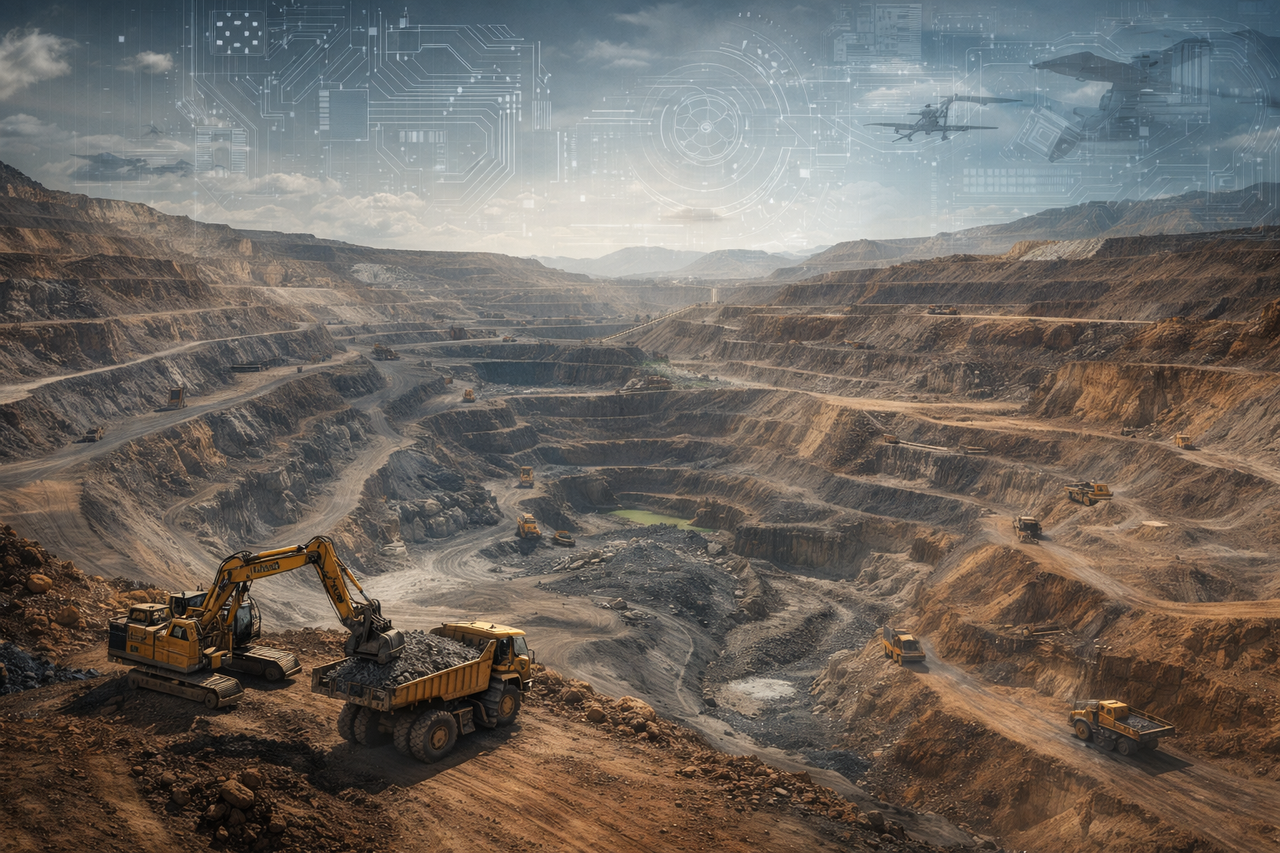
Every modern weapons system depends on a complex array of minerals and elements that must be extracted from specific geological formations, processed through specialised industrial facilities and integrated into manufacturing processes that cannot easily be replicated or substituted. Rare earth elements, lithium, cobalt, nickel, gallium, germanium and a range of specialised metals form the physical foundation on which military technology rests. Without them, the most advanced systems cannot be built, maintained or upgraded. This is not a supply chain vulnerability in the conventional sense, where one supplier can be replaced by another and the disruption is eventually absorbed. It is a structural dependency on specific materials whose production is concentrated in a small number of countries, whose processing requires industrial capacity that takes years to develop and whose strategic significance is only now being fully absorbed by the governments that depend on them most heavily.
Modern weapons systems require highly specialised materials whose properties are not interchangeable. Each serves specific functions within complex technological systems, and substituting them without compromising performance is often technically impossible within any realistic timeframe. Rare earth elements are essential for the permanent magnets used in precision guidance systems, for the phosphors used in advanced display and targeting systems, for radar and sonar technologies and for the electric motors and actuators that control drone flight surfaces and missile fins. Lithium and cobalt are critical for the high-performance batteries that power drones, portable communications equipment and the growing range of electric military platforms. High-performance alloys requiring nickel, titanium, tungsten and chromium provide the structural and thermal properties needed for jet engines, missile bodies and armour systems that must perform reliably under extreme conditions.
The dependency runs deeper than headline minerals. Gallium and germanium, both subject to Chinese export controls implemented in 2023 and 2024, are essential for the semiconductors used in radar systems, electronic warfare equipment and the infrared sensors that guide precision weapons. Indium is critical for flat panel displays and night vision systems. Hafnium is essential for nuclear control rods and high-temperature aerospace alloys. Each of these materials has a small global market, a highly concentrated production base and no readily available substitute for its specific applications. The defence industrial base of every major Western power is dependent on uninterrupted access to materials whose supply chains run through jurisdictions that are, in several cases, actively adversarial.
The strategic vulnerability created by critical mineral dependencies is not simply a function of where the minerals are mined. It is a function of where they are processed. The processing of rare earth elements into usable forms requires specialised chemical facilities that are expensive to build, produce significant waste streams requiring careful environmental management and take years to bring to commercial scale. China does not merely dominate rare earth mining. It dominates rare earth processing, which is the stage at which raw ore becomes the specific compounds that electronics manufacturers actually require. In 2024, China processed approximately 90 per cent of the world's rare earth elements, despite producing a smaller share of the raw ore. A country could theoretically develop new mining capacity outside China within several years. Developing the processing capacity to match China's current scale would take considerably longer, and at considerably greater cost.
This processing dominance gives China a structural chokepoint in the supply chain for virtually every advanced military electronics system produced in the West, irrespective of where the raw ore originates. When China implemented export controls on gallium and germanium in August 2023, and tightened those controls in 2024, the immediate market reaction reflected the degree to which Western defence and semiconductor manufacturers had internalised their exposure. European defence companies including Leonardo and Thales explicitly listed gallium and germanium as irreplaceable inputs in their annual risk assessments. The controls were not economically disabling in the short term. But they demonstrated that China possesses the institutional capacity and political willingness to restrict access to these materials, and that the Western defence industrial base has no rapid alternative.
The strategic importance of critical minerals has produced a rapid escalation of resource nationalism across the producing states. Countries rich in critical materials are introducing policies that increase state control over extraction and export, capture more domestic value from raw material production and reduce the degree to which minerals can be exported unprocessed to foreign manufacturers who capture the majority of the economic value. Export restrictions, mandatory local processing requirements, state equity stakes in mining operations and preferential pricing for domestic manufacturers are all in active deployment across multiple resource-rich states.
The Democratic Republic of Congo, which supplies over 70 per cent of global cobalt, has progressively tightened the terms under which foreign mining companies operate, increased royalty rates and sought to develop domestic battery component manufacturing rather than exporting raw ore. Indonesia, the world's largest nickel producer, banned exports of unprocessed nickel ore in 2020, forcing manufacturers who needed Indonesian nickel to establish or partner with processing facilities inside the country. Chile has moved to increase state involvement in its lithium sector, with the government of President Boric announcing a national lithium strategy in 2023 that would give the state a majority stake in future lithium contracts. Bolivia has historically maintained state control over its enormous lithium reserves in the Salar de Uyuni, limiting foreign investment in ways that have constrained development of what may be the world's largest single lithium deposit.
China does not merely dominate rare earth mining. It dominates rare earth processing. A country could develop new mines outside China within years. Developing the processing capacity to match China's scale would take a generation.
The Meridian Intelligence Desk · April 2026The geographic concentration of critical mineral deposits means that the Global South sits at the physical centre of the resource competition that is reshaping military technology and geopolitical strategy. Sub-Saharan Africa hosts the world's largest cobalt deposits, significant rare earth formations, substantial lithium reserves and major deposits of manganese, chromium and platinum group metals, all of which have military and advanced technology applications. Latin America's lithium triangle contains more than half of the world's lithium reserves. Central Asia holds significant deposits of uranium, rare earths and specialised metals. Southeast Asian nations, particularly Indonesia and the Philippines, are major producers of nickel and copper.
For the governments of these resource-rich states, the current geopolitical competition for critical minerals creates both opportunity and risk. The opportunity is real: rising demand and strategic competition among major powers gives resource-rich developing states greater leverage in negotiating the terms under which their resources are extracted than they have had at any point since the independence era. China's Belt and Road Initiative has provided one model of resource access in exchange for infrastructure investment, a model that has attracted significant scrutiny over its debt terms and governance implications. Western alternatives, including the Minerals Security Partnership launched by the United States and its allies, represent competing frameworks for securing access to critical materials while offering economic development benefits to host countries.
The Sahel's complex intersection of critical mineral deposits and active conflict creates a specific and largely underanalysed risk for Western supply chain security. Mali is the third-largest gold producer in Africa and hosts significant lithium deposits. Niger possesses uranium deposits that supply approximately 15 per cent of European Union nuclear fuel requirements. Burkina Faso holds substantial gold and manganese reserves. All three countries have undergone military coups since 2020 and have expelled French military forces, with Russian Wagner successor networks filling the security vacuum. The question of whether Western mineral access in these territories is compatible with these new security arrangements has not been resolved, and the strategic implications of mineral-rich Sahel states aligning with Russian security partners while Western companies hold mining concessions represent a structural contradiction that no policy framework has yet addressed.
Governments across the major military powers have responded to critical mineral vulnerabilities with a combination of industrial policy initiatives, diplomatic engagement and investment programmes whose scale has no post-Cold War precedent. The United States Inflation Reduction Act included significant provisions for domestic critical mineral processing and battery manufacturing. The CHIPS and Science Act addressed semiconductor supply chains partially through reducing dependence on gallium and germanium-intensive processes where alternatives exist. The European Union's Critical Raw Materials Act, adopted in 2024, set targets for domestic extraction, processing and recycling of critical minerals and established mechanisms for strategic reserves. Japan has pursued bilateral agreements with resource-rich countries in Africa, Latin America and Southeast Asia to secure long-term supply contracts for materials essential to its defence and electronics industries.
These efforts are real and some are already producing results. The United States has revived domestic rare earth mining at facilities including Mountain Pass in California, the only currently operating rare earth mine in the country. Australia has emerged as a significant alternative source of rare earth ore and is developing processing capacity to reduce China's dominance of that stage. Canada, with major lithium, cobalt and rare earth deposits, has positioned itself as a critical mineral partner for both the United States and European allies. But the structural realities of the mineral supply chain are not changed by political commitment alone. Processing facilities take four to seven years to design, permit and construct. Skilled workforce development takes longer. The environmental and permitting requirements in Western jurisdictions add both time and cost to domestic development in ways that have no equivalent in China or the DRC. The gap between strategic aspiration and operational supply chain resilience remains wide, and the timescales for closing it are measured in decades rather than years.
As military technology continues to evolve toward autonomous systems, directed energy weapons and next-generation electronic warfare platforms, the demand for critical minerals will intensify rather than diminish. Autonomous drones require advanced semiconductors, high-performance batteries and precision sensors, each of which depends on specific mineral inputs. Hypersonic weapons require exotic alloys capable of withstanding extreme thermal and mechanical stress. Space-based assets require materials with specific electromagnetic and thermal properties. The technologies that will define military competition in the 2030s are already creating demand for materials whose supply chains are no more diversified today than they were a decade ago, despite a decade of policy attention and strategic investment.
The countries that secure reliable access to critical minerals over the next decade will hold a compound advantage. They will be able to manufacture military systems that their adversaries cannot easily replicate or maintain. They will be able to sustain operations that depend on continuous replacement of expendable systems, particularly drones and precision munitions, without the supply chain constraints that afflict states dependent on narrow and potentially adversarial sources. And they will have the industrial capacity to scale production in response to the demands of prolonged conflict in ways that states with fragile mineral supply chains will not. The foundations of military power lie in the ground. And the competition to control those foundations has already begun.
The technologies defining military competition in the 2030s are already creating demand for materials whose supply chains are no more diversified today than they were a decade ago, despite a decade of policy attention and billions in strategic investment.
The Meridian · April 2026Modern warfare is often described as digital, technological and network-driven. At its physical foundation, it remains material. Every drone, missile, radar system and communications platform begins with resources extracted from the earth, processed into usable forms and integrated into complex manufacturing chains. The concentration of that extraction and processing in a small number of countries, several of which are adversarial to the states that depend most heavily on their output, represents one of the most significant and least publicly understood structural vulnerabilities in the Western defence industrial base.
The foundations of military power lie far from the battlefield. They lie in the ground. And in the political relationships, industrial policies and supply chain architectures that determine whether what is in the ground can be turned, reliably and at scale, into strategic capability.
April 2026 · War Economy Edition