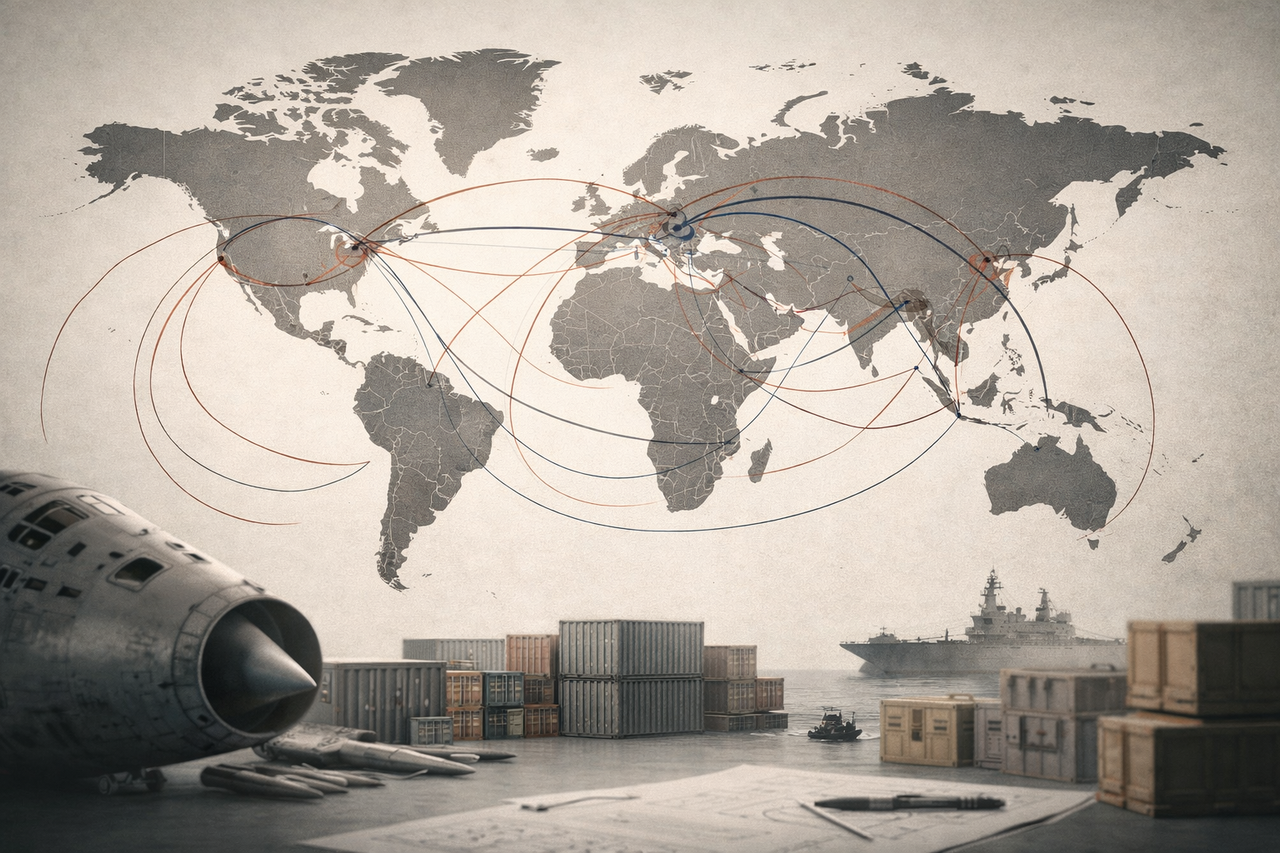
Trade System
The global arms trade has three defining structural features that distinguish it from ordinary commodity markets and that must be understood before any analysis of specific flows, exporters or regulatory frameworks can be adequately grounded. First, it is regulated, though unevenly, politically and with significant gaps between normative commitment and operational practice. Second, it is dominated by a relatively small number of powerful exporting states whose defence industries are tightly linked to national strategy and whose export decisions are instruments of foreign policy as much as commercial calculation. Third, it is shaped by alliance structures and geopolitical alignments that channel arms flows in ways that reinforce political order rather than merely satisfy military need. Together these features produce a system in which power is translated into industrial, legal and strategic form, and in which the distribution of military capability reflects and reproduces the distribution of political power in the international system. Understanding the arms trade is therefore not merely a question of tracking weapons. It is a question of reading the political economy of organised military exchange.
The first principle of the arms trade system is that military equipment is never politically neutral. Unlike civilian goods, arms exports affect the balance of force between states, the conduct of conflict and the durability of regimes in ways that no other category of traded good does. A fighter aircraft is not merely a platform. It is a strategic signal about the exporter's willingness to underwrite the recipient's security. A missile defence system is not merely a purchase. It is an alignment choice whose implications extend across the recipient state's relationships with neighbours, adversaries and other potential suppliers. Ammunition, drones, radar systems, electronic warfare equipment and artillery all carry strategic implications that extend far beyond the revenue they generate.
That is why arms exports remain subject to state control even in otherwise liberalised economies where the principle of free trade is applied comprehensively to almost every other category of good. Governments licence, restrict, delay and deny transfers based not only on commercial logic but on foreign policy, alliance obligations, domestic politics and legal commitments. In some countries, export decisions are formally governed by criteria related to regional stability, end-user verification and human rights risk assessment. In others, strategic discretion is wider and more opaque. In every case, the state remains the decisive actor. The arms trade is therefore best understood not as a free market with state interference at the margins but as a state-mediated market in which commercial logic operates within parameters set by political authority at every level of the transaction.
International regulation of arms exports exists, but it is fragmented in ways that systematically favour exporters over recipients and that create predictable gaps between normative commitment and operational outcome. At the broadest level, states participate in a web of norms, treaties and reporting frameworks intended to improve transparency and reduce irresponsible transfers. The Arms Trade Treaty, which entered into force in 2014, establishes binding obligations for states parties to assess the risk that transfers will be used to commit violations of international humanitarian law or human rights law. The Wassenaar Arrangement coordinates export controls among its forty-two participating states on conventional arms and dual-use goods. The Missile Technology Control Regime, the Nuclear Suppliers Group and the Australia Group address specific technology categories with proliferation implications. Together these instruments constitute a regulatory architecture of real normative significance.
Yet the system remains structurally limited by three features that no incremental reform has fully addressed. First, enforcement is national. International agreements depend on domestic implementation, and states decide how rigorously to apply export criteria, how much information to disclose and when strategic interests justify exception or reinterpretation. Second, not all exporters share the same regulatory philosophy or face the same domestic political constraints. This creates asymmetry: a transfer blocked by one supplier may simply be approved by another whose criteria are less demanding, whose courts are less interventionist or whose government faces different economic pressures. Third, regulation is consistently strongest for formal, high-visibility transfers between recognised states and consistently weakest in secondary markets, component flows, licensed production arrangements, dual-use technology transfers and re-exports through third countries. Modern weapons systems are modular and internationally distributed in their supply chains. Controlling the complete system is structurally more difficult than controlling the headline platform.
The arms trade is best understood not as a free market with state interference at the margins but as a state-mediated market in which commercial logic operates within parameters set by political authority at every level of the transaction. To describe it as a marketplace is to misunderstand its fundamental nature.
Vayu Putra · The Meridian · April 2026The global arms trade is highly concentrated in its supply side, and that concentration is not a temporary market condition but a structural feature of how defence industrial capacity develops and is sustained. Producing advanced military systems requires combinations of deep engineering talent, sustained state-funded research, long production runs to amortise development costs, established supply chain ecosystems and the institutional relationships between military establishments and industrial partners that take decades to build. These requirements create barriers to entry that few states can overcome, and that ensure the hierarchy of major arms exporters changes slowly even as individual exporters' relative positions shift.
States
At the top of the hierarchy sits the United States, whose defence industrial base is unmatched in scale, technological breadth and alliance integration. American arms exports are not merely commercial instruments. They are mechanisms of strategic architecture whose full significance extends far beyond the hardware exchanged. Countries that enter the US arms ecosystem through major platform purchases typically spend subsequent decades dependent on that ecosystem for maintenance, software updates, munitions compatibility, operational doctrine and the institutional relationships between their military and the US defence establishment that develop through sustained engagement. This dependency is not a side effect of arms sales. It is, from the US perspective, one of their primary strategic products.
A major arms purchase is simultaneously a military acquisition decision, a diplomatic statement and a long-term commitment to a specific strategic ecosystem. The procurement choice signals alliance consolidation, strategic hedging, political trust or security dependence depending on the specific transaction and the political context in which it occurs. India's decision to purchase 36 Rafale aircraft from France, announced in 2016, was simultaneously a capability acquisition, a diplomatic signal about India's strategic autonomy from US equipment dependence and a commercial arrangement that strengthened the France-India bilateral relationship across multiple dimensions simultaneously. Pakistan's acquisition of Chinese J-10C fighters and JF-17 aircraft signals a different set of alignments, dependencies and strategic calculations. The procurement decision is never simply technical. It is always also political.
The mechanism through which procurement creates lasting influence is dependency reproduction. Once a state commits to a major weapons ecosystem, the technical, institutional and financial costs of switching to an alternative supplier increase with every year of operation. Maintenance contracts, spare parts supply chains, training programmes, software access, munitions compatibility and the operational doctrine built around specific systems all create lock-in effects that persist across governments and across strategic reorientations. A state that acquired Russian aircraft in the 1990s and has trained pilots, built maintenance infrastructure and developed tactical doctrine around those platforms faces a transition cost to Western alternatives that is measured not only in financial terms but in years of reduced operational capacity during the transition. That transition cost is itself a form of influence that the original supplier retains long after the initial sale.
The F-35 programme represents the most extensive example of alliance-structured procurement path dependency currently operating in the global arms trade. Twelve NATO and partner nations have committed to F-35 procurement, including the United States, United Kingdom, Australia, Italy, Netherlands, Norway, Denmark, Belgium, Japan, South Korea, Poland and Israel, with additional states in various stages of consideration or negotiation. The programme creates an interoperability architecture of extraordinary depth: shared electronic warfare systems, shared data links, shared maintenance infrastructure, shared supply chains and shared operational concepts that make the collective alliance significantly more capable than the sum of its national contingents but simultaneously more dependent on continued US industrial and institutional participation in sustaining the system. The F-35 is not merely a combat aircraft. It is a binding institutional mechanism for US-led alliance cohesion embedded in steel, software and contract law that will persist for the operational lifetime of the platform, which is projected to extend to at least 2060.
The global arms trade is defined in part by a structural contradiction that no amount of regulatory architecture fully resolves. States endorse norms of restraint while defending the economic and strategic value of exports. They advocate stability in diplomatic forums while supplying arms to regions characterised by active tension or fragile governance. They regulate transfers in law while maintaining industries whose commercial survival depends on external demand that domestic procurement alone cannot sustain. They speak the language of peace behind UN podiums while negotiating long-term weapons contracts behind closed diplomatic doors. This contradiction is not accidental or correctable through better institutional design. It is the predictable product of a system in which the states most institutionally invested in international peace and security are simultaneously the states with the strongest commercial and strategic interests in sustaining the military demand that international insecurity generates.
For the Global South, this structural contradiction has direct and documented consequences. The states of sub-Saharan Africa, the Middle East and South Asia are simultaneously the primary recipients of post-conflict stabilisation rhetoric, development assistance, democracy promotion and conflict resolution mediation from major Western powers, and the primary markets for the weapons those same powers export. The contradictions are not merely rhetorical. They are operational. The same government that funds a peacekeeping mission in a conflict-affected region may simultaneously be approving export licences for military equipment supplied to parties whose behaviour is driving the conflict. The same international institution that designs post-conflict reconstruction programmes may be doing so in an institutional environment shaped by the procurement dependencies created by earlier arms transfers. The arms trade system reproduces the conditions that justify its own existence.
The final insight that a structural analysis of the arms trade system produces is also the most analytically powerful. Arms flows are not merely indicators of military capability distribution. They are maps of political order. The pattern of who supplies whom, on what terms, with what dependencies and within what alliance structures, reveals the actual architecture of influence in the international system more clearly than any formal diplomatic document. A state's procurement portfolio is its strategic autobiography, recording its alliances, its dependencies, its hedging strategies and its aspirations in the only medium that is genuinely costly to fake: the expenditure of scarce resources on specific military relationships that shape operational capability for decades.
Reading these maps requires moving beyond the headline statistics of SIPRI transfer data and into the institutional texture of specific procurement relationships. The fact that India is simultaneously the world's largest arms importer and operating equipment from the United States, France, Russia and Israel simultaneously is not a statistical curiosity. It is a deliberate strategic diversification designed to maintain operational autonomy from any single supplier while preserving access to multiple technology ecosystems and diplomatic relationships. The fact that Turkey, a NATO member, has purchased Russian S-400 air defence systems while also operating US F-16 aircraft and developing domestic drone capability is not an anomaly. It is a deliberate assertion of strategic autonomy within an alliance framework that Turkey judges to be imperfectly aligned with its national interests. The arms trade, read carefully, is a continuous commentary on the state of the international system. It records, in the most durable form available, who trusts whom, who depends on whom and who has decided that neither trust nor dependence is entirely safe.
Arms maps are also maps of political order. They record, in the most durable form available, who trusts whom, who depends on whom and who has decided that neither trust nor dependence is entirely safe. The arms trade is not the shadow of geopolitics. It is one of its operating systems.
Vayu Putra · The Meridian · April 2026The global arms trade system is best understood as a political economy of organised military exchange whose flows are shaped by law, but also by hierarchy; by firms, but also by states; by commercial incentives, but also by alliance structures and strategic ambitions. Regulation matters, yet it operates within a system whose deepest logic is geopolitical. That is why arms do not simply travel from producer to buyer. They travel through layers of power: export regulation deciding what is permissible, procurement systems deciding what is sustainable, alliances deciding what becomes normal, financial mechanisms deciding what becomes possible. Together these forces create a structured order in which military capability is distributed unevenly, dependencies are reproduced and influence is embedded in supply.
The global arms trade is not the shadow of geopolitics. It is one of its operating systems. And its operating logic will not change until the distribution of power that generates it changes. Everything else is noise.
April 2026 · War Economy Edition