Mauritius Does Not Have an Inflation Problem. It Has a Production Problem.
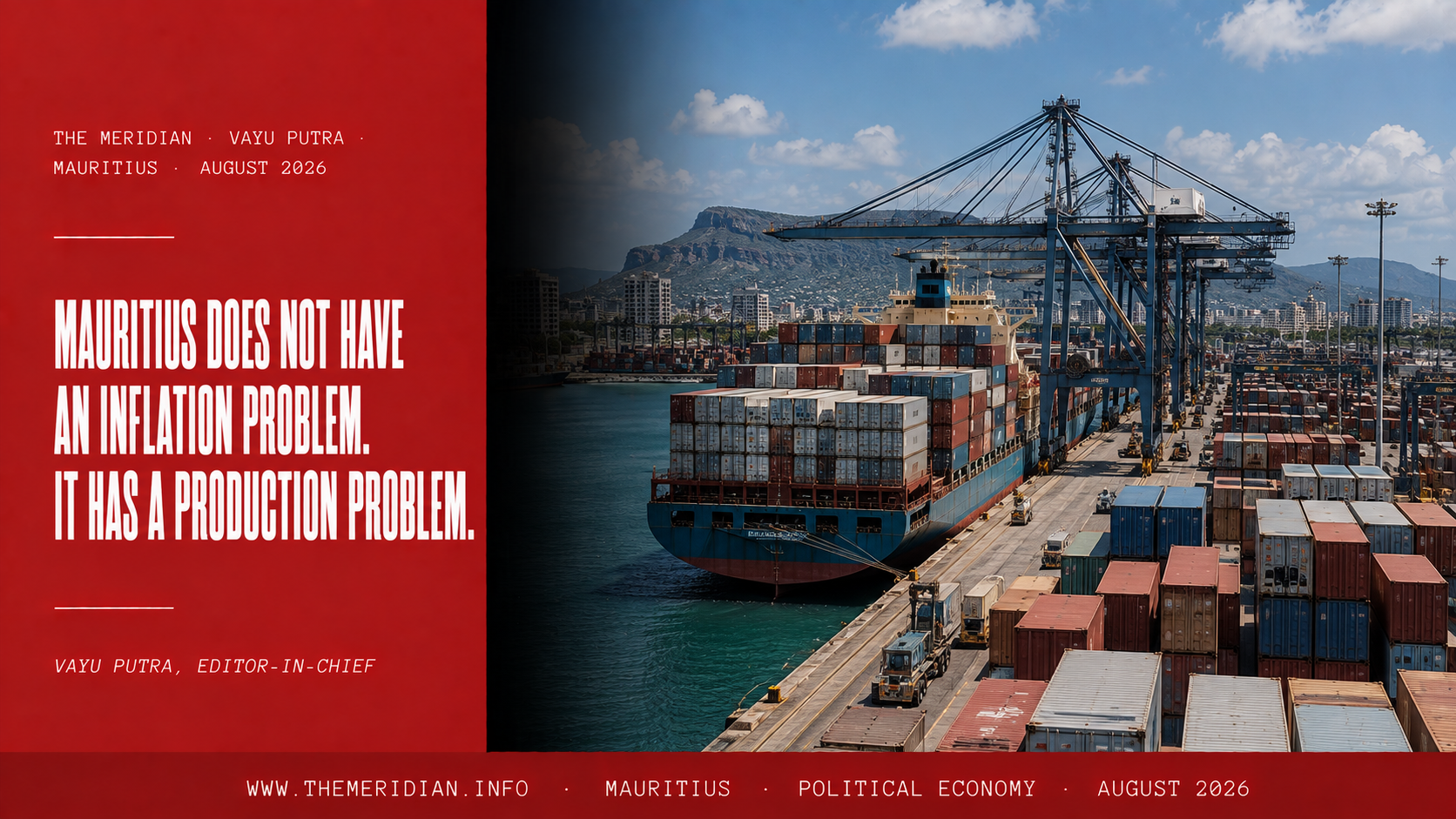
In January 2026, Mauritius imported Rs 21.7 billion worth of goods and exported Rs 8.9 billion. A ratio of 2.4 to 1. Every single month. Food in Mauritius costs approximately the same as in Germany and the United Kingdom. The Mauritian minimum wage is Rs 20,000 per month, approximately $421. The average after-tax salary in Mauritius covers 0.9 months of living expenses. In the United Kingdom it covers 1.5 months. Petrol is now $1.49 per litre, functionally equivalent to the cheapest petrol in the European Union. The official explanation for this condition is that Mauritius has too much money chasing too few goods. The evidence says the opposite. Mauritius does not have too much money. It has too little production. The prices are European. The wages are not. The gap between those two facts is not an inflation problem. It is a production problem fifty years in the making, sustained by a political economy that has consistently chosen patronage over productivity, community loyalty over industrial strategy, and the management of scarcity over the creation of abundance. The interest rate tool being applied to this condition is paracetamol for cancer. This article explains why.
The statement that Mauritius has too much money chasing too few goods requires, before anything else, a basic interrogation of its terms. Too much money relative to what? The minimum wage is Rs 20,000 per month. At the current exchange rate, that is $421 per month, or $5,052 per year. The cost of living for a single person in Mauritius, excluding rent, is approximately $386 per month according to the most current available data. The average after-tax salary covers 0.9 months of living expenses before rent. There is no money left over. There is no demand excess. There is no purchasing power surplus chasing up prices. There is a population that cannot cover its living expenses on its income, paying prices that reflect the full cost of importing almost everything it consumes from countries whose wages are eight to ten times higher, and being told by its central bank that the problem is too much demand.
Mauritius is an island. It has no oil. It has no gas. It has no iron ore. It has no significant mineral deposits beyond basalt and coral. It has no heavy industry. What it has is ocean, sun, rain, fertile volcanic soil, and 1.27 million people. From those natural endowments, it has built an economy that feeds itself partially, clothes itself in textiles whose raw materials arrive by ship, moves itself on petrol that arrives by tanker, and powers itself on electricity generated from heavy fuel oil that arrives from the Middle East through shipping routes that the 2026 Hormuz crisis made 76% more expensive.
Every item that crosses Port Louis carries a specific cost architecture that has nothing to do with domestic demand and everything to do with geography, global supply chains, and the rupee's exchange rate. The world market price is set in Chicago, Rotterdam, or Singapore. The shipping cost is set by the container oligopoly whose ten largest carriers control 85% of global capacity, documented in the August edition's Shipping Oligopoly article. The STC margin is set by a state monopoly. The importer margin, distributor margin, and retailer margin are each added sequentially. The rupee conversion is applied at a rate that has depreciated 6.7% against the dollar in 2024 and hit an all-time low of Rs 47.53 per dollar in June 2026. The consumer pays the sum of all of these. The Bank of Mauritius raises the key rate to 4.75% and calls it inflation management.
Food in Mauritius costs the same as in Germany and the United Kingdom. Petrol costs $1.49 per litre, the same as the cheapest country in the European Union. Medicines cost what the world charges for medicines. Machinery costs what the world charges for machinery. The prices are European. The wages are not. That gap is not an inflation problem. It is the price of not producing what you consume.
Mauritius's economic model rests on four productive sectors. Each is genuinely significant. Each is structurally incapable of closing the gap between what Mauritius imports and what it exports. Understanding why requires examining each one precisely rather than sentimentally.
Sugar. Mauritius has produced sugar since the colonial period. The EU's ACP preferential price made it viable for decades. The 2009 reform ended the preference. The government subsidises sugar production and retail prices because without subsidy, the industry would contract further and retail food prices would rise. The subsidy cost falls on a treasury that is already running a 9.8% fiscal deficit. The sugar subsidy is not a production success. It is a managed decline, paid for by the citizens who consume the sugar and the taxpayers who fund the subsidy simultaneously. Mauritius cannot set the world price of sugar. It cannot even set the regional price. It receives what the market offers and absorbs the cost of the gap through public expenditure.
Tourism. Tourism is Mauritius's most successful export industry and the primary source of foreign exchange that keeps the current account from collapsing entirely. In January 2026, tourism revenues were Rs 11.3 billion. But tourism cannot price freely. Airlines set the access cost. The aviation fuel crisis documented in the August edition reduced April 2026 arrivals by 3.7% year-on-year and February 2026 arrivals by 14.5% compared to the previous month. Mauritius competes for long-haul tourism against the Maldives, Seychelles, and Bali, none of which has managed the fuel cost crisis more successfully, but all of which compete on the same supply-constrained access model. Tourism revenues are real and significant. They are also hostage to decisions made in airline boardrooms, refinery pricing desks, and geopolitical crisis rooms in which Mauritius has no seat and no voice.
Textile. The textile sector employs approximately 60,000 workers in Mauritius and generates significant export earnings. It also imports its raw materials, its machinery, and its industrial inputs entirely from abroad. It employs a significant proportion of foreign workers, primarily from Bangladesh, Madagascar, and India, whose wages are converted from rupees to dollars and remitted abroad through a mechanism The Meridian documented as The Remittance Drain in the June 2026 edition. The value addition that remains in Mauritius after inputs, machinery depreciation, foreign worker remittances, and capital repatriation to foreign parent companies is the margin on which the sector's genuine contribution to the economy rests. That margin is real. It is also structurally squeezed by the same rupee depreciation and import cost inflation that affects every other sector, because inputs are priced in foreign currencies and output is sold in markets where Mauritius competes against lower-cost producers in Bangladesh, Vietnam, and Cambodia.
Real estate. Real estate FDI under EDB schemes has been the government's primary investment attraction mechanism for over a decade. A French buyer purchases a villa for $750,000 under the Property Development Scheme. The EDB records it as $750,000 in FDI. The government collects registration duty and land transfer tax. The villa is built using construction workers, local materials, and professional services. Then the transaction is complete. The villa is owned. The foreign buyer may or may not reside in Mauritius. The capital that funded the purchase may or may not have arrived as forex. The villa does not produce exports. It does not employ a permanent Mauritian workforce. It does not generate recurring foreign exchange. It is, as you said precisely, a jackpot. You sell the ticket once. Then the draw is over.
Mauritius buys from China, the UAE, India, South Africa, and France. It pays in dollars and euros. It sells to South Africa, the UK, France, the US, and Spain. It receives whatever those markets will pay in their currencies. Every time the rupee weakens against the dollar, the import bill rises automatically in rupee terms even if not a single global commodity price has moved. Every time the import bill rises, the cost of living rises for every household. Every time the cost of living rises, workers ask for higher wages. Every time wages rise, input costs for the textile sector rise, reducing competitiveness against Bangladesh and Vietnam. Every time competitiveness falls, export earnings fall. Every time export earnings fall, the current account deficit widens. Every time the current account deficit widens, the rupee comes under pressure. Every time the rupee comes under pressure, it weakens further. Every time it weakens further, the import bill rises again.
This is not a business cycle. It is a structural loop with no exit that does not involve producing significantly more of what Mauritius currently imports. The trade deficit has not been in surplus since 1986. Every government since 1986, regardless of coalition composition, community representation, or electoral mandate, has managed this structural deficit rather than resolved it. The management tools have included import substitution rhetoric, export promotion incentives, tourism infrastructure investment, financial services liberalisation, and EDB scheme FDI attraction. None of them has closed the gap between what Mauritius imports and what it exports. The gap is wider in 2026 than it was in 2006.
Demand-pull inflation, the condition to which "too much money chasing too few goods" refers, requires excess purchasing power. Consumers have more money than the economy can supply goods to absorb, and prices are bid up as a result. This is what happened in the United States between 2021 and 2023: pandemic transfer payments, accumulated savings, and supply chain disruption produced a genuine demand shock. The Fed raised rates aggressively and inflation fell within eighteen months.
The Mauritius data shows none of the conditions for demand-pull inflation. The average after-tax salary covers 0.9 months of living expenses. Real wages are declining as inflation outpaces nominal wage growth. Private consumption is 68% of GDP precisely because Mauritians spend almost everything they earn on consumption, not because they have surplus income bidding up prices. The trade deficit improvement in May 2026 was driven by a slowdown in purchases, not by export growth. When an economy's trade position improves because people are buying less, that is a sign of compressed demand, not excess demand.
The prices are not high because Mauritians are spending too freely. The prices are high because Mauritius produces almost none of what it consumes, and every item that crosses the port carries the full accumulated cost of global supply chains, shipping oligopoly margins, STC markup, distribution chains, and rupee depreciation onto a wage base that cannot absorb them. Raising the interest rate does not reduce any of those costs. It reduces domestic investment and borrowing capacity, the two things Mauritius most needs to build the productive base that would eventually reduce import dependency.
The question that the economic data raises but cannot itself answer is why. Why has Mauritius, after fifty years of independence, after periods of genuine growth and institutional development, after building a financial services sector capable of managing billions in offshore capital, after developing a tourism industry that attracts visitors from across Europe and Asia, failed to build a productive base capable of closing the gap between what it imports and what it exports?
The answer is political economy rather than economics. Resources in Mauritius have been allocated, across successive governments of every coalition composition, primarily according to political loyalty rather than productive efficiency. Industrial policy has been captured by the same oligarchic families whose sugar estates, textile factories, hotels, and real estate developments have dominated the economy since independence, and who have no structural interest in the diversification that would create competitors. The EDB's investment attraction programme has been calibrated to bring in the kind of capital that serves existing interests: real estate that creates construction work and property value appreciation for landowners, financial services that create professional employment for the educated middle class, and tourism that fills hotels owned by the same families that own the sugar estates that own the land on which the hotels are built.
The community voting pattern that delivers elections to the same rotating cast of political families is not a separate phenomenon from the economic structure. It is the same phenomenon viewed from a different angle. The patronage networks that secure votes also secure market access, government contracts, import licences, and land development rights. The citizen who votes for community loyalty is voting, consciously or not, for the continuation of the economic structure that keeps them paying European prices on developing economy wages. The paracetamol administered by the Bank of Mauritius at 4.75% treats the fever. It does not address the cancer. The cancer is the political economy of non-production, sustained across five decades and every electoral cycle, by the same calculus of community, clan, and clientelism that has delivered every government since 1968.
The inflation that Mauritians experience every day at the supermarket, at the petrol station, at the pharmacy, and at the school fees office is not the product of excess demand. It is the product of a structural condition: an island economy that imports 2.4 rupees of goods for every 1 rupee it exports, pays for those imports in currencies that have been appreciating against the rupee for a decade, and has no significant domestic productive capacity in the sectors whose global prices most directly determine the cost of living.
Sugar is subsidised to survive. Tourism is hostage to aviation fuel. Textile depends on imported inputs, imported machinery, and imported labour whose wages leave the island as remittances. Real estate FDI is a one-time transaction whose capital may never fully arrive as foreign exchange. The financial services sector processes offshore capital with minimal domestic linkages. None of these sectors closes the gap. None of them was designed to. The economic model that chose them was designed to maintain the existing distribution of economic and political power, not to maximise productive output for the benefit of the broader population.
The Bank of Mauritius is not wrong to use the tools available to it. It is applying the only instrument a central bank possesses to a structural condition that monetary policy cannot resolve. The solution to Mauritius's inflation is not a higher interest rate. It is a productive economy: one that grows food it consumes, refines the fuel it uses, manufactures goods it sells, and adds sufficient value to what it exports to close the gap with what it imports. Building that economy requires industrial policy, long-term capital allocation, and the political will to direct resources toward productivity rather than patronage. It requires a generation of political leadership that is elected for its economic programme rather than its community affiliation. It requires Mauritius to ask, at every election, not which clan should govern, but what the economy should produce. Until that question is asked and answered seriously, the petrol will cost what Europe pays, the food will cost what Germany pays, and the wages will remain what a developing economy with no productive base can afford to pay. The gap between those two facts is not inflation. It is the price of fifty years of choosing the wrong question.
Add comment
Comments