Senegal Is at a Crossroads. Here Is What the Next Ten Years Will Decide.
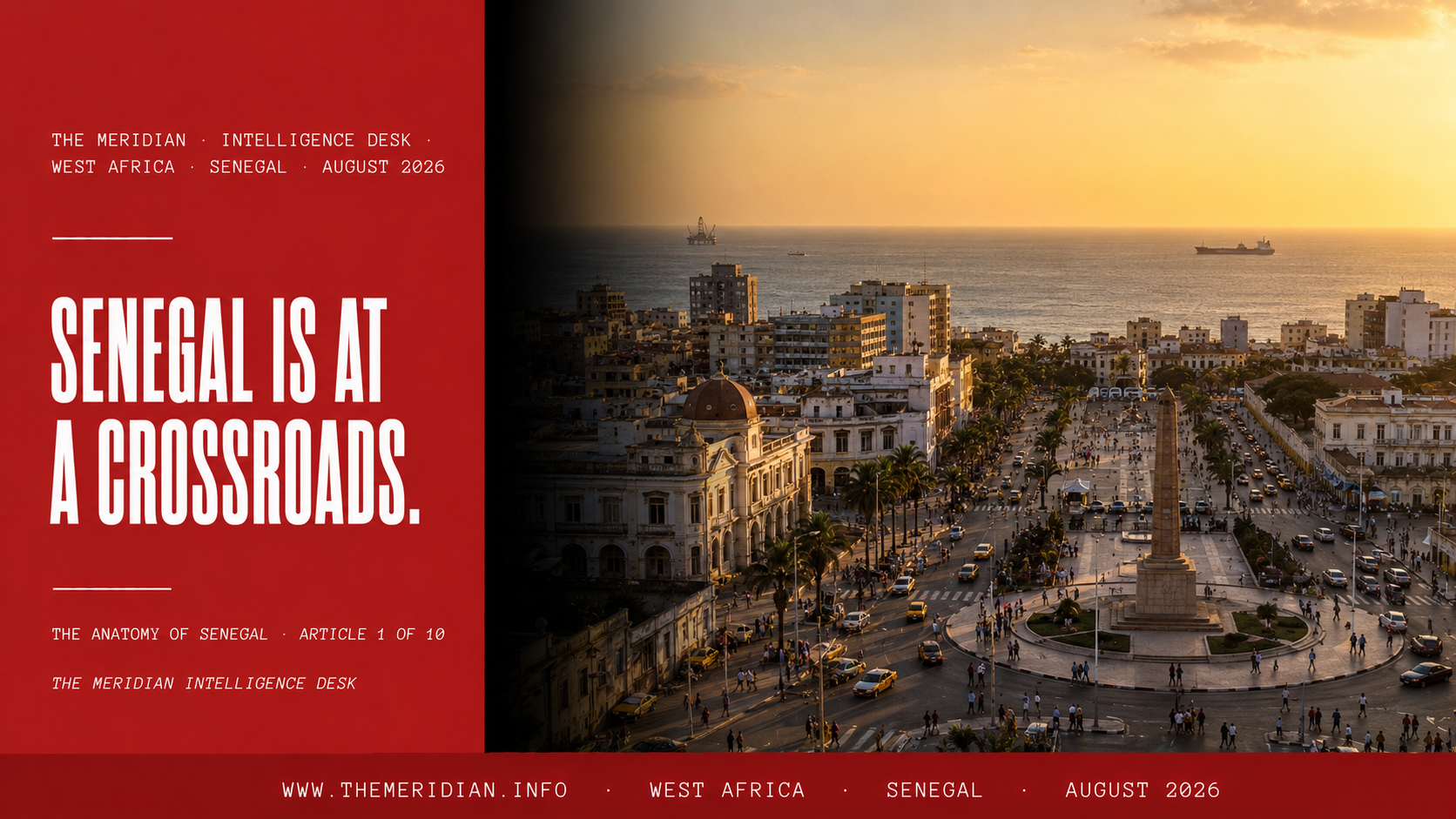
On 24 March 2024, Bassirou Diomaye Faye won the Senegalese presidential election in the first round with 54.28% of the vote. He had been released from prison twelve days earlier. He had never held elected office. His platform was sovereignty: exit the CFA franc, renegotiate resource contracts, expel French military forces, audit the public finances, and build a Senegal whose economy serves Senegalese citizens rather than the external interests that have organised it since 1945. Within eighteen months, the French military had left, the EU fisheries agreement had been cancelled, the forensic audit had revealed that the previous administration had hidden $28.55 billion in debt representing nearly 100% of GDP, oil production had begun at the Sangomar field, gas had begun flowing from the Greater Tortue Ahmeyim project, GDP growth had reached 8.4% in 2025, and the CFA franc debate had moved from academic discussion to official government policy. Senegal is at a genuine historic inflection point. The oil production window is approximately twelve years at current reserve estimates. What happens in those twelve years will determine whether Senegal becomes the most successful economy in West Africa or the most cautionary tale. The Meridian opens its ten-part Anatomy of Senegal series with the question that the evidence demands: does Senegal have everything it needs to build a sovereign, productive, prosperous economy, and does the Faye government have the political will to use the window before it closes?
The answer to the first question is yes. Senegal has everything it needs. It has oil and gas revenues now arriving at scale. It has the westernmost position of any continental African country on the Atlantic, giving it the most advantageous geography for transshipment, logistics, and Atlantic trade of any West African state. It has the region's oldest university, UCAD with 90,000 students, and the most internationally credible business school in francophone Africa at BEM Dakar. It has a diaspora sending $2.7 billion in annual remittances, the largest relative to GDP of any country in the region. It has phosphate reserves, gold deposits, one of the world's richest fishing zones, significant solar energy potential, and Atlantic submarine cable connectivity that positions it as francophone Africa's natural digital hub. It has sixty-five years of unbroken civilian rule, the only country in a West African neighbourhood where coups have become more common than elections. And it has, for the first time in its post-independence history, a president who came from prison to power on a platform of structural change, who has cancelled the agreements that constrained Senegalese sovereignty, and who is governing with an explicit awareness that the resource window is finite and the decisions made within it are permanent.
Senegal is a country of 17 million people on the Atlantic coast of West Africa. It is the former capital of French West Africa, which means it entered independence in 1960 with more institutional infrastructure than any of the eight countries France administered from Dakar. Its first president, Léopold Sédar Senghor, was a poet, philosopher, and co-founder of the Négritude movement, the first African elected to the Académie française. He governed for twenty years and resigned voluntarily before his term ended, handing power to his chosen successor Abdou Diouf. That voluntary transfer, in 1981, is the foundational act of Senegalese democratic tradition. In sixty-five years of independence, Senegal has had five presidents, five peaceful transfers of power, and no military government. In a region where Burkina Faso, Mali, Guinea, Niger, and Guinea-Bissau have all experienced coups in the past five years, this is not a minor achievement. It is the foundation on which everything else is built.
The Wolof language and culture provide a national identity that transcends the ethnic fragmentation that has destabilised many of Senegal's neighbours. Sufi Islam, practised by the majority of Senegalese through the Mouride and Tijaniyya brotherhoods, provides a social cohesion framework that has historically channelled political energy into religious community rather than ethnic conflict. The Casamance separatist insurgency, active since 1982, remains the single unresolved security challenge and a persistent drain on the region's development potential. But it has never threatened the stability of the Dakar government or the integrity of the national state.
The most important single fact about Senegal's economic position in 2026 is not the oil. It is the debt. When the Faye government commissioned an independent forensic audit of the public finances upon taking office in April 2024, it found that the total outstanding debt of the central government stood at $28.55 billion as of 31 December 2023, representing 99.67% of GDP, a substantial increase from the 74% of GDP that the Sall government had officially reported to the IMF and to international bond markets.
The gap between the reported 74% and the actual 99.67% is not a rounding error or a methodological difference. It represents $28.55 billion minus what the Sall government reported, equating to approximately $7-13 billion in obligations contracted outside the official budgetary framework. Eurobond investors who purchased Senegalese sovereign debt priced on the false 74% figure were misled. The IMF, which conducted Article IV consultations and approved disbursements based on the reported figures, was misled. The Senegalese people, who voted in elections in which the government's fiscal management was a central issue, were misled.
The fiscal deficit reached 13.4% of GDP in 2024, revealing the full scale of the inherited imbalance. The Faye government has committed to bringing it down to 7% in 2025 and 5% in 2026. IMF GDP growth expectations for Senegal are strong, exceeding 8% in 2025, driven by hydrocarbon revenues. But strong growth into a starting position of 99.67% debt to GDP and 13.4% fiscal deficit means that the oil windfall is doing two jobs simultaneously: financing the development investment that Senegal needs and servicing the debt legacy that the previous government created. Every dollar of oil revenue that goes to debt service is a dollar that does not go to a data centre, a port expansion, a hospital, or a school.
The CFA franc was created on 26 December 1945, when France ratified the Bretton Woods Agreement. The acronym originally stood for Colonies Françaises d'Afrique, French Colonies of Africa. The name was changed after independence. The architecture was not. Today, eighty years after its creation, Senegal's monetary policy is set by the BCEAO in Dakar for eight countries simultaneously at a rate of 3.25%, with no mechanism for Senegal to respond to country-specific conditions. The currency is pegged to the euro at 655.957 XOF per euro, a rate that has been fixed since 1999 when France adopted the euro at the same conversion rate that the franc had maintained since 1994.
The justification for the euro peg has always been that Europe is francophone Africa's primary trading partner. The data as of 2024 does not support that justification. The eurozone accounts for 24.8% of Senegal's imports and 19.7% of its exports. France specifically accounts for 2.8% of WAEMU exports. The Netherlands, primarily as a transshipment point for African commodities, accounts for 7.4%. The currency of 100% of Senegal's monetary policy is pegged to the currency of 19.7% of its exports. Senegal buys from China at 19%, sells to Mali at 21%, and prices its monetary policy in euros. The mismatch is not a technical oversight. It is the architecture of dependency, maintained because it serves the euro zone buyer and constrains the African seller simultaneously.
An ECB official, quoted anonymously in research reviewed for this article, was explicit: on the CFA, my lips are unfortunately supposed to be sealed. The ECB has enormous power over West African economies through the peg. This is treated as a topic that cannot even be mentioned in West Africa because it may give ideas to nations like Senegal to break out of the peg. The ECB official's instinct for secrecy failed. Senegal has the idea. President Faye has stated publicly that the CFA franc will soon be relegated to history. His high representative Aminata Toure declared it will soon be ancient history. The question is not whether Senegal will exit the CFA system. It is when and how.
Senegal's monetary policy has been set in Paris and Frankfurt since 1945. Its oil revenues arrive in dollars. Its primary export partners are Mali, India, Switzerland, China, and the UAE. Its currency is pegged to the euro. France accounts for 2.8% of what it sells to the world. The architecture of the monetary trap is visible in those numbers to anyone willing to look.
The Faye government has moved faster on the sovereignty agenda than any previous Senegalese administration and than most external analysts predicted. The French military base, present since independence, is leaving by September 2025. The EU fisheries agreement, which allowed European fleets to fish in Senegalese waters in exchange for compensation payments that critics described as inadequate, has been cancelled. The forensic audit of public finances has been conducted and published, exposing the previous administration's misreporting. The oil and gas revenue management framework is under revision to ensure more of the hydrocarbon revenues remain in Senegal rather than flowing to foreign operators and creditors.
What remains is the harder agenda. The CFA franc exit requires a currency transition that the Faye government has announced as an intention but has not yet operationalised. The port of Dakar expansion, which could position Senegal as the primary logistics hub for West Africa's 400 million ECOWAS consumers, requires capital investment that the oil revenues could provide but that debt service obligations are simultaneously consuming. The single national secular curriculum that would produce the unified, technically educated generation Senegal's development model requires has not been delivered. The health system that spends 3.8% of GDP against a WHO minimum recommendation of 5% has not been reformed. The data centre and technology sector that Dakar's Atlantic connectivity and solar energy potential support has not been developed at scale.
The Sangomar oil field has an estimated production lifespan of approximately twelve years at current reserve estimates. The Greater Tortue Ahmeyim gas project has a longer horizon but is shared with Mauritania, limiting the fiscal capture. Oil and gas revenues are expected to reach CFA 753.6 billion, approximately $1.3 billion, annually. That is the window. Twelve years of elevated dollar-denominated resource revenues that could seed the reserve base for a new currency, fund the port expansion, capitalise the sovereign wealth fund, invest in energy infrastructure, and build the digital economy.
Every African oil producer that has failed to convert its resource window into a structural economic transformation did so because it spent the window on consumption, debt service, and patronage rather than on productive investment. Nigeria had fifty years of oil and remains poor. Angola had forty years and remains poor. Gabon had fifty years. Cameroon had forty years. The list is long and the lesson is identical: the window exists, the choices are made, the window closes, and the structural condition that preceded the oil returns, now with additional debt.
Senegal's twelve-year window began in 2024. It will close approximately in 2036. The decisions made in the next ten years, on monetary policy, port infrastructure, education curriculum, health investment, digital economy development, and sovereign wealth fund management, will determine whether Senegal is a fundamentally different economy in 2036 than it was in 2024. No subsequent government will have this window. The Faye government has it now.
The Meridian's Anatomy of Senegal series will examine each dimension of this blueprint in dedicated articles over the coming months. The complete ten-article architecture is listed at the foot of this piece. Here is the summary argument.
Senegal can, within ten years, build the monetary sovereignty it has lacked since 1945. The path runs through ring-fencing oil revenues in a dollar-denominated sovereign wealth fund, investing those reserves in US Treasury bonds to earn yield while building the reserve base, allowing domestic banks to hold dollar accounts, pricing oil transactions in dollars, and eventually launching a trade-weighted digital currency pegged to a basket reflecting actual trade composition rather than the euro-only peg that currently distorts every import cost and export price. The euro's weight in that basket would be approximately 30%, reflecting its 24.8% share of imports. The dollar's weight would be approximately 50%, reflecting oil, gold, and commodity trade. The CFA's 81-year monopoly on Senegalese monetary architecture would end not through a dramatic rupture but through a managed sequencing that builds credibility before demanding it from markets.
Senegal can, within ten years, position the Port of Dakar as the primary transshipment hub for West Africa. The geography is already correct. The Atlantic position is inherently superior to Abidjan for ships arriving from Europe and the Americas. The investment required is capital, management expertise, and political will to direct oil revenues toward productive infrastructure rather than current consumption. Every container that transships through Dakar rather than Abidjan generates port fees, logistics employment, warehousing revenue, and ancillary services that remain in Senegal.
Senegal can, within ten years, develop a technology and data economy that capitalises on its Atlantic connectivity, solar energy potential, and university-educated workforce. Dakar is already described as francophone West Africa's digital hub. The Technological New Deal announced by the Faye government aims for universal high-speed connectivity. Data centres require electricity and connectivity. Senegal has the sun for one and the cables for the other. The workforce that would staff those centres is already being educated at UCAD and BEM Dakar. The diaspora engineers and technology professionals in France, the US, and Canada are the faculty of a transformed digital economy if the conditions to return are created.
And Senegal can, within ten years, feed itself. The groundnut economy that France built Senegal's colonial agriculture around was designed to export oil seeds to European soap factories, not to feed Senegalese citizens. Rice self-sufficiency has been a stated government target for decades and has never been achieved because the political economy that allocates agricultural resources has consistently chosen export crops for foreign exchange over food crops for domestic consumption. AI-assisted precision agriculture for rice, millet, and maize production, with irrigation infrastructure funded by oil revenues, can change this within a single agricultural investment cycle.
- Article 1 · Published: Senegal Is at a Crossroads. Here Is What the Next Ten Years Will Decide.
- Article 2 · Politics: The Man Who Came from Prison to the Presidency. Faye, Sonko, and the Rupture.
- Article 3 · Oil: Senegal Found the Oil. The Question Is Whether the Oil Will Find Senegal.
- Article 4 · Debt: What Macky Sall Left Behind. The $28 Billion Nobody Was Supposed to Know About.
- Article 5 · Money: Why Senegal Pays Europe's Price for Money It Cannot Control. The CFA Franc at 81.
- Article 6 · Food: Senegal Feeds the World's Tables and Cannot Feed Its Own. The Groundnut Economy's Legacy.
- Article 7 · Energy: The Sun Is Free. The Electricity Is Not. Senegal's Energy Paradox.
- Article 8 · Port: The Most Valuable Piece of Real Estate in West Africa. Why Dakar Has Not Claimed It Yet.
- Article 9 · Education: Three Curricula, Three Futures, One Country. Senegal's Educational Divide.
- Article 10 · Blueprint: Why Faye Is Senegal's Best Option. The Evidence Examined.
Senegal is the most consequential country in West Africa in 2026. Not because it is the largest, Nigeria is larger. Not because it is the wealthiest, Ivory Coast has a larger economy. Not because it is the most resource-rich, the DRC has more. Senegal is the most consequential because it is at a genuine, documented, time-limited inflection point at which the decisions made now will determine the trajectory of the next generation. The oil window is open. The monetary architecture is being challenged for the first time. The hidden debt has been exposed and must now be serviced honestly. The French military is leaving. A president who understands the structural problem is governing.
The structural problem is this: Senegal has, since 1945, organised its economy around the priorities of external actors. The CFA franc serves the euro zone. The EU fisheries agreement served European fleets. The resource contracts serve the foreign operators. The educational system serves the French cultural model. The debt contracted outside the official budgetary framework served the political interests of the previous administration. What has not been organised around Senegalese citizens' interests is Senegalese citizens' interests.
The Faye government is the first in Senegal's post-independence history to make that reorganisation its explicit and operational agenda. It may succeed. It may be stopped by the debt legacy, the political coalition's internal tensions, the BCEAO's institutional inertia, or the external pressure of the creditors whose interests the reorganisation threatens. The Meridian will examine each dimension of that agenda across the ten articles of this series, with evidence and without sentiment. What we can say at the opening is that the window is real, the agenda is correct, and the time available is finite. Senegal knows what it needs to do. The next ten years will tell us whether it did it.
Add comment
Comments