Senegal Found the Oil. The Question Is Whether the Oil Will Find Senegal.
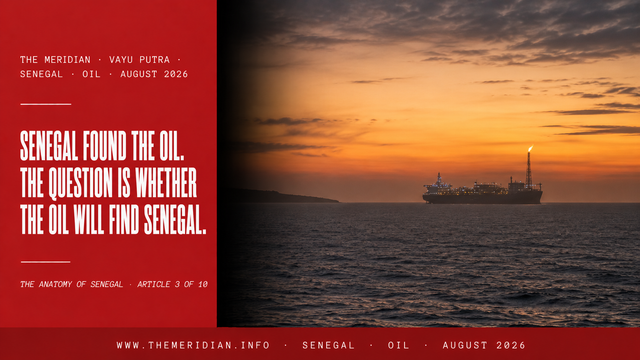
The offshore oil field Sangomar, operational since June 2024, achieved total production of 16.9 million barrels of crude oil in its first year, surpassing the initial target of 11.7 million barrels. In just 18 months, 47.09 million barrels were extracted. With a daily production capacity of 100,000 barrels, the Sangomar project could generate nearly $60 billion in revenue for Senegal over 25 years. Woodside, which holds an 82% stake in Sangomar, generated $2.6 billion in EBITDA from its share since production began. Its full year of production and marketing in 2025 generated $1.9 billion in revenue for the company alone. The Greater Tortue Ahmeyim LNG project achieved first gas on 31 December 2024. First LNG cargo was exported in April 2025. Since June 2024, the oil windfall has generated over 500 billion CFA francs for the Senegalese state and created approximately 6,000 jobs. Nigeria has been producing oil since 1958. Its GDP per capita is $824. Angola since 1955. HDI rank 148th. Gabon since 1956. HDI rank 123rd. The question that every one of those countries asked at their moment of first oil, and failed to answer correctly, is the question that Senegal must answer now: does the oil belong to the country, or does the country belong to the oil?
On 2 June 2024, the Léopold Sédar Senghor FPSO, a floating production, storage, and offloading vessel named after Senegal's poet-president, achieved first oil at the Sangomar field approximately 100 kilometres south of Dakar. The naming of the vessel after Senghor was deliberate and politically significant. Senghor was the architect of Négritude, the intellectual movement that asserted the dignity and value of African civilisation against the colonial project that had denied it. His name on the infrastructure that marks Senegal's entry into the ranks of oil-producing nations is the aspiration stated in steel: this oil will serve the project of African dignity, not replicate the extraction that preceded it. Whether the aspiration survives contact with the contractual architecture of the Sangomar field, and with the fiscal constraints of a government that inherited $28.55 billion in hidden debt, is the analytical question this article examines.
The Sangomar field was discovered in 2014 by Cairn Energy, which subsequently sold its interest. The field covers an area of approximately 7,500 square kilometres in water depths of up to 1,500 metres. The $5.2 billion first phase was developed with 23 wells tied back to the Léopold Sédar Senghor FPSO. The project reached its nameplate production capacity of 100,000 barrels of oil per day within nine weeks of startup, a remarkable ramp-up speed that reflects both the quality of the reservoir and the technical management of the Woodside-Petrosen partnership.
According to Woodside, Sangomar had produced more than 50 million barrels of oil by the end of 2025, representing approximately 8% of the field's estimated recoverable resources. Eight per cent in 18 months. The field's total recoverable resources are therefore estimated at approximately 630 million barrels. At 100,000 barrels per day, the production lifespan at current extraction rates is approximately seventeen years. At an average price of $84 per barrel, the total revenue potential is approximately $53 billion over the field's productive life. A second development phase could significantly expand resource recovery from the field. Phase 2 discussions between Woodside and Petrosen are ongoing and could extend both the volume and the lifespan of production.
The Greater Tortue Ahmeyim gas project, straddling the maritime border between Senegal and Mauritania in water depths of up to 2,850 metres, is the second major hydrocarbon asset now in production. The field boasts 1,400 billion cubic metres of gas reserves spread across 33,000 square kilometres. Phase 1, operated by BP and Kosmos Energy alongside Petrosen and Mauritania's SMH, is expected to produce around 2.3 million tonnes of LNG per annum. Phase 2 envisions an additional 2.5-3 MTPA by 2027-2028. Phase 1 production at 2.5 million tonnes per year, at a rate of $228 per tonne, is expected to amount to approximately $570 million worth of production in 2025, split between Senegal and Mauritania.
The most analytically important number in the Sangomar data table above is not the 47 million barrels produced or the $60 billion in projected 25-year revenue. It is the ownership split: Woodside 82%, Petrosen 18%. Woodside generated $2.6 billion in EBITDA from its 82% stake between June 2024 and the end of 2025. The Senegalese state received 500 billion CFA francs, approximately $833 million, through a combination of taxes, royalties, and its 18% production share over the same period. The ratio is approximately 3 to 1 in Woodside's favour before Senegal's fiscal revenue mechanisms are accounted for.
This is not unusual by the standards of African oil production sharing agreements. The Sangomar contract was negotiated in 2014 under the Sall government, before the field's production potential was confirmed. The standard logic of exploration-phase production sharing agreements is that the operator bears the geological and financial risk of exploration and development, and is compensated with a large equity stake that reflects that risk. By the time production begins, the risk has been resolved: the oil exists, the infrastructure is built, the daily production is documented. The equity stake that reflected exploration-phase risk continues to govern revenue sharing during the production phase. The Faye government's contract audit is examining whether the terms negotiated under Sall adequately reflect Senegal's sovereign interest at the production stage, when the risk profile has changed completely from the exploration stage when the terms were set.
The GTA gas project has a more complex ownership structure. BP holds 56% as operator. Kosmos Energy holds approximately 27%. Petrosen holds 10% and Mauritania's SMH holds approximately 7%. Senegal's share of the revenue from its largest gas project is 10% of Petrosen's entitlement, net of costs. The gas field holds 1,400 billion cubic metres of reserves. The Senegalese state will receive approximately 10% of the Senegalese portion of production sharing after cost recovery. The arithmetic of extraction is, once again, heavily weighted toward the foreign operator.
Woodside holds 82% of Sangomar. BP holds 56% of GTA. Petrosen holds 18% of Sangomar and 10% of GTA. The Léopold Sédar Senghor FPSO produces 100,000 barrels per day named after the poet who dedicated his life to asserting African dignity against extraction. The name on the vessel is the aspiration. The equity split is the reality. The gap between them is the precise measurement of what the contract audit must resolve.
Nigeria discovered oil in commercial quantities in 1956. It has been producing at scale since 1958. Its GDP per capita in 2026 is $824. Angola began production in 1955. Its HDI rank is 148th of 193. Gabon has been producing since 1956. Cameroon since 1977. Equatorial Guinea since 1995. Every one of these countries sits in the bottom half of the Human Development Index. Every one of them has been extracting significant hydrocarbon revenues for decades. The correlation between African oil production and poor human development outcomes is not a coincidence. It is the resource curse: the documented tendency for resource-rich countries to experience slower growth, worse governance, higher inequality, and less economic diversification than comparable resource-poor countries.
The mechanism is well-documented in the academic literature. Resource revenues flow to the government rather than through the productive economy. Governments that do not depend on taxation of productive activity do not need to maintain the accountability relationship with citizens that taxation creates. The revenues that bypass the productive economy produce Dutch disease: the exchange rate appreciates, manufacturing and agriculture become less competitive, and the non-resource economy contracts. The political economy of resource management becomes the primary arena of elite competition, replacing productive investment with rent-seeking as the dominant economic activity.
Senegal has structural advantages that Nigeria, Angola, and Gabon did not have at their moment of first oil. Its democratic tradition reduces the likelihood of the most extreme forms of resource revenue capture. Its relatively small oil production window, approximately twelve to seventeen years at current reserves, creates an urgency that larger, longer-lived producers did not face. Its existing institutional capacity, including a functioning civil service, an independent judiciary that has demonstrated its willingness to rule against the executive, and a civil society that includes active press freedom organisations and fiscal accountability advocates, provides a more robust accountability framework than existed in the countries where the resource curse has been most severe.
The Grand Tortue Ahmeyim gas project, which began operations in late 2024, promised jobs and economic growth but has coincided with a collapse in the Guet Ndar fish market. Local fishermen report shrinking fish stocks as marine life is drawn to the platform's lights and structures, leaving hundreds of boats idle and incomes plummeting. A methane leak weeks into production released gas into the ocean, which BP downplayed as negligible but Greenpeace warned could devastate the nearby deep-water coral reef.
The Guet Ndar community, whose artisanal fishing livelihood has sustained Saint-Louis for generations, is experiencing the resource curse's most immediate mechanism: the displacement of existing livelihoods by resource extraction before the promised substitute livelihoods materialise. The 6,000 jobs that Sangomar has created are skilled technical positions in offshore oil production. The fishing communities of Saint-Louis are not the beneficiaries of those jobs. They are the bearers of the environmental cost that the production imposes.
This is the resource curse in its earliest form: not the corruption of revenues that comes later, not the Dutch disease that comes as revenues scale, but the immediate displacement of the people who live closest to the resource by an extraction architecture that was designed without adequate provision for their interests. The Faye government has audited the contracts. It has not yet documented what it intends to do for the Guet Ndar fishermen whose fish market collapsed when the GTA platform was installed 8 kilometres from their beach.
Senegal passed a Petroleum Revenue Management Law in 2012 that established two funds: a stabilisation fund to smooth spending across oil price cycles, and a generational savings fund to preserve wealth for future citizens after the oil runs out. The Faye government is revising this framework. The revision is the most important single institutional decision in Senegal's current policy environment, because the framework that governs how oil revenues are received, held, invested, and spent will determine whether the $60 billion in projected Sangomar revenue over 25 years produces lasting structural transformation or is consumed by the debt service obligations, current government spending, and political patronage pressures that have absorbed resource revenues in every comparable African case.
The government aims to channel oil revenues toward reducing the fiscal deficit to 3% of GDP, sustaining an average annual growth rate of 6.5%, and strengthening energy independence. These are the stated objectives. The fiscal deficit is currently 9.8% of GDP. Moving from 9.8% to 3% while simultaneously funding infrastructure investment, health spending, educational reform, and port development requires a fiscal discipline that the inherited debt legacy makes extremely difficult. Every dollar of oil revenue that goes to debt service is a dollar that does not go to the sovereign wealth fund. Every dollar that goes to current government spending is a dollar that does not compound in Treasuries for the generation that inherits the country after the oil runs out.
The twelve-year window is the constraint that makes the sovereign wealth fund's design critical. Norway built its Government Pension Fund Global over thirty years of North Sea production, with strict rules about how much of the annual return can be spent each year. The Gulf states built their wealth funds over decades of high-volume production. Senegal has approximately twelve years at current production rates before Sangomar's reserves are significantly depleted. The fund that would sustain Senegal's development after the oil runs out must be seeded in those twelve years, with sufficient capital, sound investment rules, and institutional protection from the political pressures that have emptied comparable funds in Angola, Equatorial Guinea, and Chad.
Senegal found the oil. The Léopold Sédar Senghor FPSO is producing 100,000 barrels per day. The Greater Tortue Ahmeyim is exporting LNG. The revenues are arriving at scale for the first time. The Faye government has commissioned an audit of the contracts. The sovereign wealth fund framework is being revised. The institutional conditions for a different outcome from the African oil producer norm are more favourable in Senegal than they have been in any comparable country.
And the Guet Ndar fishing community's fish market has collapsed. The methane leak happened. The ownership split gives 82% of Sangomar to an Australian company and 18% to the Senegalese state. The fiscal deficit is being partially financed by the oil revenues that were supposed to capitalise the sovereign wealth fund. The political rupture between Faye and Sonko was triggered in part by a disagreement about how to manage the fiscal constraints that the inherited debt imposes on the oil revenue allocation. The resource curse does not wait for the revenues to arrive in full before it begins its work.
The question whether the oil will find Senegal is not answered by the production figures. It is answered by three institutional decisions: how the contract audit resolves the ownership split; how the sovereign wealth fund framework determines the allocation between current spending and long-term investment; and how the communities whose livelihoods are being displaced by the extraction architecture are compensated, retrained, and integrated into the new economy that the oil revenues are supposed to build. The Léopold Sédar Senghor FPSO carries the right name. Whether the government that named it for him also carries the right framework is the question that the next decade will answer.
Add comment
Comments