Senegal Feeds the World's Tables and Cannot Feed Its Own.
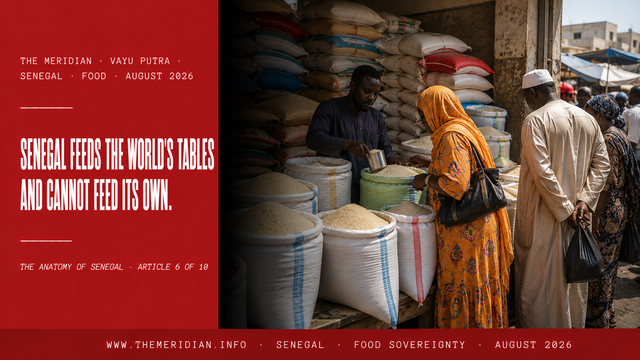
Senegal's Groundnut Basin, covering the regions of Kaolack, Kaffrine, and Fatick, produces some of the finest groundnuts in the world. They are exported to China. They feed European livestock. They supply international cosmetics and food processing industries. Senegal's national dish is thieboudienne: seasoned fish over rice. The rice is imported. Milled rice imports in the 2024-2025 marketing year were 1.55 million tonnes, up 26% in a single year following a poor domestic harvest. The cereal coverage rate is 48%: Senegal produces less than half the cereals it consumes. The government's target under the AgriConnect Compact, launched with the World Bank in February 2026, is to raise rice self-sufficiency to 64% by 2029. That target means Senegal will still import more than a third of its staple food at the end of the most ambitious agricultural reform programme in a generation. The groundnut economy was designed in Paris and London to feed European markets. It has fed them for eighty years. The question the Faye government must answer is whether the oil window provides the capital and the political will to finally reorient the agricultural economy toward feeding Senegalese citizens instead.
The story of Senegalese agriculture is the story of the extraction economy applied to the most fundamental human activity: growing food. France's colonial administration in Senegal systematically developed the groundnut as the primary cash crop because it served French industrial demand, for soap, for oil, for livestock feed, for margarine, for cosmetics. The farmers of the Groundnut Basin were integrated into a production system organised around the export of raw agricultural commodities to European processing industries. The value addition happened in France. The calories stayed in France. The Senegalese farmer received the farm-gate price for raw groundnuts and bought his rice, which he could not grow in sufficient quantity on the land allocated to groundnut production, from import traders who sourced it from India, Vietnam, and Thailand. This arrangement, which dates to the nineteenth century, has not been fundamentally altered in the eighty years since independence. Senegal still exports groundnuts. It still imports rice. The terms of the exchange have shifted. The structure has not.
Agriculture employs approximately 21.6% of Senegal's workforce and accounts for 15.5% of GDP. The primary production sectors are groundnuts, millet, sorghum, maize, cassava, horticulture, and increasingly rice in the Senegal River Valley. Senegal also has one of the richest fishing zones in the world, the Canary Current upwelling system along its Atlantic coast, whose productivity supports both artisanal fishing communities and an industrial fishing sector.
The AgriConnect Senegal Compact, launched with the World Bank Group in February 2026, aims to increase the cereal coverage rate from 48% to 78%, achieve rice self-sufficiency of 64%, and establish 100 community-based agricultural cooperatives by 2029. The current cereal coverage rate of 48% is the most precise single measure of Senegal's food dependency: the country produces less than half the cereals it consumes. Even the most ambitious target under the most ambitious programme delivers only 78% cereal coverage and 64% rice self-sufficiency. More than a third of Senegal's staple food will still cross the border from a foreign country at the end of a decade of reform.
Rice is the central analytical case. Thieboudienne, the national dish of Senegal, is built around rice. It is consumed at least once daily in most urban households. Milled rice imports in the 2024-2025 marketing year were estimated at 1.55 million tonnes, an increase of 26% due to reduced domestic supply from a poor harvest and easier access to Indian broken rice. India extended its export of broken rice to Senegal in February 2025 specifically for food security reasons, having imposed a general ban on broken rice exports since September 2022. The single most consumed food in the country, at the scale its population requires, depends on import decisions made in New Delhi, not in Dakar.
The groundnut economy is the clearest single example of the extraction economy applied to agriculture. The French colonial administration developed groundnut cultivation in the Senegal River basin from the mid-nineteenth century precisely because groundnuts could be processed in French factories into oil, soap, and animal feed. The cultivation was organised around export. The processing, and therefore the value addition, happened in Marseille and Bordeaux. Senegalese farmers received the farm-gate price for raw nuts. French processors sold the oil at the industrial price. The difference was the colonial margin.
After independence, the structure was modified but not inverted. The Industries Chimiques du Sénégal, established in the 1970s, brought some processing to Senegal. Groundnut oil and groundnut cake are now among Senegal's export products alongside raw nuts. But the primary buyer remains international: China has become the dominant importer of Senegalese groundnuts, replacing France as the primary market. The extraction logic has not changed. Raw or minimally processed agricultural commodities leave Senegal. The value-added products, refined oils, processed food ingredients, cosmetics, are manufactured abroad. Senegal receives the commodity price. Others add the value.
The structural consequence of the groundnut economy is the crowding out of food crops. The Groundnut Basin's land allocation is organised around cash crop production for export. That land is not growing rice for domestic consumption. The farmer who grows groundnuts for export earns cash income but must buy rice at the market price. When the market rice price rises, driven by a poor Indian harvest or an Indian export ban, the Senegalese farmer who grew groundnuts instead of rice cannot feed his family without buying the imported rice at whatever price the market sets. Food insecurity in the Groundnut Basin is not a consequence of insufficient land or insufficient rainfall. It is a consequence of land allocation decisions made by colonial agricultural policy and maintained by post-colonial economic inertia.
Senegal's national dish is thieboudienne: seasoned fish over rice. The fish are caught in the world's richest fishing zone. The rice is imported from India. The groundnuts that grow on the land that could grow rice are exported to China. The extraction economy does not require a mining company. It requires only that the agricultural system be organised around someone else's dinner table.
The Faye government has launched the most substantive agricultural reform programme in Senegal's post-independence history. Three specific initiatives deserve examination for what they represent and what they will actually deliver.
The first is the AgriConnect Senegal Compact, launched with the World Bank Group in February 2026. The Compact focuses on three priority value chains: grains, horticulture, and livestock. By 2029, it aims to achieve more than 90% food security at the national level and create 800,000 formal jobs in the agricultural sector, increase the cereal coverage rate from 48% to 78%, and achieve rice self-sufficiency of 64%. The World Bank's financial architecture, combining IDA grants, IFC private sector financing, and MIGA guarantees, represents a sophisticated multilateral partnership. The targets are ambitious. The 64% rice self-sufficiency target, honest in acknowledging that full self-sufficiency is not achievable by 2029, is more credible than previous governments' claims of imminent rice independence.
The second is the 2026 Hot Dry Season campaign in the Senegal River Valley, launched by Agriculture Minister Dr. Mabouba Diagne in May 2026. The Senegal River Valley is the epicentre of the national strategy to revive rice production, forming the basis of the 2025-2030 Rice Programme Contract, the first agricultural campaign of which begins with the hot dry season of 2026. The Senegal River Valley's dry season rice yields of six tonnes per hectare, the highest in the country, make it the most productive agricultural zone for rice and the natural focus of any serious rice self-sufficiency programme.
The third is the 10-year national seed self-sufficiency programme inaugurated in 2025. The focus on climate-resilient, high-yield certified seed varieties addresses the most fundamental constraint on Senegalese agricultural productivity: the quality of the seed stock available to smallholder farmers. Without certified seed, irrigation investment and fertiliser subsidy produce lower yields than they should. The seed programme is the infrastructure layer beneath every other agricultural initiative.
The Faye government cancelled the EU fisheries agreement that allowed European industrial fishing fleets to operate in Senegalese waters in exchange for compensation payments. The cancellation is a genuine sovereignty achievement. The question that follows it is whether Senegal has built the processing infrastructure to capture the value of its fish resources domestically, or whether the fish that European fleets previously processed in European factories will simply be processed by other foreign fleets, or exported raw to Asian markets.
The Canary Current upwelling system makes Senegal's Atlantic coast one of the most productive fishing zones in the world. Artisanal fishing communities, the pirogue fleet, have sustained coastal livelihoods for generations. Industrial processing capacity in Senegal remains limited. Fish is exported raw or minimally processed. The value addition happens elsewhere. The EU agreement's cancellation removes one form of extraction. Without domestic processing investment, it does not create a different one. It creates a gap that the next foreign fleet will fill.
True fisheries sovereignty requires not just the right to fish in Senegalese waters but the industrial capacity to process, package, and sell finished fish products to global markets. That capacity requires investment in cold chain infrastructure, processing facilities, quality certification, and market access that the oil revenues could fund and that the sovereignty agenda has not yet addressed with the specificity the fishing communities require.
The Faye government has done more for Senegalese agricultural policy in two years than any previous administration in a decade. The AgriConnect Compact with the World Bank, the 2025-2030 Rice Programme Contract, the Hot Dry Season campaign, the seed self-sufficiency programme, and the EU fisheries agreement cancellation collectively represent the most serious attempt to restructure Senegal's agricultural economy since independence.
The structural constraint that none of these programmes can fully overcome in the timeframe available is eighty years of land allocation organised around export commodities rather than food crops. The Groundnut Basin did not become the Groundnut Basin because Senegalese farmers chose groundnuts over rice. It became the Groundnut Basin because French colonial agricultural policy systematically developed groundnut cultivation to feed European industries and systematically underdeveloped food crop production for domestic consumption. Reversing eighty years of structural agricultural organisation in ten years, against a backdrop of a fiscal crisis requiring austerity, fertiliser import disruptions, climate variability, and a twelve-year oil window that must simultaneously fund every other dimension of the sovereignty agenda, is the most difficult agricultural policy challenge on the continent.
The 64% rice self-sufficiency target for 2029 is honest. It acknowledges that full food sovereignty is a generation's work, not a government programme's output. What the oil window can fund is the infrastructure layer: irrigation in the Senegal River Valley, cold chain for fish processing, certified seed distribution, cooperative formation, and the market access that converts domestic production into food security rather than subsistence. The question is whether the fiscal constraint created by the hidden debt will leave enough oil revenue for agricultural infrastructure after debt service, IMF programme compliance, and current government spending have taken their share. The answer to that question is the answer to whether Senegal's citizens will eat their own rice or someone else's within a generation.
Add comment
Comments