The Corridor That Carries Other People's Goods
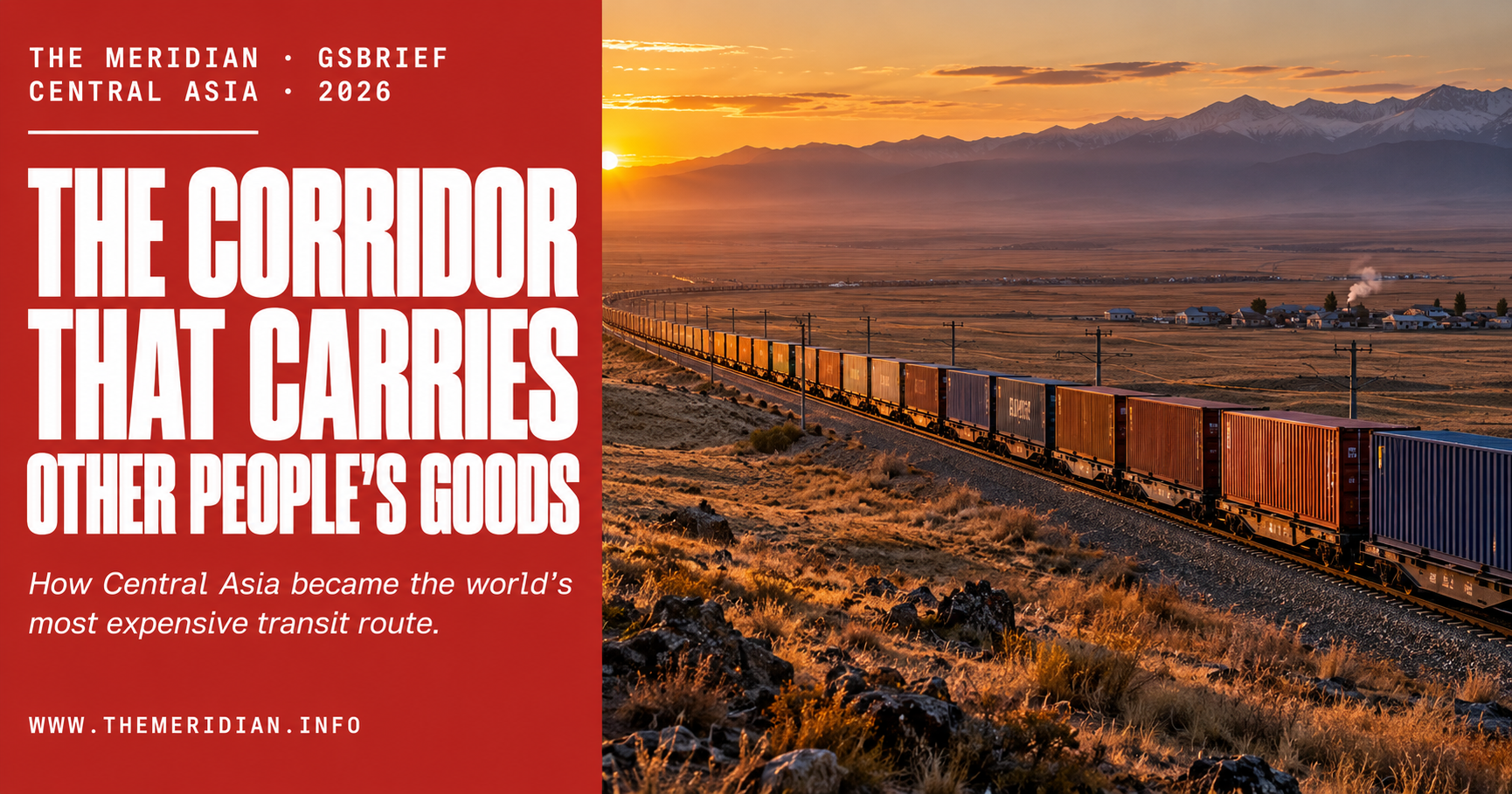
Central Asian governments are celebrating record cargo volumes on the Trans-Caspian trade route. GSBrief applies the Corridor Test and asks the question the press releases do not answer: how much of the value moving through Central Asia actually stays there?
When Kazakhstan's President Kassym-Jomart Tokayev met German President Frank-Walter Steinmeier recently, he arrived with a number. Cargo volumes on the Trans-Caspian International Transport Route -- the Middle Corridor linking China to Europe through Central Asia, the Caspian Sea, Azerbaijan, and Turkey -- had risen 22 percent in the first eight months of 2026. New roads. New railway lines. Shorter distances to the Caspian ports. The corridor, Tokayev said, was open for business.
The 22 percent figure is accurate. It is also the wrong number to celebrate.
The Trans-Caspian route carried 53,574 TEU of container traffic in January through August 2026. Of that volume, approximately 80 percent moved westward. Twenty percent moved east. The corridor is not a two-way trade route. It is a westbound conveyor, and it carries primarily what China manufactures and Europe imports.
Sea freight volumes tell a similar story. According to the Chairman of the Eurasian Economic Commission, sea freight along the Trans-Caspian route exceeded 4.5 million metric tons in the first seven months of 2026 alone -- 60 percent more than the total recorded for all of 2025. The numbers are genuinely impressive. They describe a corridor that is filling up. They do not describe who is filling it, or who earns the margin when it moves.
A further number provides the necessary perspective. Approximately 1.6 billion tons of cargo travels from China to Europe by sea each year. Kazakhstan carries 0.1 percent of it. The Middle Corridor is not yet a meaningful share of the global trade flow it aspires to serve. It is an emerging transit option whose growth, real as it is, sits at the margin of the larger system.
GSBrief applies the same analytical question to every infrastructure story in this region. Transit infrastructure moves value through a country. Productive infrastructure causes value to remain. The question is not whether the Middle Corridor is growing. It is growing. The question is what kind of infrastructure it is.
Samruk-Kazyna, Kazakhstan's sovereign wealth fund, manages the country's largest strategic assets, including Kazakhstan Temir Zholy, the national railway through which all corridor cargo travels, as well as the Aktau and Kuryk ports on the Caspian. Its assets under management reached $88 billion in 2025. The fund has committed planned investment expenditures of 5.3 trillion tenge for 2026 alone, directed at developing energy, transport, digital, and industrial infrastructure.
The state is building the road. The question the documents do not answer -- and which no press release is designed to answer -- is who earns the margin when the goods move across it.
Freight rates are charged. Transit fees are collected. But the processing, the financing, the manufacturing -- the value that transforms raw input into finished product -- these functions are performed elsewhere, before the goods arrive and after they leave. Central Asia provides the geography.
The World Bank identified this problem in its Middle Corridor assessment and forecast it to persist. Westbound flows account for four-fifths of total corridor trade, driven predominantly by Kazakhstan's energy exports and Chinese manufactured goods transiting west. The imbalance is not a temporary inefficiency. It is a structural condition of how the corridor currently functions.
Containers returning east are frequently empty or filled with low-value goods. Railway operators are actively seeking eastbound cargo because the commercial logic of a corridor requires two-way flow. The Chinese side, the World Bank noted, continues to push for more westbound traffic. The infrastructure was built, substantially, to serve that direction of travel.
The Kazakh government's position is not without merit. Transit revenue is revenue. Infrastructure that serves Chinese exports today may anchor Central Asian manufacturing tomorrow, if industrial policy follows the railway. Kazakhstan's own energy and metals exports do travel west on the same corridor. The route reduced dependence on Russian transit infrastructure following 2022, which was a genuine strategic achievement.
The question is whether the investment sequencing matches the ambition. Building the corridor first and hoping industrialisation follows is a strategy. It is not the only strategy.
Samruk-Kazyna's $88 billion in managed assets is sovereign capital. The 5.3 trillion tenge committed for 2026 investment is sovereign capital. Both flow substantially into infrastructure that, at present volumes, primarily serves the transit of another country's exports.
Central Asia built the road. China and Europe use it.
The structural question that the cargo statistics do not address is this: at what point does transit revenue become productive investment in the capacity to manufacture, process, and finance the goods that currently pass through without stopping?
That answer will not be found in the corridor volume figures. It will be found in the industrial investment data, the wage statistics from the logistics zones, the ownership records of the processing facilities, and the composition of what Central Asian countries actually export rather than transit.
GSBrief is examining those documents. The evidence will determine the conclusion.
The full assessment is not in this article.
The public brief establishes the argument. The intelligence product answers the commercial questions: who owns each segment of the corridor's logistics infrastructure, which entities capture the freight margin, what the wage and employment data from the transit zones actually show, and whether Kazakhstan's industrial policy has the sequencing to turn transit revenue into productive capacity.
For commissioned research, sector intelligence, or country briefings: editor@themeridian.info
The 22 percent growth figure is the number governments announce. The 80/20 cargo split is the number that describes the structure. The 0.1 percent of global China-Europe sea freight is the number that describes the scale of what Central Asia has yet to capture. These three numbers, placed next to each other, tell a more complete story than any corridor summit communique.
The Corridor Test does not produce a verdict against the Middle Corridor. It produces a question. Kazakhstan is spending sovereign capital at scale to build infrastructure through which other countries' goods travel. Whether that infrastructure eventually anchors domestic manufacturing, processing, finance, and employment -- or whether it remains a well-funded toll road -- will be determined not by cargo volume statistics but by the industrial policy decisions that either follow the railway or do not.
GSBrief will follow the documents. The evidence will determine the conclusion.
The Trans-Caspian International Transport Route, also known as the Middle Corridor, is a multimodal trade route linking China to Europe through Kazakhstan, the Caspian Sea, Azerbaijan, Georgia, and Turkey. It became a significant alternative to the Northern Route through Russia following the 2022 invasion of Ukraine and the subsequent sanctions on Russian logistics infrastructure.
Cargo volumes on the Middle Corridor rose 22 percent in January to August 2026, driven by infrastructure investment, simplified customs procedures, and growing demand for a Russia-free route between China and European markets. The diversion of freight away from the Northern Route following 2022 sanctions has redirected significant traffic toward the Trans-Caspian alternative.
In the first eight months of 2026, approximately 80 percent of container traffic along the Middle Corridor moved westward and only 20 percent moved eastward. This structural imbalance means containers frequently return to China empty or carrying low-value goods. The World Bank identified this imbalance in its Middle Corridor assessment and forecast it to persist through 2030.
The key logistics infrastructure in Kazakhstan is managed by Samruk-Kazyna, the state sovereign wealth fund, which controls Kazakhstan Temir Zholy, the national railway, as well as the Aktau and Kuryk ports on the Caspian Sea. Samruk-Kazyna's total assets under management reached $88 billion in 2025, and the fund committed 5.3 trillion tenge in planned investment expenditure for 2026 alone.
The Corridor Test is GSBrief's proprietary analytical framework for evaluating infrastructure investment. It asks a single question for every railway, port, highway, or trade route: does the infrastructure merely move somebody else's goods through the country, or does it stimulate manufacturing, processing, finance, employment, and domestic value creation? Transit infrastructure moves value through. Productive infrastructure causes value to remain.
Add comment
Comments