Kazakhstan's Educated Youth Cannot Afford a Business Loan
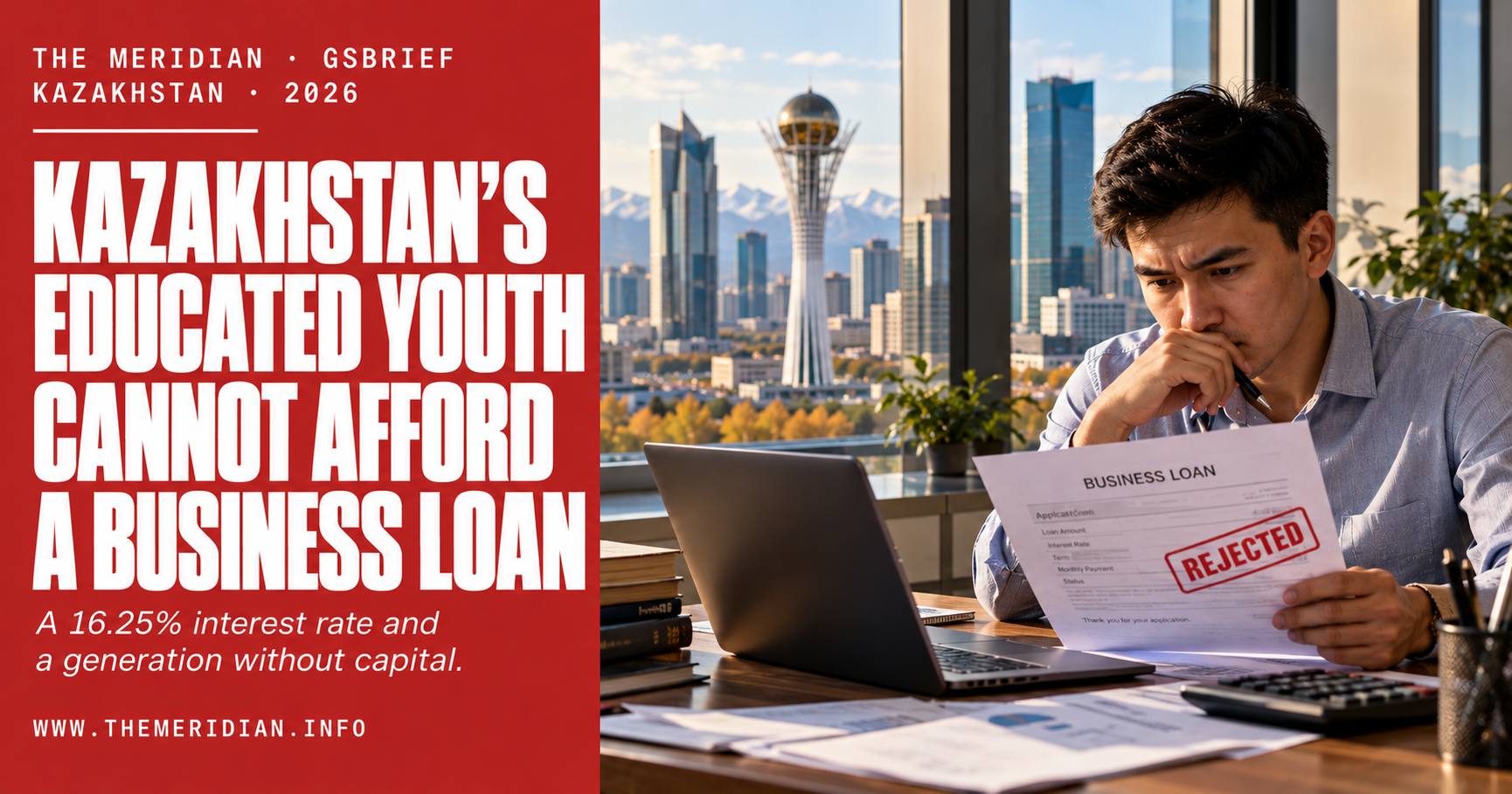
Kazakhstan's central bank cut its base rate to 16.25% in September 2026. The average weighted interest rate on commercial business loans is 22.3%. GSBrief examines the gap between those two numbers and asks who the monetary architecture is actually serving.
On 4 September 2026, the Monetary Policy Committee of the National Bank of Kazakhstan reduced its base rate to 16.25 percent per annum. It was the fourth cut of the year. The rate had opened 2026 at 18 percent, held there through April, then descended in three steps to its current level. In Astana, this was presented as evidence that disinflation is working and that monetary conditions are gradually easing. Both statements are technically accurate.
For a young Kazakhstani trying to open a business, 16.25 percent is not relief. It is a different ceiling.
The National Bank's September press release is precise on the conditions supporting the cut. Annual inflation slowed to 9.8 percent in August -- its eleventh consecutive monthly decline. The tenge has strengthened. Consumer demand has stabilised. The committee noted that its 2027 inflation forecast has been revised upward to 6.5 to 8.5 percent, and that further rate reductions will depend on incoming data. The next decision is scheduled for 23 October 2026.
What the press release does not address is the transmission gap. The base rate is the rate at which commercial banks borrow from the central bank. It is not the rate at which a thirty-year-old entrepreneur in Almaty borrows to open a warehouse. By November 2025 -- before the base rate cuts began in earnest -- the average weighted interest rate on tenge-denominated business loans had reached 22.3 percent. The spread between the policy rate and the commercial lending rate runs at approximately six percentage points. A base rate of 16.25 percent implies commercial business lending at roughly 22 percent or above.
A business borrowing at 22 percent must generate returns above that rate simply to service its debt. Most legitimate small enterprises cannot. A restaurant, a logistics company, a small manufacturer, a technology startup -- none of these generates the kind of margins that make commercial credit at 22 percent viable without either extraordinary luck or an existing asset base to collateralise. The entrepreneurs who can borrow commercially at these rates are, almost by definition, those who least need the loan.
The state has recognised this problem and addressed it in the way states typically do: by creating a parallel system. The Damu Entrepreneurship Development Fund has operated subsidised lending and guarantee programmes for small businesses since 2010. The state places funds in commercial banks at concessional rates, which are then lent to approved SMEs at below-market cost. This is not credit market access. It is a government selection process dressed as a lending facility. The entrepreneurs who receive Damu support were chosen by a committee. The entrepreneurs who did not receive it are paying 22 percent.
Kazakhstan's banks reported a return on equity of 28.4 percent in 2025. The entrepreneurs those banks were not lending to at affordable rates were generating the conditions that made that return possible.
Kazakhstan has invested substantially in its human capital. Literacy rates are among the highest in the post-Soviet space. University enrolment has expanded. The country's HDI ranking places it firmly in the high human development category. The state has spent years building the supply side of a knowledge economy -- educated, capable, young people ready to participate in a productive private sector.
The monetary architecture makes that productive private sector largely inaccessible without either state approval or inherited capital. The Bureau of National Statistics reports a youth unemployment rate of 3.0 percent for Q1 2026 among those aged 15 to 34. This is the headline number. The more revealing figure is the NEET rate: 5.8 percent of young Kazakhstanis are neither employed, nor in education, nor in training. They are not unemployed in the technical ILO sense. They have simply stopped participating in the formal economy -- a rational response to an economy where formal participation does not reliably reward the effort.
The National Bank's position is not without logic. Inflation at 9.8 percent in August, while declining, remains almost double the 5 percent target the bank has committed to reaching by 2028. Real interest rates -- the base rate minus inflation -- are barely positive. Cutting faster risks reigniting inflationary pressure, destabilising the tenge, and importing further inflation through a weaker exchange rate. The bank has cut four times in 2026 and signalled continued caution. High interest rates in a high-inflation environment are not monetary sadism. They are the orthodox response to a genuine inflationary problem.
The harder question is not whether the policy is orthodox. It is whether orthodox monetary policy, designed primarily to satisfy international credit rating benchmarks and control consumer price inflation, can simultaneously serve as the framework within which a domestic entrepreneurial economy develops. Those two objectives are not always compatible.
Kazakhstan's sovereign credit ratings -- Moody's Baa2 stable, Fitch BBB stable -- are maintained in part on the basis of the National Bank's credible anti-inflationary commitment. Tight monetary conditions are a feature of that credibility. The rating is a signal to international capital markets. It is also the policy constraint within which every Kazakhstani entrepreneur operates.
The question the monetary policy documents do not address is distributional: who bears the cost of the rating, and who benefits from it? International bondholders benefit from Kazakhstan's investment-grade status. Banks generating 28.4 percent return on equity benefit from a high-rate environment. The entrepreneur in Almaty who cannot access commercial credit at a viable rate is paying the price of a monetary framework designed partly for an audience that does not live in Kazakhstan.
This article is the opening of a larger analysis. GSBrief and The Meridian Economic Intelligence produce deeper commissioned work for organisations that need more than the public brief.
On Kazakhstan specifically: we can produce country intelligence covering monetary transmission, SME credit market structure, the Damu subsidy architecture, sovereign debt dynamics, and the political economy of the Tokayev administration's economic reform programme.
We also cover Central Asia, Africa, Europe, and the United States across political economy, trade, regulation, and investment intelligence. If a topic in this publication is relevant to your organisation's decisions, we can go deeper.
Contact us: editor@themeridian.info
The National Bank of Kazakhstan has cut its base rate four times in 2026. The trajectory is correct. The pace is defensible given inflation at 9.8 percent. The structural problem is not the pace of the cuts. It is the gap between the policy rate and the rate at which a young Kazakhstani can actually access commercial capital -- a gap that subsidised state programmes paper over without resolving.
The NEET rate of 5.8 percent is not a labour market statistic. It is a credit market statistic. It describes a generation that has calculated, correctly, that the formal economy does not offer them viable entry on commercially accessible terms.
Kazakhstan has invested in human capital and withheld the financial capital that would allow that investment to compound. At some point the question becomes whether the monetary framework is protecting the economy or merely protecting the rating.
The National Bank of Kazakhstan reduced its base rate to 16.25 percent per annum on 4 September 2026, with a corridor of plus or minus one percentage point. This was the fourth cut of 2026. The rate opened the year at 18 percent and has been reduced in steps as annual inflation declined to 9.8 percent in August 2026. The next scheduled rate decision is 23 October 2026.
There is a structural gap between the National Bank's base rate and the rate at which commercial banks actually lend to businesses. By November 2025, the average weighted interest rate on tenge business loans had reached 22.3 percent -- approximately six percentage points above the then-prevailing base rate. Most small enterprises cannot generate returns high enough to service debt at these rates, effectively locking entrepreneurs without existing capital or state programme access out of commercial credit.
Damu is a state development fund that has operated subsidised lending and loan guarantee programmes for Kazakhstani SMEs since 2010. The state places funds in commercial banks at concessional rates, which are then lent to approved businesses at below-market cost. While the programme provides some access to affordable credit, it operates as a government selection process rather than open market credit access, meaning most entrepreneurs are still subject to commercial rates of approximately 22 percent.
The NEET rate -- the proportion of young people aged 15 to 34 who are neither employed, nor in education, nor in training -- stood at 5.8 percent in Q1 2026 according to the Bureau of National Statistics. This is more revealing than the headline youth unemployment rate of 3.0 percent, which only counts those actively seeking work. The NEET figure captures those who have effectively withdrawn from formal economic participation, a response that is rational when formal entry carries high barriers and low returns.
Kazakhstan's National Bank maintains tight monetary conditions primarily to control inflation and protect the tenge exchange rate. Annual inflation peaked at 12.9 percent in September 2025 and has declined to 9.8 percent in August 2026 -- still well above the 5 percent target the bank aims to reach by 2028. High rates also support Kazakhstan's investment-grade sovereign credit ratings (Moody's Baa2, Fitch BBB), which are partly contingent on the central bank's anti-inflationary credibility. The cost is borne disproportionately by domestic entrepreneurs who cannot access affordable commercial capital.
Add comment
Comments