Asia Is Riding the AI Wave. Not Everyone Is on the Same Board.
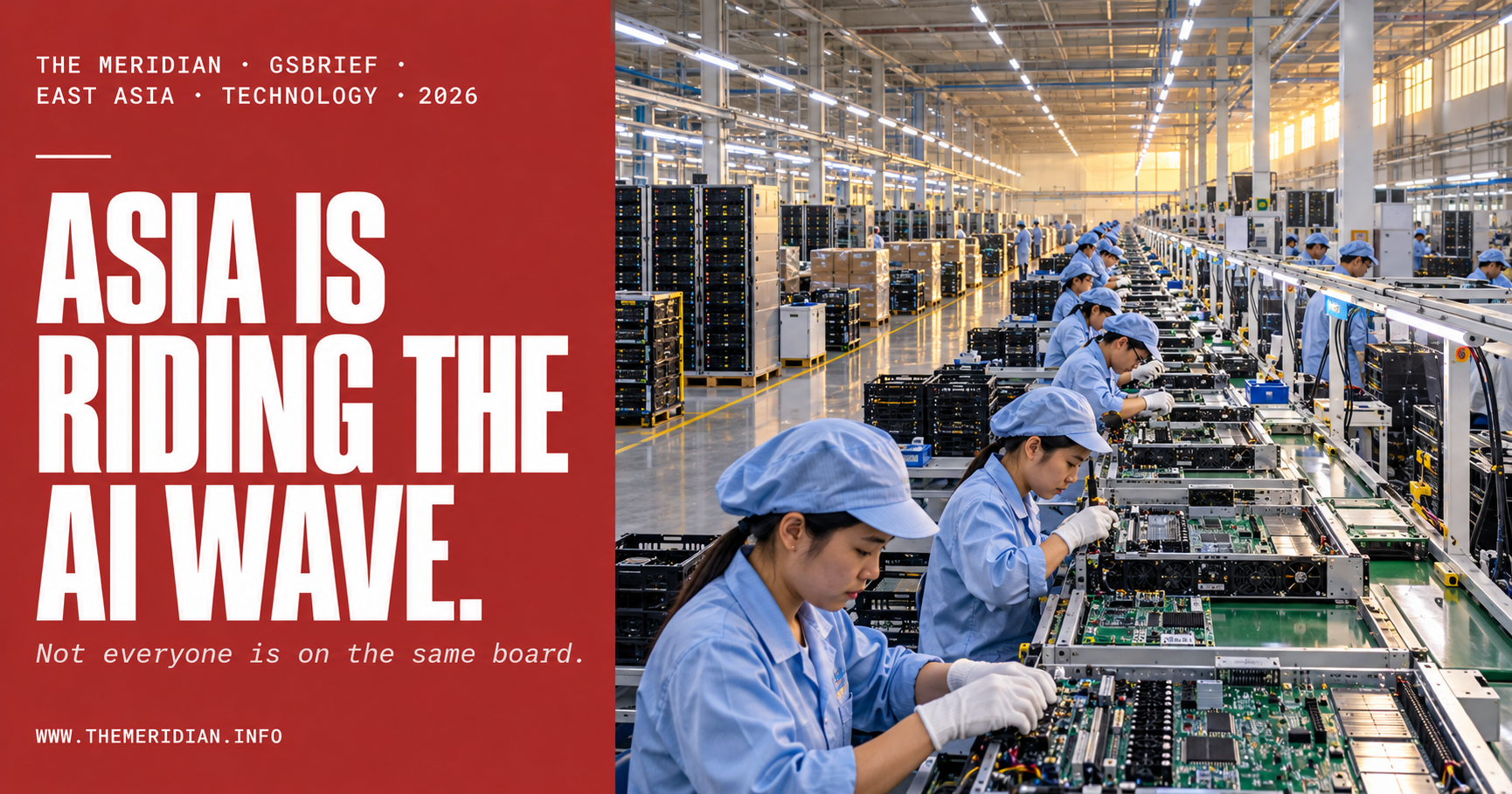
Six East Asian economies exported $1.4 trillion in AI-related goods in the twelve months to April 2026. AI products drove more than 70% of export growth in Malaysia, Vietnam, Thailand and the Philippines. The World Bank's October 2026 Economic Update says regional growth without AI goods is weak or negative. Pacific Island economies grew at 2.2%. The wave is real. The board is not shared.
Vietnam's economy grew 7.4% in 2026, the largest upward revision in the region. Malaysia grew 5.1%. Thailand grew 2.0%. Pacific Island economies grew 2.2%, half a percentage point below their previous forecast, weighed down by energy costs they cannot absorb. The World Bank's October 2026 East Asia and Pacific Economic Update carries all of these numbers in the same document. What it does not do is describe them as part of the same story. They are not. The countries growing fastest are the ones plugged into the global AI hardware supply chain. The ones growing slowest are the ones that are not, and whose energy costs are rising precisely because the data centres, semiconductor plants and electronics factories elsewhere in the region are consuming more power.
The headline number in the World Bank report is $1.4 trillion. That is the value of AI-related goods exported by six economies -- China, Indonesia, Malaysia, the Philippines, Thailand and Vietnam -- in the twelve months to April 2026. The United States alone imported $739 billion of AI-related goods in that period, one third of it from East Asia and the Pacific. Gross AI-related capital expenditure reached 6% of American GDP. Of the $2.9 trillion in AI infrastructure investment planned globally for 2025 to 2028, $800 billion is expected to be financed through private credit. AI-related lending accounted for 34% of all private credit activity in 2025, up from an 18% average in the prior five years, according to the Financial Stability Board.
The specifics of which countries are benefiting reveal the precise nature of the wave. In Malaysia, AI-related goods contributed 51.5 percentage points of export growth against 19.7 percentage points from everything else. In Vietnam, 31.5 points against 6.7. In Thailand, 26.5 against 7.9. In the Philippines, 17.2 against negative 0.1 -- meaning that without AI-related goods, Philippine export growth was essentially flat. The composition of those exports matters. Assembled equipment -- computers, servers, routers -- made up 69% of Thailand's AI-related exports and 60% of Vietnam's. These are not AI companies. They are precision assembly economies plugged into a global hardware value chain whose final customers are in the United States and Europe.
Indonesia is the outlier in this picture and deserves attention. The region's largest economy by population -- 280 million people -- contributed just 0.5 percentage points of AI-related export growth against 4.6 points from conventional goods. Indonesia is not plugged into the semiconductor and electronics assembly chain in the way Malaysia, Vietnam and Thailand are. Its export growth comes from commodities and manufactured goods. Whether Indonesia's absence from the AI supply chain is a structural problem or a missed positioning decision is one of the more consequential political economy questions in the region.
Pacific Island economies are forecast to grow 2.2% in 2026, half a percentage point below the previous forecast. The drag is energy costs. These are small open economies with limited fiscal space, no semiconductor industry, no electronics assembly capacity, and no connection to the AI hardware supply chain. They are experiencing the energy cost consequence of the AI boom -- more electricity demand globally, higher fuel prices, higher import bills -- without any of the export revenue that the boom is generating elsewhere in the region. The World Bank notes that a sustained 50% rise in fuel prices could cut household income by 3 to 4% across the Pacific, with the poor and small businesses identified as the most exposed.
The adoption picture is similarly divided. Only 13% of jobs in the East Asia and Pacific region involve the kind of complex judgment tasks where AI is currently most useful as a productivity tool, against 39% in advanced economies. Between 13% and 17% of multinational subsidiaries in China and Thailand currently use AI -- roughly one third the rate seen in industrialised countries. The World Bank identifies digital connectivity gaps and skills shortages as the primary barriers. It recommends a focus on what it calls Small AI: adapting existing tools to local conditions rather than attempting to build large language models or costly computing infrastructure from scratch. The recommendation is sensible. It also acknowledges that the countries with the most to gain from AI adoption are precisely the countries least equipped to implement it.
Indonesia has 280 million people and 0.5 percentage points of AI-related export growth. Vietnam has 99 million people and 31.5 percentage points. The difference is not population. It is supply chain position.
The Corridor Test asks whether infrastructure and trade flows build productive capacity inside an economy or move value through it to external beneficiaries. Applied to East Asia's AI boom, the question becomes sharper: Malaysia, Vietnam and Thailand are assembling AI hardware -- computers, servers, routers -- for American and European technology companies. The assembly work keeps employment and some value-added inside those economies. But 69% of Thailand's AI-related exports and 60% of Vietnam's are assembled equipment. The design, the semiconductors, the software, the intellectual property, and the final commercial use are external. What stays in the country is the assembly margin, the employment, and the infrastructure investment that the foreign companies bring. That is a substantial gain. It is not the same gain as owning the technology.
The World Bank report notes that South Korea's two largest semiconductor companies accounted for 43% of the entire KOSPI stock market valuation at the end of April 2026. That is what it looks like when a country owns the technology rather than assembling it. South Korea designed and manufactures the chips. Malaysia and Vietnam assemble the products those chips go into. Both are on the AI wave. They are not on the same board.
The World Bank's October report is not pessimistic about the AI boom. Its growth forecasts for the region have been revised upward. But it names the tail risk with precision. A reversal in global AI activity would, in its words, remove a key pillar supporting growth in trade, investment and financial valuations across the region. The mechanism is straightforward: $800 billion of the planned $2.9 trillion in AI capital expenditure for 2025 to 2028 is expected to be financed through private credit. AI-related lending has risen from 18% of private credit activity to 34% in a single year. The Bank notes that a correction could mean investment ran ahead of realised demand -- not that the technology itself failed. The consequence for Malaysia, Vietnam and Thailand, whose export growth is now structurally dependent on that investment continuing, would be severe.
The public article identifies the structure. The intelligence product maps your exposure. GSBrief and The Meridian Economic Intelligence produce commissioned research for organisations evaluating AI supply chain positioning in East and Southeast Asia, exposure to the AI capex cycle, and the political economy of digital industrialisation in Vietnam, Malaysia, Thailand, Indonesia and the Pacific.
We assess which economies are building productive AI capacity versus assembly dependency, model the consequences of an AI investment correction on specific supply chains, and analyse the gap between AI export performance and domestic AI adoption rates.
Contact us: editor@themeridian.info
The $1.4 trillion in AI-related goods exported from six East Asian economies is a genuine economic achievement. The employment, investment and growth it has generated in Vietnam, Malaysia and Thailand is real and significant. The World Bank's upward growth revisions reflect something that has actually happened, not a projection. None of that is in dispute.
What the Corridor Test identifies is the structural question underneath the achievement. Thailand exports servers and computers whose intellectual property, semiconductors and commercial applications belong to American and European technology companies. Vietnam exports assembled electronics whose design, software and end use are external. The assembly margin stays in the country. The technology rent goes elsewhere. South Korea, which owns the chips rather than assembling the products those chips go into, accounts for 43% of its stock market through two semiconductor companies alone. That is the difference between being in the supply chain and owning part of the technology.
The World Bank's warning about private credit is the structural risk the growth figures do not show. $800 billion of planned AI infrastructure investment financed through credit, against a backdrop where AI-related lending has already doubled as a share of private credit activity in one year, is a concentration risk that sits directly underneath the export models of Malaysia, Vietnam and Thailand. The Pacific Island economies are already experiencing the energy cost of the AI boom without the export revenue. A correction in AI capex would spread that experience further up the regional income ladder. The board is crowded at the top. The wave has no floor.
Six East Asian and Pacific economies -- China, Indonesia, Malaysia, the Philippines, Thailand and Vietnam -- exported $1.4 trillion of AI-related goods in the twelve months to April 2026, according to the World Bank's October 2026 East Asia and Pacific Economic Update. The United States imported $739 billion of AI-related goods in that same period, with one third sourced from East Asia and the Pacific. AI-related products drove more than 70% of export growth in Malaysia, the Philippines, Thailand and Vietnam.
Malaysia led with 51.5 percentage points of export growth from AI-related goods against 19.7 from all other goods combined. Vietnam contributed 31.5 points from AI goods, Thailand 26.5 and the Philippines 17.2 -- with the Philippines recording essentially flat non-AI export growth (-0.1 percentage points). These economies are primarily exporting assembled electronics: 69% of Thailand's AI-related exports and 60% of Vietnam's are assembled computers, servers and routers. Indonesia, the region's largest economy by population, contributed just 0.5 percentage points of AI-related export growth.
The World Bank's October 2026 report warns that a reversal in global AI activity would remove a key pillar supporting growth across the region. Of the $2.9 trillion in AI capital expenditure planned for 2025 to 2028, $800 billion is expected to be financed through private credit. AI-related lending rose to 34% of all private credit activity in 2025, up from an 18% average over the previous five years. A correction could follow if investment ran ahead of realised demand. Economies whose export growth is now structurally dependent on AI hardware demand -- particularly Malaysia, Vietnam and Thailand -- would be most exposed.
Pacific Island economies have no connection to the AI hardware supply chain and are forecast to grow at 2.2% in 2026, half a percentage point below previous forecasts. Higher global energy costs -- partly driven by the electricity demands of the AI industry -- are weighing on small open economies with limited fiscal buffers. The World Bank estimates that a sustained 50% rise in fuel prices could cut household income by 3 to 4% across Pacific Island economies, with the poor and small businesses most exposed. These economies are absorbing the energy cost of the AI boom without receiving any of the export revenue it is generating elsewhere in the region.
Add comment
Comments