Bangladesh Is Growing at 5 Percent. Its Banks Are Failing. Its Poorest Have No Account.
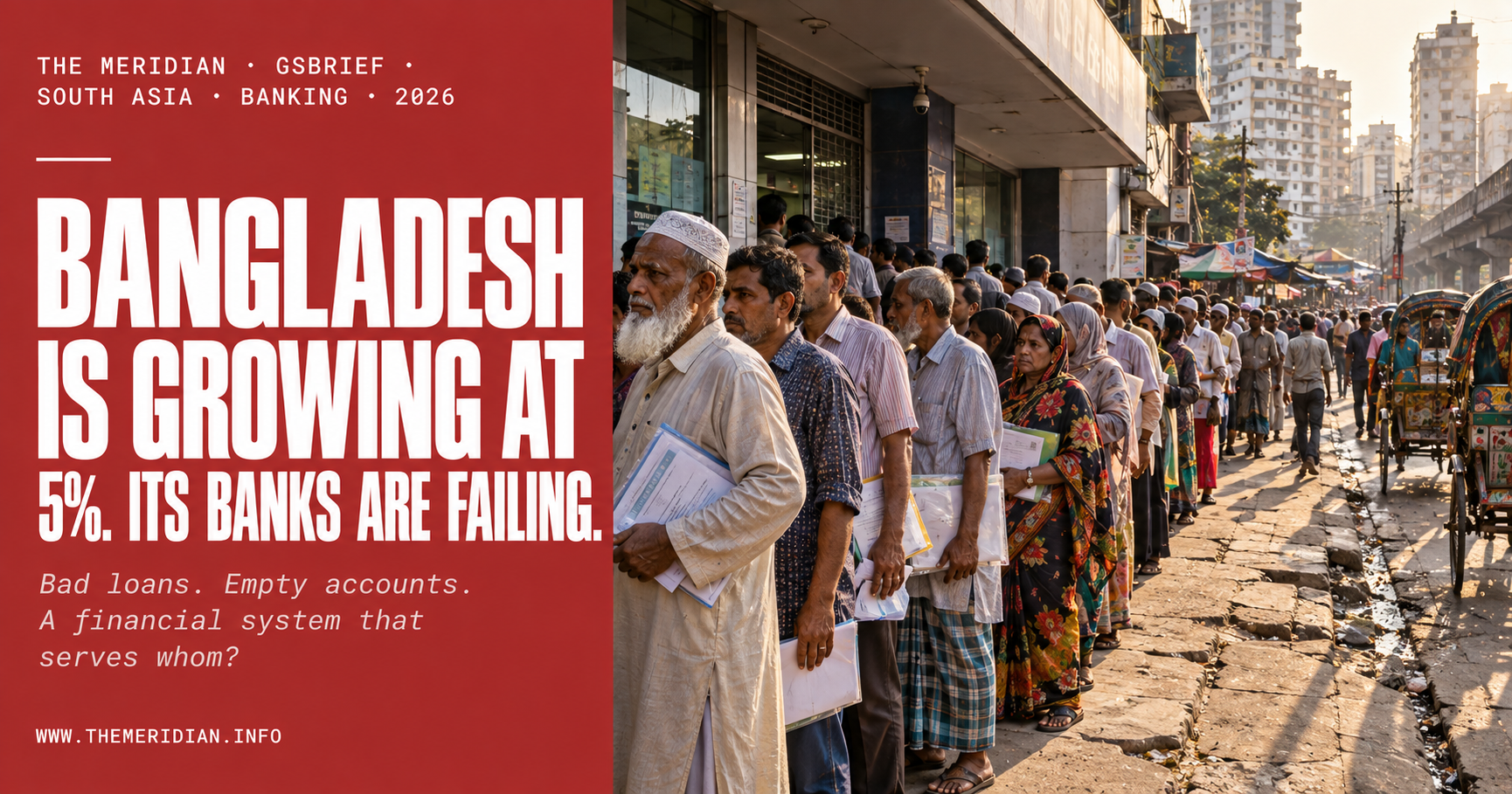
Bangladesh's IMF programme projects growth of nearly 5% for FY26. Its banking sector carries Tk4.2 lakh crore in non-performing loans, 24% of all credit outstanding. State-owned Janata Bank has an NPL ratio of 72%. The government has recapitalised its state banks in 13 of the past 15 years. Fewer than 38% of women hold a formal bank deposit account. GSBrief asks what a growth number means when the financial system it depends on is carrying those numbers underneath it.
Bangladesh's garment sector employs more than four million workers and generates roughly 84% of the country's export earnings. That sector depends on trade finance, letters of credit and working capital loans provided by commercial banks. In the first quarter of 2025 alone, the total stock of non-performing loans across the banking system rose by Tk74,570 crore, reaching Tk4.20 lakh crore. One in four taka lent in Bangladesh is now classified as troubled. That is not a rounding error at the edge of an otherwise healthy system. It is the system.
The timing matters as much as the number. Under the previous government, official NPL figures for end-June 2024 stood at Tk2.11 lakh crore, or 12.56% of total loans. After the political transition in August 2024, Bangladesh Bank applied stricter loan classification rules and extended inspections to accounts that had previously been shown as regular. By March 2025, the stock had nearly doubled. The implication of that doubling is not that the banking crisis was caused by the transition. It is that the crisis was already there, and that official figures had obscured it for years. The new numbers do not represent a deterioration. They represent a disclosure.
The worst of the damage sits in the state-owned banks. Among the six state commercial banks, average NPL ratios reached 48% of disbursed loans by early 2025. Janata Bank stood at 72%, with a capital shortfall of Tk52,890 crore -- a single institution whose deficit exceeds the annual budget of many sub-Saharan economies. The government has responded to state bank crises by injecting capital. Between 2009 and 2024 it injected more than Tk25,000 crore into state-owned lenders, recapitalising them in 13 of the past 15 years. Each injection extended the life of the institution without resolving the underlying conditions that made the injection necessary. The IMF, in its November 2025 mission statement, recommended against continued reliance on "prolonged forbearance" and called for legally robust restructuring options with identified funding sources. That recommendation has been made before, by other institutions, in other countries, with known results when it is not followed.
The crisis in the formal banking sector is not simply a story about bad loans. It is inseparable from a second structural fact: the banking system has never successfully reached most of the population it nominally exists to serve. As of December 2024, fewer than 38% of women in Bangladesh held a bank deposit account. Government social safety net programmes have opened accounts for recipients, but a large proportion of those accounts show high dormancy, used once to receive a transfer and then left inactive. Low-income earners, smallholder farmers and micro-entrepreneurs face persistent difficulty accessing formal credit. Remote areas lack the branch infrastructure that would make access physically possible. Bangladesh has a large, successful mobile financial services sector -- transactions through mobile platforms rose 32% in 2024 -- but mobile money and formal credit are not the same thing. A bKash account allows a garment worker to receive her wages. It does not allow her to borrow against them at a rate that does not extract a significant share of her earnings in interest.
"Between 2009 and 2024, the government recapitalised its state-owned banks in 13 of the past 15 years. Each injection extended the life of the institution without resolving what made the injection necessary."
The IMF programme, approved in January 2023 and extended through subsequent reviews, has set out a clear sequence of conditions: stricter NPL classification, asset quality reviews extended to all systemically important and state-owned banks, risk-based supervision replacing checklist inspections, and a new framework for recovering bad loans without prolonged forbearance. The fifth review, completed in late 2025, noted that implementation of continuous risk-based monitoring was a key programme condition and had been scheduled for January 2026. Whether that timeline has held is a question of enforcement, not design. The IMF itself projects growth of nearly 5% for FY26 if the reform path is followed. Without it, one projection puts growth as low as 3.5% in FY27. The gap between those two numbers is a measure of what is actually at stake in the implementation of banking reform.
Bangladesh's banking system illustrates what the Corridor Test looks like when applied not to physical infrastructure but to financial architecture. The question is not whether the banks are open. Most of them are. The question is what value moves through them, and for whom. An institution with a 72% NPL ratio is not intermediating savings into productive investment. It is recycling bad debt within a system that the state periodically refinances, creating no lasting accumulation of productive capital and reaching none of the households it is supposed to serve. A garment worker whose employer depends on letters of credit from a bank with a near-empty capital buffer is exposed to that bank's fragility in ways she cannot see or insure against. Growth projections sit at the top of the system. The consequences of the system's failures settle at the bottom.
This piece is part of GSBrief's ongoing South Asia banking and financial inclusion coverage. The Meridian Economic Intelligence tier produces institutional briefs on financial sector fragility, IMF programme compliance, and capital adequacy across Global South banking systems. Commissioning enquiries: editor@themeridian.info
Bangladesh's headline growth projection is real in the sense that it is produced by a real economy: garments, remittances, agriculture, construction. It is fragile in the sense that one of the core mechanisms through which a growing economy accumulates and allocates capital -- its banking sector -- is carrying a level of impairment that has no plausible near-term resolution without sustained political will and external enforcement.
The recapitalisation cycle is the tell. An institution that requires state capital in 13 of 15 years is not a bank in any operationally meaningful sense. It is a liability managed by the treasury under the label of a bank. The IMF's programme provides the diagnostic and the conditions. It does not provide the will to apply them against entrenched interests whose access to state bank credit has depended on the system remaining exactly as it is.
The financial inclusion gap compounds this. A financial system that does not reach 62% of its women, that has dormant accounts where active ones were reported, and that offers mobile wallets as a substitute for credit is not a system producing broad-based development. It is a system producing a growth average that conceals a distribution.
Bangladesh's state banks have been recapitalised repeatedly, restructured nominally and survived politically because the interests that benefit from their continued dysfunction have, until now, been more powerful than the conditions attached to the capital that keeps them operating. The IMF programme attaches conditions to disbursements. Disbursements continue. The question GSBrief leaves open is this: if an institution has been recapitalised in 13 of the past 15 years without becoming solvent, at what point does continued recapitalisation become an instrument not of reform but of preservation?
GSBrief · The Global South BriefPublished by The Meridian (themeridian.info). All rights reserved. Reproduction of this article in whole or in part without written permission is prohibited. For licensing and syndication enquiries: editor@themeridian.info
As of the first quarter of 2025, total non-performing loans reached Tk4.20 lakh crore, equivalent to 24.13% of all outstanding loans. This is nearly double the ratio at end-June 2024, following stricter classification rules applied after the political transition. State-owned banks are worst affected, with average NPL ratios of 45.79% and Janata Bank at 72%.
The government injected more than Tk25,000 crore into state-owned banks between 2009 and 2024, recapitalising them in 13 of the past 15 years. Each injection sustained the institutions without resolving the governance failures, political interference in lending and concentration of credit in connected borrowers that generate the bad loans. The IMF has explicitly warned against continued reliance on this forbearance cycle.
Bangladesh's IMF programme, running since January 2023, attaches banking sector conditions including stricter NPL classification, asset quality reviews and a shift to continuous risk-based supervision. The fifth review in late 2025 projected growth of nearly 5% for FY26 if reforms are implemented, and as low as 3.5% in FY27 without them.
As of December 2024, fewer than 38% of women in Bangladesh held a formal bank deposit account. Many accounts opened under social safety net programmes show high dormancy. Mobile financial services have expanded payment access but do not substitute for affordable formal credit, which remains inaccessible to most low-income earners, smallholder farmers and micro-entrepreneurs.
Add comment
Comments