Africa Is Growing at 4.3 Percent. Half Its People Are Still Poor. It Has 0.6% of Global AI Infrastructure.
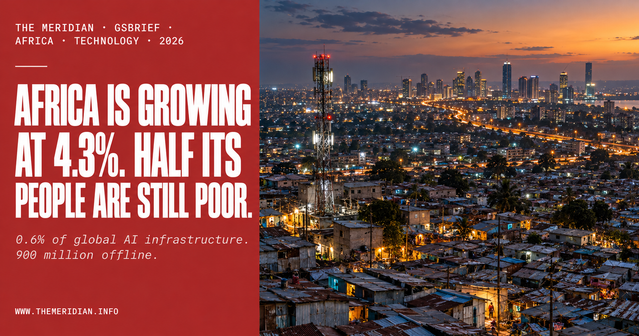
Sub-Saharan Africa is projected to grow at 4.3% in 2026, the strongest rate in years and an upgrade from the April forecast. Per-capita growth will reach 1.8%. The poverty rate will remain at 47.8%. Africa holds 0.6% of global data-centre capacity. Only 5% of those centres are AI-ready. 900 million people are offline. The World Bank's October 2026 Africa Economic Update maps an economy that is growing, and a population that is not catching up.
The number that matters in the World Bank's October 2026 Africa Economic Update is not 4.3%. It is 1.8%. Sub-Saharan Africa's population is growing faster than its per-capita income. At 1.8% per-capita growth, the $3-a-day poverty rate falls from 48.5% to 47.8% by 2026. In absolute terms, the number of people living below that line is still rising, because the population expanding beneath the rate is larger than the improvement in the rate itself. The World Bank projects this continuing through 2027 and 2028. A region can have an improving growth outlook and a worsening poverty headcount at the same time. Africa is demonstrating that it can.
The headline upgrade is real. Growth forecasts were raised for nearly three-quarters of Sub-Saharan African countries in this round of projections, including Angola, Ethiopia, Nigeria and Zambia. The aggregate rate rises from 4.1% in 2025 to 4.3% in 2026. Resource-rich economies are benefiting from stronger external demand and, in the case of oil producers, from continued production gains. None of this is to be dismissed. But the World Bank's own framing is pointed: per-capita growth is too slow to substantially reduce extreme poverty or generate enough jobs for a labour force that is expanding at a pace the existing economy cannot absorb. Bilateral aid to the region fell by roughly a quarter in 2025. High debt-service costs continue to limit what governments can spend on health, education and infrastructure. The fiscal space to close the gap is not there.
The report's second argument is about AI, and the arithmetic here is more striking than the growth figures. Africa has 18% of the world's population and 0.6% of global data-centre capacity. Only 5% of those data centres are described as AI-ready. Nine hundred million Africans remain without internet access. Among the 19 countries for which the World Bank has household survey data, only 12% of people in the poorest income quintile have both a mobile phone and access to grid electricity, against 54% in the richest quintile. These are not abstract infrastructure statistics. They are the conditions under which AI adoption either happens or does not. Generative AI adoption among working-age people in early 2026 ranged from 7.2% in Rwanda to 23.1% in South Africa. Sixteen of the countries surveyed were below 10%.
The Corridor Test asks whether infrastructure keeps value in the country or merely facilitates the transit of somebody else's product. Applied to digital infrastructure, the question becomes: who owns the data centres, who trains the models, and who collects the economic surplus from AI adoption? Africa's position in the current AI investment cycle is primarily as a market for AI-enabled services and a source of training data, not as a producer of AI systems. The 0.6% data-centre share is partly a reflection of this. Where AI investment is entering the continent -- concentrated, per the World Bank, in Kenya, Nigeria and South Africa -- it is arriving largely as hyperscaler deployments and mobile-platform integrations rather than as sovereign computing infrastructure. The distinction matters for the same reason it matters in semiconductor assembly: participation in the supply chain is not the same as capturing a share of the value the supply chain generates.
"Africa has 18% of the world's population and 0.6% of global data-centre capacity. Only 5% of those centres are AI-ready. The continent is being positioned as a market, not a producer."
The World Bank's own position on this is measured. The report argues that Africa's low exposure to automation risk -- 2.6% of jobs exposed to near-term automation, against 14.2% in high-income economies -- is partly structural protection. The labour-intensive nature of African economies means AI displacement will arrive later and more slowly than in richer countries. The same structural condition also means that the 15.2% of African jobs with AI-augmentation potential could be significant if connectivity and tools reach those workers. The caveat is embedded in the sentence: if. Nigeria's GitHub developer base has grown tenfold since 2020. That is a real signal. It is also one country's developer community measured against a baseline of near-absence. The gap between that signal and a continental AI economy is not closed by the signal alone.
Bilateral aid to Sub-Saharan Africa fell by roughly a quarter in 2025. Median government debt stands at around 57% of GDP. Debt service has consumed a stable share of output since 2021, but that stability masks the constraint: money spent on external debt service is money not spent on electricity infrastructure, broadband connectivity, or the technical education that would allow African workers to use AI tools rather than be replaced by them where replacement eventually arrives. The World Bank frames AI adoption as an opportunity to leapfrog infrastructure constraints, in the way mobile phones allowed financial inclusion without fixed-line banking. The analogy is imperfect. Mobile money required a handset, a SIM card and a signal. AI adoption requires reliable electricity, sufficient bandwidth and a device capable of running or accessing inference systems. The infrastructure baseline for the second leap is higher than for the first.
This piece is part of GSBrief's Africa political economy coverage. The Meridian Economic Intelligence tier produces institutional briefs on African growth dynamics, AI infrastructure investment flows, and fiscal capacity across Sub-Saharan sovereign issuers. Commissioning enquiries: editor@themeridian.info
The World Bank's October 2026 Africa Economic Update is not a pessimistic document. It upgrades growth forecasts for three-quarters of the region's countries. It identifies a genuine AI augmentation opportunity in the 15.2% of jobs with potential for productivity enhancement. It points to the tenfold growth of Nigeria's developer community as evidence that human capital is forming in the right direction.
What the document also contains, without softening it, is this: Africa has 18% of the world's population and 0.6% of its AI infrastructure. Per-capita income is growing at 1.8% against a population expanding faster than that. Nearly half the region's people live below $3 a day, and the absolute number of people in that condition is still rising even as the rate falls. Aid is down by a quarter. Fiscal space is constrained by debt service.
The opportunity framing and the constraint data sit in the same document. GSBrief's reading is that the constraints are currently stronger than the opportunities, not because the opportunities are illusory, but because the infrastructure preconditions for realising them are not being built at the pace required. A continent that hosts 0.6% of global data-centre capacity cannot capture 18% of the value a data-intensive technology generates. That arithmetic does not change because the growth headline improved.
The World Bank suggests that AI could allow Africa to leapfrog infrastructure constraints the way mobile phones leapfrogged fixed-line banking. The mobile money analogy holds only if the infrastructure baseline for AI adoption is comparable to the baseline for mobile money adoption. It is not. The question GSBrief leaves open is this: if the precondition for AI adoption is reliable electricity and broadband connectivity, and the precondition for both is fiscal space that debt service is currently consuming, who exactly is supposed to build the infrastructure through which the leapfrog is meant to occur?
GSBrief · The Global South BriefPublished by The Meridian (themeridian.info). All rights reserved. Reproduction of this article in whole or in part without written permission is prohibited. For licensing and syndication enquiries: editor@themeridian.info
Because per-capita growth is only 1.8% while Africa's population is expanding faster than its income. At that rate, the poverty rate falls marginally from 48.5% to 47.8%, but the absolute number of people below $3 a day is still rising. The World Bank projects this continuing through 2027 and 2028.
Africa holds 0.6% of global data-centre capacity despite 18% of the world's population. Only 5% of African data centres are AI-ready. 900 million Africans remain offline. Generative AI adoption among working-age adults ranged from 7.2% in Rwanda to 23.1% in South Africa in early 2026, with 16 countries below 10%.
Less immediately than high-income countries. Only 2.6% of African jobs face near-term automation risk, against 14.2% in high-income economies. But 15.2% of African jobs have AI-augmentation potential -- productivity gains that depend on workers having reliable electricity, connectivity and appropriate devices.
Fiscal space is constrained. Debt service absorbs a stable but significant share of government revenue. Bilateral aid to Sub-Saharan Africa fell by roughly a quarter in 2025. Median government debt stands at around 57% of GDP. The resources needed to build AI-ready infrastructure are the same resources currently committed elsewhere.
Kenya, Nigeria and South Africa lead, per the World Bank. Nigeria's GitHub developer base has grown tenfold since 2020. South Africa reports 23.1% generative AI adoption among working-age adults. Rwanda is at 7.2%. Sixteen surveyed countries were below 10%.
Add comment
Comments