Expat vs Migrant: The Vocabulary of Inequality and What Your Passport Colour Determines About Your Rights
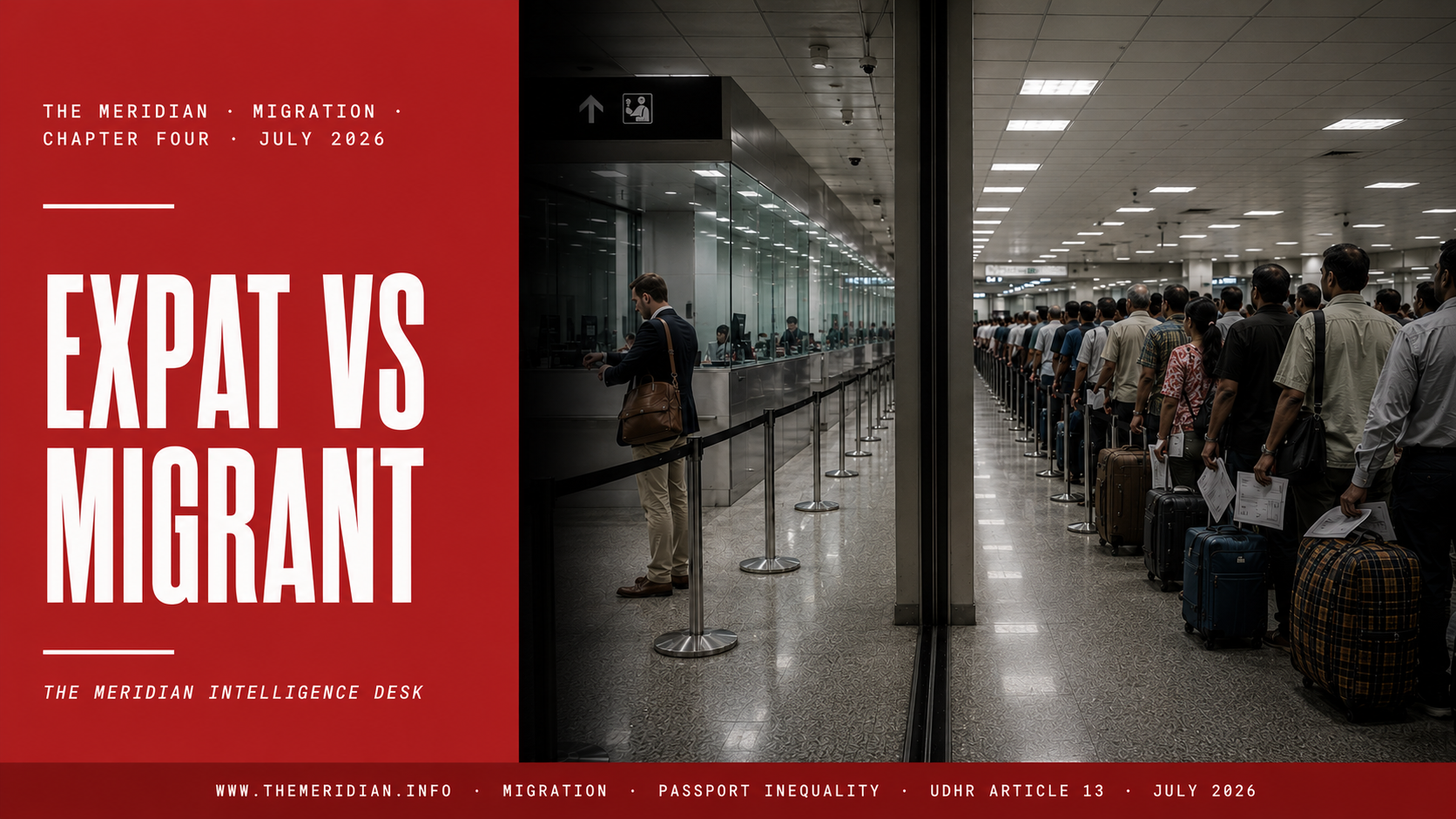
A British accountant relocates to Dubai and is called an expat. A Bangladeshi labourer relocates to Mauritius and is called a migrant. Both have crossed an international border in search of a better income. Both are exercising the right of movement that Article 13 of the UDHR guarantees to everyone, without qualification. The law does not distinguish between them. The vocabulary does -- and the vocabulary, The Meridian argues, is doing legal work that the law itself was never permitted to do.
Words are not neutral. This is the founding insight of every serious study of language and power, and nowhere is it demonstrated more clearly than in the vocabulary that the world has built around international human movement. There is no formal legal distinction between an expat and a migrant. No treaty defines the terms differently. No statute attaches different rights to one category than the other. And yet the distinction operates with such consistency, across so many countries and so many decades, that it has become one of the most efficient mechanisms ever devised for communicating, without ever stating it explicitly, whose presence in a country is welcome and whose is merely tolerated.
The pattern is not subtle once it is named. Western professionals working abroad -- in finance, in technology, in education, in diplomacy -- are overwhelmingly described as expatriates, or expats: a term that carries connotations of choice, of temporary adventure, of skill transferred voluntarily to a grateful host economy. South Asian, African, and Southeast Asian workers performing manual, domestic, or low-wage labour abroad are overwhelmingly described as migrants or migrant workers: a term that carries connotations of necessity, of economic desperation, of a presence that is functional rather than welcomed. The same act -- crossing a border to work -- receives two entirely different vocabularies, and those vocabularies do real work in shaping how each population is treated by the law, by the media, and by the societies that host them.
Article 13 of the UDHR states that everyone has the right to freedom of movement and residence within the borders of each state, and that everyone has the right to leave any country, including their own. This is one of the UDHR’s most unconditional articles. It does not distinguish between movement for professional advancement and movement for economic survival. It does not grant a different quality of right to a person moving from a wealthy country to a wealthy country than to a person moving from a poor country to a wealthy one, or to a poor country. The right to leave, in the UDHR’s own language, belongs to everyone.
What Article 13 does not guarantee -- and this is the critical limitation that the architecture of international migration law has built around the right to leave -- is the right to enter any particular country, or the right to remain there on terms equal to that country’s own citizens. States retain sovereign control over who may enter and on what conditions, and international law has never seriously challenged that sovereignty. The right to leave is universal. The right to arrive, on terms that respect dignity and equality, is not. It is this second right -- unprotected by any binding international instrument -- that the expat/migrant vocabulary distinction operates to allocate unequally, without any state ever having to admit that it is doing so.
The UDHR guarantees the right to leave. It does not guarantee the right to arrive with dignity. The vocabulary that society has built fills that gap -- and it fills it according to passport, skin colour, and class, not according to any principle the UDHR would recognise.
The pattern is most visible in the Gulf states, where the contrast operates within a single labour market. A British, American, or European professional working in Dubai, Doha, or Abu Dhabi is described, in virtually every piece of media coverage, corporate communication, and casual conversation, as an expat. A Filipino domestic worker, a Bangladeshi construction labourer, or a Nepali security guard performing work in the same cities, often for the same employers or their household staff, is described as a migrant worker. Both are, in strict legal terms, foreign nationals working under a sponsorship-based visa system that ties their right to remain in the country to a specific employer -- the kafala system, which applies, with variations, to both categories, though its most severe practical consequences fall disproportionately on lower-wage workers with less leverage to change employers or challenge abusive conditions.
The same pattern holds in reverse. European retirees who relocate to Portugal, Spain, or Thailand for a lower cost of living and a warmer climate are described as expats living their golden years abroad. They are, in the strict economic sense, lifestyle migrants -- people who have moved internationally because their resources go further elsewhere, exactly as an economic migrant from the Global South moves internationally because their labour is worth more elsewhere. The structural logic of the decision is identical. The vocabulary applied to it is not.
The vocabulary is not merely descriptive. It shapes the legal and political treatment that follows. A population consistently described as expats is rarely the subject of restrictive visa legislation, deportation campaigns, or public hostility framed in terms of economic burden or cultural threat. A population consistently described as migrants is, with depressing regularity, exactly that subject -- regardless of the actual economic contribution either population makes to the country hosting them.
Research on the economic contribution of migrant labour in destination economies consistently finds that migrant workers, including those in low-wage sectors, are net contributors to the economies that host them -- through tax contributions, through consumption, through filling labour shortages that domestic workforces are unable or unwilling to fill, and through remittances that, while they leave the host economy, are typically a small fraction of the total economic value the worker generates while present. This economic reality does not protect migrant-labelled populations from the political and legal hostility that the vocabulary primes societies to direct at them. Expat-labelled populations, whose net economic contribution is not categorically different, do not face equivalent hostility, in significant part because the vocabulary applied to them does not invite the comparison.
Mauritius hosts both populations the vocabulary distinguishes. European and South African professionals and retirees relocating under the country’s premium visa schemes are described, in Mauritian media and in the government’s own promotional materials, as expats or investors -- a category the state actively courts through tax incentives and residency programmes.
Bangladeshi and other South Asian workers employed in the textile, construction, and seafood processing sectors -- including the tuna processing industry The Meridian has documented elsewhere in this edition -- are described as migrant workers, subject to a more restrictive work permit regime that ties their legal residence to a specific employer and that provides considerably less practical flexibility to change employment or challenge working conditions.
Both populations are, in the strict terms of Article 13, exercising the same right of movement. The Mauritian state has built two entirely different legal and rhetorical architectures around them, and the architecture that applies to each is determined by passport and economic category, not by any principle the UDHR would recognise as legitimate grounds for differential treatment.
The expat/migrant vocabulary distinction did not emerge from nowhere. Its roots lie in the colonial-era practice of describing European administrators, merchants, and settlers in colonised territories as expatriates -- a term that implied a temporary, voluntary, and ultimately reversible presence, distinct from the permanent and involuntary presence of the colonised population on their own land. The word carried, from its earliest usage, a built-in assumption of superior status: the expatriate was a representative of the metropole, present by choice and entitled to return, rather than a person whose presence was structurally necessary to the economy in the way that colonised and later migrant labour has always been.
The persistence of this vocabulary into the postcolonial era, applied now to a global labour market rather than a formal colonial administration, suggests that the underlying assumption has not been dismantled along with the formal colonial structures that produced it. The British professional in Lagos, Nairobi, or Mumbai today is still, with remarkable consistency, called an expat -- a linguistic echo of the colonial administrator whose presence was never meant to be questioned on the same terms as the people he governed. The vocabulary has outlived the empire that produced it, and it continues to do quiet legal and political work on the empire’s behalf.
A human rights framework genuinely committed to the equal application of Article 13 would require, at minimum, the abandonment of vocabulary that assigns different moral and legal weight to functionally identical acts of international movement based on the wealth, skin colour, or country of origin of the person moving. This is not a demand for linguistic policing for its own sake. It is a recognition that the vocabulary is not separable from the legal and political consequences it produces -- that a Bangladeshi worker described consistently as a migrant is more vulnerable to restrictive legislation, public hostility, and limited legal protection than the same worker would be if the language applied to their presence carried the same connotations of welcome that the word expat carries.
It would also require the reform of sponsorship-based visa systems -- the kafala system in the Gulf, the work permit regimes in Mauritius and elsewhere -- that tie a worker’s legal right to remain in a country to a single employer, regardless of whether that worker is labelled an expat or a migrant. These systems create the structural vulnerability that the vocabulary then naturalises: a worker who cannot change employer without risking deportation is, by definition, in a weaker bargaining position than a worker with full labour mobility, and the consistent application of the migrant label to this category of worker obscures the fact that the vulnerability is produced by the visa architecture, not by anything inherent in the worker’s nationality or skill level.
Article 13 of the UDHR does not contain the word expat. It does not contain the word migrant either. It contains the word everyone -- a single, unconditional category that does not admit the distinction that global vocabulary has built around it. The right to leave one’s country and seek a better life elsewhere belongs, under the document every government in the room signed in 1948, equally to the British accountant and the Bangladeshi labourer, the European retiree and the Filipino domestic worker.
The vocabulary that has grown up around this right does enormous, largely invisible work in determining which of these people will be welcomed, which will be merely tolerated, and which will face the restrictive visa regimes, the public hostility, and the limited legal protection that the word migrant has come to license. None of this work is required by international law. All of it is permitted by the absence of any binding instrument that addresses how states and societies are permitted to describe the people exercising the right Article 13 guarantees to them.
Language is not a footnote to the human rights architecture. It is one of its primary mechanisms -- and in the case of global migration, it is a mechanism that has been allowed to do, quietly and without challenge, exactly the discriminatory work that the UDHR’s drafters believed they had foreclosed when they wrote the word everyone into Article 13 and meant it.
Add comment
Comments