The Garment Workers’ Rights Gap: Bangladesh, Cambodia, and the Labour Rights Fast Fashion Does Not Want You to Read
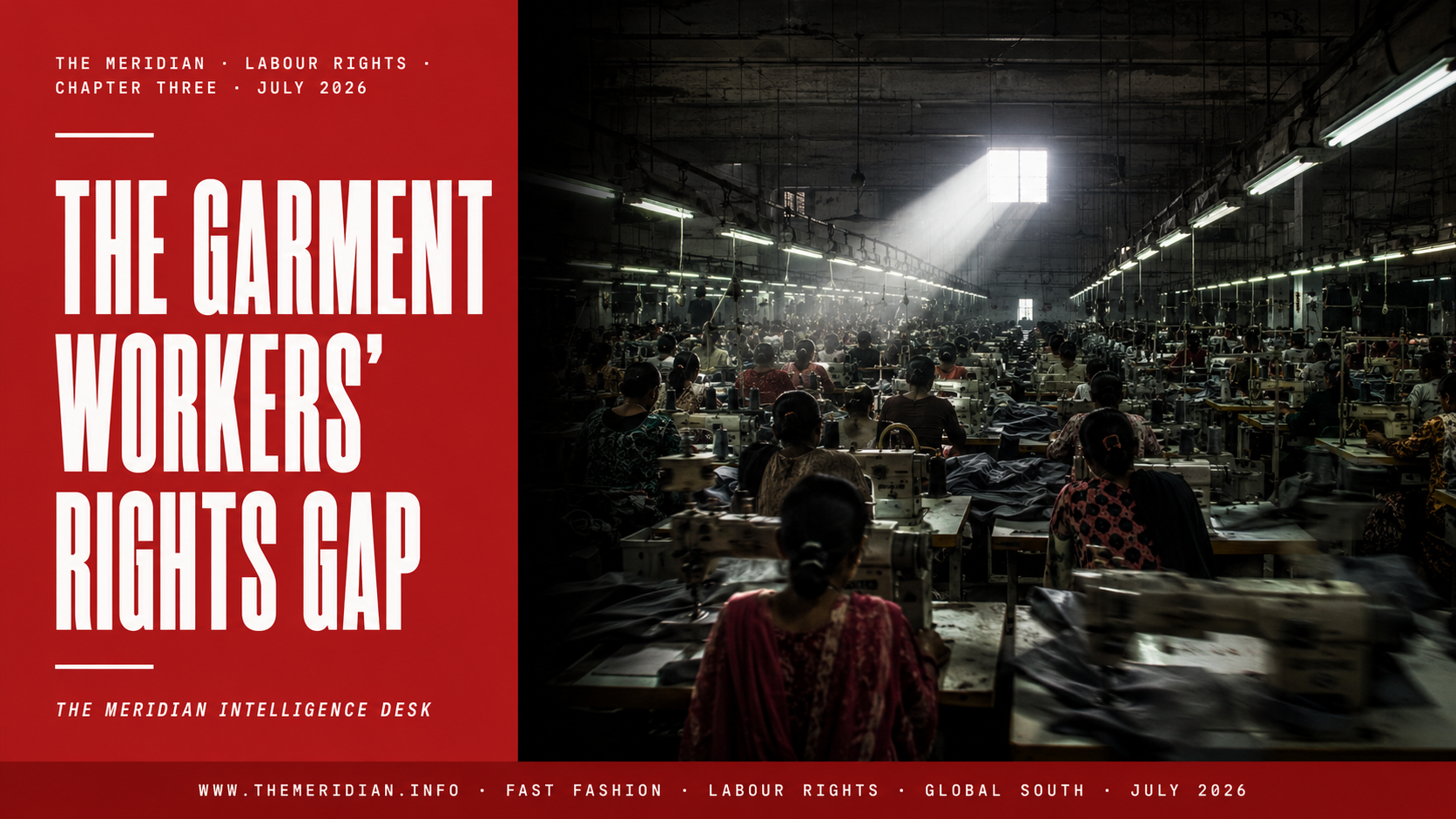
There is a shirt. It was made in Dhaka or Phnom Penh by a woman earning between $95 and $170 a month, without the right to organise freely, without a living wage guarantee, and without any binding remedy if the building she works in collapses. It is sold in London or Paris or New York for $40. The brand that sells it has signed voluntary codes of conduct. It faces no binding legal obligation under international law. The Meridian examines the architecture that makes this arrangement permanent -- and the UDHR articles it violates every working day.
On 24 April 2013, the Rana Plaza building in Savar, Bangladesh collapsed. The building contained five garment factories producing clothing for brands including Primark, Mango, Walmart, and Benetton. One thousand one hundred and thirty-four workers were killed. Two thousand five hundred were injured. The collapse was not unforeseeable. Cracks had been identified in the building the previous day. Workers at the factories on the upper floors had been told to return to work regardless. They were not in a position to refuse. The Rana Plaza collapse is the deadliest industrial accident in the history of the garment industry. It produced significant media coverage, significant corporate expressions of regret, significant pledges to improve supply chain safety, and no binding legal accountability for any brand whose products were being manufactured in the building when it fell.
Thirteen years later, the garment industry employs approximately 75 million workers globally, the overwhelming majority of them women in the Global South. Bangladesh employs approximately 4.4 million garment workers, making it the second largest garment exporter in the world after China. Cambodia employs approximately 700,000, with the sector accounting for around 70 per cent of the country’s total export earnings. Vietnam, Myanmar, Sri Lanka, Indonesia, and Ethiopia are among the other major production countries. The clothes these workers produce are sold in retail environments across Europe and North America at price points that depend, structurally, on the labour costs remaining as low as possible in the countries where they are made.
The Universal Declaration of Human Rights guarantees the right to work under just and favourable conditions, the right to equal pay for equal work, the right to form and join trade unions, and the right to a standard of living adequate for health and wellbeing including food, clothing, housing, and medical care. Every one of these rights is systematically denied to significant proportions of the global garment workforce. The brands whose supply chains depend on those denials have signed voluntary codes of conduct committing them to uphold these rights. The codes are not enforced. The denials continue.
The minimum wage for garment workers in Bangladesh was raised to 12,500 taka per month -- approximately $113 -- in November 2023, following strikes and protests in which workers were killed by police. The raise was significantly below what workers and unions had demanded. It was also significantly below what independent assessments identify as a living wage for Bangladesh -- the wage at which a worker can meet their own and their dependants’ basic needs for food, housing, healthcare, education, and transport without working excessive overtime.
The Asia Floor Wage Alliance, which calculates living wages across Asian garment-producing countries, estimated the living wage for Bangladesh at approximately 51,000 taka per month at the time of the November 2023 increase -- more than four times the legal minimum. The gap between the minimum wage and the living wage is not a marginal discrepancy. It is a structural feature of the industry’s cost model. The price points at which fast fashion brands sell their products to consumers in wealthy countries are dependent on labour costs in producing countries remaining far below what a living wage would require.
The minimum wage in Bangladesh is $113 a month. The living wage is estimated at over $450. The gap between those two numbers is not a market outcome. It is a design choice -- made by brands, enforced by supply chain structures, and protected by the absence of any binding legal obligation to close it.
In Cambodia, the minimum wage for garment workers was set at $204 per month in 2024 -- higher than Bangladesh in absolute terms but still significantly below living wage estimates for the country. Cambodian garment workers have faced persistent suppression of union activity, with multiple documented cases of union leaders dismissed, blacklisted, or subjected to legal harassment after organising or leading strikes. The right to form and join trade unions, guaranteed under Article 23 of the UDHR and given binding treaty form under Article 8 of the International Covenant on Economic, Social and Cultural Rights, is formally recognised in Cambodian law and systematically constrained in Cambodian practice.
Article 23 of the UDHR states that everyone has the right to form and to join trade unions for the protection of their interests. This right is not abstract in the garment industry context. The ability of workers to organise collectively is the primary mechanism through which wages above the legal minimum, safe working conditions, and effective remedy for violations can be secured. The suppression of that right is therefore not merely a violation of Article 23 in isolation. It is the mechanism through which all other labour rights violations in the industry are sustained.
In Bangladesh, the legal framework for trade union registration is complex and has been used historically to obstruct union formation in the garment sector. Unions require a minimum of thirty per cent of workers in a factory to register -- a threshold that creates significant practical barriers in an industry where employers can and do dismiss organisers before the threshold is reached. Workers who attempt to organise face dismissal, blacklisting across multiple factories, and in documented cases, physical intimidation. The Bangladesh Garment Manufacturers and Exporters Association -- the industry body that represents factory owners in negotiations with brands -- has significant influence over the regulatory environment in which union activity operates.
In Cambodia, the situation is in some respects more acute. Cambodia has a higher rate of union registration than Bangladesh in formal terms -- but the proliferation of employer-controlled or employer-friendly unions has diluted the effectiveness of genuine independent unionism. The murder of union leader Chea Vichea in 2004, and the imprisonment of his alleged killers in a trial that international observers described as deeply flawed, established a precedent for the treatment of independent union leadership that has shaped Cambodian labour relations ever since. The workers who make the clothes bear the full cost of the risk. The brands whose cost structures depend on those workers bearing that risk face none of it.
The international community’s response to the labour rights crisis in the garment industry has been, for three decades, the voluntary code of conduct. Brands publish supplier codes of conduct committing their supply chains to compliance with ILO core labour standards -- freedom of association, prohibition of forced labour, prohibition of child labour, non-discrimination. They commission third-party audits of their factories. They publish sustainability reports documenting their progress. They join multi-stakeholder initiatives -- the Business Social Compliance Initiative, the Fair Labor Association, the Better Work programme -- that provide frameworks for monitoring and improvement.
None of this has produced a living wage for a Bangladeshi garment worker. None of it prevented Rana Plaza. None of it has stopped the systematic suppression of union activity in Cambodia. The voluntary framework is not failing because it is being implemented badly. It is failing because it was designed to provide the appearance of accountability without its substance -- to give brands a mechanism for managing reputational risk without accepting legal liability for the conditions in which their products are made.
After Rana Plaza, a group of mainly European brands signed the Bangladesh Accord on Fire and Building Safety -- a legally binding agreement that required brands to fund factory safety inspections, remediate identified hazards, and submit to independent dispute resolution if they failed to do so.
The Accord was binding. It had an enforcement mechanism. It produced measurable improvements in factory safety standards that the previous voluntary framework had not. When its initial term expired, brands lobbied to replace it with a weaker, industry-controlled successor. The International Accord -- its replacement -- maintained binding elements but with a narrower scope and weaker enforcement.
The Accord demonstrated that binding frameworks work. The industry’s response to that demonstration was to spend significant resources attempting to limit the Accord’s scope and duration. The lesson the industry drew from Rana Plaza was not that binding accountability is necessary. It was that binding accountability is dangerous to the cost model and must be contained.
The European Union’s Everything But Arms initiative grants duty-free, quota-free market access to exports from least-developed countries including Bangladesh, Cambodia, and Myanmar, on the condition that those countries uphold a set of international conventions covering labour rights, human rights, and governance. The GSP+ arrangement extends similar preferences to a wider set of countries in exchange for ratification and implementation of 27 international conventions.
The labour rights provisions in these arrangements are not voluntary. They are conditions of market access. A country that fails to implement the required labour standards is, in principle, subject to the withdrawal of preferences -- a sanction with significant economic consequences for export-dependent garment sectors. In practice, the enforcement of these provisions has been sporadic, slow, and frequently subordinated to other diplomatic and commercial considerations. Cambodia had its GSP+ preferences partially withdrawn in 2020 following documented human rights violations -- a withdrawal that took years of documented evidence to trigger and that was partial rather than complete. Bangladesh has not faced equivalent action despite documented evidence of labour rights violations that meets the threshold for review under the EBA framework.
The gap between the text of the trade agreement and its enforcement is structurally identical to the gap between the text of the UDHR and its enforcement. In both cases, the language of rights exists. In both cases, the enforcement mechanism is controlled by parties -- powerful states in the case of the UDHR, the EU in the case of GSP -- whose commercial and diplomatic interests in not enforcing it are real and significant. In both cases, the people whose rights are being denied are not at the table where enforcement decisions are made.
In 2024, the European Union adopted the Corporate Sustainability Due Diligence Directive -- a binding instrument that requires large companies operating in the EU to identify, prevent, and address human rights and environmental risks in their supply chains, and that creates civil liability for companies that fail to do so. This is the most significant binding supply chain accountability instrument adopted by any major jurisdiction. It represents a genuine departure from the voluntary framework that has dominated corporate human rights governance for thirty years.
It is also significantly weaker than the instrument the European Parliament originally proposed. The final text applies to a narrower set of companies, contains a longer implementation timeline, and includes liability limitations that make successful legal action against major brands more difficult than a strict reading of the directive’s stated purpose would suggest. The lobbying effort mounted by European industry associations against the original proposal was among the most intensive in recent EU legislative history.
The directive does not apply retroactively. It does not cover the conditions that produced Rana Plaza. It does not guarantee a living wage. It does not give Bangladeshi or Cambodian workers direct access to EU courts. It is a step in the direction of binding accountability -- the first genuine step in that direction taken by any major jurisdiction -- and it remains to be seen whether its implementation will produce the accountability that its text promises or the appearance of accountability that the voluntary framework has provided for thirty years.
The clearest way to understand the garment workers’ rights gap is the comparison that the industry’s defenders never make. If a garment factory in Germany or France or the United Kingdom employed workers at wages below the legal minimum, denied them the right to organise, exposed them to unsafe working conditions, and dismissed them for union activity, the employers responsible would face criminal prosecution, regulatory action, and civil liability. The workers would have access to labour courts, to union representation, to statutory redundancy payments, and to health and safety inspections with real enforcement powers.
The same shirt, made under conditions that would constitute multiple criminal offences in the country where it is sold, is manufactured legally in Bangladesh or Cambodia because those countries have lower legal standards -- standards that are lower, in significant part, because the cost model of the brands buying the shirts requires them to be. The brand is not breaking any law. It is operating within a legal architecture that was constructed, maintained, and defended by the states and corporations that benefit from it -- an architecture that allows the same human being, doing the same work, producing the same product, to have radically different rights depending on which side of a border they happen to have been born on.
The same shirt. Made under conditions that would be criminal in the country that sells it. Legal in the country that makes it. The law did not produce this outcome by accident. The law produced this outcome by design.
The garment workers’ rights gap is not a failure of the international human rights system to reach a difficult problem. It is a demonstration of the system operating exactly as its most powerful participants have designed it to operate. Voluntary codes of conduct exist to manage reputational risk. Trade agreement labour provisions exist to be cited in negotiations and not enforced in practice. Sustainability reports exist to satisfy institutional investors. The Accord demonstrated that binding accountability works -- which is precisely why the industry spent so much energy limiting it.
Article 23 of the UDHR says every worker has the right to just and favourable conditions of work, to equal pay, and to form and join trade unions. Article 25 says every person has the right to a standard of living adequate for health and wellbeing. These rights have been formally guaranteed to garment workers in Bangladesh and Cambodia since 1948. They have not been delivered. The gap between the guarantee and the delivery is measured in the lives of 1,134 workers killed in a building whose cracks had been identified the day before, in the union leaders dismissed and blacklisted for exercising a right the UDHR says is theirs, and in the monthly pay packets that are $113 when the cost of a dignified life requires $450.
The shirt costs $40 in the shop. The worker who made it earns $113 a month. The brand that sells it has no binding legal obligation to change either number. That is not a market outcome. That is a human rights violation, sustained by the deliberate absence of the enforcement architecture that would end it.
Add comment
Comments