Same Plant, Different Laws: How Pharmaceutical Patents, Cannabis Prohibition, and Seed Monopolies Weaponise the Law Against the Poor
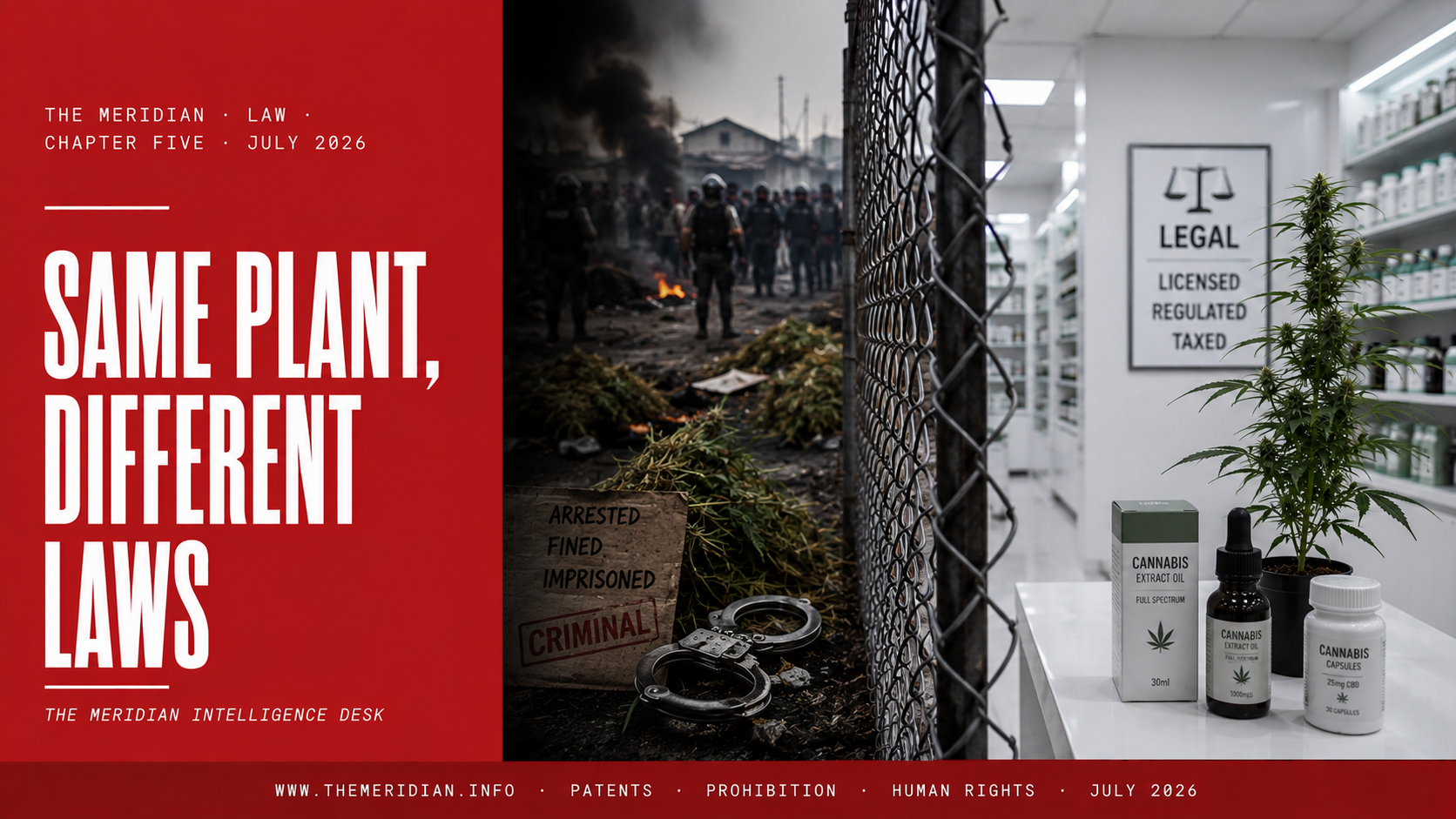
The same molecule. A patent in one jurisdiction, a generic medicine in another, a criminal charge in a third. The same seed, saved and replanted for ten thousand years, now intellectual property theft under a trade agreement the farmer never negotiated. The same plant, a regulated commodity in Canada and a twenty-five-year sentence in Mauritius. The Meridian argues that patent law, prohibition law, and seed monopoly law are not three separate legal systems. They are one architecture, applied selectively, that determines who is permitted to access nature and who is criminalised for needing it.
There is a recurring pattern in the legal architecture this edition has examined, and nowhere is it more starkly visible than in the law that governs access to the natural world -- to medicine, to the plants that produce it, and to the seeds that grow the food that sustains billions of people. The pattern is this: the same substance, the same biological material, the same act of cultivation or consumption, receives radically different legal treatment depending not on any property of the substance itself, but on the wealth, geography, and political power of the person engaging with it. A molecule is patented and priced beyond reach in one country and manufactured as an affordable generic in another. A plant is a regulated medical commodity in one jurisdiction and a twenty-five-year prison sentence in another. A seed that has been saved and replanted by farming communities for ten millennia is, under a trade agreement those communities did not negotiate, now legally classified as intellectual property theft.
These three legal architectures -- pharmaceutical patent law, cannabis and drug prohibition law, and seed monopoly law -- are rarely discussed together, because they sit in different legal silos, administered by different ministries, negotiated through different international bodies, and litigated in different courts. The Meridian argues they should be discussed together, because they share a single underlying logic: each constructs a legal mechanism through which access to a naturally occurring or naturally derived resource is restricted, monetised, or criminalised in a manner that consistently transfers wealth and freedom from the Global South to corporate and state interests concentrated in the Global North, while doing so through legal instruments presented as neutral, technical, and unrelated to questions of human rights.
The TRIPS Agreement -- the Agreement on Trade-Related Aspects of Intellectual Property Rights, negotiated as part of the World Trade Organization's founding framework in 1994 -- established minimum standards for intellectual property protection, including pharmaceutical patents, that all WTO member states were required to implement. Before TRIPS, many developing countries, including India, had patent regimes that did not extend product patent protection to pharmaceuticals, allowing domestic generic manufacturers to produce affordable versions of medicines that were patented and priced at premium rates in wealthier markets. TRIPS required these countries to extend full pharmaceutical patent protection, with developing countries granted a transition period before full implementation was required.
The clearest historical demonstration of what this architecture costs in human terms is the global HIV/AIDS antiretroviral crisis of the late 1990s and early 2000s. At the height of the crisis, patented antiretroviral therapy cost in excess of $10,000 per patient per year in the markets where the patent holders set the price -- a cost that placed the medicine entirely beyond reach for the overwhelming majority of the more than 20 million people living with HIV in sub-Saharan Africa at the time. Indian generic manufacturers, operating under India's pre-TRIPS patent regime, began producing equivalent generic antiretroviral combinations at a fraction of the cost -- famously brought to under $1 per day by Cipla in 2001 -- a price reduction that became one of the central catalysts for the global scale-up of HIV treatment access that followed.
The 2001 Doha Declaration on TRIPS and Public Health affirmed that the agreement should not prevent member states from taking measures to protect public health, and explicitly recognised the right of states to grant compulsory licences -- authorising domestic production or importation of a generic version of a patented medicine without the patent holder's consent, in exchange for a reasonable royalty -- in public health emergencies. The mechanism exists in international law. Its use has, in practice, been rare and politically fraught, with countries that invoke compulsory licensing facing diplomatic and trade pressure from the governments of the patent-holding corporations' home jurisdictions in numerous documented instances, including against South Africa, Thailand, and India over various periods since TRIPS came into force.
The right to override a patent in a public health emergency exists in international law. The political cost of exercising that right has, in case after case, been calibrated to ensure it is rarely used. The molecule is the same. The price is not. The law that determines the price was written by the parties who benefit from it being high.
The COVID-19 pandemic provided a real-time repetition of the HIV/AIDS antiretroviral pattern, on a compressed timescale and with the entire world watching. India and South Africa proposed, at the WTO in October 2020, a temporary waiver of TRIPS intellectual property protections for COVID-19 vaccines, treatments, and diagnostics, to allow generic manufacturers in developing countries to produce these tools without licensing negotiations or royalty payments to the patent holders, during the acute phase of a global pandemic emergency. The proposal was supported by more than 100 WTO member states. It was opposed, for the better part of two years, by the European Union, the United Kingdom, and Switzerland -- jurisdictions home to the major vaccine-developing pharmaceutical corporations -- with the United States eventually offering qualified support for a narrowed version of the waiver in May 2021.
By the time a substantially narrowed waiver was finally agreed at the WTO in June 2022 -- covering vaccines only, not the therapeutics and diagnostics the original proposal addressed, and with implementation conditions that limited its practical effect -- wealthy countries had already secured the overwhelming majority of the global vaccine supply through advance purchase agreements, and the acute phase of the global vaccine access crisis, during which low-income countries' vaccination rates lagged wealthy countries' by a factor of many multiples, had already passed. The phrase vaccine apartheid, used by the WHO Director-General and numerous public health figures to describe this period, captures the structural reality with more precision than diplomatic language typically permits: a legal architecture of patent protection, defended by the governments whose domestic corporations held the patents, that determined who received a life-saving vaccine first by wealth and geography rather than by epidemiological need.
The Meridian has documented, across an extensive body of reporting, the architecture of cannabis prohibition and its human cost in the Global South, including in Mauritius, where the Dangerous Drugs Act 2000 has produced consequences including the death of musician Kaya in police custody in 1999, the prosecution of an eighty-one-year-old man facing a potential twenty-five-year sentence for cultivating cannabis for personal medical relief, and the provisional charging of children as young as eleven. The same plant -- with no recorded overdose deaths in documented medical history, with an endocannabinoid receptor system present in every human body on earth, and with five thousand years of recorded medicinal use predating the first prohibition statute by millennia -- is legally regulated and commercially available in Canada, Germany, Uruguay, South Africa, and twenty-four American states.
The cannabis prohibition architecture this publication has documented at length follows precisely the pattern this article identifies: a substance whose criminalisation has no defensible basis in pharmacology or public health evidence, maintained through international treaty obligations -- principally the 1961 UN Single Convention on Narcotic Drugs, which scheduled cannabis alongside heroin under pressure that was geopolitical rather than scientific in origin -- that continue to bind Global South states to a prohibition framework that wealthier states have, in growing numbers, simply abandoned domestically while leaving the international legal architecture formally intact for everyone else.
In Canada, an adult may legally purchase, possess, and cultivate cannabis for personal use, subject to quantity limits, under a regulated commercial framework that generates billions of dollars in tax revenue annually.
In Mauritius, an eighty-one-year-old man cultivating the same plant for his own medical relief faces a potential sentence of twenty-five years' imprisonment under the Dangerous Drugs Act 2000 -- a law passed one year after a musician died in police custody for publicly challenging it.
The plant has not changed. The pharmacology has not changed. The only variable that has changed is the jurisdiction -- and the jurisdiction was, in both cases, shaped by the same international prohibition architecture that one country has chosen to depart from and the other has not yet been permitted, politically and diplomatically, to depart from with equal ease.
The saving and replanting of seeds from one harvest to sow the next is among the oldest continuous practices in human civilisation, predating recorded history and forming the technical foundation of agriculture itself. It remains, for hundreds of millions of subsistence and smallholder farmers across Africa, South Asia, and Latin America, the primary mechanism through which next season's crop is secured, particularly for farmers without reliable access to commercial seed markets or the capital to purchase seed annually.
Seed monopoly laws -- intellectual property frameworks, increasingly required as a condition of trade agreements with the EU, the US, and other major agricultural exporters, that grant plant breeders exclusive commercial rights over patented or plant-variety-protected seed varieties -- have, in jurisdictions that have adopted the most restrictive versions of these frameworks, made the saving and replanting of protected varieties a civil or criminal infringement, regardless of whether the farmer purchased the original seed in good faith or has been growing a related variety for generations. The International Union for the Protection of New Varieties of Plants, in its 1991 revision (UPOV 91), significantly narrowed the traditional farmers' privilege to save and exchange seed that earlier frameworks had preserved, and trade agreements between the EU and developing country trade partners have, in numerous documented cases, required UPOV 91 accession as a condition of preferential market access.
The practical effect, documented extensively by agricultural rights organisations and by farmer testimony across multiple jurisdictions that have adopted UPOV 91-aligned seed law under trade agreement pressure, is the gradual erosion of a ten-thousand-year-old agricultural practice, replaced by a legal requirement to purchase commercial seed annually from corporations holding the relevant plant variety rights -- corporations concentrated, as with pharmaceutical patents, overwhelmingly in wealthy countries, extracting a recurring payment from subsistence farmers in the Global South for access to genetic material whose underlying biological heritage frequently traces back to varieties those same farming communities, or their regional counterparts, originally developed and preserved over generations before any corporate breeding programme existed.
Article 25 of the UDHR guarantees the right to a standard of living adequate for health and wellbeing, including medical care. Article 27 guarantees the right to share in scientific advancement and its benefits. Both rights are directly engaged by each of the three legal architectures this article has examined. Patent law determines whether the medical care Article 25 requires is financially accessible. Prohibition law determines whether a medicine that has been used safely for five millennia is legally available to the patients who need it. Seed monopoly law determines whether the agricultural knowledge and practice that Article 27's protection of access to scientific and cultural benefit was written to extend to everyone remains a freely exercised right or becomes a recurring corporate payment obligation.
In each case, the legal architecture is presented in technical, apolitical terms -- as intellectual property law, as drug scheduling policy, as plant variety protection. In each case, the practical effect is the same: a naturally occurring or naturally derived resource that, absent legal intervention, would be freely accessible to the people who need it, is converted into a restricted, monetised, or criminalised resource, through legal mechanisms negotiated predominantly by and for the benefit of corporate and state interests concentrated in wealthy countries, and binding on Global South states through trade agreement conditionality that those states' negotiating position rarely allowed them to meaningfully resist.
Pharmaceutical patent law, cannabis prohibition law, and seed monopoly law are administered by different agencies, negotiated through different treaties, and discussed in entirely separate policy conversations. They share a single underlying architecture: each takes something the natural world produces freely, or that human agricultural and medical knowledge has freely shared for millennia, and constructs a legal mechanism that restricts access to it, in a pattern that consistently and predictably transfers wealth, freedom, and health outcomes from the Global South to the Global North.
The Doha Declaration exists. Compulsory licensing exists in law. The TRIPS waiver for COVID vaccines was, eventually, agreed. None of these correctives arrived in time to prevent the human cost their absence produced in the interim -- the HIV/AIDS deaths during the years before generic antiretrovirals reached scale, the vaccine apartheid of 2021, the eighty-one-year-old Mauritian facing twenty-five years for a plant that kills no one, the subsistence farmer paying an annual royalty for a seed variety descended from one her grandmother freely saved.
The molecule, the plant, and the seed are not the problem. The architecture built around them is. It was built, deliberately, by parties who benefit from restricted access, and it has been defended, deliberately, against every correction that would have made access more equal, for as long as the corporations and states who benefit from the restriction have had the political power to defend it. That power has, so far, been sufficient. This edition exists to document what it has cost, and to make the cost impossible to describe as accidental.
Add comment
Comments