The Mauritius Labour Rights Trap: Bangladeshi Workers, the Rs 16,500 NMW, and the Rights the Tuna Supply Chain Ignores
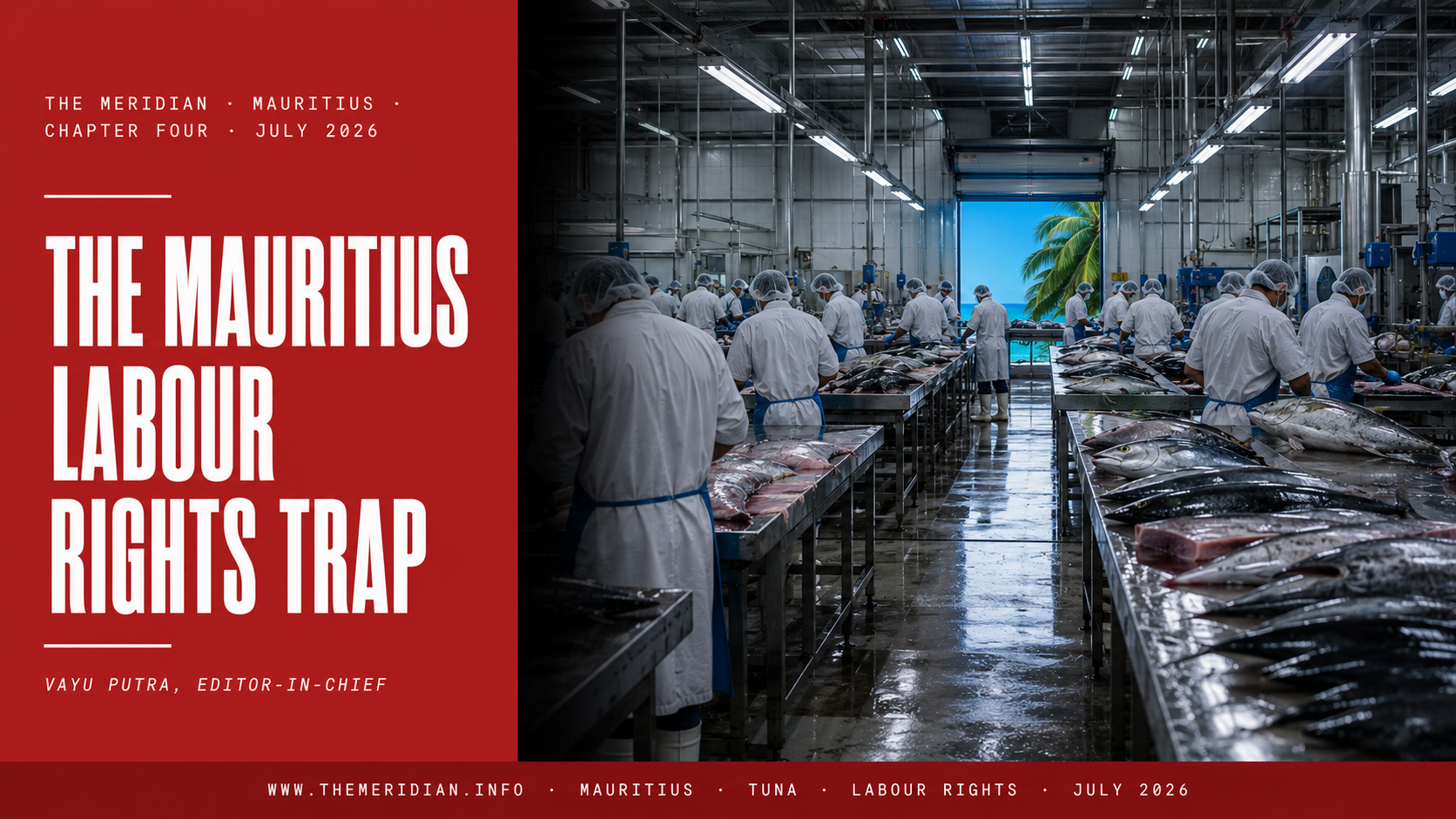
She arrived in Mauritius on a work permit that ties her legal right to remain in the country to a single employer. She earns Rs 16,500 a month processing tuna that is exported to the United Kingdom and the European Union under trade agreements containing explicit, binding labour rights obligations. Those obligations are not enforced against the conditions under which her wage is set. I document the gap between the treaty text and the factory floor -- and name who benefits from the gap remaining exactly as wide as it is.
Mauritius exports approximately 95 per cent of its canned tuna production to the European Union and the United Kingdom, under preferential trade arrangements that have, for decades, been central to the island’s export economy and to the survival of its largest private sector employer outside of textiles. The Economic Partnership Agreement between the EU and the Eastern and Southern Africa states, and the equivalent post-Brexit arrangement Mauritius maintains with the United Kingdom, grant Mauritian tuna products duty-free, quota-free access to two of the wealthiest consumer markets on earth. Both agreements contain provisions requiring Mauritius to uphold core labour rights standards as a condition of the preferential access. Both agreements have, in the years since their conclusion, produced no meaningful enforcement action in connection with the labour conditions under which the tuna they govern is actually processed.
The workforce processing that tuna includes a significant population of migrant labourers -- predominantly from Bangladesh, alongside workers from Madagascar, India, and other source countries -- recruited under Mauritius’ Non-Citizens (Employment Restriction) Act framework, which ties a foreign worker’s legal right to remain in Mauritius to continued employment with the specific employer who sponsored their work permit. The national minimum wage in Mauritius, set at Rs 16,500 per month as of the most recent adjustment, applies to this workforce as it applies to Mauritian nationals in equivalent roles. It is this figure, and the legal architecture surrounding it, that this article examines against the labour rights obligations that the EU and UK trade agreements explicitly require Mauritius to honour.
The legal mechanism through which Bangladeshi and other migrant workers are employed in Mauritius’s tuna processing and broader manufacturing sectors is the work permit system administered under the Non-Citizens (Employment Restriction) Act. A foreign worker may only legally work in Mauritius for the specific employer named on their work permit. Changing employer requires the cancellation of the existing permit and the issuance of a new one, a process that is administratively cumbersome, frequently requires the cooperation of the current employer to formally release the worker, and exposes the worker to a period of legal uncertainty during which their right to remain in the country is unclear.
This is the same structural mechanism this edition has examined in the Gulf states under the kafala system, and the same mechanism that, in Article 10 of this edition, was identified as the architecture that produces the vulnerability the vocabulary of migrant labour then naturalises as inevitable. A worker who cannot change employer without significant administrative difficulty and risk to their legal status is a worker with substantially reduced bargaining power over their wages, their working conditions, and their treatment by management. This is true regardless of whether minimum wage law is formally complied with. The minimum wage sets a floor. The sponsorship system determines how much bargaining power exists to negotiate above that floor, and for migrant workers under this system, that bargaining power is structurally minimal.
The minimum wage is not the ceiling on exploitation. It is the floor below which exploitation becomes formally illegal. Everything above that floor depends on bargaining power -- and the work permit system is specifically engineered to ensure that migrant workers have almost none.
The Economic Partnership Agreement between the European Union and the Eastern and Southern Africa states, of which Mauritius is a signatory, contains provisions on sustainable development that explicitly reference the parties’ commitment to internationally recognised labour standards, including the core conventions of the International Labour Organisation covering freedom of association, the elimination of forced and child labour, and non-discrimination in employment. The UK’s post-Brexit continuity trade agreement with the Eastern and Southern Africa states, which preserved the substance of the prior EU arrangement for UK-Mauritius trade, contains equivalent language.
These provisions are not merely aspirational preambular language. They are, in the formal architecture of both agreements, conditions attached to the preferential market access that Mauritius’ export economy depends on. Mauritius has ratified all eight of the ILO’s fundamental conventions -- a formal compliance record that exceeds many of its regional peers and that is frequently cited, including by the Mauritian government itself, as evidence of the country’s commitment to labour rights. Formal ratification of a convention and the practical delivery of the rights it contains are, however, two different things, and the gap between them is precisely where the migrant worker employed under a sponsorship-tied work permit, earning a wage that independent cost-of-living assessments suggest does not cover a basic standard of living, is currently located.
Rs 16,500 per month is, in absolute terms, a wage that situates a single migrant worker close to or below what independent cost-of-living assessments for Mauritius identify as adequate for a dignified standard of living once accommodation, food, remittances to dependants in the country of origin, and the administrative costs associated with the work permit system itself are accounted for. Mauritius is not a low-cost economy by regional African or South Asian standards. Its cost of living, driven in significant part by its tourism-oriented economy and its status as a relatively high-income country within the African continent, is considerably higher than the source countries from which most migrant workers in the tuna and manufacturing sectors originate.
The structural logic that produces this wage is not different in kind from the structural logic this edition documented in Bangladesh and Cambodia’s garment sector in Article 7. A workforce with limited bargaining power, employed in an export sector whose price competitiveness in wealthy consumer markets depends on labour costs remaining low, will see its wages set as close to the regulatory floor as the law permits, regardless of what that floor actually provides in terms of a dignified standard of living. Article 25 of the UDHR guarantees the right to a standard of living adequate for health and wellbeing. The minimum wage that Mauritian law sets, and that the EU and UK trade agreements implicitly accept as compliant with their labour rights provisions by taking no enforcement action against it, does not, on the available evidence, reliably deliver that standard to the workforce earning it.
Many migrant workers in the Mauritius tuna and manufacturing sectors arrive with significant debt incurred to recruitment agencies in their country of origin, a pattern documented extensively across South Asian labour migration corridors. This debt creates immediate pressure to remit income home rather than retain it for living costs in Mauritius, compounding the gap between the nominal minimum wage and the worker’s actual disposable income.
The combination of a wage set near the regulatory floor, a work permit system that constrains bargaining power, and a recruitment debt structure that creates pressure to remit rather than retain income, produces what this publication has elsewhere termed a Double Exploitation Mechanism: the worker is exploited both at the point of recruitment, through debt-financed migration, and at the point of employment, through wage suppression enabled by structural immobility.
Neither the EU nor the UK trade agreement’s labour provisions address recruitment debt or remittance pressure directly. Both gaps in the enforcement architecture compound each other, and both fall entirely outside the scope of what either trade agreement has, in practice, been willing to enforce.
The enforcement architecture of the EU and UK trade agreements’ labour provisions operates through a process of dialogue, monitoring, and, in the most severe cases, the potential suspension of preferential access -- a sanction that has, in the EU’s relationship with Cambodia documented elsewhere in this edition, been applied, partially, after years of accumulated evidence. It has not been applied to Mauritius, and the reasons are structurally similar to the reasons enforcement has lagged across every case this edition has examined: the economic relationship is valuable to both parties, the violations are diffuse and difficult to attribute to specific, prosecutable state action rather than systemic labour market conditions, and the political cost of triggering a formal review process is higher than the political cost of continued inaction.
Mauritius’ broader human rights and governance profile -- a stable, multiparty democracy with an independent judiciary, by the standards of the region one of the strongest performers on most governance indices -- also works against the triggering of trade sanctions in a way that more dramatic governance failures elsewhere do not. The labour rights gap in the tuna processing sector is not the product of an authoritarian government deliberately suppressing labour organising, in the way Article 6 of this edition documented in Nigeria. It is the product of a structurally embedded, economically convenient set of arrangements that no actor in the chain -- not the Mauritian government, not the factory owners, not the EU or UK trade authorities, not the international brands that ultimately purchase the tuna -- has a strong institutional incentive to disturb.
The structural reform that would close the gap between the treaty text and the factory floor is not, on its own terms, complex to specify, even if it has proven politically difficult to deliver. It would require, first, the reform of the work permit system to grant migrant workers the right to change employer without risking their legal status -- a reform that several Gulf states have, under sustained international pressure, begun to implement in modified form for their own kafala systems, and that Mauritius, as a smaller and more institutionally responsive state, could implement with considerably less friction than the larger Gulf economies have faced.
It would require, second, a living wage assessment specific to the cost of living faced by migrant workers in Mauritius -- accounting for accommodation, food, remittance obligations, and recruitment debt -- conducted independently of the social partner negotiations that set the national minimum wage primarily with reference to the broader Mauritian labour market and economy. And it would require, third, a genuine willingness on the part of the EU and UK to treat the labour provisions in their trade agreements with Mauritius as binding commitments subject to monitoring and consequence, rather than as preambular language that exists to be cited in trade negotiations and set aside in trade enforcement.
Mauritius has done what the international community typically asks of states seeking access to wealthy consumer markets. It has ratified the ILO’s core conventions. It has negotiated and signed trade agreements containing explicit labour rights provisions. It has maintained, by regional standards, strong democratic governance and judicial independence. None of this has, on the evidence available, translated into a wage or a work permit architecture for its migrant tuna processing workforce that reliably delivers the standard of living Article 25 of the UDHR requires, or the freedom of association and bargaining power that Article 23 guarantees.
This is not a story about a uniquely exploitative Mauritian state. It is a story about an international trade architecture in which labour rights provisions function, almost universally, as conditions that exist to be formally satisfied through ratification and formal compliance rather than substantively delivered through wages, mobility, and bargaining power adequate to a dignified life. The worker processing the tuna that reaches a supermarket shelf in London or Paris is, in the strictest legal sense, covered by an agreement that was supposed to protect her. In the practical sense that determines whether her wage covers her costs and her permit allows her to leave an exploitative employer, she is not.
I have spent years documenting Mauritius’ political economy from the inside. The labour rights trap facing migrant tuna processing workers is not a failure of Mauritian law in isolation. It is the local expression of a global trade architecture that writes labour rights into its treaties and writes no enforcement mechanism capable of delivering them into the same documents. The treaty text says one thing. The factory floor says another. The gap between them is where this worker’s rights currently live -- unenforced, undelivered, and entirely legal.
Add comment
Comments