When the Economics of Survival Runs Out
Protests broke out simultaneously across nine countries with almost nothing in common. I investigated the economics of why. The answers went from macro to micro, and the pattern was the same everywhere.
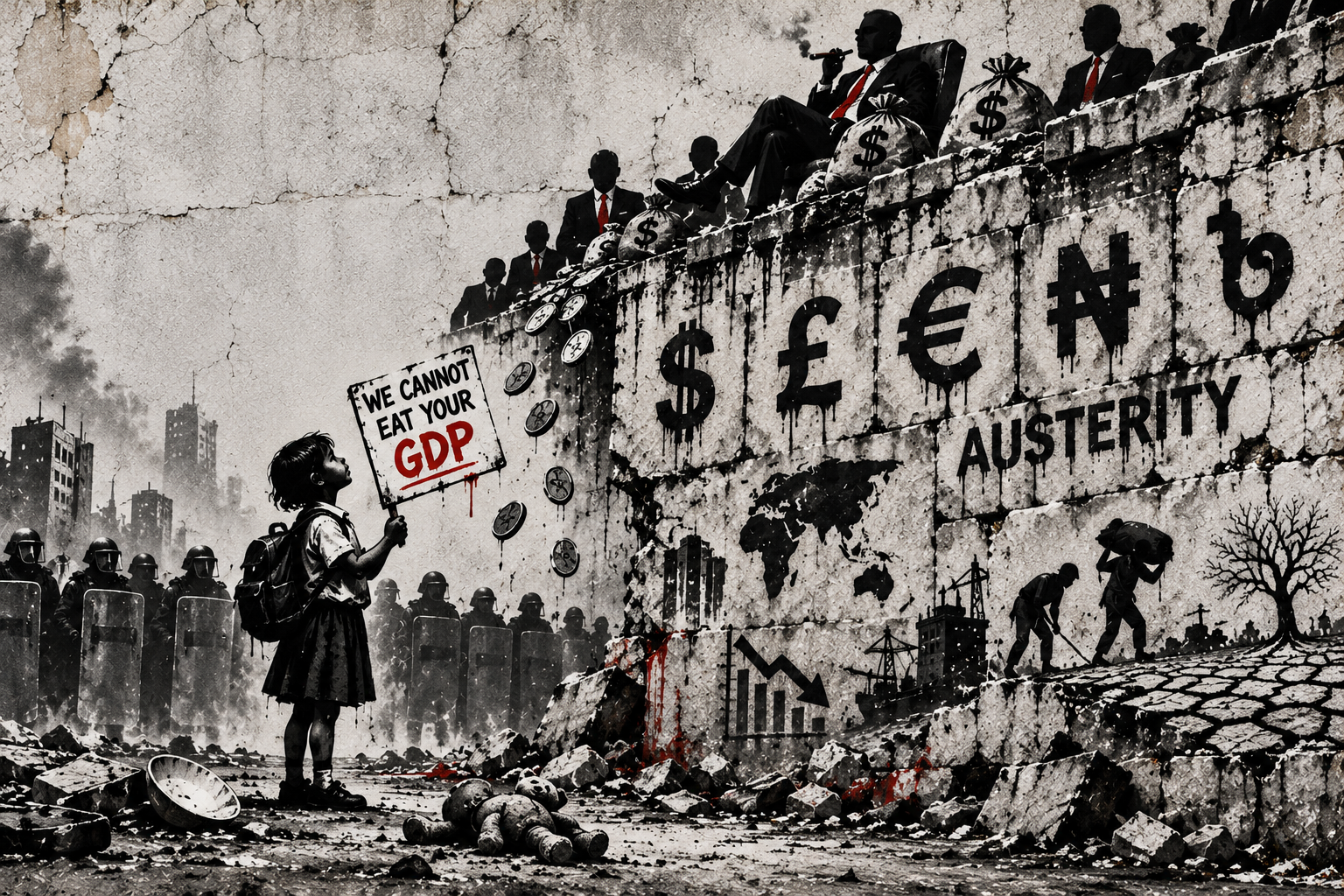
I started paying close attention to something in late 2024 and into 2025. Protests were breaking out in countries that had almost nothing in common. Bangladesh. Nigeria. Kenya. The United States. France. Argentina. Germany. Pakistan. China. They were happening simultaneously, across completely different political systems, on different continents, under different governments. That kind of pattern does not appear by chance. It is a signal.
So I started asking the question that economics trains you to ask. Not why are people angry. That is the easy question and it has a hundred political answers. The harder question is: what changed in the material conditions of daily life that made the street the only response left?
I went looking for the data. What I found, working from the macro level down to the micro, was a story that repeated itself in country after country with striking consistency.
What the Big Picture Showed
At the macro level, meaning the large-scale forces operating on national economies, several things converged at roughly the same time. After the pandemic, inflation rose sharply across most of the world. The United States Federal Reserve responded by raising interest rates to levels not seen in four decades. This made borrowing expensive globally, and it strengthened the US dollar significantly. For countries carrying debt in dollars, and many developing nations do, that meant the cost of repaying what they owed went up automatically, without any new borrowing. Economists call this a terms of trade squeeze. Governments that needed money to protect their populations were instead sending more of their budgets to creditors.
At the same time, the prices of food and energy stayed elevated far longer than central banks predicted. Supply chains did not recover as quickly as expected. The war in Ukraine disrupted grain and fertiliser markets that the entire Global South depends on. And International Monetary Fund programmes across Africa and Asia were pushing governments to remove fuel subsidies and raise taxes, often at exactly the moment when households were least able to absorb those changes.
“Governments needed money to protect their populations. Instead they were sending more of their budgets to creditors.”
None of these forces was new on its own. What was new was that all of them arrived together.
What It Looked Like at the Household Level
The macro picture explains the pressure on governments. But it does not fully explain why the person is on the street. For that, you have to go to the micro level: what is happening inside individual households.
When food, fuel, and transport become more expensive at the same time that wages are not rising, families run out of room very quickly. Economists call this real wage erosion. It means your pay might go up by five percent, but if prices go up by twenty percent, you are actually earning less in terms of what you can buy. For households already spending most of their income on necessities, there is no cushion left. No savings to draw on. No month where it is possible to cut back a little more and wait for things to improve.
There is an old principle in economics that describes this precisely. It is called Engel’s Law: as income falls, food takes up a larger and larger share of what a household spends. Poor households in developing countries can spend sixty to seventy percent of their income on food alone. When food prices rise by thirty percent, that is not an inconvenience. That is a crisis at the kitchen table.
That is the micro story. And it connects to the macro story through one simple mechanism: when governments cannot or will not absorb the shock, the household absorbs it instead. And when the household can no longer absorb it, the pressure goes into the street.
Country by Country: The Same Mechanism, Different Streets
I want to walk through some of what I found. Not as a list of grievances, but as a set of case studies in how the same mechanism expressed itself differently across different contexts.
The world’s largest economy, and even there the pressures were visible. Between 2021 and 2024, the typical American household lost purchasing power despite nominal wage growth. The cost of housing, groceries, and healthcare rose faster than earnings for the bottom half of income earners. Student debt continued to weigh on a generation that entered the workforce during one crisis and is now navigating another. In a country with no formal safety net of the kind that exists in most of Europe, that arithmetic becomes precarious very quickly.
France became the site of some of the most sustained protests in recent European memory. The government’s pension reform, which raised the retirement age, triggered strikes across the country. But the pension question sat on top of a deeper frustration: years of fiscal restraint had weakened public services while the cost of living kept rising. In Germany, energy costs rose sharply following the disruption of Russian gas supplies, and industrial output contracted. In the United Kingdom, workers in public services, transport, and healthcare went on strike in numbers not seen since the 1970s. These are wealthy nations, but inflation hit fixed and low incomes with particular force, and the social contract that had been holding started to show its cracks.
Perhaps the most extreme case on the economic spectrum. Annual inflation crossed two hundred percent in 2023. Families were buying goods the same day they received their wages because money lost value within hours. A new government came in with radical fiscal correction, cutting pensions and subsidies simultaneously. Real incomes collapsed faster than at almost any point in the country’s long history of economic crisis. The streets reflected it.
A student uprising in 2024 that eventually brought down a government. The country’s garment workers, who produce clothing for the world’s biggest fashion brands, had not seen wages rise to match inflation that had exceeded thirty percent in some months. Bangladesh is the second-largest clothing exporter on the planet. Its own workers could not afford cooking oil. That contradiction, between what the country produces for the world and what its people can access, became impossible to contain.
The government removed its fuel subsidy in 2023. For decades that subsidy had kept petrol prices artificially low. Its removal, combined with a sharp devaluation of the naira against the US dollar, meant that the cost of everything that needed to be transported, cooked, or manufactured rose almost overnight. For a country where the majority of workers are in the informal economy, meaning no fixed salary, no collective bargaining, no social protection, that was not an adjustment. It was a collapse in daily affordability.
The Finance Bill protests of 2024 were among the most striking events of the period. Young Kenyans, organising through social media, rejected a set of proposed taxes that the government had agreed to with the IMF as a condition of debt support. The programme was designed to help Kenya’s fiscal position. To the people on the street, it looked like the cost of that programme was being passed directly to those least able to pay it. It is worth noting that Kenya was spending more on debt service than on healthcare and education combined at the time.
A different kind of unrest, less visible but no less significant. Youth unemployment crossed twenty percent officially in 2023, and many economists believe the true figure was higher. A phenomenon called “lying flat” spread among young graduates: a conscious withdrawal from economic ambition in a system that no longer seemed to reward it. The property sector, which had accounted for a quarter of China’s economic output, collapsed. The consequences are still working through an economy that the world depends on for manufacturing and demand.
The canary in the coal mine, and nobody acted on it. By 2022, Sri Lanka had run out of foreign currency to import fuel, medicine, and food. The government fell. What happened there was the early version of what many other nations were approaching from different angles. When a country’s debt becomes unserviceable, its capacity to protect its population from price shocks disappears with it. Sri Lanka was not an outlier. It was a preview.
An IMF programme requiring energy price increases arrived at the same time the currency was losing value and inflation was above thirty-eight percent. The squeeze came from every direction at once. Households that had managed through previous crises by drawing on savings found those savings had been eroded by the combination of inflation and currency collapse. The politics followed the economics, as it usually does.
The Pattern Underneath It All
What unsettled me most, as I worked through all of this, was not any individual country’s story. It was how consistent the pattern was across places that are completely unlike each other. The United States is not Argentina. Kenya is not France. Bangladesh is not Germany. China is not Sri Lanka. And yet, in each of these places, at roughly the same time, the economics of daily life produced the same result.
The mechanism is not complicated once you see it. When the cost of necessities rises faster than income, and governments are constrained in their ability to cushion that gap because of debt obligations or political choices, the pressure accumulates. It accumulates inside the household first. When the household can no longer hold it, it moves into the street. The political form it takes varies. The economic cause underneath it does not.
“These are not separate stories. They are the same story, told in different languages, on different streets, by people who share more in common than they know.”
This is what economists sometimes call a synchronised shock: a set of forces that hit multiple countries at the same time because the global economy is deeply interconnected. A rate decision in Washington affects the cost of debt in Nairobi. A war in Ukraine affects the price of bread in Lahore and Accra. A property collapse in China affects demand across Central Asia and Africa. These are not separate stories. They are the same story, told in different languages, on different streets, by different people who share more in common than they know.
I also noticed something about the geography of the response. The countries that absorbed the shock most quietly were generally the ones with stronger fiscal buffers, more developed social protection systems, or more diversified economies. The countries where the street became the primary channel of response were generally the ones with weaker fiscal positions and populations most exposed to the prices of food and fuel. That is not a coincidence. That is the structure of global economic inequality expressing itself.
What This Edition Investigates
This November edition of The Meridian is our attempt to understand that pattern before the next cycle begins. We are not writing about riots as political events. We are investigating the economics underneath them: where the money went, where the costs landed, and why so many different societies reached the same breaking point in the same window of time.
The analysis across these pages is structured in six layers. We begin with the economics of protest itself, then move to the fiscal conditions that created the trap, then to how unrest has been used as political cover, then to the Global South dimension, then to what the data suggests is still to come, and finally to the question of whether reform is possible or whether we are simply watching a cycle prepare to repeat.
We write for institutions and individuals, for central bankers and for the common man, for readers in Europe, Africa, the Americas, Asia, and the Indian Ocean. What we share, whatever our position in the global economy, is an interest in understanding what is actually happening, as opposed to what we are told is happening.
The data does not flatter anyone in particular. It rarely does.
The Riot Economics: Aftermath is the November 2026 edition of The Meridian. This letter opens the full investigation, which spans six analytical layers and sixteen articles examining the economics of simultaneous global unrest. The Meridian is an independent publication covering Global South political economy.
© The Meridian 2026 / © Vayu Putra 2026. All rights reserved.This Editor’s Letter is the opening piece of The Meridian’s November 2026 edition: “The Riot Economics: Aftermath.” The Meridian is an independent publication. themeridian.info