Forty-Three Countries. One Pattern. The Wage Stagnation That Explains Why the Street Moved.
In 2022, global real wages fell for the first time since 2008. In Italy, real pay remains 8.7 per cent below its 2008 level. In the United Kingdom, sixteen years of wage stagnation only ended in 2024. This is not a cost of living crisis. It is the bill arriving for a structural policy decision made before most of the rioters were old enough to vote.
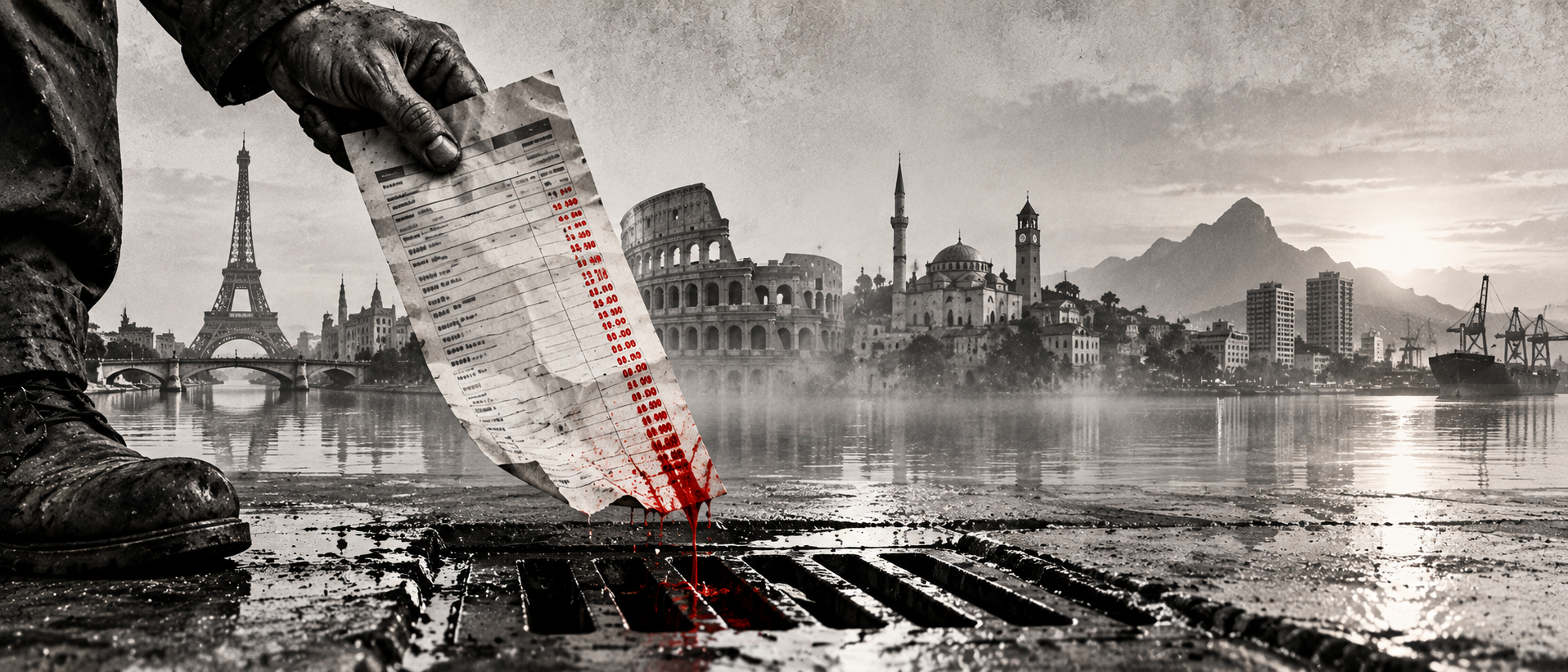
The alarm was sounded before the first barricade was lit. In November 2022, the International Labour Organisation published its annual Global Wage Report and gave the world a number it was not prepared to hear: real monthly wages had fallen 0.9 per cent in the first half of 2022. It was the first decline since the 2008 financial crisis. The ILO's Director-General, Gilbert Houngbo, made the connection explicit. Continued wage deterioration, he said, risked "further increasing inequalities and fuelling social unrest." That sentence appeared in the report's executive summary. It received modest coverage. Three years later, the unrest it anticipated arrived across 57 countries.
The question is not what happened in 2025 and 2026. The question is what happened in the decade before.
The ILO's 2022-23 report contained a second finding that received even less attention than the first. For high-income countries, the gap between real labour productivity growth and real wage growth had reached its widest point since 1999. Workers were producing more. The share of that production returning to them as wages was shrinking. This is not a temporary dislocation caused by a pandemic or a war. It is a structural condition, sustained over more than two decades, across every major economy in the world.
Economists describe this through the concept of the labour share of income. When wages rise in line with productivity, the labour share is stable: workers receive a consistent proportion of what the economy produces. When productivity rises faster than wages, the labour share falls, and the difference flows instead to profits, rents, and capital returns. Between 1999 and 2022, that transfer had been accumulating across the high-income world, quietly, without generating the political response it warranted. The inflation wave that began in 2021 did not create this condition. It made it visible. When prices accelerated, the gap between what workers earn and what a basic life costs became impossible to explain away. The mechanism had not changed. The transparency had.
The most extreme case in the G20 is instructive not because Italy is exceptional but because it is a direction made legible by its magnitude. According to ILO data, Italian real wages are 8.7 per cent lower today than in 2008, the worst performance among all G20 economies over that period. As of the first quarter of 2024, per OECD figures, real wages in Italy were 6.9 per cent below their fourth-quarter 2019 level, making Italy the worst performer in the euro area and the third worst among the 38 OECD member countries, behind only the Czech Republic and Sweden.
Italy has high employment by historical standards, a functioning welfare state, and one of the largest economies in Europe. It also has a 47.1 per cent tax wedge on average labour costs, one of the highest in Europe, according to 2024 OECD data, which means that a worker earning a modest wage costs the employer substantially more than the employee receives. The combination produces a labour market in which employment has increased and real pay has declined simultaneously. More people are working. Most of them are poorer than they were before the 2008 crisis. The question this data raises is not why Italians have protested. The question is why it took this long.
France and the United Kingdom confirm the direction, at lower intensity. France's real wage growth in 2024 was 0.7 per cent, the lowest among the five largest European economies, per the OECD's Taxing Wages 2025 report. In the United Kingdom, a Bloomberg analysis in July 2024 reported that real wages had "finally returned to their pre-financial crisis peak." That sentence carries within it a fact worth reading carefully: the sixth-largest economy in the world spent sixteen years paying its workers less, in real terms, than it had before a financial crisis it did not cause. During those sixteen years, London house prices rose by more than 80 per cent. The FTSE 100 set successive records. The gap between capital returns and labour returns widened consistently, without generating a systemic political response. It generated one eventually.
- Italy: Real wages 8.7% below 2008 levels (ILO). Worst performance in the G20 over this period.
- Italy: Real wages 6.9% below Q4 2019 as of Q1 2024 (OECD). Worst in the euro area. Third worst among 38 OECD members.
- United Kingdom: Real wages returned to pre-2008 peak only in mid-2024 (Bloomberg / OECD). Sixteen years of effective stagnation.
- United Kingdom: Two-thirds of local authorities still have average pay below 2008 real levels (GPA Research). The national recovery did not reach most of the country.
- France: +0.7% real wage growth in 2024 (OECD Taxing Wages 2025). Lowest among the EU's five largest economies.
- European Union: Real wages fell 2.4% in the first half of 2022 (ILO Global Wage Report 2022-23).
- Eastern Europe: Real wages fell 3.3% in the first half of 2022 (ILO). Steepest regional decline globally.
- Italy, Japan, Mexico, United Kingdom: Real wages in 2022 were already below their 2008 levels before the inflation wave accelerated (ILO).
Wage stagnation is not a natural economic phenomenon. It is the cumulative product of specific policy decisions made over three decades: the systematic weakening of collective bargaining frameworks in the name of labour market modernisation; the deregulation of employment contracts in the name of flexibility; the reorientation of corporate governance toward shareholder primacy, which redirected the proceeds of rising productivity toward dividends and buybacks rather than wages; and the asymmetric design of macroeconomic frameworks, in which central banks hold mandates to contain inflation in goods and services but carry no equivalent obligation to ensure that productivity gains reach workers.
That asymmetry is not a technical oversight. It is a political settlement, constructed over the 1980s and 1990s, about who bears the cost of economic management and who receives its gains. The inflation wave of 2021-24 disrupted that settlement because it made the cost visible in the most direct terms possible: at the supermarket checkout, on the petrol forecourt, in the rent invoice. For the first time in a generation, the mechanism was not abstract. It was arithmetic. And that arithmetic, as The Meridian documented in the preceding article in this layer, produces consequences at the household level that macro indices were never designed to capture.
"Workers were producing more. The share returning to them as wages was shrinking. This is not a temporary dislocation. It is a structural condition sustained across every major economy for more than two decades."
The productivity-wage gap is a global phenomenon. Its consequences are not equally distributed.
In Mauritius, the rupee has depreciated approximately 30 per cent against the dollar since 2020, while cumulative domestic inflation over the same period reached a comparable order of magnitude, according to Statistics Mauritius data. The structural vulnerability that amplifies this: more than 75 per cent of the country's food and manufactured goods are imported, priced in dollars and euros. A worker whose nominal wage did not fall has nonetheless seen their effective purchasing power compressed from two directions simultaneously: currency depreciation on the value of their earnings, and import price inflation on the goods those earnings must buy. The wage stagnation problem, in a small open economy with high import dependence, becomes a currency exposure problem. It arrives faster and cuts deeper than the same nominal conditions would produce in a larger, more self-sufficient economy.
In Albania, the national minimum wage stands at approximately 240 euros per month, one of the lowest in the European region. According to Albanian statistical authorities, approximately one-third of the population lives below the poverty line. On International Workers' Day 2022, demonstrators marched from Skanderbeg Square to the Prime Minister's Office in Tirana demanding labour rights, higher wages, and basic service provision. By 2025, the structural conditions behind those demands had not been substantially addressed. The wage floor, already low, had not risen to meet the cost of living that had.
The structural condition across both countries is the same as in France, Italy, and the United Kingdom: wages have not kept pace with what a basic life costs. What differs is the speed and depth of the exposure. A 30 per cent currency depreciation combined with 75 per cent food import dependence is not a version of the European problem. It is the European problem on a steeper gradient, without the fiscal buffers or institutional safety nets that partially absorbed the shock in the higher-income countries. The floor falls at the same rate. There is simply less below it.
It is worth returning to the ILO's November 2022 report, because it represents something specific: an institutional warning, issued by the United Nations system's own labour authority, in the plainest available language. Real wages were falling. The productivity-wage gap was at a generational extreme. The combination risked fuelling social unrest. The report was published in the period between the inflation surge and the wave of protests that followed it. It named the mechanism. It identified the risk. It recommended action: wages matched to productivity, more generous minimum wage adjustments, greater policy coordination.
Most governments did not act on those recommendations in any systemic way. Some raised minimum wages. Few addressed the underlying decoupling of wages from productivity growth. The fiscal frameworks that prioritised controlling labour cost inflation over ensuring wage adequacy remained in place. The central bank mandates that governed monetary policy did not change. The political settlement around labour markets and corporate governance did not shift.
The ILO named the risk in 2022. The risk materialised in 2025 and 2026, across 57 countries, in the form of the largest sustained wave of economically-driven civil unrest since the Arab Spring. Neither the warning nor the unrest that followed it were surprising to the economists and institutions that study wage dynamics. They were surprising, apparently, to the governments that had spent two decades treating labour market stagnation as an acceptable structural condition and the accumulated productivity-wage gap as a settled and manageable feature of modern capitalism.
The street disagreed. In the specific vocabulary of mass mobilisation, it explained why. Forty-three of the fifty-seven countries that experienced significant unrest in 2025-26 share one structural feature more consistently than any other: a sustained, multi-year gap between what their economies produce and what their workers are paid to produce it. The barricades, in this reading, are not a political phenomenon. They are economic data, expressed in a medium that governments cannot file and forget.
The floor had been falling for years. The invoices began arriving in 2025. They have not stopped.
- International Labour Organisation, Global Wage Report 2022-23: The Impact of Inflation and COVID-19 on Wages and Purchasing Power. ILO, Geneva, 2022. Reported by Al Jazeera, 30 November 2022: aljazeera.com
- OECD Employment Outlook, cited in 9colonne.it analysis, July 2024: Italian real wages 6.9% below Q4 2019 as of Q1 2024, worst in euro area. 9colonne.it
- ILO data on Italian real wages, cited in Il Foglio / Il Sole 24 Ore analysis, July 2026: real wages 8.7% below 2008, worst in G20. ilfoglio.it
- OECD, Taxing Wages 2025, cited in Euronews, May 2025: real wage growth by country 2024. France +0.7%, lowest among EU's five largest economies. euronews.com
- BNN Bloomberg, 18 July 2024: "UK real wages finally return to pre-financial crisis peak." bnnbloomberg.ca
- GPA Research: pay packets in two-thirds of UK local authorities worth less than in 2008. gpa.net
- Statistics Mauritius / Allafrica, October 2025: rupee depreciation approximately 30% against dollar since 2020; cumulative inflation of comparable magnitude; food and manufactured imports exceed 75% of total consumption goods. allafrica.com
- Exit.al, May 2022: Albania minimum wage approximately €240/month; one-third of population below poverty line; May Day protests, Tirana. exit.al
- Playroll, Minimum Wage in Albania: Rates, Trends & Compliance. playroll.com
© The Meridian 2026. All rights reserved. This article is published under The Meridian's standard editorial terms. Reproduction in full or in part requires written permission. Analysis and editorial judgements are those of the author. All statistical data is sourced and attributed. The Meridian is an independent publication.
© Copyright Protected
This article is the intellectual property of The Meridian. Reproduction in full or in part requires written permission from the Editor-in-Chief. All rights reserved.
For permissions: themeridian.info