Gustave Le Bon Wrote the Manual. Nobody Read It.
In 1895 a French psychologist published the founding text of crowd theory. Fifty years later a social psychologist proved, in a laboratory, exactly how manufactured consensus works. Together they explain the 2026 state response with precision. Neither text appears to have been read by the governments that needed them most.
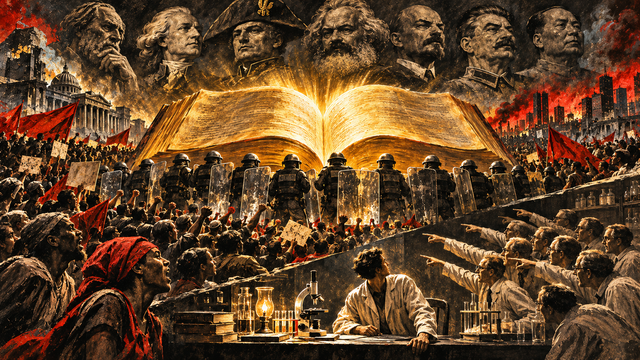
La Psychologie des Foules was published in Paris in 1895. Within a decade it had been translated into sixteen languages and had found its way onto the reading lists of political leaders across the ideological spectrum: Mussolini annotated his copy, Lenin cited its analysis of crowd suggestibility, Churchill referenced it in his early writing on political crowds, and Theodore Roosevelt corresponded with Le Bon directly. Freud engaged it at length in his 1921 Group Psychology and the Analysis of the Ego, the most sustained critical encounter the text ever received. The book has not been out of print since. It remains the foundational text of crowd psychology. Half a century after it was published, a social psychologist named Solomon Asch proved, in a series of laboratory experiments, exactly how the mechanism Le Bon had described could be manufactured from the outside. Between them, the two bodies of work constitute a complete analytical toolkit for understanding what happened in 2026, on the streets and in the official response to the streets. The governments involved appear to have read neither.
Three mechanisms sit at the core of Le Bon's model. Anonymity: in a crowd, individuals shed personal identity and the social constraints that ordinarily govern behaviour. The crowd grants a form of impunity, and impunity releases what Le Bon called the unconscious substratum, the layer of impulse ordinarily kept in check by civilised social life. Contagion: ideas and emotions transmit through a crowd with a speed and force that bypasses rational evaluation, operating more like infection than persuasion. Suggestibility: the crowd in this state becomes acutely receptive to the images, symbols, and emotional cues projected by those who understand its psychology. It responds to slogans rather than arguments, to heroes rather than programmes, to the vivid image rather than the careful analysis.
Le Bon's crowd is not an aggregate of individuals making collective decisions. It is a temporary psychological entity with its own logic and its own specific vulnerabilities, to manipulation from below by agitators and to management from above by states that understand what it responds to. The book is, in this sense, a manual for both sides. What Le Bon understood, and what the governments of 2026 appear not to have absorbed, is that a crowd formed around genuine material grievance cannot be dispersed by force. Force applied to such a crowd removes its visible expression. The pressure relocates. When suppression lifts, or when a new trigger activates a population whose conditions have not changed, the crowd reforms. Dispersal is not resolution. The manual makes this explicit.
"A state that reads a crowd as pathology rather than signal will consistently misdiagnose what it is facing. Treating it as Le Bon's irrational mob turned a policy problem into a policing problem."
Conformity is a shift in public judgement toward an answer a person can already see is wrong. Solomon Asch isolated it in the early 1950s on a line-matching task: alone, people almost never missed; faced with a unanimous group naming the wrong line, they went along on roughly a third of critical trials. Perception held. What failed was saying that judgement aloud.
Asch identified two distinct mechanisms driving this failure. Normative influence is the cost of standing alone: people comply in public while knowing privately they are wrong, because social isolation is a real cost and accuracy is not always worth it. Informational influence treats a confident room as better informed than one's own eyes: if everyone else says the left line is longer, perhaps they can see something I cannot. In the line-matching context the informational reading is obviously incorrect. In more complex political and economic situations it is harder to dismiss, and states that want to manufacture consensus know this.
Unanimity matters more than group size in Asch's results. A single correct partner removed most of the conformity effect, and even a partner who was merely different from the majority, without being correct, significantly weakened it. One dissenting voice changes the calculus for everyone watching. A manufactured consensus must therefore prevent the first dissenter from being heard, or discredit them quickly enough that others do not register the break in unanimity. Doubt only has to become silence. And silence, in a room where everyone else appears to agree, is read as agreement. Pluralistic ignorance is the name for what results: a population of individuals who each privately doubt the official position but each believe they are alone in doubting it, because no one around them is saying so aloud.
A coordinated minority heard first, repeating one wrong answer as if the question were already settled, is enough to start the process. Each person who complies makes the majority look larger to the next person who encounters it. The minority does not have to be large. It has to be early, consistent, and confident. The answer, once it has apparent majority support, begins to travel on its own.
In 1961 Jacobs and Campbell showed that an arbitrary norm, planted by confederates with no basis in the task, kept passing to members who had never met the original confederates. The planters could leave. The position had already transferred into the group's operating assumptions. Herbert Kelman's framework explains the mechanism behind this persistence. He separated three forms of influence: compliance, where a person conforms publicly while privately dissenting; identification, where a person adopts a position because of their relationship to the source; and internalisation, where the position becomes genuinely held and part of identity. Repeated, rewarded agreement moves people through that sequence. Once internalised, the position is no longer held because of external pressure. The external pressure is no longer required. The recent audience polices dissent on the position's behalf.
"Belief perseverance keeps the original conclusion after its evidential support is withdrawn. The continued-influence effect means the assertion outlasts its retraction. Reassessment feels like social defection."
The pattern Asch documented in a laboratory appears wherever a public answer is cheaper to copy than to check: political messaging designed to characterise protesters as externally directed; communications campaigns that repeated, at volume, the claim that unrest was manufactured rather than economically grounded; staged press appearances with predetermined questions; social media amplification coordinated to make official framing appear to have broad organic support. In each case the mechanism is the same as the laboratory version. The private answer, the recognition that food prices had risen by documented amounts and that real wages had not kept pace, was available to the populations involved the whole time. What spread was not a false belief but the cost of giving the true one aloud.
Once the official position had been internalised by enough of the population, correction became expensive. Governments that later acknowledged some portion of the underlying economic case found that the acknowledgement produced less movement than the original framing. Belief perseverance kept the initial narrative in place after its supporting claims had been withdrawn. The continued-influence effect meant that the original assertion, in many cases, outlasted the retraction. The populations most fully converted were those where the consensus had been most thoroughly manufactured, and they were therefore the last to revise.
1895 — year of publication of La Psychologie des Foules; in continuous print for 130 years; named readers include Mussolini, Lenin, Churchill, Roosevelt, and Freud
~33% — share of critical trials on which subjects conformed to the obviously wrong group answer in Asch's original experiments
1 — dissenting partner needed to dramatically reduce Asch's conformity effect; unanimity is the critical variable, not group size
1961 — Jacobs and Campbell show arbitrary norms outlive their planters; the position transfers without the source
3 — Kelman's influence stages: compliance, identification, internalisation; only the last requires no external policing
0 — state responses to the 2026 protest wave that addressed the underlying economic conditions identified in the preceding layers
Le Bon provided the first map of the crowd's internal logic. Asch proved, experimentally, that the crowd's susceptibility to apparent consensus is not a feature of crowds specifically but of individuals under social pressure, which is to say of everyone. Kelman explained why the position, once embedded, persists without its original sponsors. Jacobs and Campbell showed it transfers across generations of group membership. The whole machinery of manufactured consensus, the coordinated minority heard first, the engineered appearance of unanimity, the suppression of the first dissenter, the self-sustaining norm that outlives its planters, is documented across decades of empirical work. The toolkit has been available for the better part of a century.
What spread in 2026 was not confusion. It was the cost of clarity. The private answer was available to the populations involved throughout: food prices had risen to specific, measurable, documented levels. Real wages had not kept pace. The five indicators covered in the preceding layers were present in every country where unrest emerged. The people who took to the streets had done the calculation. The people who did not were not ignorant of it. They had assessed the cost of saying it aloud and decided the cost was too high. Pluralistic ignorance is not a failure of perception. It is a rational response to a social environment in which the cost of dissent has been successfully raised. The manual for raising that cost has been available since the 1950s. The manual for why the underlying crowd does not thereby disappear has been available since 1895.
The irony available in this material is precise. The governments that manufactured consensus to manage the protest wave used mechanisms that are comprehensively documented in the academic literature. The crowds they were managing formed for reasons that are equally well documented. The tools for understanding both sides of this encounter have been in libraries for decades. The evidence that both sets of tools went unread is in the streets, and in the fact that the conditions that put people in the streets remain structurally intact.
- Le Bon, Gustave, La Psychologie des Foules (The Psychology of Crowds), 1895; Sparkling Books edition 2009
- Freud, Sigmund, Group Psychology and the Analysis of the Ego, 1921; International Psycho-Analytical Press
- Asch, Solomon E., "Effects of Group Pressure upon the Modification and Distortion of Judgments," in H. Guetzkow (ed.), Groups, Leadership and Men (Carnegie Press, 1951)
- Jacobs, Robert C. and Donald T. Campbell, "The Perpetuation of an Arbitrary Tradition through Several Generations of a Laboratory Microculture," Journal of Abnormal and Social Psychology 62(3), 1961
- Kelman, Herbert C., "Compliance, Identification, and Internalization: Three Processes of Attitude Change," Journal of Conflict Resolution 2(1), 1958
- Reicher, Stephen D., "The Psychology of Crowd Dynamics," in Blackwell Handbook of Social Psychology: Group Processes (Blackwell, 2001)
- Lewandowsky, Stephan, et al., "Misinformation and Its Correction: Continued Influence and Successful Debiasing," Psychological Science in the Public Interest 13(3), 2012
Analysis and editorial: Vayu Putra, Editor-in-Chief. November 2026.