China's $1 Trillion Debt Trap: Myth and Reality
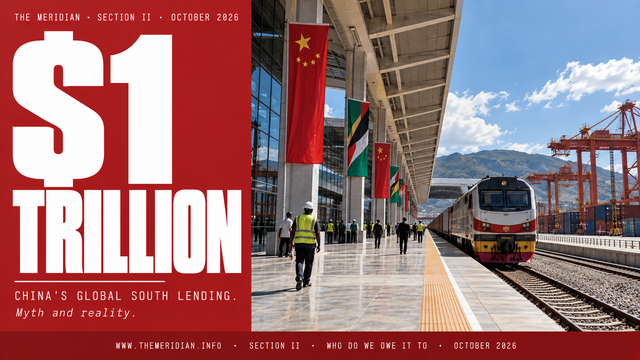
China has lent approximately $1 trillion across the Global South. The West calls it a debt trap. The evidence is more complicated. Here is what Beijing actually holds, what it has restructured, and what the leverage actually looks like in 2026.
The debt trap narrative is one of the most politically consequential stories about Chinese foreign policy in circulation. It holds that China deliberately engineers debt distress in developing countries, waits for the borrower to default, and then claims sovereign assets as repayment. The narrative has a canonical case: the Hambantota Port in Sri Lanka, which China took on a 99-year lease in 2017 after Sri Lanka could not service its debt to Chinese state lenders. The story spread globally. It became the primary Western framework for understanding Chinese engagement with the Global South.
It is substantially wrong. Not entirely wrong: Chinese lending does create leverage, involves terms less transparent than multilateral alternatives, and concentrates in sectors with strategic value. But the specific mechanism of the debt trap, deliberate entrapment followed by strategic asset seizure, is not well supported by the evidence. The distinction matters because the myth distracts from the real problems with Chinese lending, which are different and in some respects more concerning.
The Hambantota Port is more complicated than the standard narrative allows. Sri Lanka borrowed to build it not primarily because China pressured it to, but because the Rajapaksa government wanted the project for domestic political reasons: the port was in the President's home district. Financing came from China Merchants Port Holdings at approximately 6% interest, higher than concessional but not predatory. When Sri Lanka faced a balance of payments crisis in 2015 to 2016, the port lease was one element of a broader restructuring negotiation, not a pre-planned seizure. China received a 70% equity stake in the port management company and a 99-year land lease on adjacent land. The port remains Sri Lankan sovereign territory. (Source: Sri Lanka Ports Authority; Lowy Institute analysis)
The characterisation of Hambantota as a debt trap has been systematically challenged by the academic literature. Deborah Brautigam of Johns Hopkins SAIS-CARI, whose research has produced the most comprehensive database of Chinese overseas lending, described the debt trap narrative as largely a myth in her 2019 analysis. Her team found no documented case in which China had deliberately engineered debt distress to seize an asset. The Hambantota outcome was real. The predatory intent attributed to it was not established by the evidence. (Source: Brautigam, "Is China the World's Loan Shark?", 2019; AidData 2021)
AidData's 2021 Global Chinese Development Finance Dataset tracked approximately $843 billion in Chinese state financing across 165 countries between 2000 and 2017. Updated estimates incorporating subsequent lending bring the total to approximately $1 trillion. The dataset's findings diverge significantly from the debt trap narrative. (Source: AidData 2021)
China has restructured debt more often than it has seized assets. AidData identified 165 cases of loan renegotiation or restructuring between 2000 and 2017. The majority resulted in extended repayment periods rather than asset transfers. When a country cannot pay, China's most common response has been to roll the debt over, often with additional lending to cover interest payments, rather than demand collateral.
Chinese lending is heavily concentrated in infrastructure rather than in sectors where a strategic asset seizure logic would yield geopolitical value. The African Union headquarters in Addis Ababa, built with $200 million in Chinese financing, is a conference facility of symbolic rather than strategic importance. The Kenya Standard Gauge Railway, at approximately $3.2 billion in Chinese loans at 3.6% interest over 20 years, is a transport project of genuine developmental value and questionable economic viability, but not a strategic asset China has any mechanism for claiming.
The countries most indebted to China are not the most vulnerable to asset seizure. Angola, the largest African recipient at approximately $40 billion, repaid its debt primarily in oil, a collateral mechanism agreed upfront rather than seized in distress. The arrangement was transparent, commercially rational for both parties, and consistent with how commodity-backed lending has always functioned. (Source: AidData; SAIS-CARI Angola dataset)
"China has restructured debt more often than it has seized assets. The specific mechanism of the debt trap, deliberate entrapment followed by strategic seizure, is not well supported by the evidence."
None of this means Chinese lending is unproblematic. The actual concerns are different from the debt trap narrative and in some respects more difficult to address precisely because they are less dramatic.
China Development Bank commercial rate loans: approximately 5 to 6% interest. World Bank IDA concessional rate: approximately 1.25 to 2%. African Development Fund: approximately 0.75%.
On a $1 billion loan over 20 years: at 6% the borrower pays approximately $860 million in interest. At 1.5% the same loan costs approximately $160 million in interest. The gap is $700 million per $1 billion borrowed. This is not debt trap engineering. It is commercial lending to countries the multilateral system has excluded or underserved, at terms that reflect that market position. (Source: AidData; Humphrey and Michaelowa, 2019)
The first real problem is opacity. Chinese loan terms are systematically less transparent than those of the World Bank, IMF, or Paris Club creditors. AidData's analysis of 100 Chinese loan contracts found widespread confidentiality clauses requiring borrowing governments not to disclose the terms to other creditors. Cross-default clauses in some contracts allow Chinese lenders to call loans if the borrower defaults to any other creditor. Several contracts require that disputes be resolved in Chinese courts rather than through international arbitration. None of these terms would be acceptable under Paris Club conventions. All of them appear in documented Chinese state lending contracts. (Source: AidData "How China Lends" report, 2021)
The second real problem is what the opacity enables: political leverage that is real but difficult to document. The Zambia restructuring, involving Chinese creditors holding approximately $6 billion in Zambian debt, took three years to conclude and remained partially opaque throughout. The final terms have not been fully disclosed to the Zambian public. (Source: IMF; Zambia Ministry of Finance, 2024)
The Coca Codo Sinclair dam in Ecuador, financed by China Eximbank at $1.68 billion, illustrates the gap between the debt trap narrative and the real problems. China did not seize the dam. It was not designed as a strategic asset capture. It was designed as a hydroelectric project that would reduce Ecuador's energy import bill. As built, it has developed thousands of structural cracks and has failed to achieve its projected power output. Ecuador is repaying the loan regardless, because the contract terms require it to and because the alternative is losing access to Chinese financing for future projects. (Source: AidData; Reuters investigative reporting)
The problem is not that China stole the dam. The problem is that Ecuador borrowed $1.68 billion for a dam that does not work as specified, at commercial rates, under a contract not subject to independent review, and is repaying that debt from oil revenues pre-committed as collateral. The dam will not be seized. The oil has already been spent.
The debt trap narrative gave Western governments a simple story: China is predatory, its lending is a weapon, and the solution is to offer an alternative. The narrative was politically convenient and substantially inaccurate. China has not systematically seized assets. It has lent commercially, at rates above multilateral alternatives, under terms that are opaque and structurally advantageous to the lender, to countries that needed financing and had limited options.
The real problem is not what China has taken. It is what borrowing countries did not receive: transparency, concessional rates, independent oversight, and the ability to negotiate in multilateral frameworks that include all their creditors simultaneously. The debt trap is not a trap set by China. It is a trap set by the architecture of international finance, which left the Global South to borrow on commercial terms from whoever would lend, and then blamed the lender for the terms that resulted.
Zambia, Ghana, and Sri Lanka are not in debt distress because China trapped them. They are in debt distress because the global system of development finance has never been designed to serve them as effectively as it serves the countries that designed it. China filled the gap. The gap was real. The terms of filling it are the problem.
Add comment
Comments