When America Cuts, It Chooses. When Ghana Cuts, It Has No Choice.
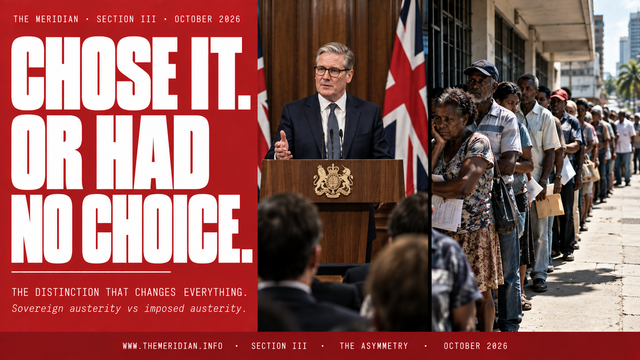
The UK had austerity after 2010. America had spending cuts. But nobody required them as a condition of survival. Ghana, Pakistan, and Zambia had no such choice. The distinction between sovereign austerity and imposed austerity is the asymmetry this edition is built around.
In October 2010, George Osborne stood at the despatch box and announced the most significant reduction in British public spending since the Second World War. Departments would be cut by an average of 19%. Welfare would be reformed. The deficit would be eliminated within a parliamentary term. It was, in every contemporary account, austerity.
It was also a choice. The British government chose the pace of consolidation. It chose which departments bore the largest cuts. It chose to protect the NHS budget in nominal terms. It chose the timeline. When the coalition decided in 2012 that the pace of deficit reduction was damaging growth and extended the programme, it extended the programme. No external institution required it to accelerate. No quarterly benchmark determined whether the British state could access the resources needed to pay its civil servants, its pensioners, its NHS staff.
This is sovereign austerity. It is real. It is painful. It is not, in any structural sense, the same thing as what Ghana experienced in 2023, what Pakistan experiences permanently, what Zambia experienced under its IMF programme, or what Kenya was told to do in June 2024.
The distinction is not about the existence of spending pressure. It is about who controls the terms, who monitors compliance, how deep the floor goes before the cut must stop, and whether the exit is available when the government chooses.
Sovereign austerity is fiscal consolidation conducted by a government that retains full monetary sovereignty and whose compliance is accountable to its own electorate, not to an external creditor.
The UK's 2010 Spending Review was self-imposed. The Treasury set the targets. Parliament debated and approved the measures. The electorate had the opportunity to remove the government at the following election. The Bank of England retained independent control of monetary policy. The pound was not touched. (Source: HM Treasury Spending Review, October 2010)
The United States Congressional sequestration of 2011 to 2013, under the Budget Control Act, imposed automatic spending cuts across discretionary programmes when Congress failed to agree a deficit reduction plan. It was painful and economically damaging. The dollar was not devalued. The Federal Reserve was not instructed to raise rates as a condition of fiscal compliance. No IMF mission visited Washington to verify that cuts had been implemented before releasing the next tranche of funding. There was no tranche. The United States borrowed in its own currency, from its own financial system and from foreign central banks who required access to dollar assets. (Source: Congressional Budget Office historical data)
In both cases the government retained policy space: the ability to change course, reverse measures, extend timelines, or exit the consolidation when political or economic conditions warranted. In both cases the social floor remained. UK austerity cut the growth rate of NHS spending. It did not eliminate the NHS, close hospitals, or deny treatment. It applied pressure to a system that, however strained, continued to function as a universal service throughout.
Imposed austerity is fiscal consolidation conducted as a condition of accessing external financing without which the state cannot meet its basic obligations. It is monitored by the creditor. Compliance is verified quarterly. Deviation results in the suspension of programme disbursements. The government does not choose the pace. It negotiates the terms, but within a framework set by an institution whose governance is controlled by its major creditors.
Pakistan in 2025 and 2026 is the most concentrated illustration available. The country spends more than 50% of its federal budget on debt service before a single rupee reaches a school, a hospital, or a road. This is not a policy choice in any meaningful democratic sense. It is the arithmetic consequence of debt accumulated under conditions the Pakistani state did not control, at interest rates it could not set, in a currency it does not issue, serviced under terms negotiated with an institution in which it holds a small fraction of the voting power.
Pakistan cannot choose to spend less on debt service and more on health. The debt service obligation is senior to everything else in the fiscal architecture. If Pakistan deviates from IMF programme conditions, the programme is suspended. If the programme is suspended, Pakistan cannot meet its external obligations. If it cannot meet its external obligations, it faces default with consequences that would dwarf the costs of compliance.
Ghana's 2023 IMF programme required the country to impose losses on domestic bondholders: pension funds, banks, individual savers. The people who lost money were not the people who made the borrowing decisions. They were Ghanaian citizens whose retirement savings were in instruments the government subsequently restructured as a precondition of accessing IMF support. (Source: IMF Ghana Extended Credit Facility, 2023)
Greece between 2010 and 2018 sits between these two categories and is worth examining precisely because it is the exception that proves the rule.
Greece was a European sovereign that had surrendered monetary sovereignty when it joined the eurozone. It could not devalue the drachma because there was no drachma. It could not instruct the ECB to buy its bonds because the ECB was not its central bank. When the Troika imposed the terms of the bailout, Greece was in a position more analogous to a developing country under IMF conditionality than to the UK in 2010. Greek GDP declined by approximately 25% during the adjustment period. Pensions were cut by 40 to 50% in some categories. Hospitals ran short of medicines. Youth unemployment reached 60%. (Source: World Bank/Eurostat; European Commission programme documents)
The implication is precise: the protection against imposed austerity is not geography or wealth. It is monetary sovereignty. Countries that issue their own freely floating currencies retain policy space. Countries that borrow in currencies they do not issue surrender that space the moment debt service costs exceed what they can generate domestically. Greece, inside the eurozone, had surrendered that ability. The UK had not. The US never has.
"Sovereign austerity is a democratic choice, however painful. Imposed austerity is a condition of survival, however undemocratic. The distinction is not about the existence of pain. It is about who controls it."
1. Who sets the terms. Sovereign: the government and its parliament. Imposed: an external creditor institution whose governance is controlled by major creditor economies.
2. Who monitors compliance. Sovereign: the electorate, at the next election. Imposed: IMF staff missions conducting quarterly reviews, with the next disbursement conditional on meeting agreed benchmarks.
3. What happens when the government changes course. Sovereign: it changes course. The 2012 UK autumn statement extended the deficit reduction timeline with no external consequence. Imposed: the programme is suspended and the country must negotiate a return to compliance.
4. How deep the floor goes. Sovereign: the government sets the floor and has chosen, in every documented case, to preserve core services. Imposed: the floor is set by the fiscal arithmetic the creditor requires, which has in documented cases required cuts to health, education, and pension systems below any threshold a democratic government would voluntarily choose.
5. What happens to the currency. Sovereign: floats, managed by a central bank accountable to the domestic polity. Imposed: currency devaluation is frequently a programme condition, with consequent import price rises and foreign currency debt burden increases falling on the population.
The $348 trillion in global debt must be serviced. When it cannot be serviced, it must be adjusted. The adjustment falls somewhere. In sovereign austerity economies it falls, however unevenly, on a population with democratic recourse: the electorate can remove the government that imposed it. In imposed austerity economies it falls on a population with no recourse against the institution that required it, which is not on any ballot, which they did not vote for, and which represents the interests of the creditors to whom the debt is owed.
That is the asymmetry. Not that rich countries feel no pain. It is that the pain they feel is theirs to manage, theirs to exit, and theirs to answer for politically.
The pain that imposed austerity delivers is managed by someone else, exits when someone else decides, and is answered for politically by nobody. That is the distinction. And it applies to every country in this edition that has ever stood in a queue at the IMF.
Add comment
Comments