The IMF: Lender of Last Resort or Instrument of Creditor Power?
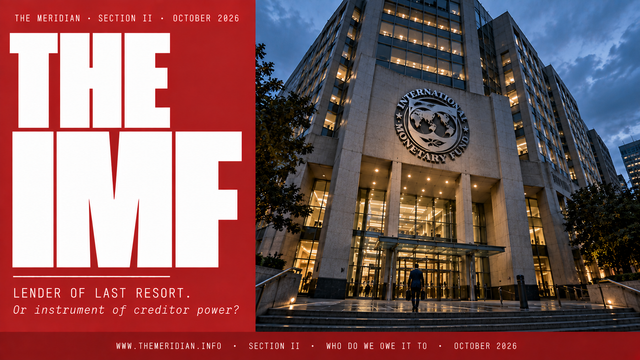
The IMF requires Ghana to devalue the cedi, Sri Lanka to devalue the rupee, Pakistan to devalue the rupee. It has never required the United Kingdom to devalue the pound or the United States to devalue the dollar. Here is why, and what that asymmetry means for the global debt reckoning.
The International Monetary Fund was created in 1944 at Bretton Woods with a mandate its founders considered straightforward: prevent the competitive currency devaluations and financial instability of the 1930s from recurring. The institution would provide balance of payments support to member countries in crisis, stabilise exchange rates, and ensure that no country needed to resort to the destructive policies that had contributed to the Great Depression and, ultimately, to the war that followed.
That mandate has not changed. What has changed is the understanding of whose crisis the institution is designed to manage, under what conditions, and at what cost.
The IMF is governed by a quota system in which voting weight is proportional to financial contribution. The United States holds approximately 16.5% of votes, enough to veto any major decision requiring an 85% supermajority. (Source: IMF voting structure documentation) The European Union countries collectively hold approximately 30% of votes. Together, the G7 economies control a majority of IMF voting power.
The countries that most frequently need IMF assistance, the low-income and lower-middle-income economies of sub-Saharan Africa, South Asia, and Latin America, hold a small fraction of voting power proportional to their financial contributions. The institution designed to help countries in financial distress is governed by the countries least likely to be in financial distress and most likely to be the creditors whose interests are served by the conditions the IMF attaches to its assistance.
The standard IMF structural adjustment programme, as it evolved through the 1980s and 1990s, contained a recognisable package of conditions: fiscal consolidation through spending cuts and revenue increases; monetary tightening to control inflation; currency devaluation to improve export competitiveness; trade liberalisation to reduce import barriers; and privatisation of state-owned enterprises to reduce fiscal obligations and attract foreign investment. The Washington Consensus, as the economist John Williamson named it in 1989, was the intellectual framework within which this package operated.
The conditionality was presented as technically neutral: these were the measures that stabilised economies in crisis, regardless of where the crisis occurred. The evidence accumulated over four decades suggested otherwise.
Here is the specific asymmetry that the standard framing of IMF conditionality never names directly.
Currency devaluation is a standard condition of IMF structural adjustment programmes for developing country borrowers. Ghana devalued the cedi under its 2023 Extended Credit Facility. Sri Lanka devalued the rupee under its 2023 Extended Fund Facility. Pakistan has devalued the rupee repeatedly under successive IMF programme conditions. Egypt devalued the pound as a condition of IMF support in 2016 and again in 2022. Argentina has devalued the peso under IMF conditions multiple times.
"The pound has never experienced this. The dollar has never experienced this. The euro has never experienced this. The currencies that have experienced devaluation as an IMF condition are, without exception, the currencies of countries that did not design the system and do not control it."
The United Kingdom has never been required to devalue the pound as a condition of IMF assistance. The United States has never been required to devalue the dollar. Germany, France, and Italy have never been required to devalue their currencies. These countries issue their own currencies. The United Kingdom issues the pound. The United States issues the dollar. When the pound fell dramatically in September 2022 during the gilt crisis, nobody called it a devaluation. It was called market adjustment. No IMF condition was attached. No quarterly benchmark was set. No staff mission monitored compliance.
When the Ghanaian cedi falls under an IMF programme, it is a policy condition: designed and monitored by IMF staff, required as a condition of continued access to the programme's resources, and measured against quarterly performance benchmarks. The country's monetary authorities lose, for the duration of the programme, the ability to defend their exchange rate through policy. The population absorbs the consequences: import prices rise, foreign currency debt becomes more expensive, living costs increase for those least able to absorb them.
The asymmetry extends to the cost of IMF lending itself. The IMF charges interest based on the Special Drawing Right rate, derived from a basket of five reserve currencies: the dollar, euro, renminbi, yen, and pound. For 2026, the SDR rate has been approximately 3.8%.
The IMF charges surcharges on top of the base SDR rate: +200 basis points for borrowers accessing more than 187.5% of their quota, plus an additional +100 basis points for countries with outstanding credit above 187.5% of quota for more than 51 months.
The result: the countries in the deepest distress, the ones borrowing the most for the longest periods, pay the highest interest rates to the institution designed to help them. A maximum-surcharge borrower in 2026 could pay approximately 6.8% or higher, comparable to commercial market borrowing, levied by a multilateral institution on a country too distressed to access commercial markets at all.
The IMF reformed surcharge policy partially in 2023, raising the thresholds at which surcharges apply. The fundamental structure, higher interest for the most indebted, remains. (Source: IMF surcharge reform documentation, 2023)
Ghana entered an IMF Extended Credit Facility in May 2023, accessing approximately $3 billion over three years. Conditions included fiscal consolidation, domestic debt restructuring, and currency adjustment. The programme required Ghana to impose losses on domestic bondholders, affecting pension funds, banks, and individual savers. The cedi has lost approximately 40% of its value against the dollar since the programme began. Inflation peaked above 50% in 2022 to 2023. (Source: IMF Ghana Extended Credit Facility, 2023)
Sri Lanka's collapse in 2022 was the most acute: foreign reserves effectively exhausted, fuel queues, rolling power cuts, food price inflation above 90%. The IMF programme agreed in 2023 required comprehensive debt restructuring, fiscal consolidation, and new taxation on a population already impoverished by the crisis. (Source: IMF Sri Lanka Extended Fund Facility, 2023)
Kenya's June 2024 experience has been documented elsewhere in this edition: IMF-backed tax proposals on basic goods, parliament stormed, at least 39 deaths. The Finance Bill was withdrawn. The programme continued.
In none of these cases was the country's situation comparable to the United States running a $2 trillion annual deficit, or the United Kingdom borrowing £100 billion per year above revenue. The scale of fiscal deterioration that triggers IMF conditionality for a developing country is, in absolute terms, smaller than the ordinary annual fiscal operations of the countries that set the institution's terms.
The IMF reform debate is real. The institution has acknowledged failures of the Washington Consensus era, introduced climate financing instruments, and created the Resilience and Sustainability Trust in 2022. The question is whether these reforms address the structural condition: that an institution created to serve the global financial system is governed by those who benefit most from the existing architecture of that system, lends at asymmetric costs, requires currency devaluations from borrowers that it cannot by structural definition require from its largest shareholders, and applies fiscal disciplines to economies that those shareholders apply to nobody.
The IMF did not cause global poverty. It did not cause the debt crises it was called to manage. It managed them in ways that served certain interests more than others. That is the honest record.
The $348 trillion in global debt this edition examines was built in a system the IMF has helped to sustain. Whether it can be unwound equitably is inseparable from whether the institution managing the unwinding is capable of applying the same standards to all of its members. The evidence, accumulated across fifty years, does not strongly support an affirmative answer.
Add comment
Comments