Interest Rates for the Global South: Why the Same Debt Costs Four Times as Much
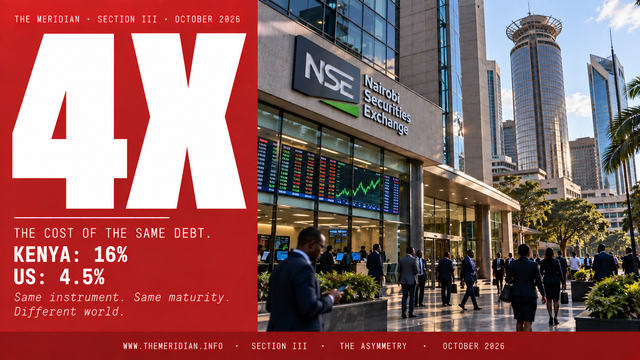
Kenya issues bonds at 16%. The US issues at 4.5%. Same instrument. Same maturity. Four times the cost. The gap is not explained by default risk alone. Here is what actually explains it: original sin, the reserve currency effect, and the credit rating problem.
Kenya issues ten-year government bonds at approximately 16% yield. The United States issues ten-year Treasury bonds at approximately 4.5%. These are the same instrument: a government promise to repay borrowed money with interest over a fixed period. The maturity is the same. The legal structure is similar. The credit rating agencies assign Kenya a B rating, the United States a AA+ rating, and the gap between those ratings is presented as the explanation for the yield difference.
It is not a sufficient explanation. Kenya has never defaulted on its sovereign debt. Its debt-to-GDP ratio, at approximately 70%, is lower than France's at 112%, Italy's at 140%, or Japan's at 263%. The United States is currently running a $2 trillion annual deficit. By standard fiscal metrics, several of the countries paying four times the US borrowing rate are in better fiscal positions than the countries paying 4.5%.
The spread is real. It is structural. And it is not primarily explained by the creditworthiness of the borrower in any straightforward sense.
The sovereign spread is the difference between the yield on a developing country's government bonds and the yield on the benchmark risk-free rate, conventionally the US Treasury bond of the same maturity. It is measured, aggregated, and published by JP Morgan's Emerging Market Bond Index, the EMBI, which is the primary reference for how the market prices developing country sovereign risk. (Source: JP Morgan EMBI documentation)
The EMBI spread reflects multiple factors simultaneously. Default risk is the most discussed. Liquidity risk is the second: developing country bonds are less liquid than US Treasuries, so investors require a premium to compensate for the cost of holding an instrument that is harder to sell. Currency risk is the third: most developing country Eurobonds are issued in dollars, meaning the borrower takes on exchange rate risk, and investors require compensation for the risk that the borrower's currency depreciates, making it harder to generate the dollars needed to service the debt.
Each of these components is legitimate. None of them, individually or together, fully explains why Kenya pays 16% and the United States pays 4.5%.
The sovereign credit rating is the most visible determinant of borrowing costs and the most contested. Moody's, Standard and Poor's, and Fitch assign ratings based on assessments of fiscal position, institutional quality, economic growth, external vulnerability, and political stability. The ratings drive the spreads: a downgrade increases the yield a sovereign must pay on new issuance, which increases the deficit, which can lead to further downgrades. The relationship is partly circular.
The rating methodology has been criticised for systematic biases that disadvantage developing country borrowers. A 2021 UNCTAD report found that African sovereigns were systematically rated lower than their fiscal fundamentals justified, and that the methodology overweighted factors that correlate with income level regardless of their independent predictive value for default. An African country with the same debt-to-GDP ratio, deficit, and growth rate as a European country will typically receive a lower credit rating, pay a higher spread, and incur a higher borrowing cost. (Source: UNCTAD Sovereign Credit Ratings, 2021)
The concept of "original sin" in international finance was named by economists Barry Eichengreen and Ricardo Hausmann in 1999. It describes the condition of economies that cannot borrow internationally in their own currencies and must issue debt in foreign currencies, primarily the US dollar. (Source: Eichengreen and Hausmann, 1999)
A developing country does not choose to borrow in dollars because it is imprudent. It borrows in dollars because no international investor will lend it money in its own currency at scale.
The consequence: when the dollar strengthens, the real burden of a developing country's debt increases without any action of its own. When the Federal Reserve raises rates, the refinancing cost of dollar-denominated debt rises. The spread widens at precisely the moment when the borrower is under the most stress and least able to absorb the additional cost.
The United States borrows in the currency it prints. The US can always service its dollar debt in extremis because the Federal Reserve can always create the dollars required. This is not a practical statement about whether the US would choose to do so, but it is a structural statement about the absence of hard currency risk in US sovereign debt.
Kenya cannot print dollars. Nigeria cannot print dollars. Pakistan cannot print dollars. Their debt is denominated in a currency they do not control, issued by an institution whose mandate is to manage the US economy, not the global one. When the Federal Reserve raises rates to control American inflation, the cost of Kenyan dollar debt rises regardless of whether the rate rise is appropriate for the Kenyan economy. The Federal Reserve does not consider Kenya when it sets rates. It should not have to. Kenya has to consider the Federal Reserve whether it wants to or not.
"The same instrument. The same maturity. The same basic promise. Four times the cost. The Federal Reserve does not consider Kenya when it sets rates. Kenya has to consider the Federal Reserve whether it wants to or not."
The spread is not an abstract number. On a $1 billion bond issue with a 20-year maturity, at 4.5% the total interest payments are approximately $900 million. At 16%, the total interest payments are approximately $3.2 billion. The difference is $2.3 billion on a single bond issue. That is money that cannot be spent on anything else. It is the compound consequence of the rating differential, the original sin premium, and the reserve currency effect, expressed as a number that has to be found somewhere in the budget of a government that may already be spending 40 or 50% of its revenues on debt service.
Nigeria's 2023 Eurobond issuance was priced at approximately 9.6% on a seven-year dollar bond. Nigeria's oil revenues are substantial. Its debt-to-GDP ratio is not extreme by European standards. It paid 9.6% because it is Nigeria. The United Kingdom, running a higher deficit and a higher debt ratio, pays approximately 4.5% on comparable maturities. Because it is the United Kingdom. (Source: Bloomberg / Nigerian Debt Management Office, 2023)
The spread is the number that makes all the other asymmetries in this edition visible as money. The CFA franc costs money. The IMF surcharge costs money. The original sin premium costs money. The rating methodology bias costs money. The reserve currency privilege saves money. All of these effects, compounding across decades and across billions of dollars in bond issuance, produce the fiscal positions that then require the IMF programmes that then impose the austerity that then costs the populations who had nothing to do with designing any of it.
$348 trillion in global debt is not evenly distributed. The cost of carrying it is not evenly distributed. The same debt, at the same maturity, for the same purpose, costs four times as much in Kenya as in the United States.
That is not a market outcome. It is a structural condition, built into the architecture of international finance, and it is the compound effect of every asymmetry this section has described.
Add comment
Comments