The CFA Franc: How 14 African Countries Finance the ECB and Nobody Talks About It
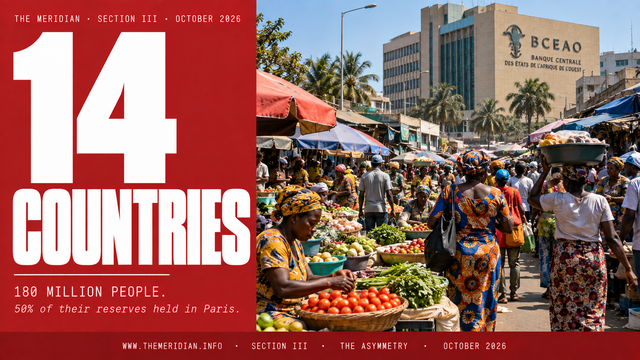
14 African countries. 180 million people. 50% of their foreign exchange reserves held in the French Treasury. The CFA franc was created in 1945. Here is how it works, what it costs, and why it persists 80 years after decolonisation.
In December 1945, two weeks after France signed the Bretton Woods Agreement, the French colonial ministry issued a decree creating the franc des Colonies Françaises d'Afrique. The name was later changed. The acronym was retained. The CFA franc has been in continuous operation since that December, making it the longest-running post-colonial monetary arrangement in the world by some considerable distance.
Eighty years later, 14 African countries and 180 million people conduct their economic lives in a currency whose exchange rate is set in Paris, whose convertibility is guaranteed by the French Treasury, and 50% of whose foreign exchange reserves are deposited in an account at the French Treasury from which the member countries draw a market rate of interest.
The arrangement is not a secret. It is documented in treaties, published in official agreements, and discussed in academic economics. It is simply not discussed in the mainstream financial press with anything approaching the scrutiny that would apply to a comparable arrangement elsewhere. This article names it plainly.
The CFA franc was created for colonial purposes: to maintain French economic control over its African territories while integrating them into the post-war Bretton Woods order. The original design tied the colonial franc to the French franc, guaranteed free convertibility between the two, and required colonial territories to hold their reserves in Paris. The arrangement made French Africa's foreign exchange reserves available to support the French franc during the difficult post-war adjustment period.
Decolonisation happened. The monetary arrangement did not. As each French African territory became independent through the late 1950s and early 1960s, it was offered, and accepted, the continuation of the CFA franc arrangement as the monetary framework of its newly sovereign economy. The arguments made for continuing the arrangement were the same arguments made for it today: stability, low inflation, and guaranteed convertibility unavailable to small economies with new and untested central banks.
The operations account is the architectural centre of the CFA franc system. Under the agreements between the two regional central banks and the French Treasury, each central bank is required to deposit 50% of its foreign exchange reserves in an operations account held at the French Treasury. The French Treasury pays a market rate of interest on the balance. In return, France guarantees the convertibility of the CFA franc into euros at the fixed rate, and commits to providing unlimited financing to the operations account if it goes into deficit. (Source: BCEAO/BEAC agreements with French Treasury)
When a CFA zone country earns foreign exchange through exports, a portion of those earnings flows into the operations account in Paris. When it needs foreign exchange to pay for imports or service external debt, it draws on the account. France guarantees the account will always have a positive balance: if it goes into deficit, France provides the financing.
The member country always has access to convertible currency. This guarantee is real and has been exercised. It is also the mechanism by which European Central Bank monetary policy decisions become the monetary policy decisions of 14 African economies that had no seat at the table when those decisions were made.
The peg rate of 655.957 CFA francs per euro has been fixed since 1999, previously fixed to the French franc. Member countries cannot depreciate their currencies to restore competitiveness. Adjustment must come through domestic price deflation.
The first cost is the reserve cost. Depositing 50% of foreign exchange reserves in Paris means those reserves are not available for domestic deployment, cannot be invested at higher returns in alternative instruments, and are subject to French Treasury management decisions rather than the member country's own monetary authority.
The second cost is exchange rate inflexibility. The fixed peg to the euro means CFA zone countries cannot adjust their exchange rates in response to economic shocks. When a commodity price collapse reduces export revenues, the standard monetary policy response of currency depreciation to restore competitiveness is unavailable. The adjustment must come through domestic price deflation: wages must fall, costs must fall, the real exchange rate must depreciate through domestic economic pain rather than through a nominal exchange rate movement.
The third cost is sovereignty. The exchange rate of the CFA franc is determined by ECB decisions about the euro, not by the economic conditions of West or Central Africa. When the ECB tightens monetary policy to control eurozone inflation, the CFA franc tightens with it. The economic cycles of France and its European partners set the monetary conditions for Senegal, Ivory Coast, and Cameroon, regardless of whether those conditions are appropriate for those economies at that moment. (Source: Ndongo Samba Sylla; Kako Nubukpo; academic literature)
The argument for the CFA franc arrangement is not trivial and intellectual honesty requires it to be stated.
The CFA zone has maintained consistently low inflation by sub-Saharan African standards for decades. Countries outside the zone have experienced currency crises, hyperinflation, and the destruction of savings that come with rapid monetary expansion. Ghana's currency lost approximately 40% of its value against the dollar in 2022 alone. Nigeria's naira has been repeatedly devalued. Zambia experienced severe currency depreciation alongside its debt crisis. None of the CFA zone countries experienced anything comparable during the same period.
The convertibility guarantee is also a real economic benefit. Businesses in CFA zone countries can price contracts in a currency with guaranteed European convertibility, eliminating the exchange rate risk that businesses in many other African countries must price into every transaction. This is a genuine competitive advantage for trade and foreign investment.
"The stability argument is real. The sovereignty cost is also real. What is not debatable is that the tradeoff exists, is substantial, and was not freely negotiated by the populations who live under it in its current form."
In June 2019, at an ECOWAS summit in Abuja, the heads of state of West African countries announced the planned launch of the Eco, a new single currency that would replace the CFA franc for ECOWAS member states. The announcement was framed as a historic step toward West African monetary sovereignty. France's President Macron announced that France would end the requirement to deposit reserves in Paris and dissolve the operations account.
The Eco has not launched. As of October 2026, the currency remains a declared intention rather than an operational reality. The criteria established for Eco convergence, including deficit limits, inflation targets, and reserve requirements, have not been met by a sufficient number of member states. The political will to complete the transition has not translated into the technical and institutional architecture required to implement it. The CFA franc, in its current form, continues to govern the monetary lives of 180 million people. (Source: ECOWAS heads of state declaration, June 2019)
The CFA franc is 80 years old. It was created to serve French interests in the colonial period. It has been maintained, with modifications, as the monetary framework of 14 post-colonial states for more than six decades since independence. The stability argument has merit. But the populations of Senegal, Ivory Coast, Cameroon, and the 11 other member countries have never been asked, in any direct democratic sense, whether they want to deposit 50% of their foreign exchange reserves with the French Treasury as the price of monetary stability.
The CFA franc is in this edition because it is the clearest surviving example of the principle that runs through every section of this analysis: the terms on which developing economies access financial security are set by the countries that designed the system, reflect the interests of those countries, and persist because the alternatives are genuinely worse and because the political cost of change is borne by a different set of people than the political cost of continuity.
$348 trillion in global debt sits on top of an international monetary architecture that the CFA franc illustrates in miniature. The architecture is old. It is not accidental. And it has never been redesigned with the interests of its least powerful participants as the primary objective.
Add comment
Comments