Japan: The Laboratory of Debt
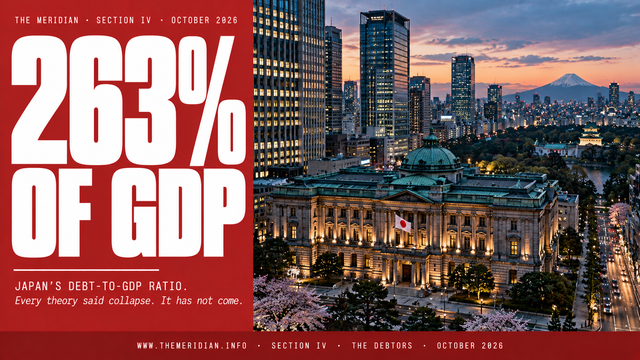
Japan owes 263% of its GDP. It has not defaulted. It was the first country in history to implement quantitative easing. Every theory of sovereign debt crisis predicted it would collapse. Here is what Japan actually teaches us about debt -- and why its lessons do not travel to the Global South.
Japan has the highest debt-to-GDP ratio of any major economy in the world. At approximately 263%, it dwarfs Italy at 140%, the United States at 100%, and France at 112%. By the standard models of sovereign debt sustainability, Japan should have experienced a debt crisis decades ago. Bond markets should have revolted. Yields should have spiked. The yen should have collapsed. The IMF should have been dispatched to Tokyo with a structural adjustment programme.
None of this has happened. Japan's ten-year government bond yield sits at approximately 1.0 to 1.5%. The yen, despite periodic bouts of depreciation, remains a functioning global currency. Japan retains a strong sovereign credit rating. It continues to borrow, to service its debt, and to function as the world's third largest economy without any of the market pressure that the same debt level would instantly produce in a developing country.
Japan is not an anomaly. It is a laboratory. What it tests, and what its results prove and do not prove, is one of the most important questions in the $348 trillion debt landscape this edition maps.
The surface reading of these numbers is that Japan has discovered something the rest of the world has missed: that high debt, if managed correctly, need not produce crisis. This reading is circulated by governments in the Global South who wish to argue that their own debt levels are sustainable, by heterodox economists who contest orthodox debt limits, and by politicians who want to spend without the constraint of bond market discipline.
The surface reading is incomplete. Japan has not discovered that debt does not matter. It has demonstrated that debt sustainability depends entirely on the conditions under which the debt is held -- and that those conditions are specific to Japan in ways that do not transfer.
Japan is not only a laboratory of debt quantity. It is a laboratory of monetary policy response. When its asset bubble collapsed in the early 1990s, Japan became the first country in the world to exhaust conventional monetary tools and reach for unconventional ones.
The Bank of Japan cut interest rates to near zero in 1999, introducing what became known as the Zero Interest Rate Policy, ZIRP. When that proved insufficient to stimulate the economy, the Bank of Japan went further. On 19 March 2001, it implemented Quantitative Easing for the first time in the history of central banking: targeting not the price of money but the quantity, flooding the banking system with liquidity by purchasing Japanese Government Bonds directly and setting targets for commercial bank reserves held at the BoJ. (Source: Bank of Japan policy statements)
The rest of the world watched and largely dismissed Japan's experiment as a product of unusual circumstances. Then 2008 happened. The Federal Reserve, the European Central Bank, and the Bank of England each reached for the same tool Japan had pioneered seven years earlier. What had looked like a Japanese peculiarity became the standard monetary response to financial crisis across the developed world. Japan did not discover a solution. It discovered the limit beyond which conventional tools cease to function -- and invented the response that everyone else would eventually need.
"Japan did not discover that debt does not matter. It demonstrated that debt sustainability depends entirely on the conditions under which the debt is held -- and those conditions do not transfer."
1. Domestic ownership. Approximately 90% of Japanese Government Bonds are held by Japanese institutions and individuals: pension funds, insurance companies, banks, and the Bank of Japan itself. A domestic creditor base does not flee to foreign safety when yields are low. It does not demand repayment in foreign currency. It does not trigger the sudden stop that characterises external debt crises. The debt is owed by Japan to Japan.
2. Currency sovereignty. Japan borrows in yen. It issues yen. There is no foreign currency risk in its debt structure. A country that owes money in its own currency can always service that debt, because the central bank can always create the currency required. This is the same structural protection that the United States holds. It is precisely the protection that Ghana, Pakistan, Sri Lanka, and Argentina do not have, because they borrow in dollars they cannot print.
3. Persistent current account surplus. Japan runs a consistent current account surplus: it earns more from the world than it sends to it. This means Japan does not depend on foreign capital inflows to finance its deficit. It is the world's largest net creditor nation. The assets Japanese institutions hold abroad exceed the claims foreigners hold on Japan by a substantial margin. This external balance provides a structural buffer that no heavily indebted developing economy possesses.
4. Deflationary environment. Japan's decades of deflation and near-zero inflation meant that low nominal yields were in fact positive in real terms. Investors accepted 0.5% nominal yields because prices were falling, making the real return acceptable. This dynamic is specific to Japan's post-bubble economic stagnation and cannot be replicated by economies with structural inflation driven by import costs and currency depreciation.
When governments in the Global South cite Japan to argue that high debt is sustainable, they are citing a country whose debt is 90% domestically held in a currency it issues, whose external position is the strongest of any major economy in the world, and whose monetary policy has been the most innovative in modern history precisely because no standard tool worked. None of these conditions describes a heavily indebted developing economy.
Sri Lanka's debt, before its 2022 collapse, was overwhelmingly external and denominated in foreign currency. When the dollar strengthened and global risk appetite fell, the sudden stop was immediate and total: foreign creditors stopped rolling over the debt, foreign exchange reserves were exhausted, and the government could not import fuel, medicine, or food. Japan could not have experienced this dynamic because Japan does not borrow in foreign currency and does not depend on foreign creditors for rollover.
Argentina has defaulted nine times. Each default has been on external, foreign-currency debt. Argentina cannot borrow in pesos internationally because no foreign investor will accept peso exposure at scale. Japan can borrow in yen internationally because the yen is a reserve currency with global demand. The comparison is not between two heavily indebted countries. It is between two fundamentally different debt architectures.
The lesson Japan offers is precise and limited: a country that borrows in its own currency, from its own citizens, while running a current account surplus, can sustain very high debt levels without market crisis. This lesson is correct. It is also available only to countries that possess all four of those characteristics simultaneously. No heavily indebted developing economy currently does.
Japan is the most important experiment in the history of sovereign debt management. It pioneered quantitative easing before the world knew it needed it. It has sustained debt levels that no model predicted were survivable. It has done this without imposing austerity on its population at the scale that the IMF requires of countries a fraction of its size.
What it proves is not that debt does not matter. It proves that the architecture of debt -- who holds it, in what currency, under what external conditions -- determines whether it produces crisis or not. Japan's architecture is specific, historically unusual, and deeply tied to structural conditions that took decades to build and that most of the world's heavily indebted economies do not share.
The Global South debtor who cites Japan is citing the one example in the world where every protective condition is present simultaneously -- and applying it to situations where none of them are. The laboratory has results. They are being misread.
Add comment
Comments