France: The Social Contract and the Bond Market
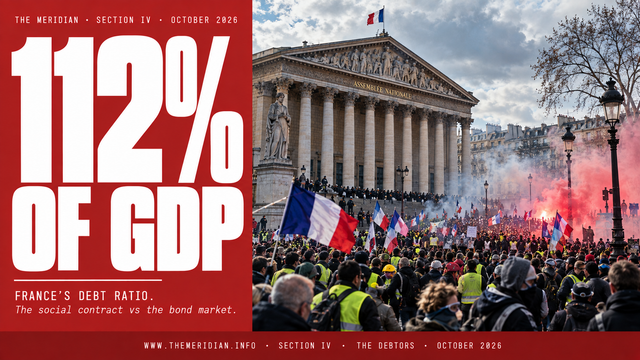
France has 112% debt-to-GDP, a deficit of 5.1% of GDP, and a population with a demonstrated willingness to paralyse the country in response to any attempt to cut the social contract. The bond market and the social contract are on a collision course. Here is what that collision looks like from the inside.
In March 2023, the French government raised the retirement age from 62 to 64. It did not put the measure to a parliamentary vote. The Prime Minister invoked Article 49.3 of the French Constitution, a provision allowing the government to pass legislation without a vote, because the government knew the vote would fail. The streets of France responded with months of strikes and protests involving millions of workers across every sector of the economy. The pension reform passed. The anger did not dissipate.
This episode is the compressed version of France's fiscal dilemma. The social contract that France has constructed over 80 years, universal healthcare, generous pensions, subsidised higher education, strong employment protections, the shortest working week in the OECD, costs approximately 57% of GDP in total government expenditure, the highest share in the European Union. Financing it requires borrowing at a scale that the bond market is beginning to question. Cutting it requires a political confrontation that no French government has been able to win cleanly since the Fifth Republic began.
France is not facing a debt crisis. Not yet. But it is facing something that may be harder to resolve: a structural gap between what its population expects from the state and what the bond market will continue to finance without a premium.
France's social model is not a political accident. It is the deliberate product of the post-war settlement, built across four decades by governments of both left and right, and it reflects a genuine political consensus that the state should provide comprehensive protection against the principal risks of economic life: illness, unemployment, old age, and poverty. That consensus is real, deep, and has survived numerous attempts to modify it.
French social spending at approximately 31% of GDP is among the highest in the OECD. The healthcare system, regularly rated among the best in the world by international measures, absorbs a substantial share. The pension system, based on a pay-as-you-go model in which current workers finance current retirees, is structurally generous by international standards: replacement rates, the share of pre-retirement income that the pension replaces, are high. The system was designed for a demographic structure that no longer exists: a young, growing workforce supporting a smaller retiree population. France, like every developed economy, has aged. The arithmetic no longer works without either higher contributions, reduced benefits, or longer working lives. (Source: OECD social expenditure database 2025)
The 2023 pension reform was the third serious attempt in 20 years to address the arithmetic. Each attempt has produced large-scale social disruption. The 2023 attempt succeeded legislatively, at the cost of being imposed without parliamentary approval and generating a political backlash that contributed to subsequent governmental instability. The reform bought time. It did not resolve the structural gap between what the system promises and what demographics and fiscal capacity can sustain.
"The social contract is both France's greatest achievement and its most constrained fiscal variable. Every attempt to modify it produces a political crisis. Every failure to modify it widens the deficit that the bond market is beginning to price."
The OAT-Bund spread, the difference in yield between French ten-year government bonds (OATs, Obligations Assimilables du Trésor) and German ten-year Bunds, is the market's real-time verdict on France's fiscal position relative to its eurozone partner. For most of the period between 2010 and 2020, the spread was manageable: 30 to 50 basis points, reflecting France's stronger fiscal position relative to the southern European sovereigns that were under acute market pressure during the eurozone crisis.
By 2026, the spread has widened to approximately 70 to 80 basis points. This is not a crisis spread. Italy's spread relative to Germany runs considerably wider. But the direction of movement matters as much as the level: the spread has widened as France's deficit has remained persistently above the EU's 3% threshold, as successive governments have struggled to implement consolidation plans that survive political contact, and as the European Commission has placed France formally under the Excessive Deficit Procedure. (Source: Bloomberg 2026; European Commission 2024)
The rating agencies have responded. Standard and Poor's downgraded France from AA to AA- in 2023. Fitch followed. Moody's rates France at Aa2. The trajectory is downward, and each notch of downgrade increases the borrowing cost on new issuance and, over time, on the stock of debt as it rolls over. France is not approaching the territory where the spread produces a self-reinforcing crisis, as it did for Greece and Italy in 2010 to 2012. But it is moving in that direction, slowly and steadily, without a credible plan that addresses both the fiscal requirement and the political constraint simultaneously.
1. No devaluation. France is a eurozone member. It cannot devalue its currency to restore competitiveness or reduce the real value of its debt. The adjustment mechanism available to the UK, the US, or Japan -- allowing the exchange rate to absorb fiscal pressure -- is structurally unavailable. All adjustment must come through internal prices: wages, spending, or borrowing costs.
2. No monetisation. The European Central Bank's mandate prohibits direct monetary financing of member state deficits. France cannot instruct the ECB to purchase OATs to suppress yields the way the Bank of Japan suppressed JGB yields through yield curve control. The ECB's Transmission Protection Instrument can be deployed in extremis, but only under conditionality that would require fiscal consolidation as a precondition of support.
3. EU fiscal rules. The EU's revised Stability and Growth Pact requires France to reduce its deficit below 3% of GDP on a credible medium-term trajectory. The Excessive Deficit Procedure opened in 2024 is not merely a formality: failure to produce a credible consolidation plan risks EU fiscal sanctions and loss of access to EU cohesion and structural funds. France is a large enough economy that full sanctions are politically unlikely, but the fiscal surveillance is real and the reputational cost of non-compliance accumulates.
France's fiscal position is not unsustainable in any immediate sense. Its debt is largely domestically held in euros, its economy is the seventh largest in the world, and the ECB provides a systemic backstop that no developing economy creditor can offer. France will not face a sudden stop. It will not run out of dollars because it does not borrow in dollars.
What France faces is slower and more political: a widening gap between the social commitments its population will defend with strikes and street protests, and the fiscal trajectory that the bond market is beginning to price into the spread. Each year of deficit above 3% of GDP adds to the debt stock. Each addition to the debt stock widens the gap between what France promises and what it can sustain. Each attempt to close that gap meets organised political resistance from a population that did not create the fiscal problem and does not see why it should bear the cost of resolving it.
France is the clearest example in this edition of sovereign austerity -- the self-imposed kind described in Section III -- meeting democratic resistance at scale. The bond market and the social contract are both real. They are not compatible on the current trajectory. One of them will eventually move. Which one moves will be the defining political question of French economic governance for the decade ahead.
Add comment
Comments