Italy: The Trap at the Heart of Europe
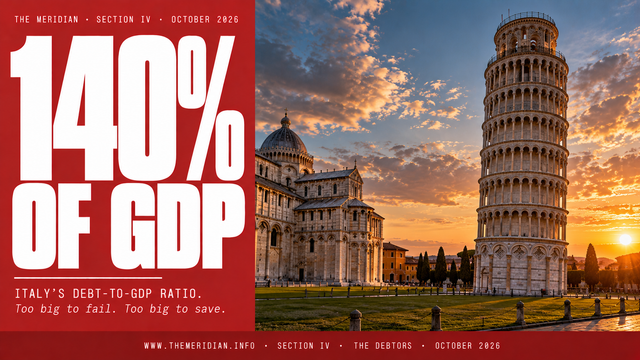
Italy has 140% debt-to-GDP, near-zero growth for two decades, and a bond market that nearly broke the eurozone in 2012. It cannot devalue. It cannot default without destroying the European banking system. It is too big to fail and too big to save. It is the trap at the heart of Europe.
On 26 July 2012, Mario Draghi stood before an audience of investors in London and said that the European Central Bank would do "whatever it takes" to preserve the euro. Three words stabilised the Italian bond market, which had been trading at spreads that made the eurozone's continued existence genuinely uncertain. The BTP-Bund spread, the difference in yield between Italian ten-year government bonds and German Bunds, had reached 550 basis points: a level at which Italy's debt was becoming unsustainable at any plausible growth rate. Draghi's statement, and the Outright Monetary Transactions programme announced shortly after, brought the spread back to manageable levels without a single bond being purchased.
The three words worked because markets believed them. They believed them because an Italian default would not merely be an Italian problem. Italy's sovereign debt, at approximately 2.7 trillion euros, is the third largest bond market in the world. Italian government bonds sit on the balance sheets of Italian banks, French banks, German banks, and financial institutions across the eurozone. An Italian default would produce bank failures across the continent. The eurozone, and arguably the European project itself, would not survive it in its current form.
This is Italy's trap. It is too big to be rescued without political consequence that the ECB's mandate cannot easily absorb. It is too interconnected with European finance to be allowed to fail. It is growing too slowly to reduce its debt through output expansion. And it has been in this position, in various degrees of severity, for more than a decade with no structural resolution in sight.
Italy's debt problem is inseparable from its growth problem. Between 2000 and 2020, Italy's economy grew at an average of approximately 0.2% per year, the worst sustained growth performance of any major economy in the developed world over that period. In per capita terms, Italian living standards in 2020 were barely above where they were in 2000. An entire generation of Italian economic life produced almost nothing in net output terms. (Source: IMF / World Bank data)
The reasons are structural and resistant to short-term policy remedies. The Italian labour market is segmented between a highly protected core of older workers and a precarious periphery of younger workers on temporary contracts, producing low labour mobility and weak incentives for firms to invest in productivity-enhancing technology. The judicial system is among the slowest in Europe: contract enforcement takes an average of over 500 days, a disincentive to investment that compounds across every sector of the economy. The banking system, historically fragmented into hundreds of local and regional institutions, has been slow to consolidate, slow to recognise non-performing loans, and slow to direct capital toward high-productivity firms.
The regional divide deepens the problem. Northern Italy, concentrated in the arc from Turin through Milan to Venice, is a globally competitive industrial economy with productivity comparable to Germany. Southern Italy, the Mezzogiorno, has productivity approximately 45% below the north, depends heavily on public sector employment and transfers from Rome, and has exported its most mobile young workers northward and abroad for decades. The two economies share a currency, a tax system, and a debt burden, but not a productive base that can carry both. (Source: ISTAT / European Commission regional data)
"Italy cannot grow its way out of 140% debt-to-GDP at 0.2% average annual growth. The arithmetic is unforgiving. The political conditions for the structural reforms that growth would require have not existed for a generation."
1. The sovereign-bank nexus. Italian banks hold approximately 400 to 500 billion euros in Italian government bonds. When Italy's borrowing costs rise, the market value of those bonds falls, weakening Italian bank balance sheets. Weakened banks reduce lending to businesses. Reduced lending slows growth. Slower growth worsens the fiscal deficit. A worsening deficit raises borrowing costs. The loop closes and begins again. (Source: European Banking Authority / ECB data)
2. The demographic drain. Italy has one of the oldest populations in Europe and one of the lowest birth rates. Its workforce is shrinking. Its pension system, already expensive, is absorbing a growing share of fiscal resources. Its most mobile and educated young workers emigrate at approximately 100,000 per year, reducing the productive base that generates the tax revenues that service the debt. Each year of emigration narrows the future fiscal capacity the debt requires.
3. The political reform deficit. Every structural reform that economists identify as necessary -- labour market liberalisation, judicial acceleration, banking consolidation, public administration efficiency -- has a constituency that loses from it and is capable of political mobilisation to block it. Italy has had more than 65 governments since 1946. Political instability is not a temporary condition. It is a structural feature of Italian democracy that interacts with the reform deficit to produce policy paralysis at precisely the moments when structural change is most urgent.
The ECB's "whatever it takes" commitment, now institutionalised in the Transmission Protection Instrument announced in July 2022, provides Italy with a structural backstop that no developing economy creditor can offer. The TPI allows the ECB to purchase Italian government bonds in the secondary market if the spread widens to levels the ECB judges to reflect unwarranted market dynamics rather than fiscal fundamentals. (Source: ECB documentation 2022)
The TPI has a condition attached: the country must be in compliance with EU fiscal rules and following a credible consolidation path. Italy, under the EU Excessive Deficit Procedure since 2024, is in a position where that conditionality is not automatically satisfied. The backstop exists. Its availability is not unconditional. And the ECB's mandate, price stability for the eurozone as a whole, does not permit it to finance Italian deficits indefinitely without the political and legal constraints that define the limits of central bank action under European treaty law.
Italy cannot default without triggering a European banking crisis. It cannot be rescued without a political and legal architecture that does not currently exist at the scale required. It cannot grow its way out because the structural conditions for growth have not been created. It cannot devalue because it shares a currency with Germany, whose fiscal and monetary interests diverge sharply from Italy's at almost every point. Every exit is blocked by something structural, institutional, or political. This is what a trap looks like from the inside.
Italy is not in crisis. The BTP-Bund spread at 130 to 150 basis points is elevated but not catastrophic. The ECB backstop holds. The Italian government continues to borrow, to service its debt, and to function. The trap is not the acute Italian debt crisis that markets periodically fear. The trap is the structural condition in which Italy is neither stable enough to ignore nor unstable enough to force the political resolution that stability would require.
Every year of 0.2% growth at 140% debt-to-GDP is a year in which the denominator of the ratio does not grow fast enough to offset the numerator. Every year of demographic decline is a year in which the future fiscal base narrows. Every year of political reform failure is a year in which the structural conditions for growth remain unaddressed.
Italy is the eurozone's unresolved question. It has been the unresolved question for fifteen years. The resolution, when it comes, will either be a political breakthrough of a kind that Italian democracy has not produced since the post-war settlement, or a crisis of a kind that the ECB's mandate cannot fully contain. There is no middle path that holds indefinitely at 140% of GDP and 0.2% average growth.
Add comment
Comments