Argentina: Nine Defaults and Still Borrowing
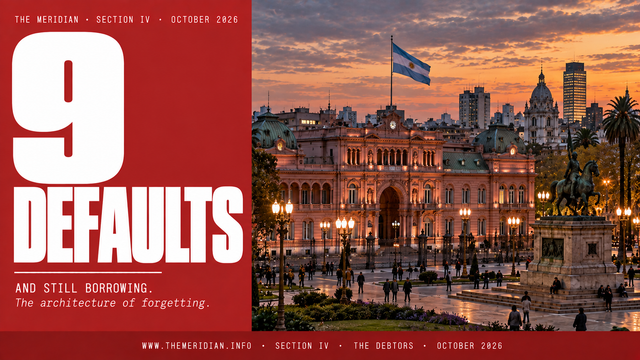
Argentina has defaulted on its sovereign debt nine times since independence. It has borrowed from the IMF more than any other country in history. It is the largest single IMF borrower. Here is what serial default actually teaches us about debt, creditors, and the architecture of forgetting.
Argentina is the most borrowed-from country in IMF history, and one of the most frequently defaulting sovereigns in the world. These two facts coexist not because they are unrelated but because they are the same story told from two different ends. Argentina borrows because it cannot finance itself at sustainable rates in international markets. It cannot finance itself at sustainable rates because creditors price the default history into the spread. The spread makes debt unsustainable. Unsustainable debt leads to default. Default returns Argentina to the IMF. The IMF lends. The cycle restarts.
This is not a failure of Argentine economic management alone, though that has contributed to every chapter. It is a structural condition produced by the interaction of Argentina's domestic political economy, its position in the international financial architecture, and the logic of creditor behaviour in the face of serial default. Understanding Argentina is not understanding an anomaly. It is understanding the architecture of a debt cycle at its most concentrated and most visible.
The 2001 default is the most studied. At approximately $100 billion, it was the largest sovereign default in history at the time of its occurrence. It followed a decade of convertibility, a currency board that pegged the Argentine peso one-to-one with the US dollar, which had eliminated hyperinflation but had progressively destroyed Argentine export competitiveness and locked the country into deflation when the US dollar strengthened in the late 1990s. When the peg collapsed in January 2002, the peso depreciated by approximately 75% in weeks. Savings denominated in pesos lost three quarters of their value overnight. The social consequences were acute: the poverty rate reached approximately 57% in 2002. Five presidents occupied the Casa Rosada in two weeks. (Source: IMF / academic record)
Argentina's nine defaults are not nine separate events. They are nine iterations of the same structural cycle, varying in their triggers and magnitudes but sharing the same underlying architecture.
Argentina is a commodity exporter of the first order: the world's third largest soy exporter, a major corn and beef exporter, and the holder of the world's second largest lithium reserves. It has the natural resource base to finance development without persistent external borrowing. What it has consistently lacked is the institutional capacity to convert commodity export revenue into stable fiscal positions that survive commodity price cycles, electoral cycles, and the distributional conflicts that both generate. (Source: Argentine Ministry of Economy / World Bank)
When commodity prices are high, Argentine governments expand social spending, subsidise domestic consumption, and accumulate reserves. When commodity prices fall, the fiscal position deteriorates, the currency comes under pressure, and the government faces a choice between devaluation, which imposes real costs on the population and triggers inflation, and maintaining the exchange rate, which depletes reserves until they are gone and forces a more disorderly adjustment. Either path produces social and political conflict. The conflict produces political instability. The instability undermines investor confidence. The confidence collapse raises borrowing costs. The higher costs make debt unsustainable. Default follows.
"Argentina's nine defaults are not nine separate failures. They are nine iterations of the same structural cycle: commodity boom, fiscal expansion, commodity bust, exchange rate crisis, social conflict, default. The architecture repeats because the underlying conditions have not changed."
Argentina's relationship with the IMF is the longest and most conflicted creditor relationship in the institution's history. Argentina has entered IMF programmes more frequently than any other country. In 2018, under President Macri, it received a $57 billion standby arrangement, the largest in IMF history at the time of its signing, as the peso collapsed under the pressure of capital outflows and a widening current account deficit. The programme was extended and modified but did not prevent the political conditions that brought the Fernandez government to power in 2019 or the 2020 restructuring of $65 billion in commercial debt. (Source: IMF programme documentation)
1. Original sin, amplified. Argentina cannot borrow internationally in pesos at scale. Its debt is predominantly in US dollars. When the peso depreciates, the dollar debt burden rises in local currency terms, worsening the fiscal position at the precise moment when the economy is under the most stress. The same original sin problem documented in Section III operates in Argentina at maximum intensity.
2. The holdout problem. The 2014 technical default arose from a US court ruling in favour of NML Capital, a holdout creditor that had refused to participate in Argentina's 2005 restructuring. Judge Thomas Griesa's ruling applied the pari passu clause to require Argentina to pay holdouts before paying restructured creditors, making any further payments legally impossible without paying the holdouts in full. The ruling illustrated how a single creditor in a single jurisdiction can block a sovereign restructuring and extract full payment while the majority of creditors accept losses. (Source: US court record; NML Capital v Argentina)
3. The Milei experiment. President Milei, elected in late 2023, implemented the most aggressive fiscal adjustment in Argentine history: eliminating subsidies, cutting public sector employment, and achieving a primary fiscal surplus of approximately 1.5% of GDP in 2024, the first surplus in many years. Inflation, which had reached approximately 211% annually in 2023, fell sharply. The experiment demonstrated that fiscal adjustment is possible in Argentina. Whether it is durable, whether it breaks the structural cycle or merely delays the next iteration, remains the open question. (Source: INDEC; Argentine Ministry of Economy 2024)
The most instructive aspect of Argentina's nine defaults is not the defaults themselves. It is the lending that follows each one. After 2001, after the largest sovereign default in history, after a restructuring that imposed losses of approximately 65 cents on the dollar on most creditors, after a legal battle that ran for over a decade and involved courts on three continents, Argentina re-entered international capital markets in 2016 with a $16.5 billion bond issue that was oversubscribed. Investors queued to lend to a country that had just completed history's largest sovereign default.
This is the architecture of forgetting. The financial system has a structural amnesia about sovereign default that is not irrational from any individual creditor's perspective: by the time Argentina returns to markets, old creditors have been paid out or written off, new creditors are pricing a spread that appears to compensate for the risk, and the commodity cycle has turned in a direction that makes repayment seem plausible. The collective memory of the system is shorter than the structural cycle that produces the defaults.
Argentina under Milei has achieved something genuine: a fiscal surplus, a sharp reduction in inflation from its 2023 peak, and a degree of market confidence that had been absent for years. These are real achievements against a genuinely difficult starting point. They are not, by themselves, a structural resolution of the conditions that have produced nine defaults over two centuries.
Those conditions are the original sin of dollar debt, the commodity cycle dependence, the distributional conflicts that each adjustment cycle produces, and the institutional fragility that prevents any government from locking in gains across electoral cycles. Until these are addressed, Argentina's current programme is the beginning of the next chapter of the cycle, not the end of the cycle itself.
The nine defaults are not a record of Argentine failure. They are a record of what happens when a country with enormous natural wealth, a persistent original sin debt structure, and deep distributional conflict interacts with a global financial system that prices risk into spreads, forgets into complacency, and returns to lend again when the spread looks attractive enough. The architecture repeats because both sides of it keep showing up.
Add comment
Comments