Sri Lanka: What Collapse Actually Looks Like
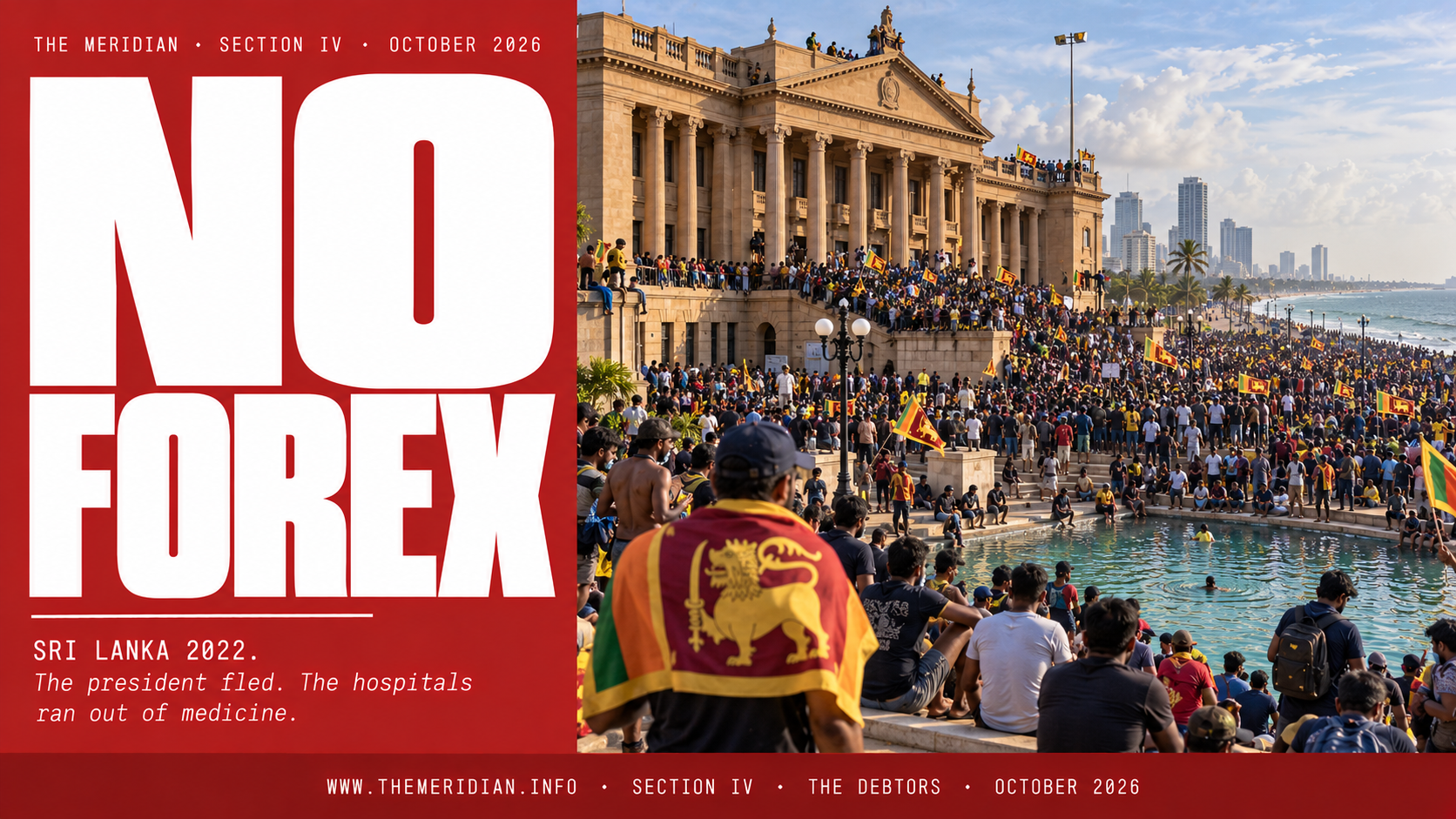
In April 2022, Sri Lanka's usable foreign exchange reserves fell below $50 million -- less than a single day of fuel imports. Fuel queues stretched for miles. Hospitals ran out of medicines. The president fled to the Maldives. Sri Lanka is not a cautionary tale. It is a blueprint for what happens when every vulnerability activates simultaneously.
The queue for petrol in Colombo in April 2022 stretched for miles. Motorists slept in their cars for days waiting for fuel that might or might not arrive. Hospitals were cancelling non-emergency surgeries because anaesthetic supplies had run out. Schools were closed to conserve electricity during 13-hour daily power cuts. The Sri Lankan rupee had lost more than 40% of its value in a matter of weeks. And the government's usable foreign exchange reserves had fallen below $50 million: less than a single day's worth of fuel import costs for an island of 22 million people. (Source: Central Bank of Sri Lanka 2022; AP, Reuters, BBC press record 2022)
This is what sovereign debt collapse actually looks like. Not as an abstract fiscal metric. Not as a bond spread on a Bloomberg terminal. As people sleeping in cars outside petrol stations, hospitals rationing medicines, and a government that had borrowed its way into a position where it could no longer pay for the imports without which modern life cannot function.
In May 2022, Sri Lanka declared its first sovereign default in its history. In July 2022, President Gotabaya Rajapaksa, whose government had presided over the accumulation of the vulnerabilities that produced the crisis, fled to the Maldives after hundreds of thousands of protesters stormed the presidential palace. Sri Lanka's collapse was not an accident. It was the endpoint of a sequence of decisions, vulnerabilities, and external shocks that interacted in ways that no single one of them would have produced alone. Understanding that sequence is the purpose of this article.
Sri Lanka's debt was accumulated across two decades and multiple governments. The Rajapaksa family, which dominated Sri Lankan politics from 2005 to 2022 with a brief interruption, pursued an infrastructure-heavy development model financed substantially by Chinese bilateral loans at commercial rates. The Hambantota Port, built with Chinese financing in the home district of the Rajapaksa family, generated insufficient revenue to service its debt and was leased to a Chinese state company for 99 years in 2017, becoming the most cited example of what critics called Chinese debt-trap diplomacy. Whether the Hambantota transfer was coerced or negotiated is contested; what is not contested is that the loan was taken at rates and on terms that the project's revenues could not sustain. (Source: AidData / Chatham House)
The wider debt structure, however, was not primarily Chinese. Sri Lanka had issued approximately $12 billion in international sovereign bonds on commercial markets, carrying dollar-denominated interest obligations that had to be serviced regardless of what happened to tourism revenue, export earnings, or domestic growth. These bonds were the immediate trigger for the 2022 default: when reserves fell to levels that made repayment impossible, the government suspended servicing its commercial debt.
Three shocks converged on Sri Lanka between 2019 and 2022, each of which would have been manageable in isolation. Together they were not.
The first was the COVID-19 pandemic. Tourism accounted for approximately 12% of Sri Lanka's foreign exchange earnings before 2020. The pandemic eliminated it almost entirely for two years. Remittances from Sri Lankan workers abroad also fell as the pandemic disrupted global labour markets. The foreign exchange inflows that had been servicing the commercial debt evaporated. (Source: Sri Lanka Tourism Development Authority)
The second was a policy error of remarkable magnitude. In April 2021, President Rajapaksa banned the import of synthetic fertilisers and mandated an overnight transition to organic farming for the entire agricultural sector. The policy was implemented without preparation, without transition support for farmers, and without any credible agronomic basis for believing that Sri Lanka's rice production could be maintained without inputs. Rice production fell by approximately 20 to 25% within months. Sri Lanka, historically a rice exporter, was forced to import food at the precise moment when its foreign exchange reserves were already under severe pressure from the COVID shock. The fertiliser ban was reversed within seven months, but the agricultural damage lasted longer and compounded the import bill during the critical period. (Source: Sri Lankan government record; press)
The third was the global commodity price surge of 2021 to 2022. Sri Lanka imports virtually all of its fuel. When global oil prices rose sharply following the post-COVID demand recovery and then the Ukraine conflict, Sri Lanka's import bill for fuel rose at the same time as its foreign exchange earnings remained suppressed and its agricultural production had been damaged by the fertiliser ban. The three shocks created a simultaneous increase in import costs and decrease in foreign exchange inflows that the reserve position could not absorb.
"Sri Lanka did not run out of money. It ran out of foreign currency. It could not print dollars. It could not instruct the Federal Reserve to support the rupee. When the reserves were gone, the imports stopped. When the imports stopped, the hospitals ran out of medicine and the petrol stations ran out of fuel."
The IMF approved a $2.9 billion Extended Fund Facility for Sri Lanka in March 2023, after months of negotiations that required Sri Lanka to secure assurances from its bilateral creditors, including China, India, and Japan, that they would restructure their claims in parallel with the commercial debt restructuring. China's participation in that process was delayed and complicated by its reluctance to engage through the Paris Club framework, which it views as a creditor club dominated by Western interests. The coordination between China, India, Japan, and Western creditors over a small island economy's debt illustrated, in compressed form, the geopolitical complexity that now governs sovereign debt restructuring globally. (Source: IMF programme documentation March 2023)
1. The foreign exchange constraint is absolute. A government can always print its own currency to avoid domestic default. It cannot print foreign currency. When the foreign exchange is gone, the imports stop. There is no monetary policy tool that substitutes for dollar reserves when dollar-denominated obligations fall due. Sri Lanka demonstrated this in its most direct form.
2. Multiple vulnerabilities activate simultaneously. No single factor produced the Sri Lanka crisis. It was the interaction of external debt in foreign currency, tourism concentration, a policy error, and a commodity price shock that each, alone, was survivable. Together they were not. The lesson for every small open economy is that vulnerability management must account for correlation: the scenarios in which bad things happen together are the ones that produce collapse, not the ones in which they happen separately.
3. Debt restructuring in a multipolar creditor world is slow. The involvement of China as a major bilateral creditor complicated the standard Paris Club restructuring process. The coordination took months longer than a purely Western creditor group would have required. As China's presence as a sovereign creditor grows across the Global South, the restructuring architecture built for a world of Western bilateral creditors is becoming less adequate for the world that now exists.
By 2024 and 2025, Sri Lanka had stabilised. Reserves had been rebuilt with IMF support. The currency had found a new equilibrium. A new government was implementing the programme conditions: revenue increases, energy price reform, fiscal consolidation. The worst was over. The recovery was real, if fragile.
What had not changed was the underlying structure: a small open economy dependent on tourism for foreign exchange, carrying external debt in currencies it does not issue, with a domestic political economy that makes the accumulation of those vulnerabilities a recurring pattern across governments of different parties and ideologies.
Sri Lanka is in this edition not as a unique catastrophe but as a concentrated illustration of the $348 trillion debt problem at its most human scale. The people who waited in fuel queues for days did not take out the sovereign bonds. The hospitals that ran out of anaesthetic did not negotiate the Chinese infrastructure loans. The adjustment cost falls on the population. The decisions that produced it were made by governments and creditors operating within an international financial architecture that had no mechanism to prevent the accumulation of vulnerabilities until they activated all at once.
Add comment
Comments