Britain: No Growth Since 2008. No Plan Since 2022. The Debt Keeps Rising.
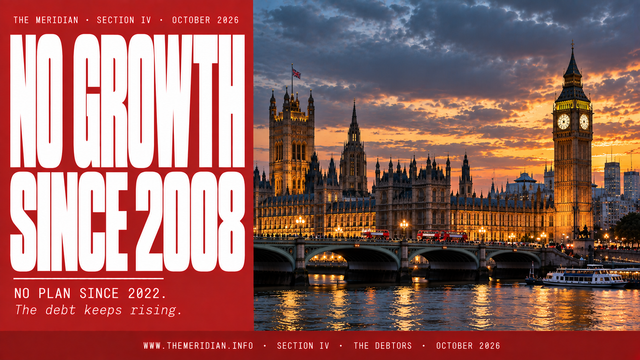
Britain's productivity has not grown meaningfully since 2008. In September 2022 its bond market panicked and required emergency Bank of England intervention. Its debt has crossed 100% of GDP. Its last major oil refinery closed in 2024. It imports approximately 40% of its food. Every government since the financial crisis has borrowed to avoid confronting the structural problem. Here is what the bill looks like -- and what a genuine structural answer would require.
On 23 September 2022, Kwasi Kwarteng, then Chancellor of the Exchequer, announced the largest package of unfunded tax cuts in British post-war history. Within hours, the pound fell to its lowest level against the dollar since 1985. Within days, the ten-year gilt yield had spiked sharply and pension funds using Liability Driven Investment strategies were facing margin calls they could not meet. The Bank of England, which had been tightening monetary policy to control inflation, was forced to reverse course and begin purchasing gilts in an emergency programme of approximately £65 billion over two weeks to prevent a cascade of pension fund failures. Kwarteng was sacked after 38 days. Truss resigned after 45 days. The mini-budget was reversed in full. (Source: Bank of England press releases 2022; Bloomberg)
The September 2022 crisis was acute and temporary. The conditions it exposed are neither. Britain in 2026 carries debt above 100% of GDP, borrows approximately £100 billion per year, spends approximately £100 billion per year on debt interest alone, has recorded near-zero productivity growth for 17 consecutive years, and has just closed its last major oil refinery while importing roughly 40% of the food it consumes. The question is not whether Britain has a structural problem. The question is whether any government can produce a plan that confronts it.
The productivity puzzle is the name economists have given to a specific and documented phenomenon: UK output per hour worked has grown at approximately zero percent per year since the 2008 financial crisis, against an average of approximately 2% per year in the preceding two decades. This gap, compounded across 17 years, represents an enormous volume of output that has not been produced, income that has not been earned, and tax revenue that has not been collected. Without productivity growth, real wages stagnate, living standards stall, and tax revenues grow more slowly than public spending commitments. The annual borrowing requirement of approximately £100 billion is, in significant part, the fiscal expression of a productivity problem that has not been addressed. (Source: ONS productivity bulletin 2026)
Business investment has been chronically low by G7 standards, partly because Brexit-related uncertainty suppressed capital expenditure through the 2016 to 2022 period. Public investment, cut sharply in the 2010 to 2019 austerity period, has not recovered to levels that generate meaningful productivity gains. And the post-Brexit reduction in trade intensity, estimated by the OBR at approximately 4% below the counterfactual, has removed the competitive pressure that trade exposure provides as a driver of business efficiency.
The Liability Driven Investment crisis that the Truss mini-budget triggered deserves more attention than it typically receives. UK defined-benefit pension funds had adopted LDI strategies to match long-term liabilities to long-dated gilt assets, with leverage amplifying their positions. When the mini-budget caused yields to spike within hours, the leveraged positions generated margin calls the funds could not meet without liquidating gilts, which would accelerate the very yield increase triggering the calls. The Bank of England's emergency purchase programme prevented what could have been a systemic failure in the UK pension system. A government that had held its course for another week would have faced a different outcome entirely. (Source: Bank of England; FCA 2022)
The episode illustrated that British fiscal credibility, while real, is not unconditional. It is maintained by institutional reputation, the Bank of England's independence, and sterling's partial reserve currency status. All three were tested simultaneously in September 2022. All three held -- but only because the policy reversal was total and took less than six weeks.
"Britain borrows approximately what it costs to service what it already owes. Annual borrowing and annual debt interest are both approximately £100 billion. That is not a stable fiscal position. It is a deferred reckoning that compounds each year the structural problem goes unaddressed."
In 2024, the Grangemouth refinery in Scotland closed its refining operations. Grangemouth had been operating for over a century. It was the last major oil refinery in Scotland and one of the last in Britain. Its closure means that Britain, which sits above significant North Sea oil reserves and has refined petroleum products domestically for generations, now imports a substantially larger share of its refined fuel from abroad. The import bill for energy products, already elevated by the post-2022 global energy price surge, rose further. The current account deficit, persistently negative at approximately 3 to 4% of GDP, was made marginally worse. (Source: Petroineos / press record 2024)
The Grangemouth closure raises a question that British industrial policy has not answered credibly for four decades: why does an island with domestic energy resources, agricultural land, manufacturing history, and a large domestic consumer market import approximately 40% of its food, the majority of its refined fuel, and an increasing share of the goods it once produced? The question is not sentimental. It has a direct fiscal answer: every pound spent on imports that Britain could produce domestically is a pound that does not circulate in the British economy, does not generate British tax revenue, and does not reduce the current account deficit that puts persistent downward pressure on sterling and upward pressure on import costs.
The case for domestic energy refining capacity is not simply nationalistic. A country that refines its own oil controls the margin between crude and refined product. It retains the employment and the industrial skills that refining generates. It reduces its exposure to international refined product price volatility and supply chain disruption. It keeps the value added by refining within the domestic economy rather than transferring it to refiners in the Middle East, the United States, or the Netherlands. The same logic applies to food: Britain produces approximately 60% of what it consumes. There is no agronomic reason it could not produce more. The barriers are policy, subsidy design, and supermarket supply chain economics -- all of which are within the scope of government to address. (Source: DEFRA 2026)
The arguments against are real and should be stated. Reopening refineries requires substantial capital investment in assets that may face a shortened economic life as the energy transition progresses. Global refining capacity is in structural surplus. The competitive economics of domestic refining against imported refined products are not always favourable. And food self-sufficiency achieved through protectionist subsidy has costs that consumers and trade partners would resist. But the counter-argument is equally real: a country that has allowed its refining capacity, its manufacturing base, and a significant share of its food production to migrate abroad has made itself structurally dependent on imports in ways that widen its current account deficit, increase its import costs, and reduce the domestic economic activity that generates the tax revenue that services the debt. Import dependency and fiscal deficit are not unrelated. They are the same problem expressed in different accounting identities.
1. The investment and productivity deficit. UK business investment as a share of GDP is among the lowest in the G7. Without investment, productivity does not grow. Without productivity growth, real wages stagnate, tax revenues underperform, and the government borrows the difference. The investment deficit compounds into a fiscal deficit over time. No government since 2010 has produced a durable framework for closing it.
2. The NHS funding trap. The NHS absorbs an increasing share of public spending, growing faster than GDP, as an ageing population generates demand that the workforce cannot meet without continued real-terms budget increases. Cutting the NHS is politically impossible. Growing it at current rates without structural productivity improvement within the service is fiscally unsustainable. The trap has no exit within the current operating model.
3. The import dependency and current account drain. Britain's persistent current account deficit reflects decades of deindustrialisation, reduced domestic energy capacity, and reduced food self-sufficiency. Every year of current account deficit requires financing from abroad, which means selling UK assets or increasing external liabilities. The closure of Grangemouth in 2024 is the most recent symbol of a longer structural choice to import what Britain could produce -- a choice that has fiscal consequences that compound alongside the debt.
Britain is not in fiscal crisis. Its debt is in sterling, the Bank of England issues sterling, and the gilt market has stabilised after September 2022. Its institutional framework provides a structure within which the problem can be managed. It is not, on the current trajectory, a problem that resolves itself.
A structural answer exists and its components are not mysterious: sustained public and private investment in productivity, a reformed NHS operating model, a credible industrial policy that rebuilds domestic capacity in energy, food, and manufacturing, and a trading relationship with the European market that reduces the 4% trade intensity drag the OBR has documented. None of these require abandoning market economics. All of them require a government willing to make the same argument consistently across more than one electoral cycle.
Britain closed its last major oil refinery in 2024 and imports 40% of its food in 2026 while borrowing £100 billion a year to finance a state that cannot grow fast enough to pay for itself. These are not separate facts. They are the same fact: a country that has systematically chosen consumption over production, imports over domestic capacity, and short-term borrowing over long-term structural investment. The debt keeps rising because the structural choices that would slow it have not been made. They remain available. They have simply not been chosen.
Add comment
Comments