Kenya: The IMF Programme That Started a Revolution
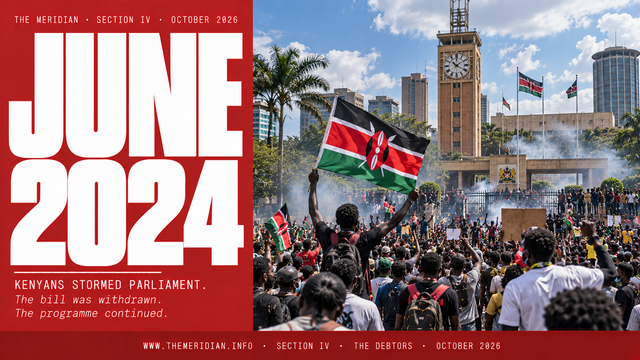
In June 2024, an IMF-backed Finance Bill proposed taxes on bread, cooking oil and sanitary products. Kenyans stormed parliament. At least 39 people died. The president withdrew the bill. The IMF programme continued. Kenya is the edition's live case study: the moment when the theory of imposed austerity becomes the practice of June 2024.
On 25 June 2024, protesters in Nairobi breached the perimeter of the Kenyan parliament building. Some entered the building itself. Others gathered in their thousands on the streets outside, waving Kenyan flags, carrying signs that named the specific measures they were rejecting: a tax on bread, a tax on cooking oil, a tax on sanitary products, a motor vehicle circulation tax, an eco-levy on a range of consumer goods. The Finance Bill 2024 had proposed approximately KSh 346 billion in new revenue measures as part of Kenya's obligations under its IMF programme. The Kenyan parliament had passed it. The protesters had not been consulted. (Source: Kenyan National Assembly / Reuters, BBC, AP press record June 2024)
The security forces responded. At least 39 people were killed in the days of protest that followed, according to documentation by the Kenya National Commission on Human Rights. On 26 June 2024, President William Ruto appeared on national television and withdrew the Finance Bill in full. It was a direct capitulation to street pressure on a measure that had been passed by parliament and that formed part of a programme agreed with an international creditor institution.
The IMF programme continued. The debt remained. The revenue requirement did not disappear. Kenya had won the battle of June 2024. The structural conditions that produced the Finance Bill were unchanged by the outcome of that battle. This is Kenya's story and, in concentrated form, it is the story of every country in this edition that has stood in a queue at the IMF.
Kenya's debt position is not extreme by the standards of this edition. At approximately 70% of GDP, its debt ratio is lower than France, Italy, the United States, or Japan. But Kenya's debt is predominantly external and denominated in foreign currency. It borrows at rates approximately four times higher than comparable maturities in the United States, as documented in Section III of this edition. It spends approximately 37% of its government revenues on external debt service before a single shilling reaches a school, a hospital, or a road. And in June 2024 it faced the maturity of a $2 billion Eurobond that required successful refinancing in international markets that were watching its fiscal position closely. (Source: IMF Kenya Article IV consultation 2024)
The Eurobond was refinanced successfully in early 2024. The relief was real but temporary: the refinancing added to the debt stock at the prevailing Kenyan borrowing rate, which is not the rate at which the United States refinances its debt. Each rollover of Kenyan external debt at Kenyan rates compounds the debt service burden on a government already spending more than a third of its revenues on debt before it can fund anything else.
The Finance Bill 2024 was not a random collection of tax proposals. It was a revenue mobilisation package constructed to meet the targets agreed under Kenya's IMF Extended Credit Facility. The IMF programme required Kenya to increase domestic revenue collection as a condition of continued programme support. The Kenyan government translated that requirement into specific tax measures: a 16% VAT on bread, a 16% VAT on cooking oil, taxes on sanitary products, a motor vehicle circulation tax of KSh 2.5 per kilometre, and an eco-levy on a range of imported goods including phones and solar panels.
Each of these measures had a fiscal logic. Bread, cooking oil, and sanitary products are high-volume consumption goods whose taxation generates significant revenue. The motor vehicle tax targeted a consumption category associated with middle-class income. The eco-levy addressed an environmental objective alongside a revenue one. The package was internally coherent as a revenue instrument. It was also, in its distributional impact, a set of taxes that fell with maximum weight on the people least able to pay them: the urban poor who buy bread and cooking oil daily, women who require sanitary products, and commuters whose livelihoods depend on road transport.
The Kenyan parliament passed the bill. The Gen Z movement, organised with remarkable speed and effectiveness through TikTok and X under the hashtag #RejectFinanceBill2024, mobilised a population that had not previously demonstrated at this scale. The protesters who stormed parliament on 25 June were not a disorganised mob. They were a generation that had grown up watching Kenya's debt accumulate, its public services deteriorate, and its politicians negotiate programme conditions with an institution in Washington that had no ballot box in Nairobi. (Source: press record June-July 2024)
"The protesters who stormed parliament were not rejecting taxation. They were rejecting the specific logic of imposed austerity: that the cost of a debt they did not contract, negotiated by an institution they did not vote for, should fall on the price of bread."
After withdrawing the Finance Bill, President Ruto announced a programme of spending cuts to replace the foregone revenue. The IMF, in its public statements, acknowledged the withdrawal and noted that programme discussions would continue with the Kenyan government on alternative fiscal measures. The quarterly review proceeded. Kenya remained in the programme. The revenue requirement did not disappear; it was redistributed across different measures and a different timeline.
This outcome is the most instructive part of the Kenya episode. The specific measures were successfully resisted. The underlying structural condition -- a government that must raise approximately 37% of its revenues for debt service before funding public services, under a programme monitored by an external creditor institution -- was unchanged by the protests. The form of the adjustment changed. The need for adjustment did not.
1. Democratic resistance can change the form of imposed austerity, not its substance. The Finance Bill was withdrawn. The debt remained. The IMF programme continued. The revenue requirement was met through alternative measures. The Kenyan population successfully rejected the specific tax package. It could not reject the fiscal arithmetic that made a tax package necessary. The arithmetic is set by the debt, the interest rate, and the programme conditions -- none of which were on the ballot in June 2024.
2. The distributional question is the political question. The Finance Bill failed not because the revenue was not needed but because the specific incidence of the proposed taxes was politically unacceptable: taxes on bread and cooking oil fall with maximum weight on the poorest consumers. Had the revenue been raised through taxes on wealth, capital gains, or high-income earners, the political response would have been different. The distributional design of fiscal adjustment is not a technical question. It is the political question that determines whether adjustment is sustainable.
3. Social media has changed the speed of democratic response to imposed austerity. The Gen Z movement organised faster than any previous Kenyan political mobilisation, using platforms that did not exist during previous rounds of IMF conditionality. This is a structural change in the politics of imposed austerity globally: the time between a government announcing a programme condition and a population mobilising against it has compressed dramatically. Governments and creditor institutions that design conditionality without accounting for this compression are operating on an outdated political model.
Kenya in June 2024 is this edition's live illustration of the argument made in Section III. Imposed austerity is not an abstraction. It is a tax on bread, proposed by a government meeting a revenue target agreed with an external institution, passed by parliament, and withdrawn only when the population demonstrated at sufficient scale and cost that withdrawal became the less politically dangerous option.
The at least 39 people who died in those protests did not borrow Kenya's external debt. They did not negotiate the Eurobond terms or agree the IMF programme conditions. They went into the streets because the price of bread was about to rise as a direct consequence of a fiscal agreement between their government and a creditor institution in Washington whose governance they do not participate in and whose decisions they cannot reverse through any democratic mechanism available to them.
The IMF programme continued. The debt continues to be serviced. Kenya continues to spend approximately 37% of its government revenues on external debt before a shilling reaches a classroom or a clinic. The June 2024 protests changed a tax bill. They did not change the architecture that made the tax bill necessary. That architecture is the subject of this entire edition.
Add comment
Comments